






Wednesday, Jun 24, 2026

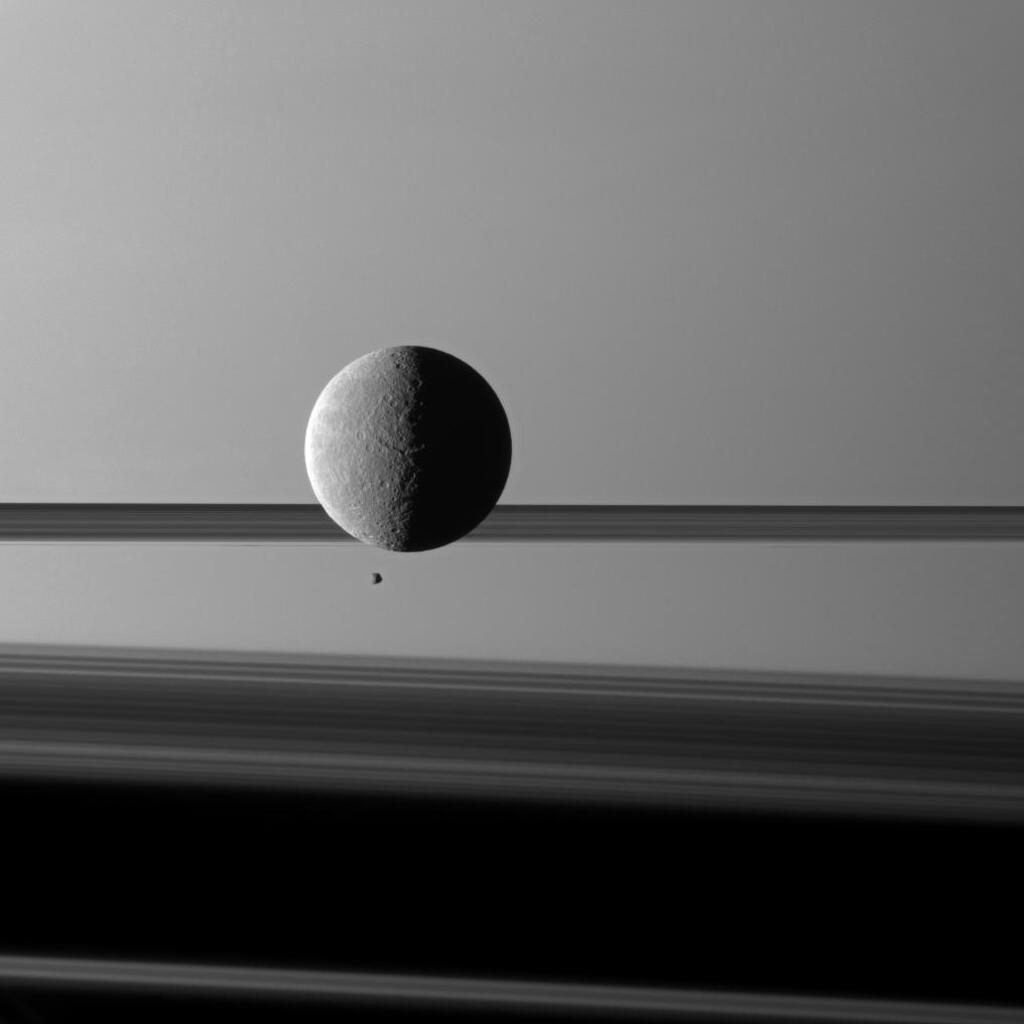
Credit: NASA/JPL/Space Science Institute/CICLOPS

Monday, 15 June 2026

Big and Small Before Rings

At first glance, it looks as though Saturn's icy moon Rhea towers over tiny Epimetheus against a breathtaking backdrop of rings and cloud tops. In reality, the two worlds are separated by hundreds of thousands of kilometers, creating a celestial illusion captured by the Cassini spacecraft in 2010.

Credit: NASA Earth Observatory/Michala Garrison

Tuesday, 16 June 2026

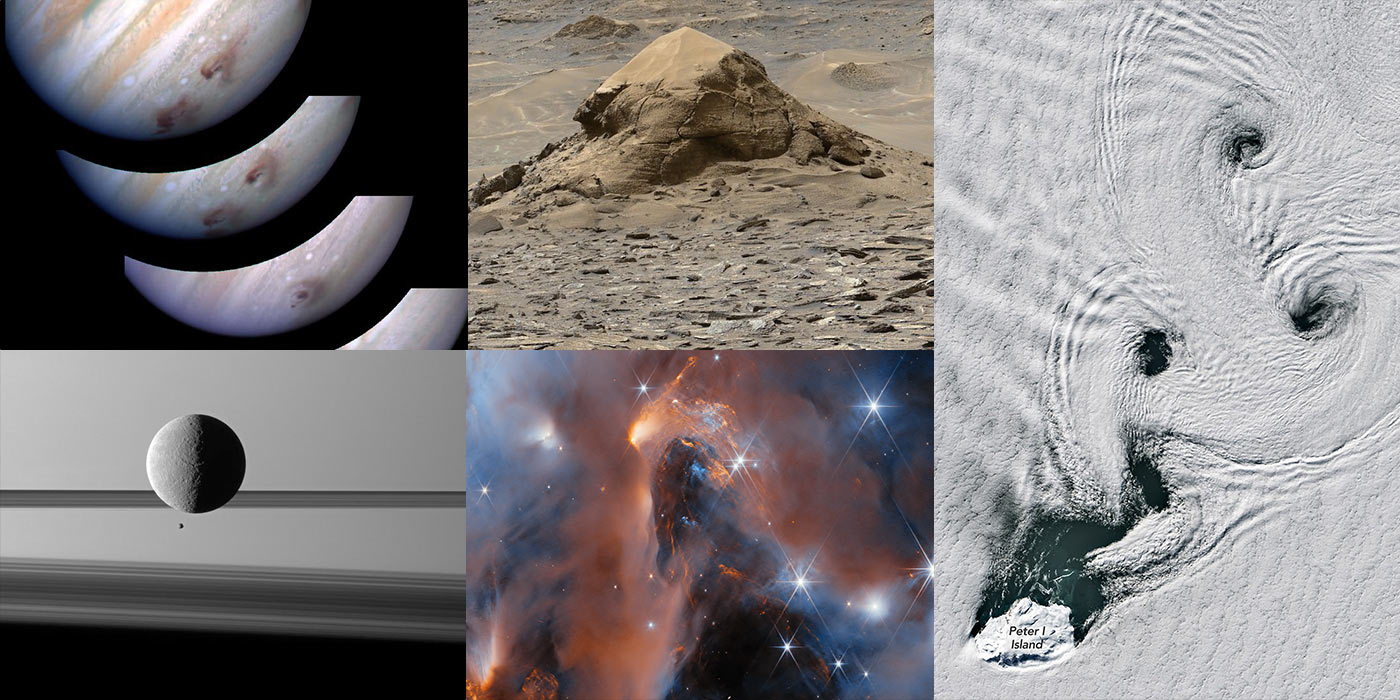
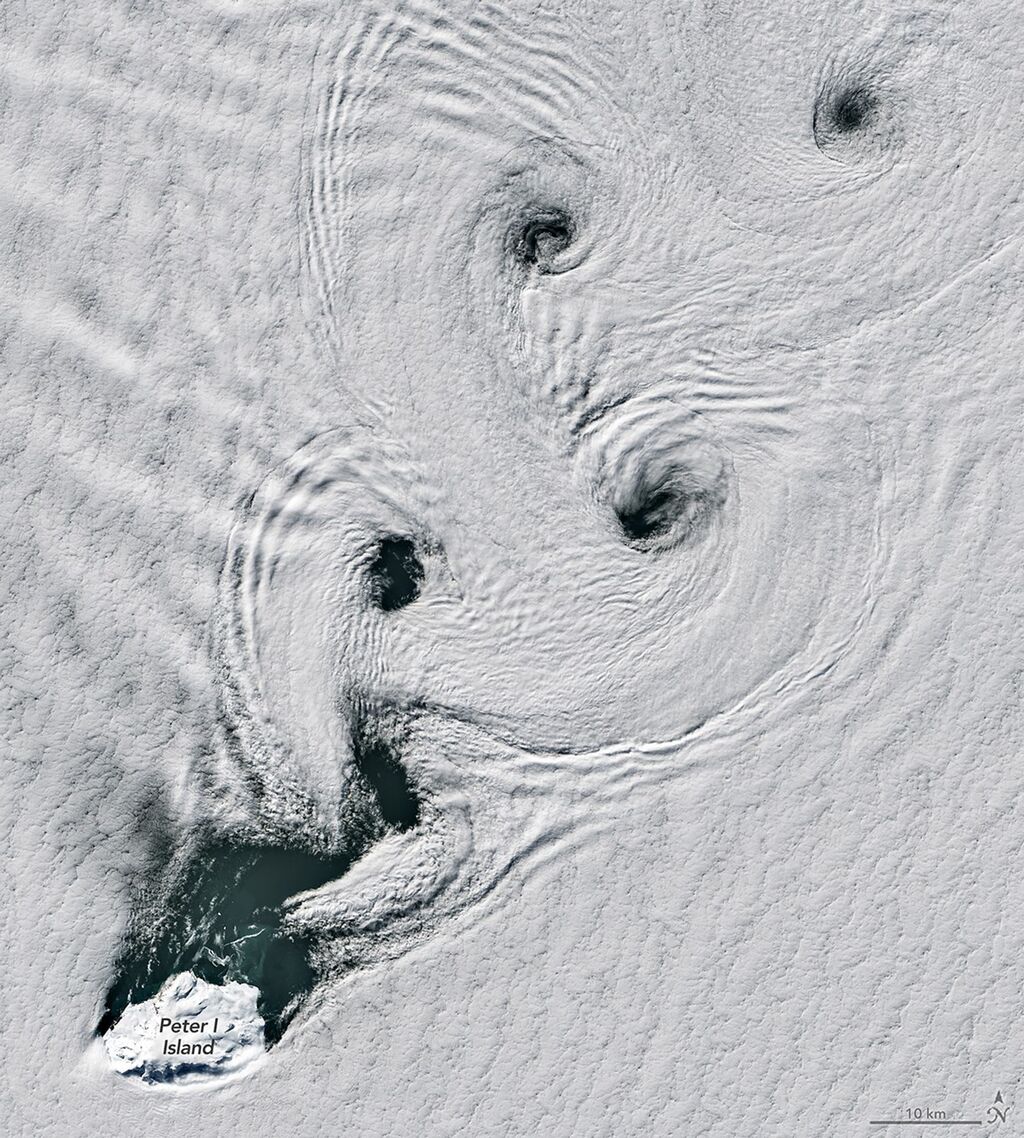
A Sea of Spinning Clouds

Over the Southern Ocean surrounding Antarctica, winds can whip around the globe relatively unimpeded by land. Intrepid sailors termed these southern latitudes the Roaring Forties, Furious Fifties, and Screaming Sixties on account of the strong prevailing winds.

When those winds encounter a barrier like an island, the disruption in airflow can be beautiful. One impediment, shown here, is remote Peter I Island. This ice-cloaked volcano lies at 68.86 degrees south latitude in the Bellingshausen Sea, some 400 kilometers off the coast of West Antarctica and more than 1,800 kilometers from Cape Horn, Chile.

On an austral summer day in 2026, the Landsat 8 satellite captured this image of von Kármán vortex streets downwind of the island. These counterrotating spirals form as flowing air is deflected, slows, and spins into eddies.

Credit: NASA/JPL-Caltech/MSSS/Thomas Thomopoulos

Wednesday, 17 June 2026

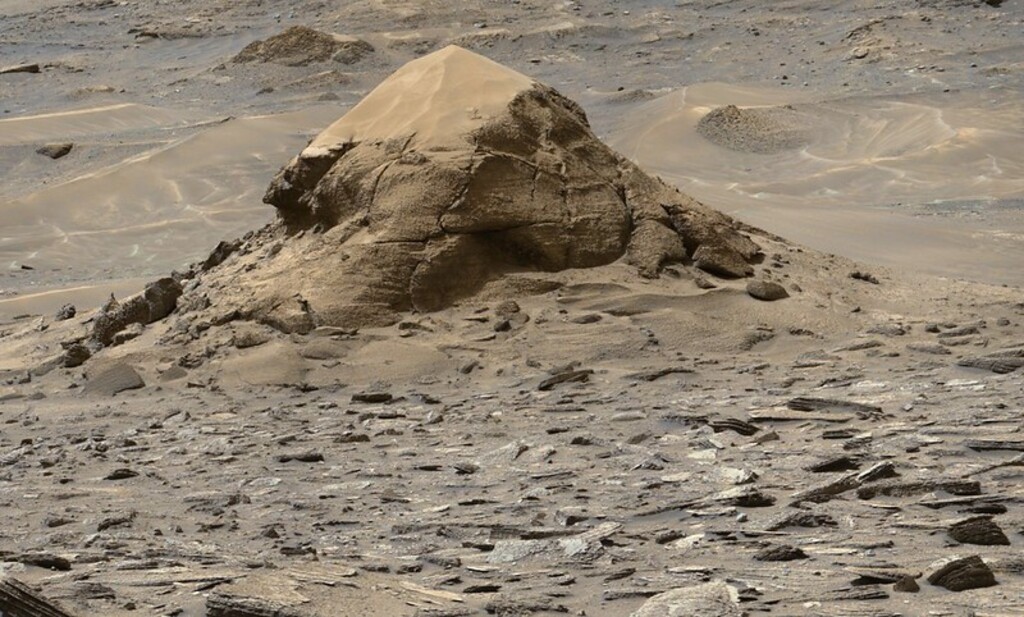
Mira Flores

View of “Mira Flores,” a small erosional outlier on Mars imaged by NASA’s Curiosity rover while driving south toward the Yardang Unit on Mount Sharp, Gale Crater. The butte exposes layered sedimentary bedrock partly covered by wind-blown sand, a small but striking remnant of Mars’ long history of deposition and erosion. (And as Nathalie Cabrol said: Look! A turtle!)

Credit: R. Evans, J. Trauger, H. Hammel, and the HST Comet Science Team and NASA

Thursday, 18 June 2026

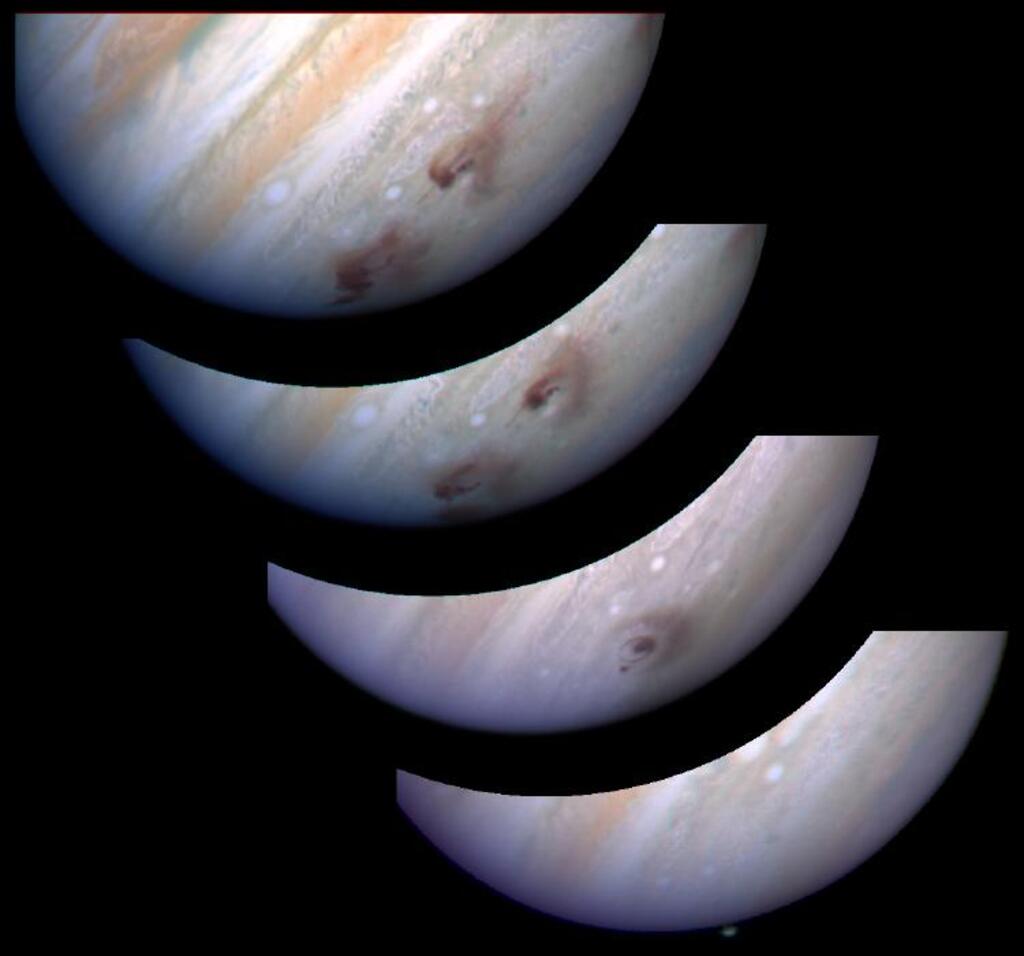
Comet Fragment Slams into Jupiter

In July 1994, 21 chunks of comet Shoemaker-Levy 9, which had broken apart a year earlier, slammed into Jupiter. The Hubble telescope recorded this spectacular event.

These images, beginning at the lower right, chronicle the results of one such collision. Hubble began snapping pictures of the impact area just five minutes after the collision. Nothing can be seen. Less than two hours later, a plume of dark debris is visible [bull's-eye pattern, image second from bottom]. Two impact sites are visible in the next picture, taken a few days later. The final snapshot shows three impact sites, the newest near the bull's-eye-shaped region.

This event remains one of the most profound, generation-defining astronomical events ever witnessed, beautifully cataloged by Hubble, revealing the volatile, ever-changing nature of our solar system.

Credit: ESA/Webb, NASA & CSA, A. Scholz, K. Muzic, A. Langeveld, R. Jayawardhana

Friday, 19 June 2026

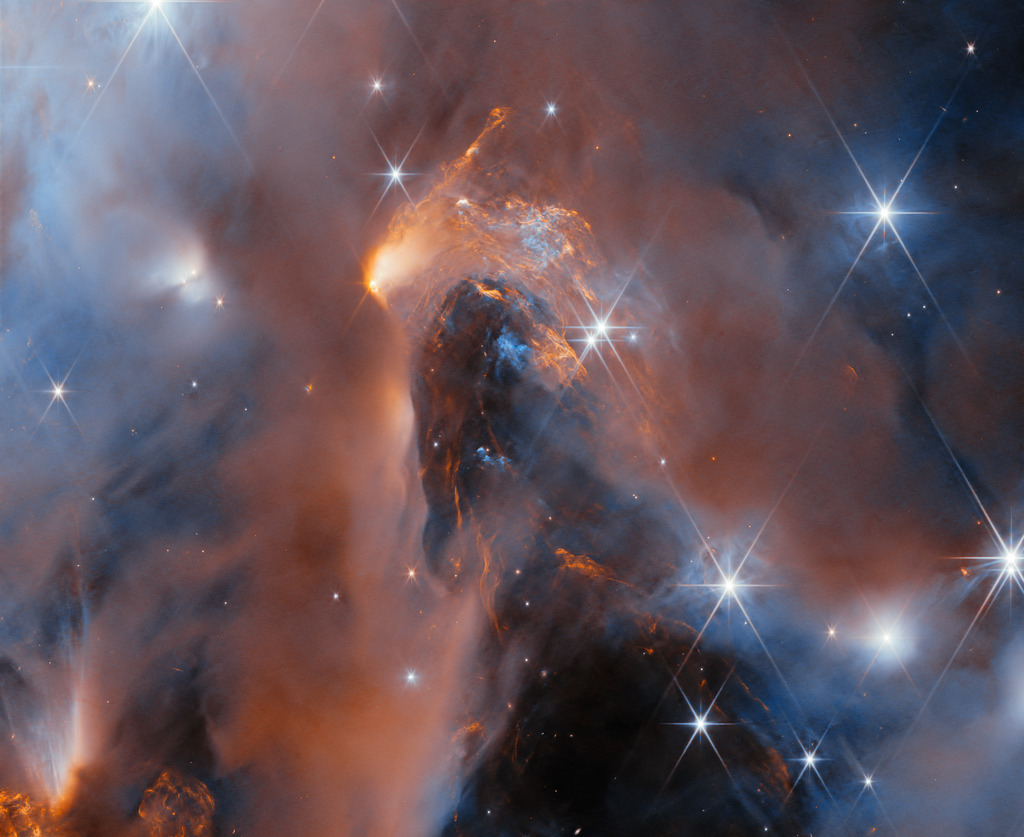
A Starry View

NASA’s JWST has infrared vision that lets us peer through the dusty veil of the nearby star-forming region NGC 1333. We can see planetary mass objects, newborn stars, and brown dwarfs; some of the faintest ‘stars’ in this mosaic image are in fact newly born free-floating brown dwarfs with masses comparable to those of giant planets. The images were captured as part of a JWST observation program to survey a large portion of NGC 1333. These data constitute the first deep spectroscopic survey of the young cluster.

News

Related News

Featured Image
Sep 2, 2026
Planetary Picture of the Day - Week of August 24, 2026
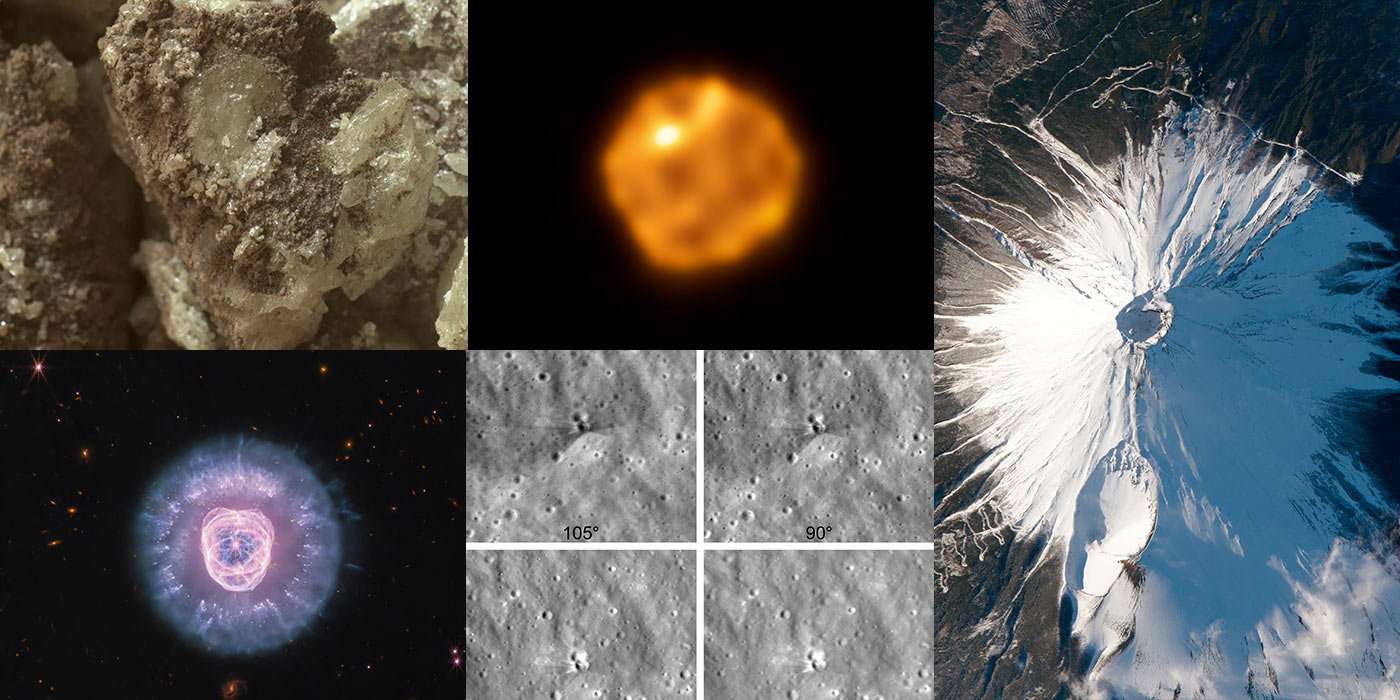
We journey from Mount Fuji as seen from orbit to the bubbling surface of Betelgeuse, exploring the forces that shape planets, moons, and stars across the cosmos. Along the way, JWST reveals the remains of a dying star, Curiosity uncovers clues to Mars’ volcanic past, and a fresh rocket impact on the Moon gives scientists a new opportunity to study how collisions reshape its surface. #PPOD
Featured Image
Aug 26, 2026
Planetary Picture of the Day - Week of August 17, 2026
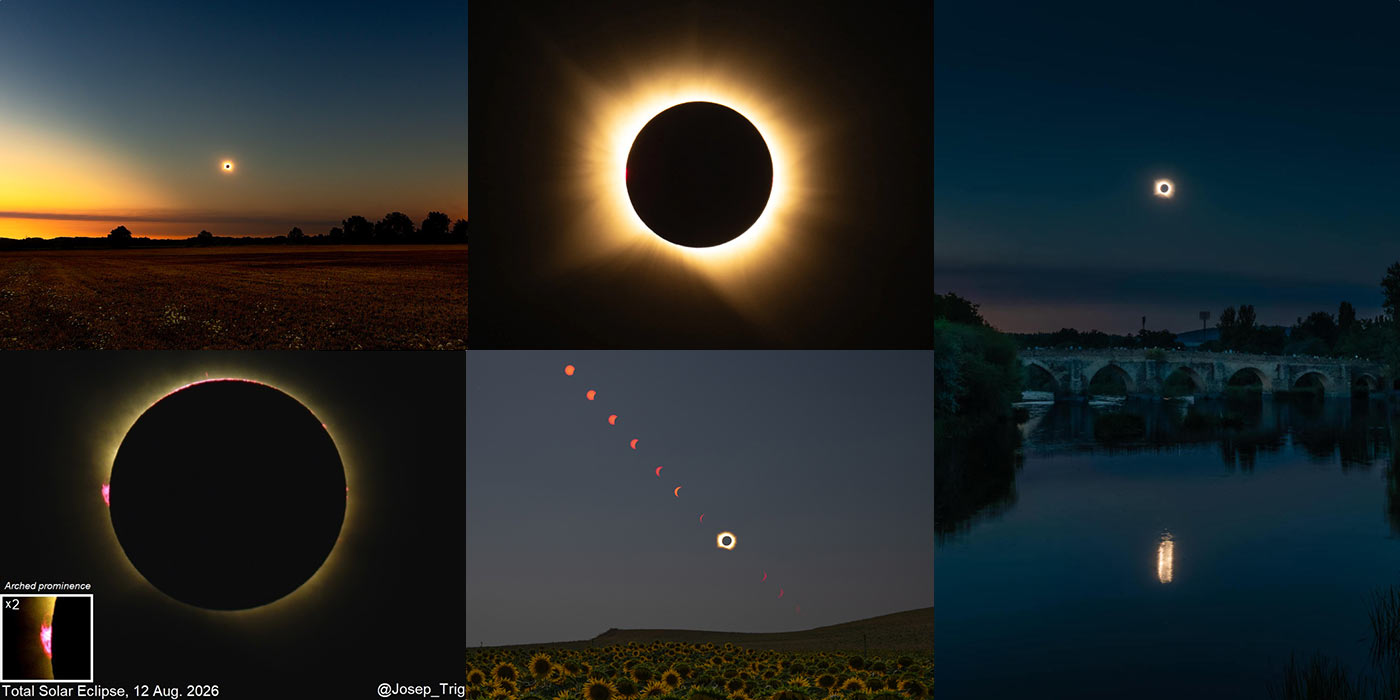
Let's celebrate the August 12 total solar eclipse through the eyes of photographers who experienced the Moon’s shadow sweeping across Spain. From Baily’s Beads and a glowing solar prominence to totality reflected in a river and framed by fields of sunflowers, these images capture both the science and extraordinary beauty of one of nature’s most spectacular celestial events. #PPOD #Eclipse
Featured Image
Aug 19, 2026
Planetary Picture of the Day - Week of August 10, 2026
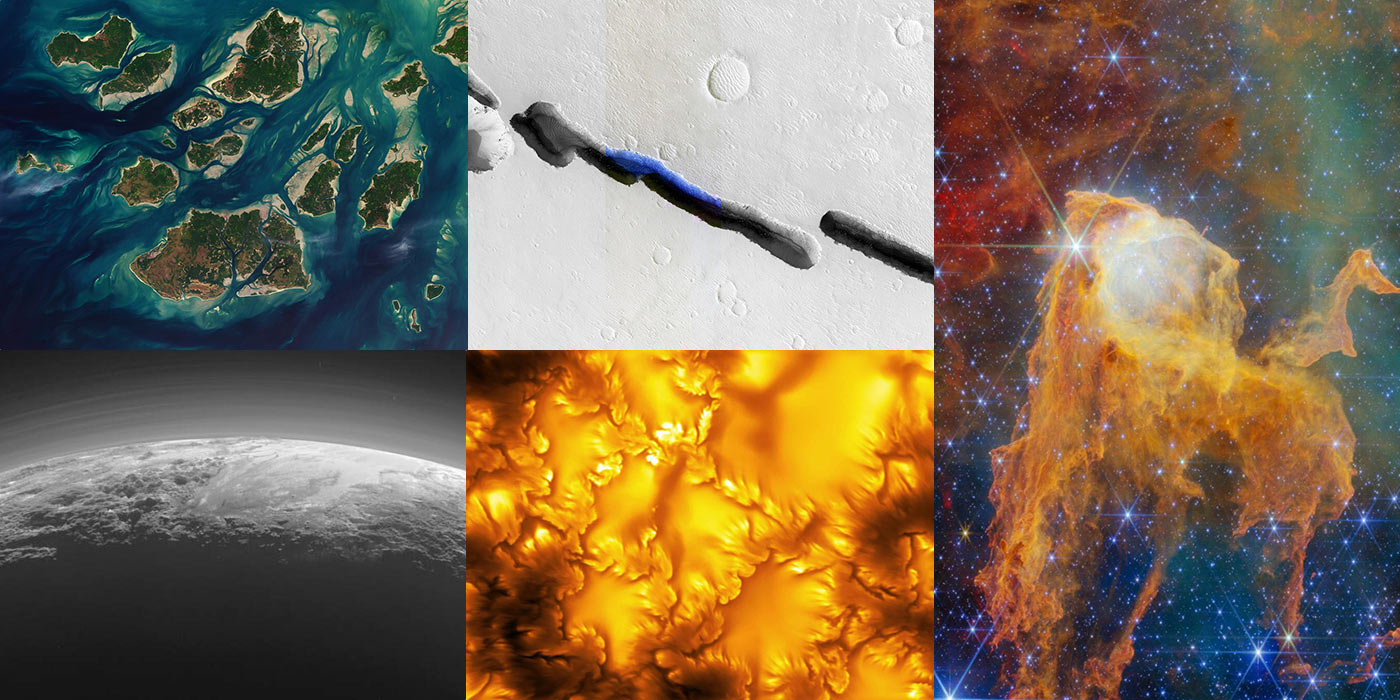
The universe is shaped by forces both immense and intricate, from fractured terrain on Mars and shifting tidal landscapes on Earth to tiny vortices dancing across the surface of the Sun. Farther afield, dramatic views of Pluto’s icy mountains and hazy atmosphere and a treasure chest of newborn stars in the Carina Nebula showcase the remarkable detail revealed by spacecraft and telescopes exploring the cosmos. #PPOD
Featured Image
Aug 12, 2026
Planetary Picture of the Day - August 3, 2026
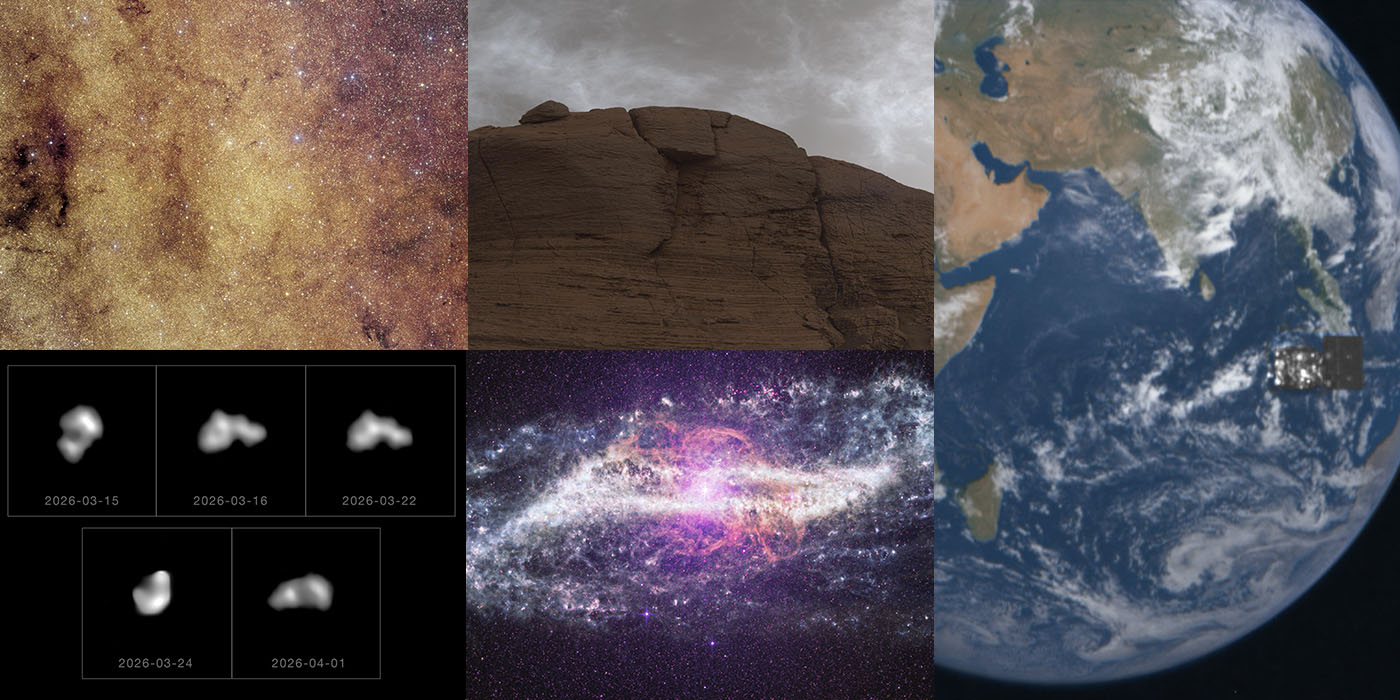
This week, we reveal hidden wonders across the cosmos, from delicate Martian clouds and a dust-shrouded galaxy to an asteroid with a never-before-seen shape and the crowded heart of the Milky Way. Together, these images showcase how new missions and advanced observatories continue to uncover surprising details about our solar system, our galaxy, and the universe beyond. #PPOD
Featured Image
Aug 5, 2026
Planetary Picture of the Day - Week of July 27, 2026
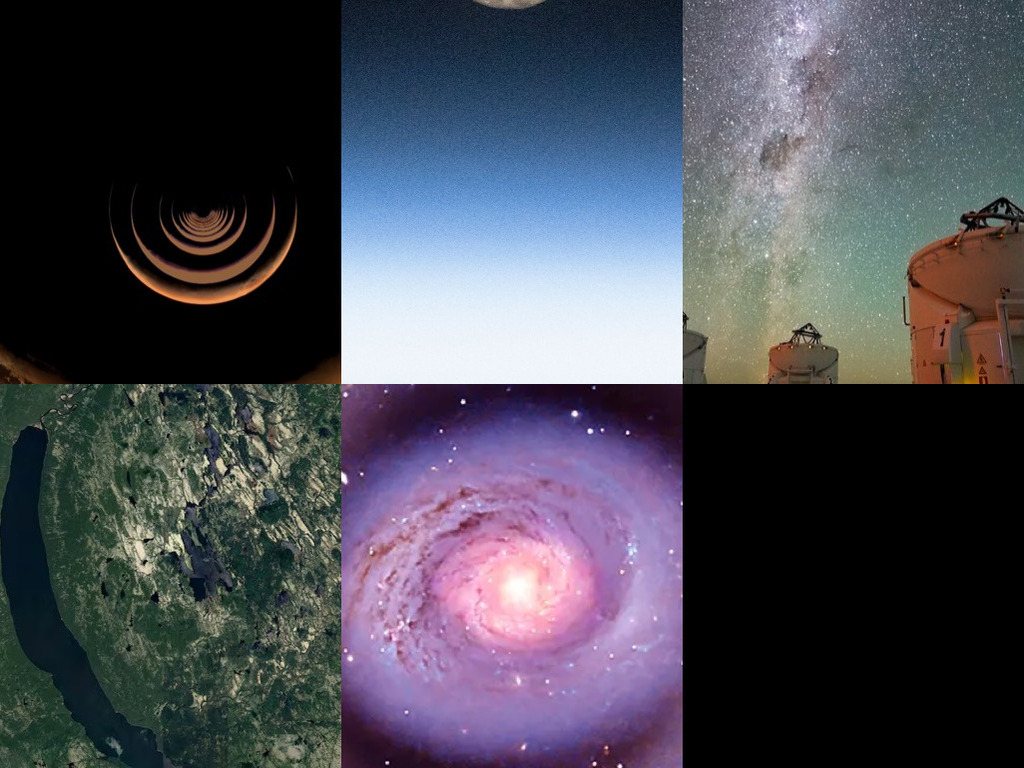
These images span the journey from our own backyard to distant galaxies, featuring Mars, the Moon, breathtaking night skies, and a fresh view of the star-forming galaxy Messier 94. Along the way, we celebrate exploration and discovery—from NASA’s Psyche mission preparing for its asteroid encounter to the revelation of a previously unknown impact crater on Earth —reminding us that there are still new wonders to uncover both on our own planet and across the cosmos. #PPOD
Featured Image
Jul 29, 2026
Planetary Picture of the Day - Week of July 20, 2026
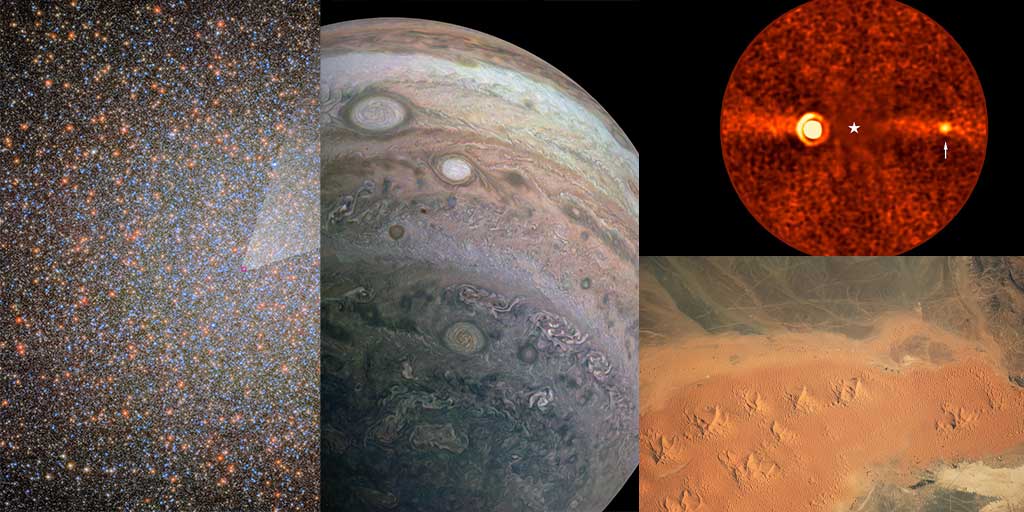
This week, we celebrate fifty years since Viking 1 became the first spacecraft to successfully land on and photograph the surface of Mars, alongside stunning new views of worlds, stars, and galaxies that continue to expand our understanding of the universe. From sculpted Sahara sand dunes and Jupiter’s colorful cloud bands to a newly discovered exoplanet and the first stellar-mass black hole identified in Omega Centauri, these images showcase the remarkable diversity of cosmic exploration. #PPOD
Research

Related Projects

Featured Image
SkyMapper • SETI • Citizen Science • Astronomy
SkyMapper: Expanding Access to Real-time Astronomy Through a Global Astronomical Network
SkyMapper and the SETI Institute are connecting educators, students and the public to live astronomical observations through a distributed astronomical network. #SkyMapper #SETI #Citizen Science #Astronomy
Featured Image
VPL
Virtual Planetary Laboratory
How can we best assess whether an exoplanet supports life? #VPL
Featured Image
Discovery and Futures Lab
What happens if life beyond Earth is discovered? The Discovery and Futures Lab at the SETI Institute fosters novel and anticipatory research at the intersection of science, society, our planet, and the search for life beyond Earth.  #Discovery and Futures Lab
Support Us

Support the
SETI Institute

Scientists are getting closer in their search for life beyond earth. But with limited federal funding for the search for extraterrestrial intelligence, supporters are the reason cutting-edge scientists can keep their eyes on the sky.