Viking 1
Monday, 20 July 2026
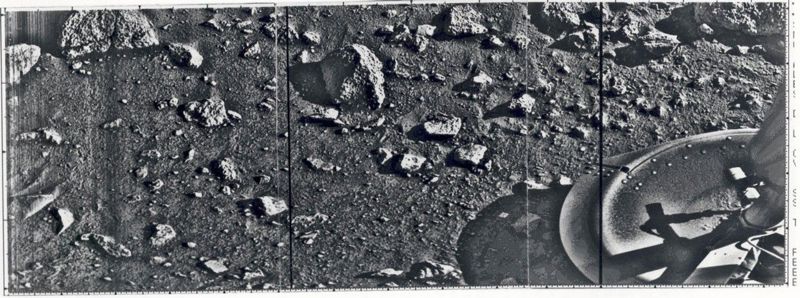
This is the first photograph ever taken on the surface of Mars. It was obtained by NASA's Viking 1 minutes after the spacecraft landed on July 20, 1976, fifty years ago today. The lander touched down in western Chryse Planitia ("Golden Plain") at 22.697°N 312.05°E and operated until November 11, 1982. Image Credit: NASA/JPL-Caltech
Sandy Sculptures in Morocco
Tuesday, 21 July 2026
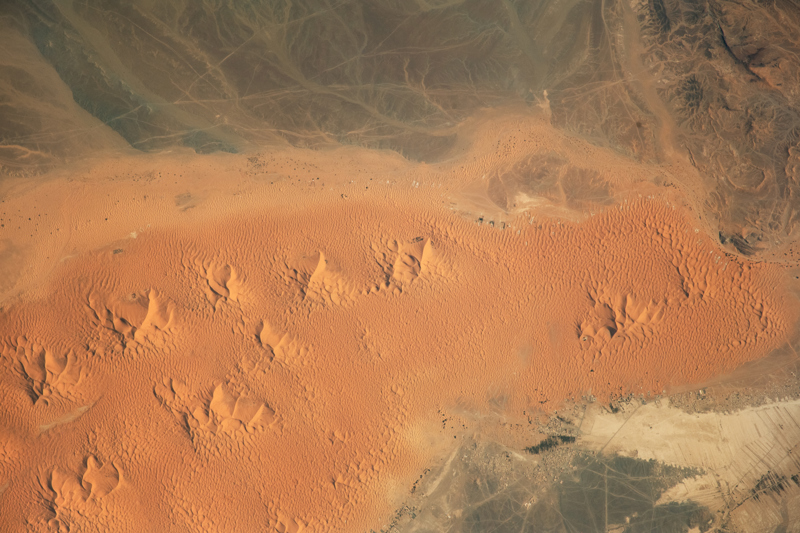
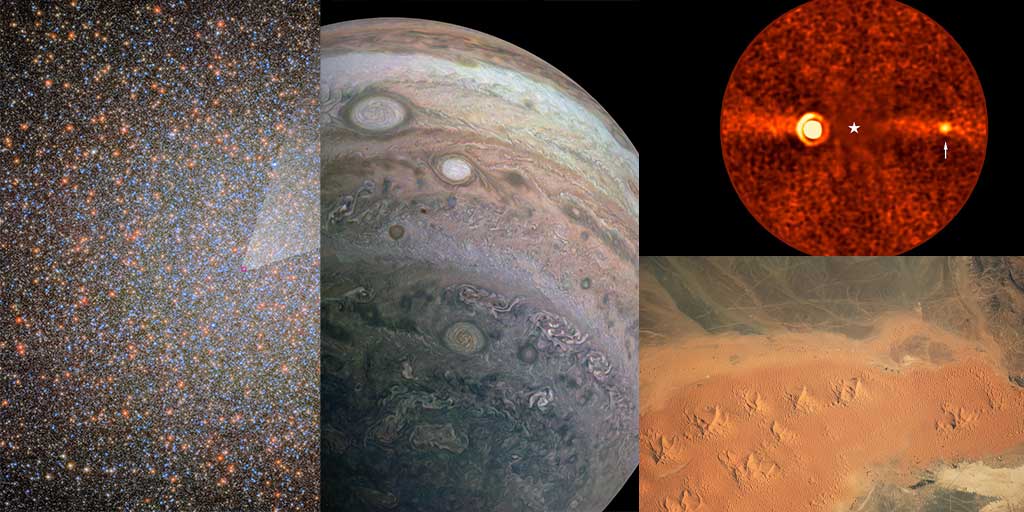
An astronaut aboard the International Space Station took this photograph while orbiting over northern Africa. The image shows a dune field known as Erg Chebbi, located in southeastern Morocco, near the border with Algeria and northeast of the Little Atlas mountain range. This erg, a wide sandy area covered with dunes, lies in the northwestern region of the Sahara Desert.
Dunes are created when the wind transports and deposits fine sand, forming mounds of sediment. The dunes in this photo display multiple smooth sides, known as slip faces, where sand has cascaded down from the peak. The windward side, located opposite the slip face, is where the wind blows material upward. The dune continues to grow vertically as long as sediment is available and the wind is strong enough to transport it upward. The large dunes crossing the center of the image, characterized by sharp multidirectional ridges, are star dunes. These are also known as pyramid dunes and are a distinctive feature of the Sahara. Image Credit: NASA
Beta Pictoris d
Wednesday, 22 July 2026
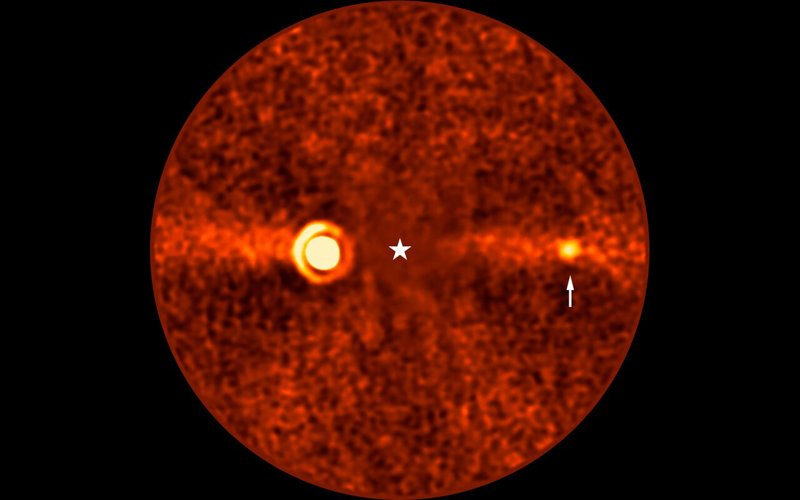
This image, taken with ESO’s Very Large Telescope (VLT), shows Beta Pictoris d, a new planet found orbiting the star Beta Pictoris. The star is at the center of the frame and was subtracted during data processing, revealing the environment around it. The new planet, indicated with an arrow, is the third one found around this star. The other two are Beta Pictoris bc – the bright source to the left - and Beta Pictoris c, orbiting much closer to the star and not seen here.
The image was taken with the ERIS instrument at the VLT. Based on its infrared brightness and color, the new planet appears to be a gas giant, about 2.4 times more massive than Jupiter.
The diffuse horizontal band in this image is a debris disc around the star, seen here edge-on, the leftover material of planetary formation. Image Credit: ESO/B. Sutlieff, M. Bonse et al.
Jupiter’s Racing Stripes
Thursday, 23 July 2026
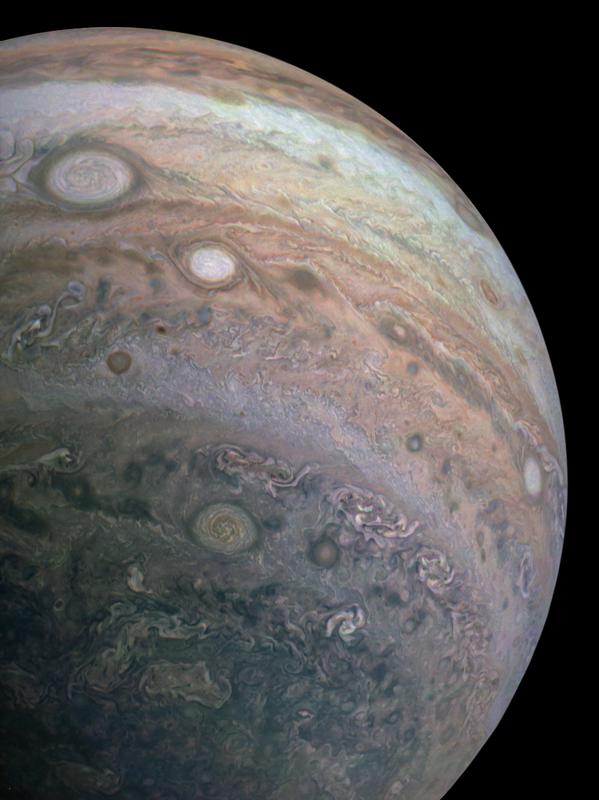
This enhanced-color image from NASA's Juno spacecraft captures the striking cloud bands of Jupiter's southern latitudes. Jupiter is not only the largest planet in the solar system, it also rotates at the fastest rate, completing a full day in just 10 hours. This rapid spinning creates strong jet streams, separating Jupiter's clouds into bright zones and dark belts that wrap around the planet. Image Credit: NASA/JPL-Caltech/SwRI/MSSS; Processing: David Marriott
Omega Centauri
Friday, 24 July 2026
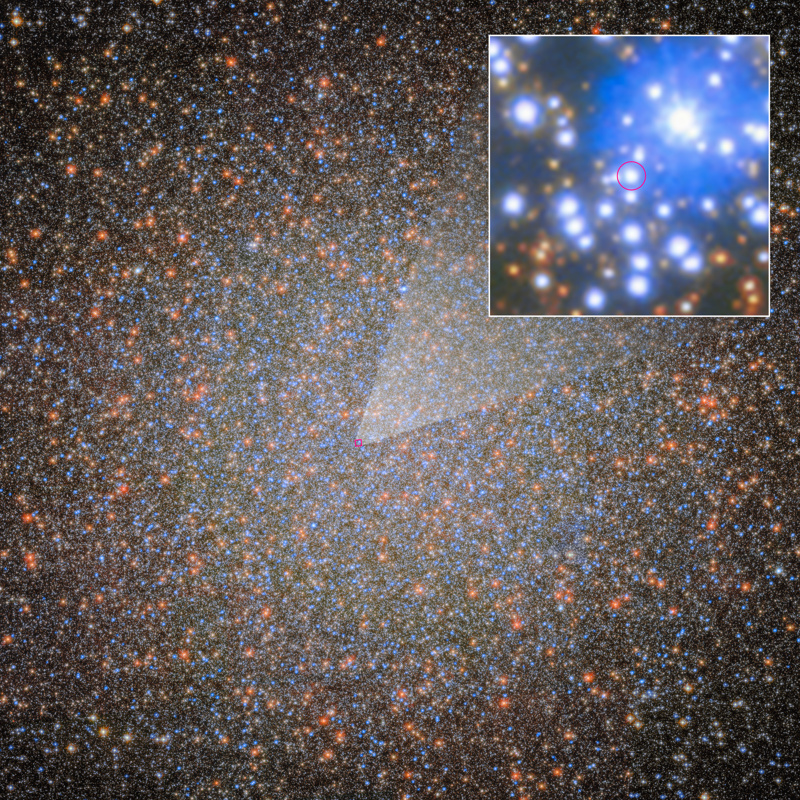
Although models suggest globular star cluster Omega Centauri should contain approximately 10,000 stellar-mass black holes, observational evidence of their existence has remained scarce.
A team of astronomers recently tracked the position of stars on the sky over more than 20 years using a robust multi-mission dataset of archival data from NASA’s Hubble Space Telescope as well as recent data from NASA’s James Webb Space Telescope. Based on their analysis, the science team detected a visible main-sequence star orbiting a stellar-mass black hole. The main-sequence star companion is encircled and shown in greater detail in the pullout in the top-right corner. The stellar-mass black hole, called oMEGACat BH-2, is the first of its kind found in Omega Centauri.
Its discovery sparks many questions surrounding the physics and formation of stellar-mass black holes within globular star clusters, and strengthens the need for follow-up studies of Omega Centauri and investigations into similar environments. Image Credit: ESA, NASA, Maximilian Häberle (MPIA), Joseph DePasquale (STScI)
)