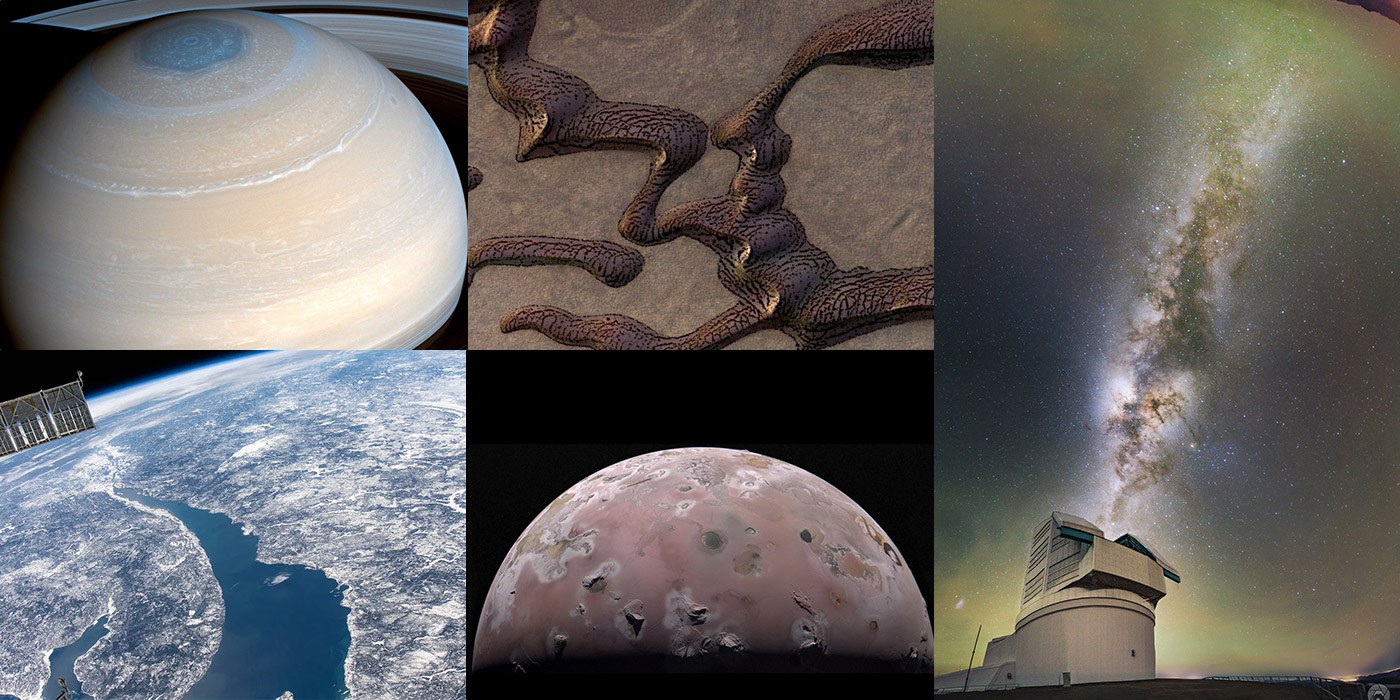







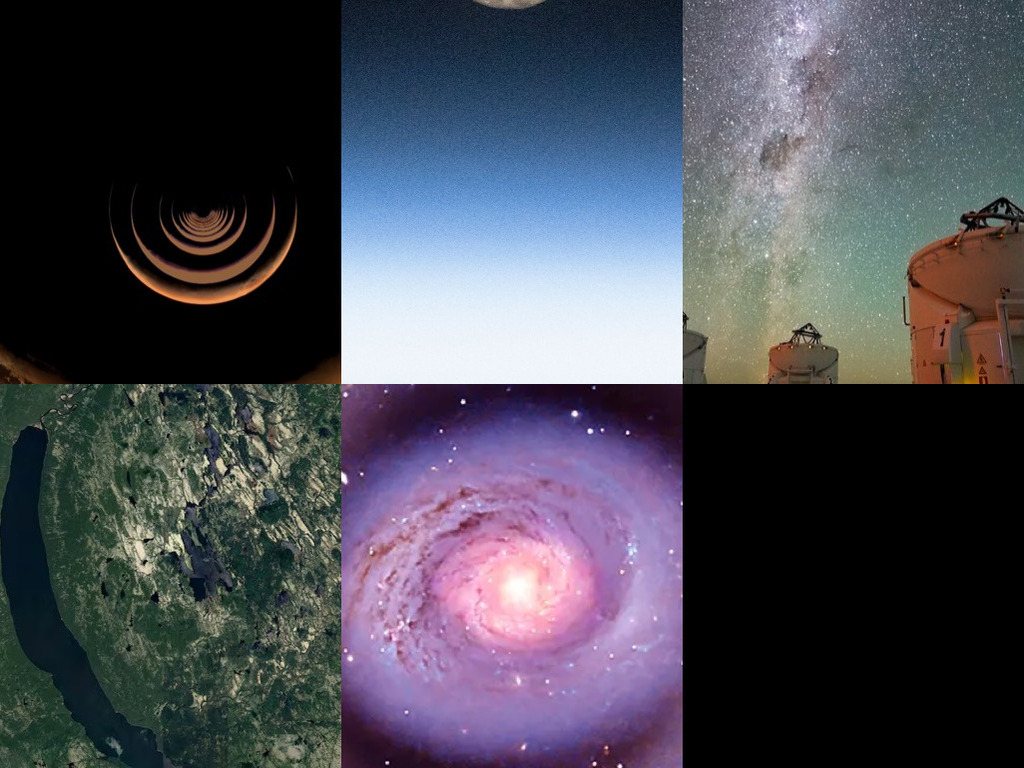
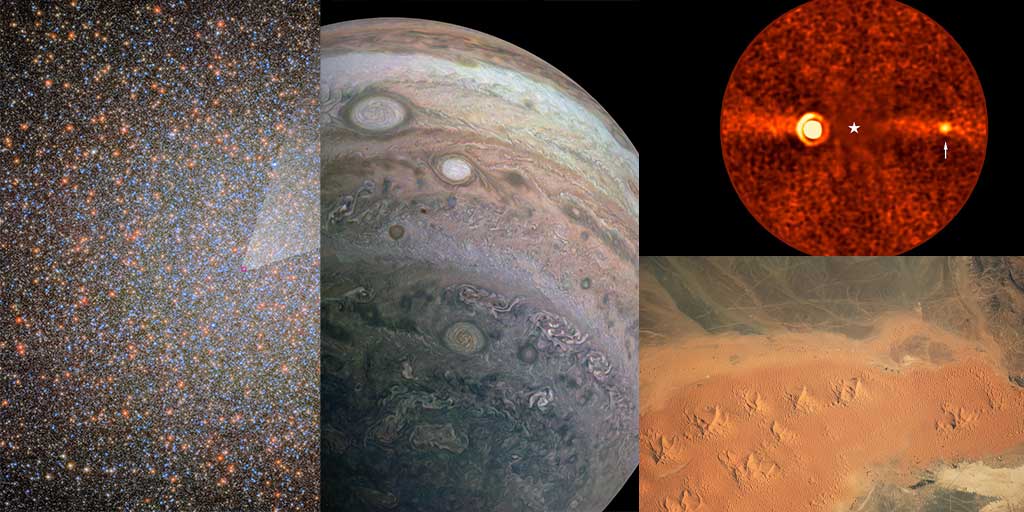
Seen from space, many intriguing features are found on the worlds of our solar system, from ancient craters on Earth to dunes on Mars, Saturn's hexagon, and Io's volcanoes. Now, we can add observations from Earth that will discover new details in space, involving the brand-new NSF-DOE Rubin Observatory.
Monday, 8 September 2025
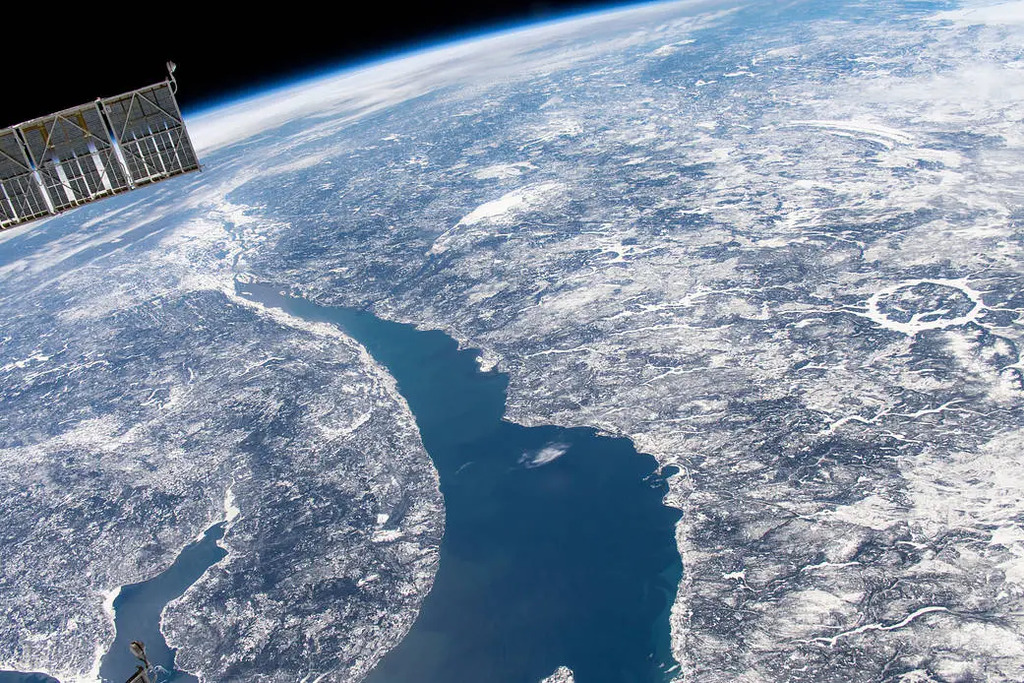
Manicouagan Crater, Quebec
More than 214 million years ago, a five-kilometer-wide asteroid collided with Earth, forming the Manicouagan Crater, a prominent feature of the planet today. Seen from space, the vast, annular reservoir surrounds a central island that is uplifted. Known as the "Eye of Quebec," the island fills the crater's 70-kilometer inner ring, a vivid sign of a massive asteroid strike from the Triassic Period.
Tuesday, 9 September 2025
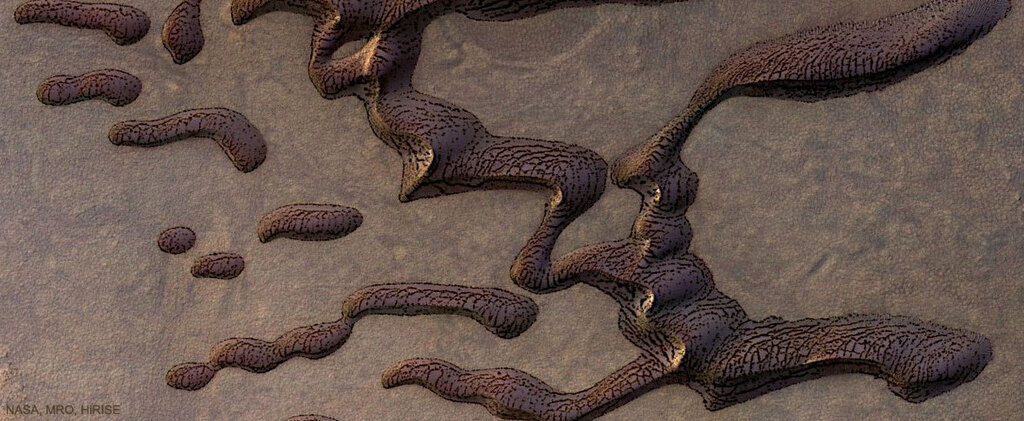
Striped Sand Dunes on Mars
Many Martian dunes are known to be covered unevenly with carbon dioxide (dry ice) frost, creating patterns of light and dark areas. Carbon dioxide doesn’t melt; instead, it sublimates, directly turning into a gas. Carbon dioxide is also a greenhouse gas, even in its solid form, so it can trap heat beneath the ice and sublimate from the bottom up, causing geyser-like eruptions.
During Martian spring, these eruptions can cause a pattern of dark defrosting spots, where the darker sand is exposed. This image, however, was taken during Martian autumn, when the weather is getting colder, making these stripes particularly puzzling. One hypothesis is that they are caused by cracks in the ice that form due to weaker eruptions or thermal stress as part of the day-night cycle; however, research continues. Watching these dunes and others through additional Martian seasons may provide us with more clues to solve this mystery.
Wednesday, 10 September 2025
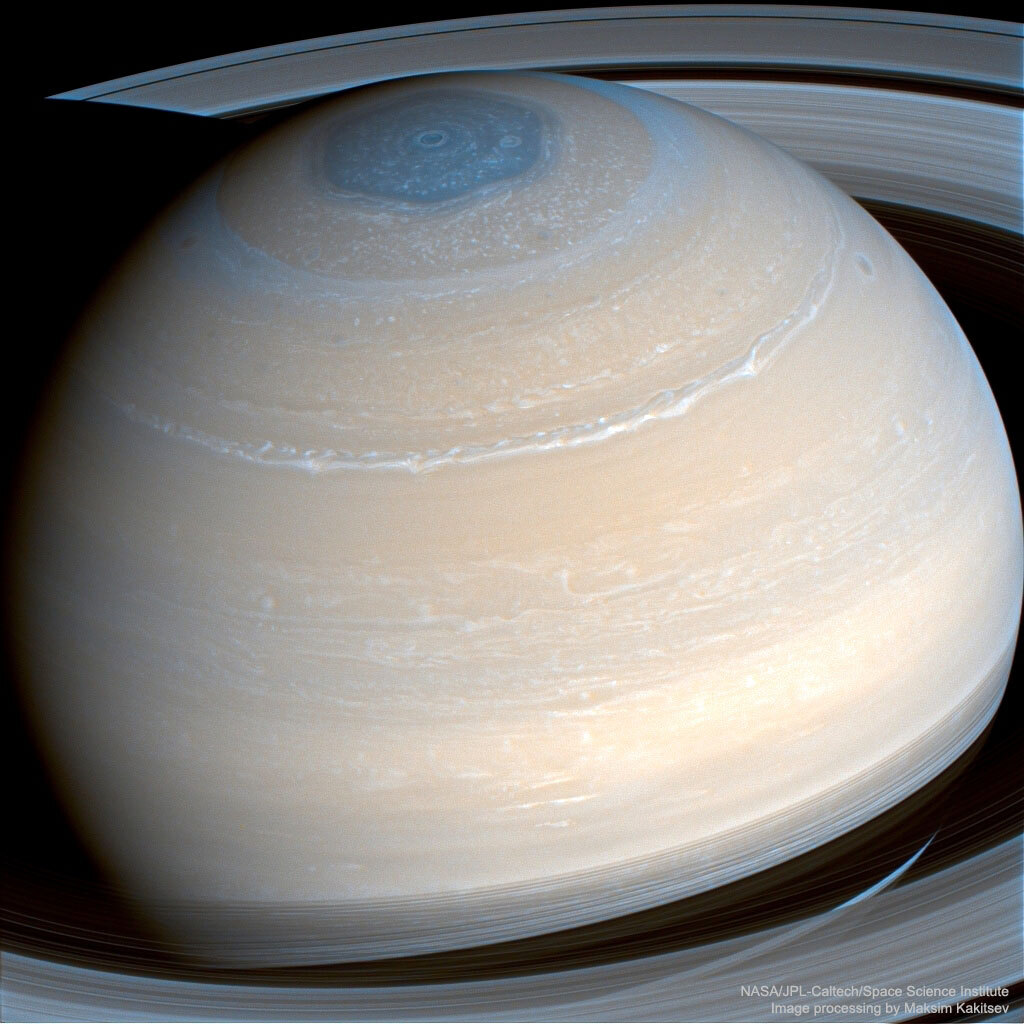
Saturn in Infrared
Saturn viewed at infrared wavelengths, as imaged by NASA's Cassini spacecraft in 2014. The hexagon at the top represents a giant jet stream, approximately 29,000 to 30,000 kilometers wide, with sides approximately 14,500 kilometers long – longer than Earth's diameter. This massive storm spans 75 to 300 kilometers high and is a long-lived atmospheric feature centered around Saturn's north pole.
Thursday, 11 September 2025
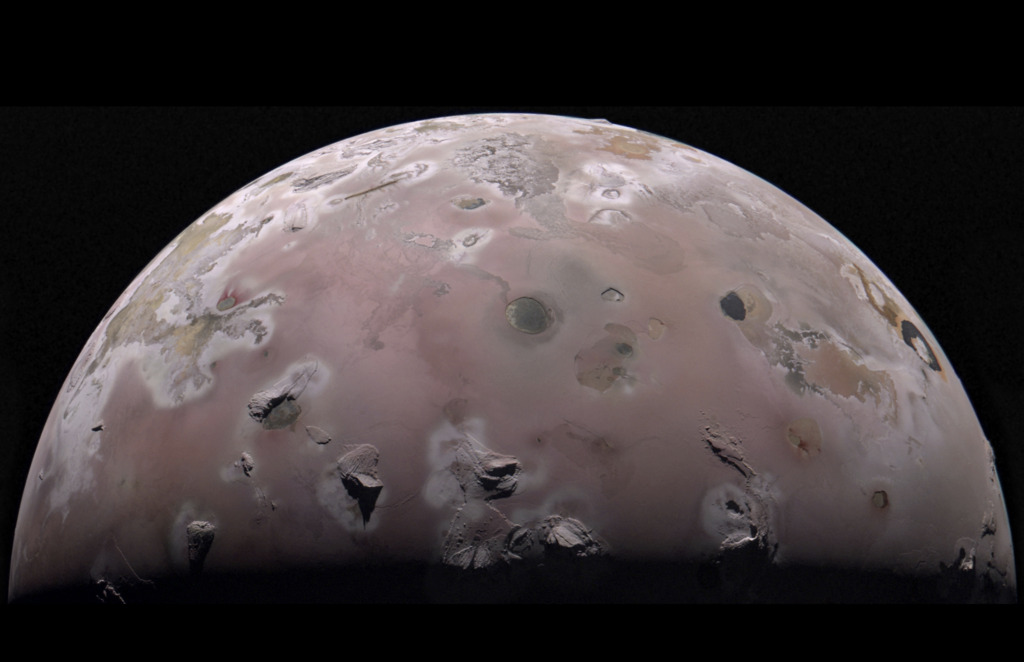
Io in Detail
The north polar region of Jupiter’s volcanic moon Io was captured by NASA’s Juno during the spacecraft’s 57th close pass of the gas giant on Dec. 30, 2023. Using data from recent flybys, scientists have discovered that the volcanoes on Jupiter’s moon Io are each likely powered by their own chamber of roiling hot magma rather than an ocean of magma.
Friday, 12 September 2025
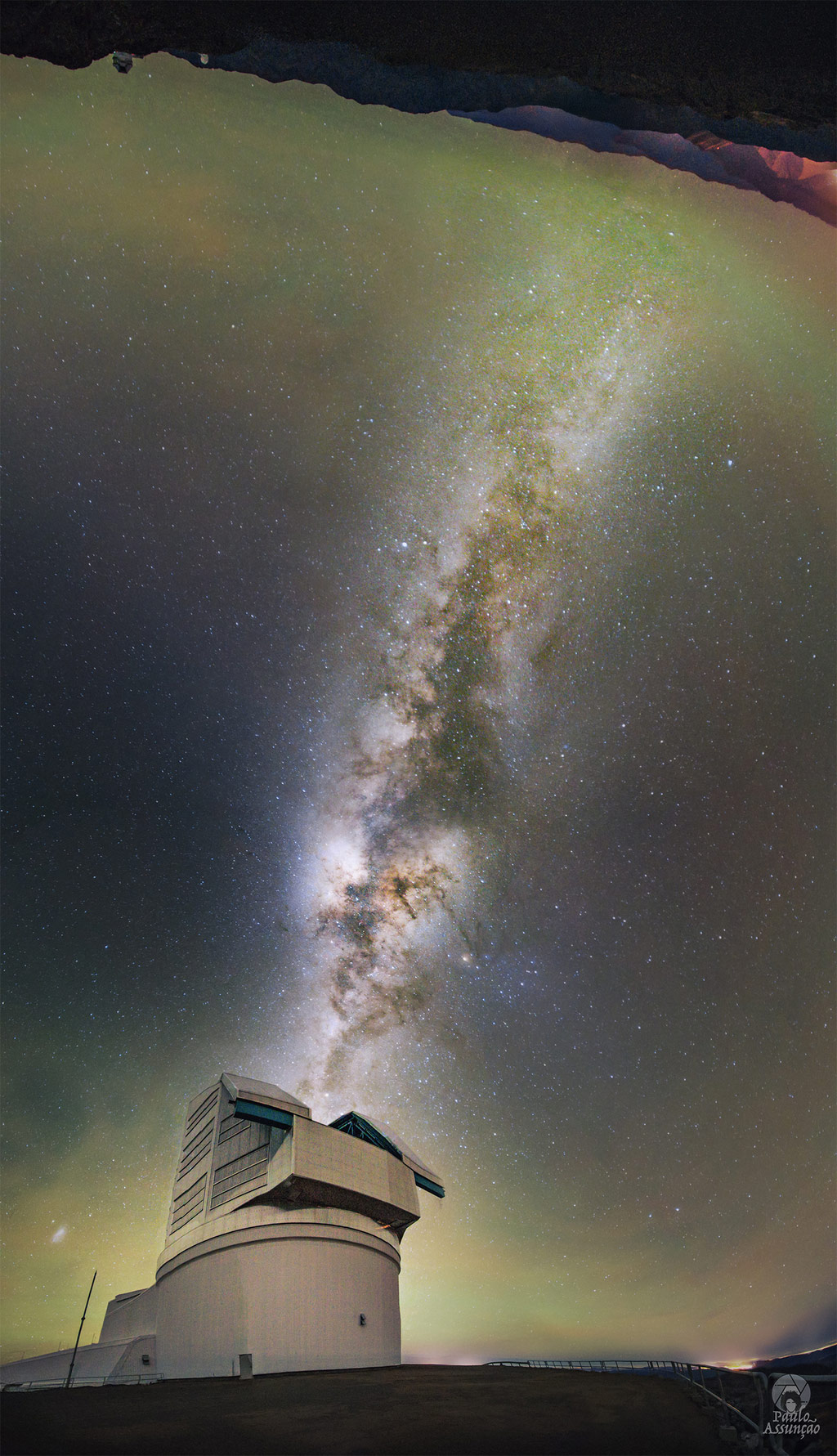
Milky Road to Rubin Observatory
From the summit of Cerro Pachón in Chile, the NSF-DOE Vera C. Rubin Observatory reaches for the "Milky Road" above. The new facility will spend a decade creating the Legacy Survey of Space and Time, a cosmic history that will capture every visible change in the southern sky. Named for the pioneering astronomer Vera C. Rubin, this new observatory uses the world's largest digital camera to explore the cosmos. Here, it stands sentinel under the brilliant band of our home galaxy, the Milky Way. The composite image, taken in May 2025, features the airglow on the horizon and arcs across the sky from horizon to horizon. The Small Magellanic Cloud galaxy can be seen in the lower left.
News
Related News
Planetary Picture of the Day - Week of August 24, 2026
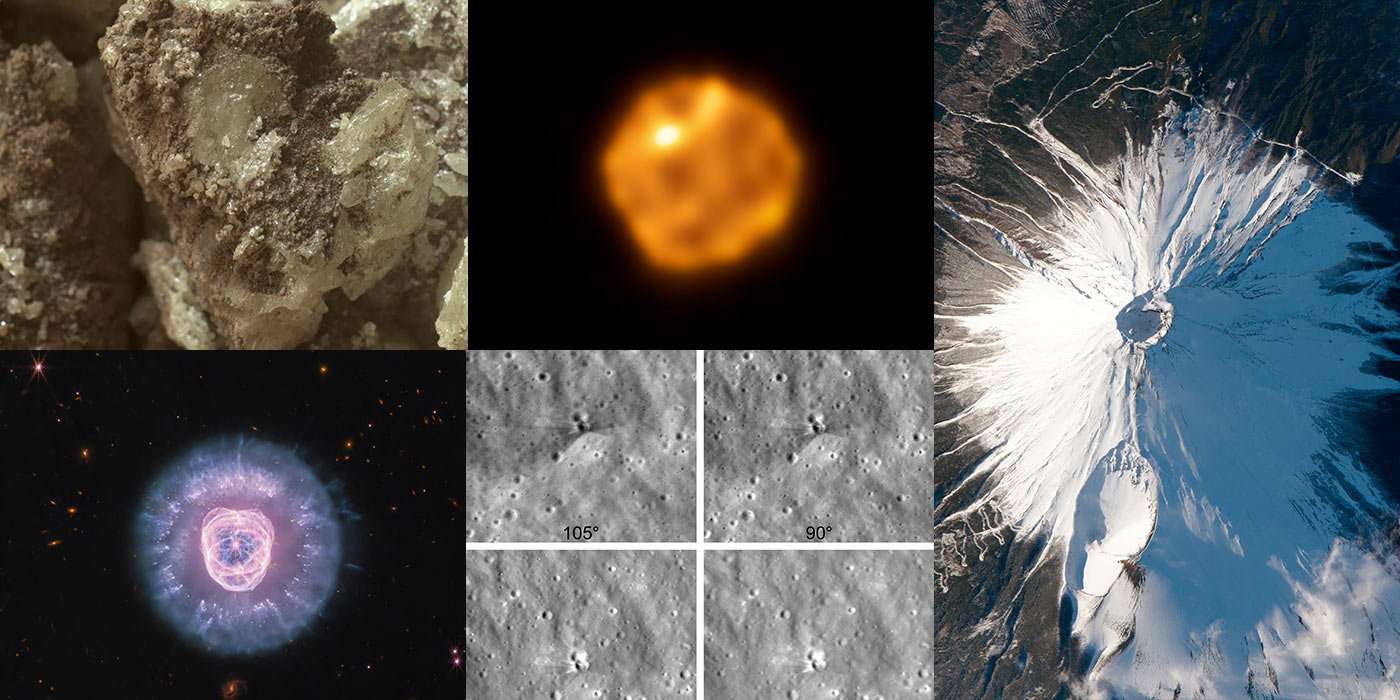
We journey from Mount Fuji as seen from orbit to the bubbling surface of Betelgeuse, exploring the forces that shape planets, moons, and stars across the cosmos. Along the way, JWST reveals the remains of a dying star, Curiosity uncovers clues to Mars’ volcanic past, and a fresh rocket impact on the Moon gives scientists a new opportunity to study how collisions reshape its surface. #PPOD

Planetary Picture of the Day - Week of August 17, 2026
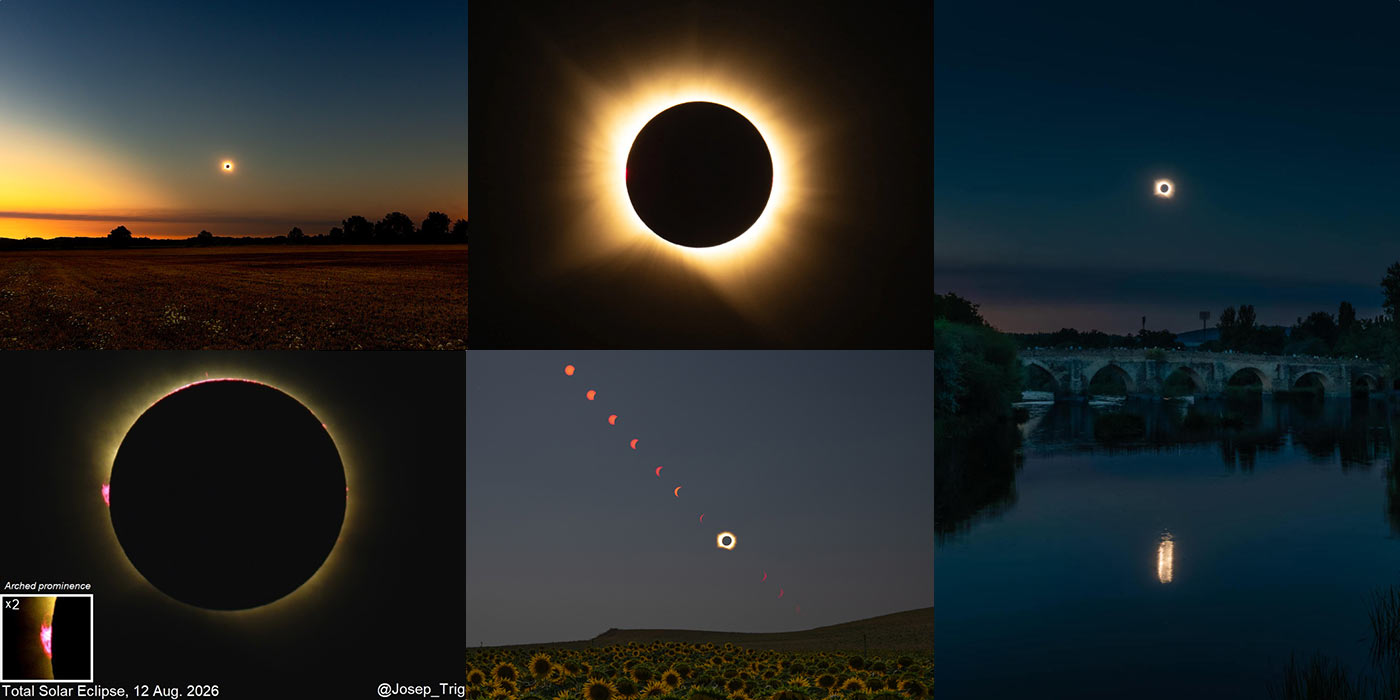
Let's celebrate the August 12 total solar eclipse through the eyes of photographers who experienced the Moon’s shadow sweeping across Spain. From Baily’s Beads and a glowing solar prominence to totality reflected in a river and framed by fields of sunflowers, these images capture both the science and extraordinary beauty of one of nature’s most spectacular celestial events. #PPOD #Eclipse
Planetary Picture of the Day - Week of August 10, 2026
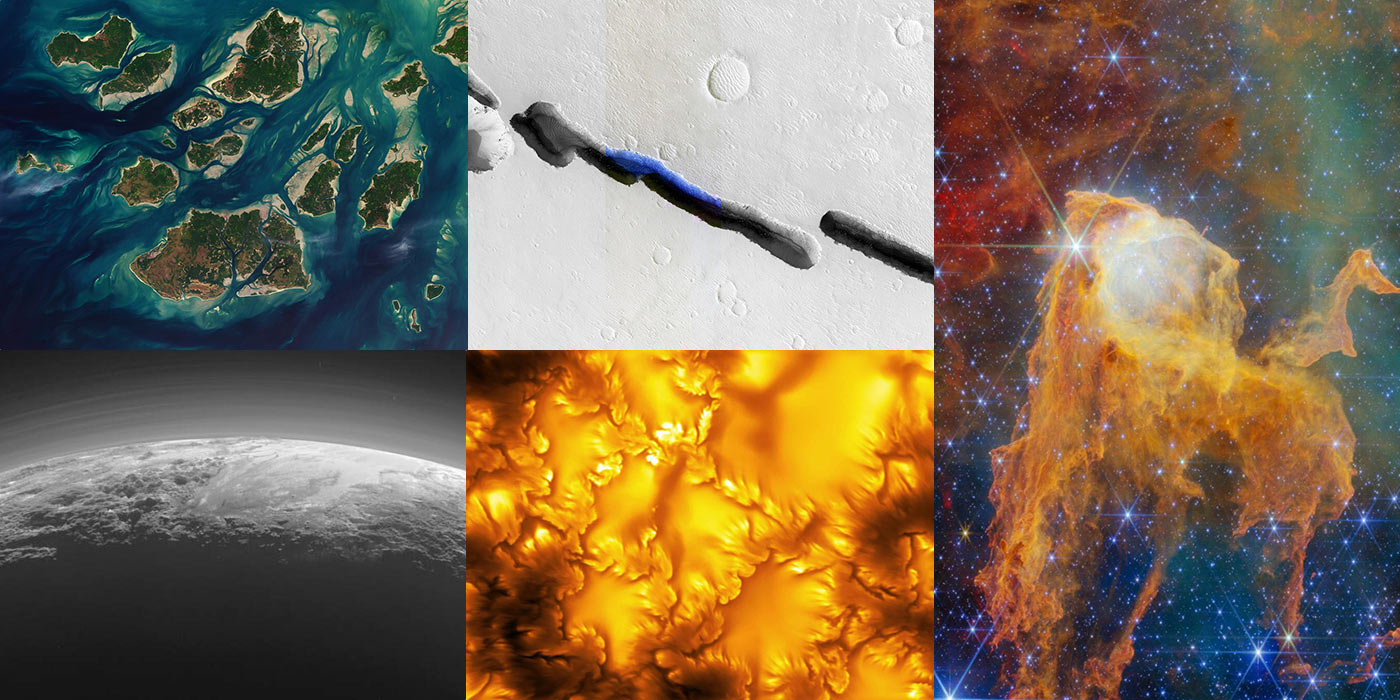
The universe is shaped by forces both immense and intricate, from fractured terrain on Mars and shifting tidal landscapes on Earth to tiny vortices dancing across the surface of the Sun. Farther afield, dramatic views of Pluto’s icy mountains and hazy atmosphere and a treasure chest of newborn stars in the Carina Nebula showcase the remarkable detail revealed by spacecraft and telescopes exploring the cosmos. #PPOD
Planetary Picture of the Day - August 3, 2026
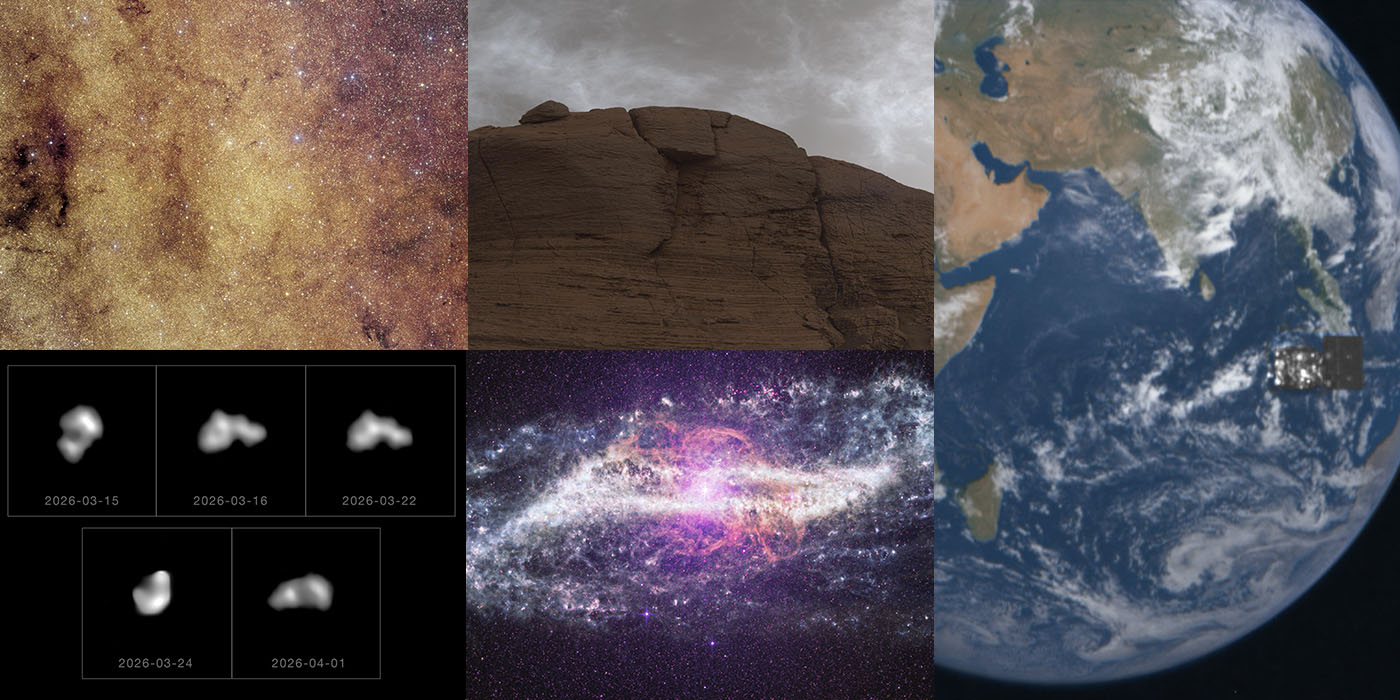
This week, we reveal hidden wonders across the cosmos, from delicate Martian clouds and a dust-shrouded galaxy to an asteroid with a never-before-seen shape and the crowded heart of the Milky Way. Together, these images showcase how new missions and advanced observatories continue to uncover surprising details about our solar system, our galaxy, and the universe beyond. #PPOD
Planetary Picture of the Day - Week of July 27, 2026
These images span the journey from our own backyard to distant galaxies, featuring Mars, the Moon, breathtaking night skies, and a fresh view of the star-forming galaxy Messier 94. Along the way, we celebrate exploration and discovery—from NASA’s Psyche mission preparing for its asteroid encounter to the revelation of a previously unknown impact crater on Earth —reminding us that there are still new wonders to uncover both on our own planet and across the cosmos. #PPOD
Planetary Picture of the Day - Week of July 20, 2026
This week, we celebrate fifty years since Viking 1 became the first spacecraft to successfully land on and photograph the surface of Mars, alongside stunning new views of worlds, stars, and galaxies that continue to expand our understanding of the universe. From sculpted Sahara sand dunes and Jupiter’s colorful cloud bands to a newly discovered exoplanet and the first stellar-mass black hole identified in Omega Centauri, these images showcase the remarkable diversity of cosmic exploration. #PPODResearch
Related Projects
SkyMapper: Expanding Access to Real-time Astronomy Through a Global Astronomical Network
SkyMapper and the SETI Institute are connecting educators, students and the public to live astronomical observations through a distributed astronomical network. #SkyMapper #SETI #Citizen Science #Astronomy
Virtual Planetary Laboratory
How can we best assess whether an exoplanet supports life? #VPL
Discovery and Futures Lab
What happens if life beyond Earth is discovered? The Discovery and Futures Lab at the SETI Institute fosters novel and anticipatory research at the intersection of science, society, our planet, and the search for life beyond Earth. #Discovery and Futures LabSupport the
SETI Institute
Scientists are getting closer in their search for life beyond earth. But with limited federal funding for the search for extraterrestrial intelligence, supporters are the reason cutting-edge scientists can keep their eyes on the sky.