This week, things that look like other things -- a string of pearls, fingers, a crystal ball. What do you see in these images? Plus, we share the results of using infrared observations vs visible light.
Monday, 3 March 2025
Credit: NASA/JPL-Caltech/SwRI/MSSS/Kevin M. Gill
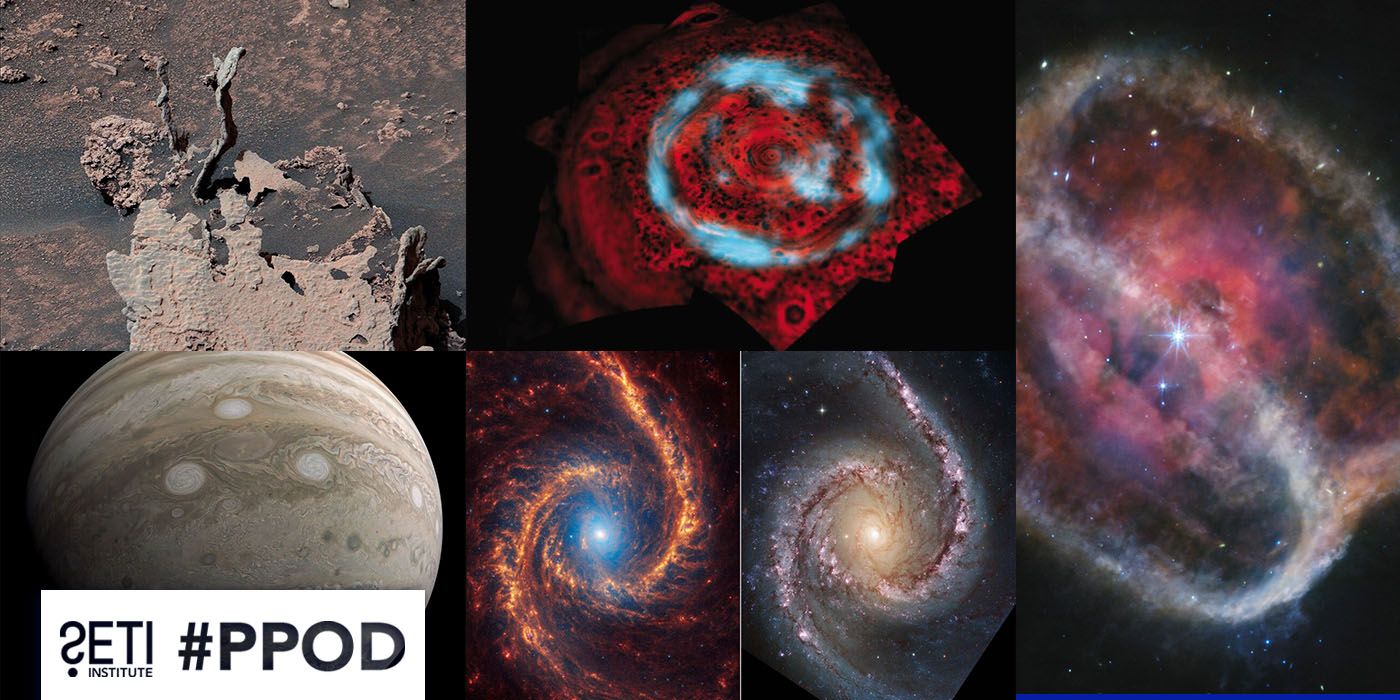
String of Pearls
This beautiful triad of storms on Jupiter is part of eight known as "the string of pearls." These storms can reach 1/3 to 2/3 the size of the Earth! Kevin M. Gill processed five images taken on 21 February 2021 by NASA's JunoCam onboard the Juno spacecraft to create this composite image of Jupiter's South Temperate Domain.
Note: JunoCam uses a wide-angle lens, which distorts images and makes foreground objects, like the cyclones, appear larger than they are in reality. They are still really, really big!
Tuesday, 4 March 2025
Credit: NASA/JPL-Caltech/MSSS
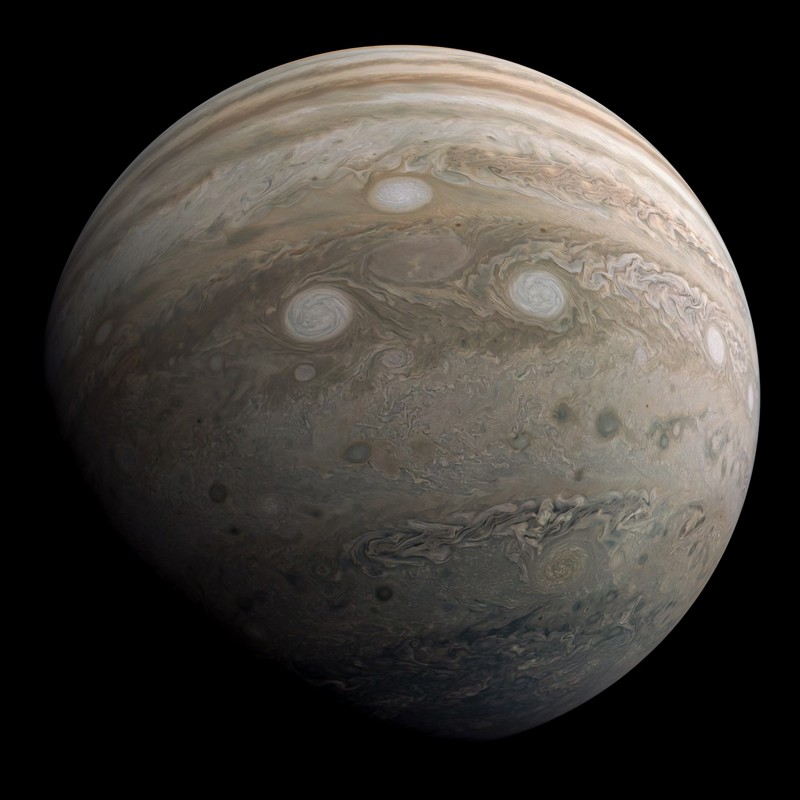
Finger-Like Rocks
NASA’s Curiosity Mars rover spotted these finger-like rocks with its Mast Camera, or Mastcam, on May 15, 2022, the mission's 3,474th Martian day, or sol. These rocks likely formed as groundwater trickled through rock in the ancient past, depositing mineral cements over time. When the rock was exposed to the atmosphere many years later, wind eroded the softer material around the cemented portions. The rocks were found on Mount Sharp, the 5-kilometer-tall mountain that Curiosity has been climbing since 2014.
Wednesday, 5 March 2025
Credit: NASA, ESA, CSA, M. E. Ressler (JPL); Processing: Judy Schmidt
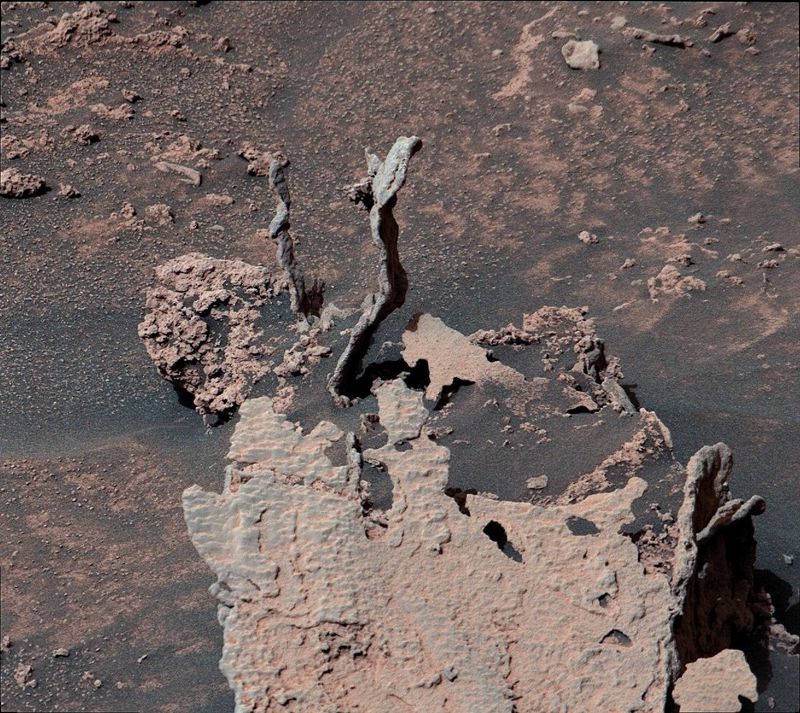
Planetary Nebula in Infrared
NGC 1514, also known as the Crystal Ball Nebula, is a planetary nebula in the constellation of Taurus. In this infrared image from JWST, the two outer dusty rings appear in neutral gray while the interior parts of the nebula are deep red. Because it is infrared light, these colors do not have traditional meanings like they might with visible light, but they are still indicative of the elemental composition and temperature of the material cast off by the central star as it ended its hydrogen fusing stage before transitioning to a white dwarf.
Infrared observations show that a huge region of dust, spanning 8.5 light years, surrounds the planetary nebula, which is located 2,283 light years away from Earth.
Thursday, 6 March 2025
Credit: NASA/JPL/University of Arizona
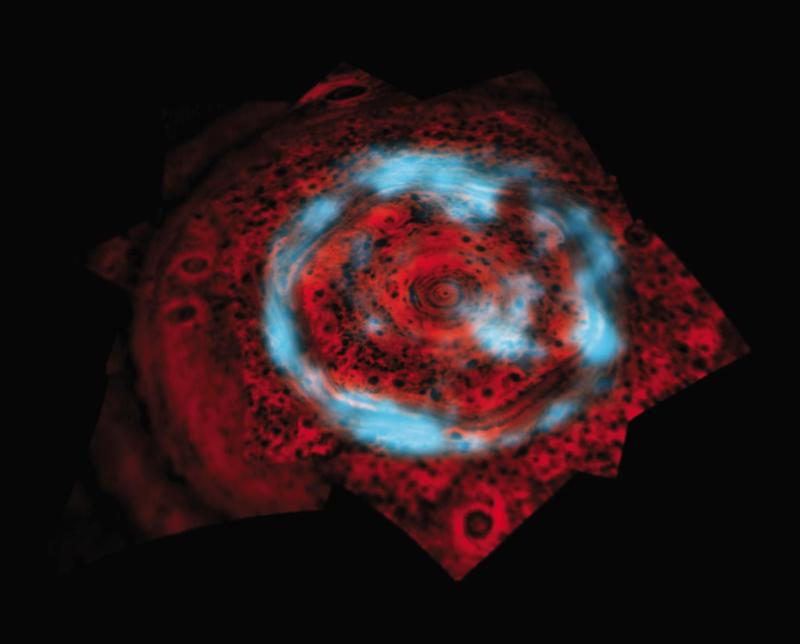
Saturn's Polar Aurora
This composite image of Saturn's northern polar region shows the aurora and underlying atmosphere, captured by NASA's Cassini spacecraft's visual and infrared mapping spectrometer, at two different wavelengths of infrared light.
Energetic particles crashing into the upper atmosphere cause the aurora, shown in blue, to glow brightly at 4 microns (six times the wavelength visible to the human eye). The image shows both a bright ring, as seen from Earth, and an example of bright auroral emission within the polar cap that had been undetected until the advent of Cassini. This aurora, which defies past predictions of what was expected, has been observed to grow even brighter than is shown here. Silhouetted by the glow (cast here to the color red) of the hot interior of Saturn (clearly seen at a wavelength of 5 microns, or seven times the wavelength visible to the human eye) are the clouds and haze that underlie this auroral region.
Friday, 7 March 2025
Credit: NASA, ESA, CSA, STScI, Janice Lee (STScI), Thomas Williams (Oxford), Rupali Chandar (UToledo), Daniela Calzetti (UMass), PHANGS Team
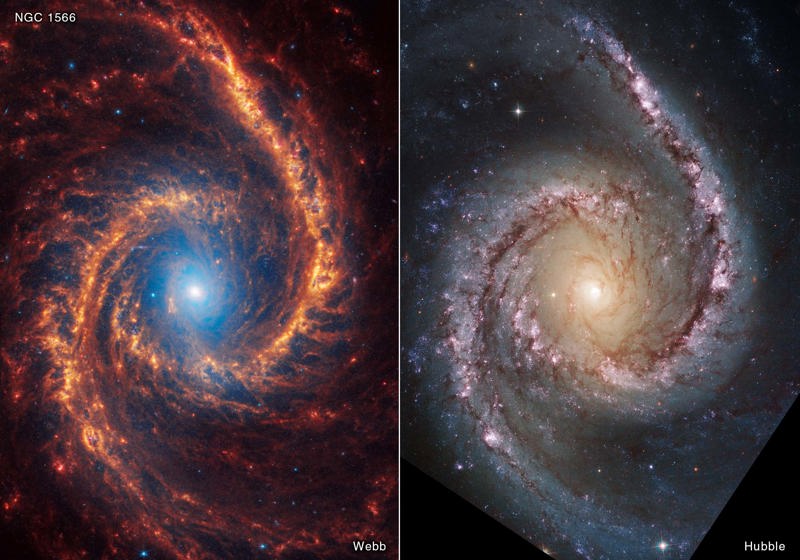
Infrared vs Visible Light
The face-on spiral galaxy NGC 1566 is shown twice. At left, Webb’s observations combine near- and mid-infrared light. At right, Hubble’s observations feature visible and ultraviolet light. Dust absorbs ultraviolet and visible light and then re-emits it in the infrared. In Webb's images, we see dust glowing in infrared light. In Hubble’s images, dark regions are where starlight is absorbed by dust. These two instruments make what’s invisible to our senses visible.
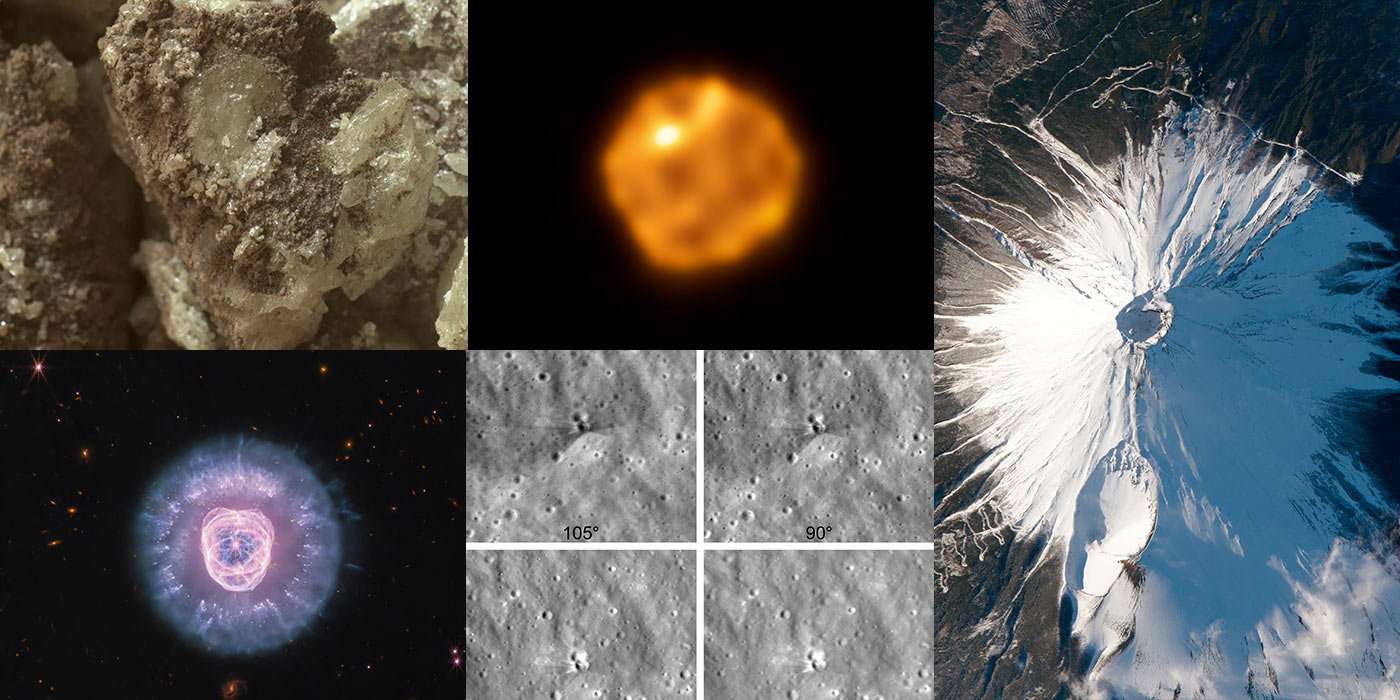
We journey from Mount Fuji as seen from orbit to the bubbling surface of Betelgeuse, exploring the forces that shape planets, moons, and stars across the cosmos. Along the way, JWST reveals the remains of a dying star, Curiosity uncovers clues to Mars’ volcanic past, and a fresh rocket impact on the Moon gives scientists a new opportunity to study how collisions reshape its surface.
#PPOD
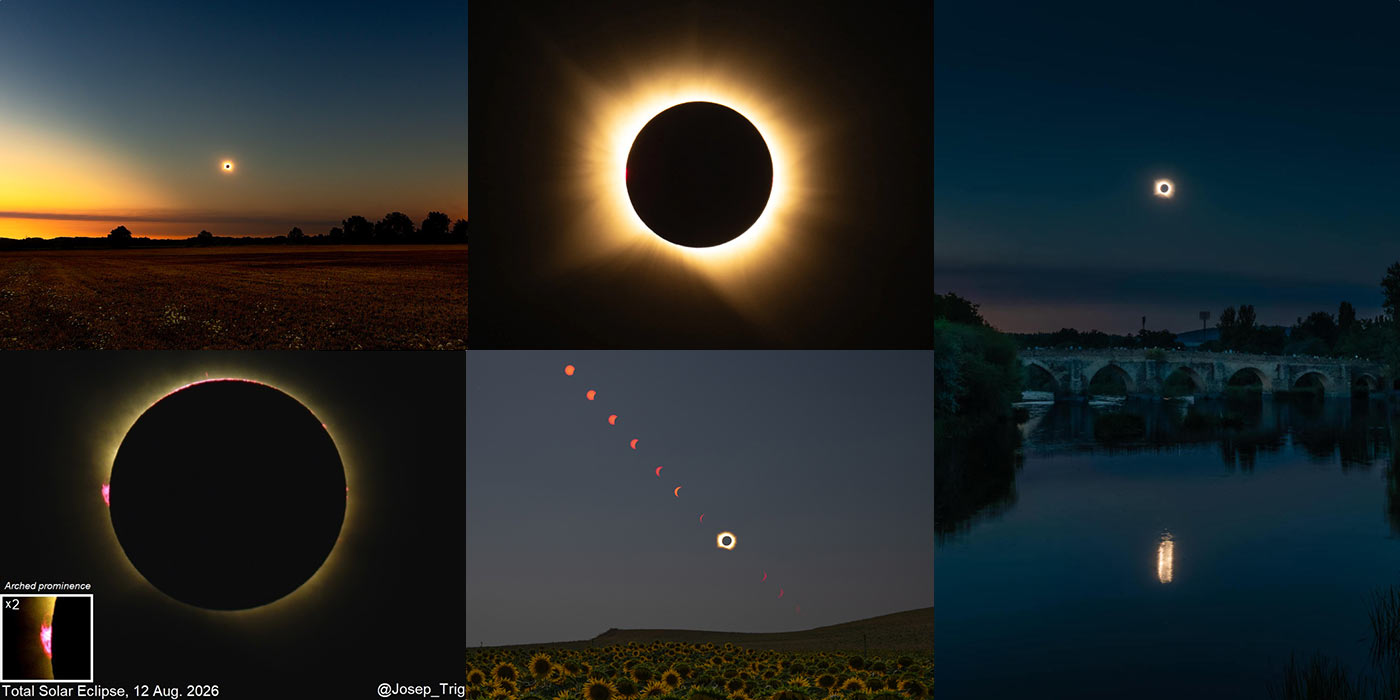
Let's celebrate the August 12 total solar eclipse through the eyes of photographers who experienced the Moon’s shadow sweeping across Spain. From Baily’s Beads and a glowing solar prominence to totality reflected in a river and framed by fields of sunflowers, these images capture both the science and extraordinary beauty of one of nature’s most spectacular celestial events.
#PPOD
#Eclipse
The universe is shaped by forces both immense and intricate, from fractured terrain on Mars and shifting tidal landscapes on Earth to tiny vortices dancing across the surface of the Sun. Farther afield, dramatic views of Pluto’s icy mountains and hazy atmosphere and a treasure chest of newborn stars in the Carina Nebula showcase the remarkable detail revealed by spacecraft and telescopes exploring the cosmos.
#PPOD
This week, we reveal hidden wonders across the cosmos, from delicate Martian clouds and a dust-shrouded galaxy to an asteroid with a never-before-seen shape and the crowded heart of the Milky Way. Together, these images showcase how new missions and advanced observatories continue to uncover surprising details about our solar system, our galaxy, and the universe beyond.
#PPOD
These images span the journey from our own backyard to distant galaxies, featuring Mars, the Moon, breathtaking night skies, and a fresh view of the star-forming galaxy Messier 94. Along the way, we celebrate exploration and discovery—from NASA’s Psyche mission preparing for its asteroid encounter to the revelation of a previously unknown impact crater on Earth —reminding us that there are still new wonders to uncover both on our own planet and across the cosmos.
#PPOD
This week, we celebrate fifty years since Viking 1 became the first spacecraft to successfully land on and photograph the surface of Mars, alongside stunning new views of worlds, stars, and galaxies that continue to expand our understanding of the universe. From sculpted Sahara sand dunes and Jupiter’s colorful cloud bands to a newly discovered exoplanet and the first stellar-mass black hole identified in Omega Centauri, these images showcase the remarkable diversity of cosmic exploration.
#PPOD
We journey from Mount Fuji as seen from orbit to the bubbling surface of Betelgeuse, exploring the forces that shape planets, moons, and stars across the cosmos. Along the way, JWST reveals the remains of a dying star, Curiosity uncovers clues to Mars’ volcanic past, and a fresh rocket impact on the Moon gives scientists a new opportunity to study how collisions reshape its surface.
Let's celebrate the August 12 total solar eclipse through the eyes of photographers who experienced the Moon’s shadow sweeping across Spain. From Baily’s Beads and a glowing solar prominence to totality reflected in a river and framed by fields of sunflowers, these images capture both the science and extraordinary beauty of one of nature’s most spectacular celestial events.
The universe is shaped by forces both immense and intricate, from fractured terrain on Mars and shifting tidal landscapes on Earth to tiny vortices dancing across the surface of the Sun. Farther afield, dramatic views of Pluto’s icy mountains and hazy atmosphere and a treasure chest of newborn stars in the Carina Nebula showcase the remarkable detail revealed by spacecraft and telescopes exploring the cosmos.
This week, we reveal hidden wonders across the cosmos, from delicate Martian clouds and a dust-shrouded galaxy to an asteroid with a never-before-seen shape and the crowded heart of the Milky Way. Together, these images showcase how new missions and advanced observatories continue to uncover surprising details about our solar system, our galaxy, and the universe beyond.
These images span the journey from our own backyard to distant galaxies, featuring Mars, the Moon, breathtaking night skies, and a fresh view of the star-forming galaxy Messier 94. Along the way, we celebrate exploration and discovery—from NASA’s Psyche mission preparing for its asteroid encounter to the revelation of a previously unknown impact crater on Earth —reminding us that there are still new wonders to uncover both on our own planet and across the cosmos.
This week, we celebrate fifty years since Viking 1 became the first spacecraft to successfully land on and photograph the surface of Mars, alongside stunning new views of worlds, stars, and galaxies that continue to expand our understanding of the universe. From sculpted Sahara sand dunes and Jupiter’s colorful cloud bands to a newly discovered exoplanet and the first stellar-mass black hole identified in Omega Centauri, these images showcase the remarkable diversity of cosmic exploration.
SkyMapper and the SETI Institute are connecting educators, students and the public to live astronomical observations through a distributed astronomical network.
#SkyMapper
#SETI
#Citizen Science
#Astronomy
What happens if life beyond Earth is discovered? The Discovery and Futures Lab at the SETI Institute fosters novel and anticipatory research at the intersection of science, society, our planet, and the search for life beyond Earth.
#Discovery and Futures Lab
SkyMapper and the SETI Institute are connecting educators, students and the public to live astronomical observations through a distributed astronomical network.
What happens if life beyond Earth is discovered? The Discovery and Futures Lab at the SETI Institute fosters novel and anticipatory research at the intersection of science, society, our planet, and the search for life beyond Earth.
Scientists are getting closer in their search for life beyond earth. But with limited federal funding for the search for extraterrestrial intelligence, supporters are the reason cutting-edge scientists can keep their eyes on the sky.
)