We celebrate the 370th anniversary of the discovery of Saturn's moon, Titan, and then we look out into the wider galaxy and universe with stunning images from JWST and Euclid.
Monday, 24 March 2025
Credit: NASA/JPL-Caltech/University of Arizona/University Paris Diderot/IPGP/CICLOPS
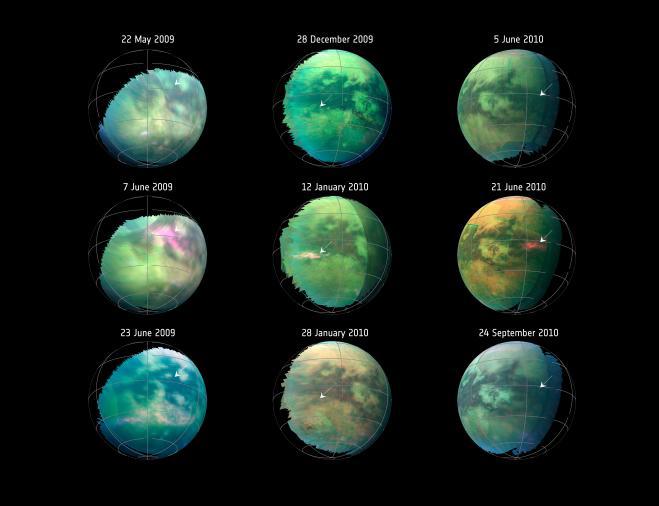
Dust Storms on Titan
On this date, 25 March 1655, Dutch astronomer Christiaan Huygens discovered Saturn's largest moon, Titan, using telescopic observations. Since then, we have found that Titan has a thick atmosphere and stable liquid bodies. NASA is currently developing the Dragonfly rotorcraft for a 2028 launch to explore Titan, and many scientists consider the world a good candidate for non-terrestrial biology.
This compilation of images taken by NASA's Cassini spacecraft from nine flybys of Titan in 2009 and 2010 captures three instances when clear, bright spots suddenly appeared in images taken by the spacecraft's Visual and Infrared Mapping Spectrometer. The brightenings were visible only for a short period of time—between 11 hours and five Earth weeks—and could not be seen in previous or subsequent images.
Tuesday, 25 March 2025
Credit: NASA, ESA, CSA, STScI
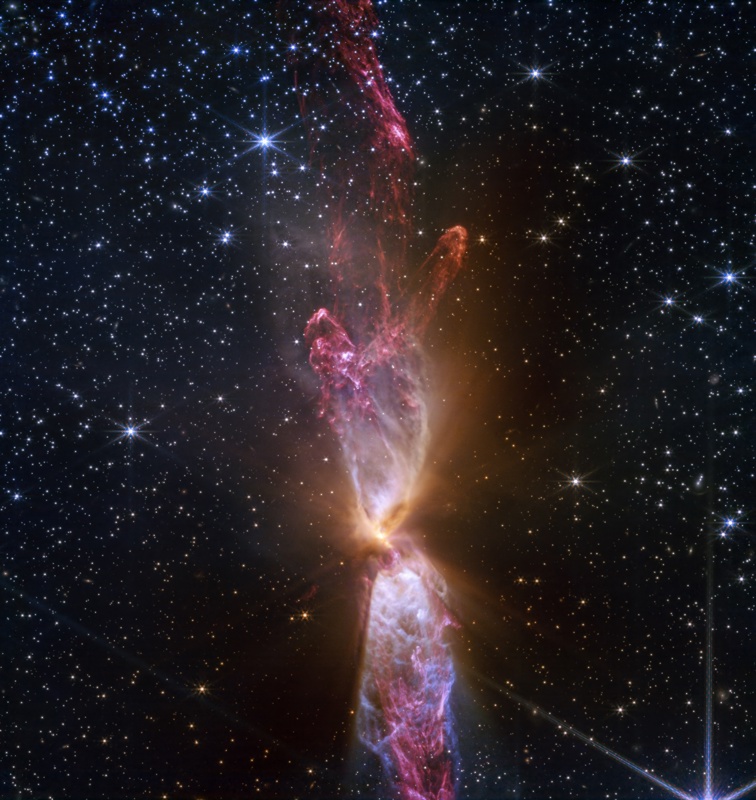
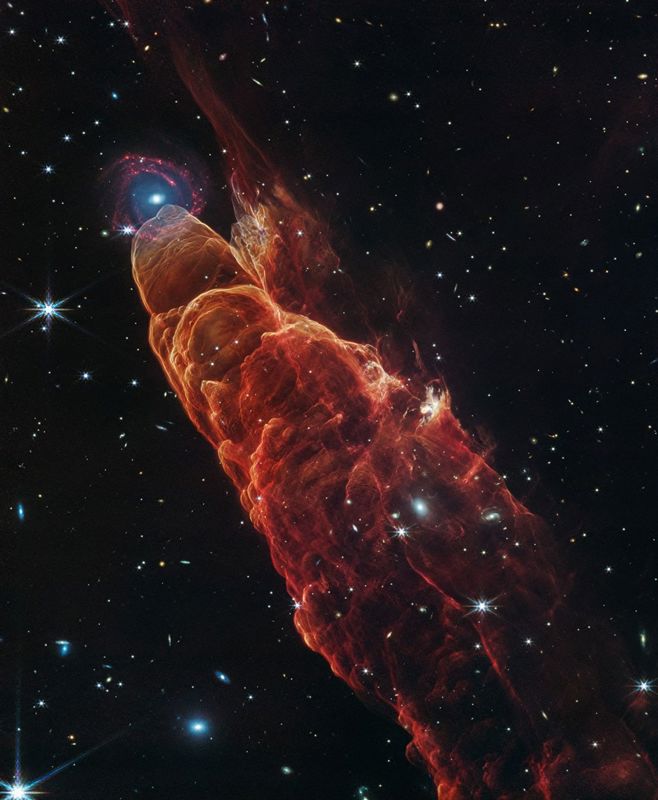
Like Sands Through the Hourglass…
Two actively forming stars are responsible for the shimmering hourglass-shaped ejections of gas and dust that gleam in orange, blue, and purple in this representative color image captured by NASA’s James Webb Space Telescope. This star system, called Lynds 483, is named for American astronomer Beverly T. Lynds, who published extensive catalogs of “dark” and “bright” nebulae in the early 1960s.
The two protostars are at the center of the hourglass shape, in an opaque horizontal disk of cold gas and dust that fits within a single pixel. Much farther out, above and below the flattened disk where dust is thinner, the bright light from the stars shines through the gas and dust, forming large semi-transparent orange cones.
Wednesday, 26 March 2025
Credit: ESA/Euclid/Euclid Consortium/NASA; image processing by J.-C. Cuillandre, E. Bertin, G. An-selmi
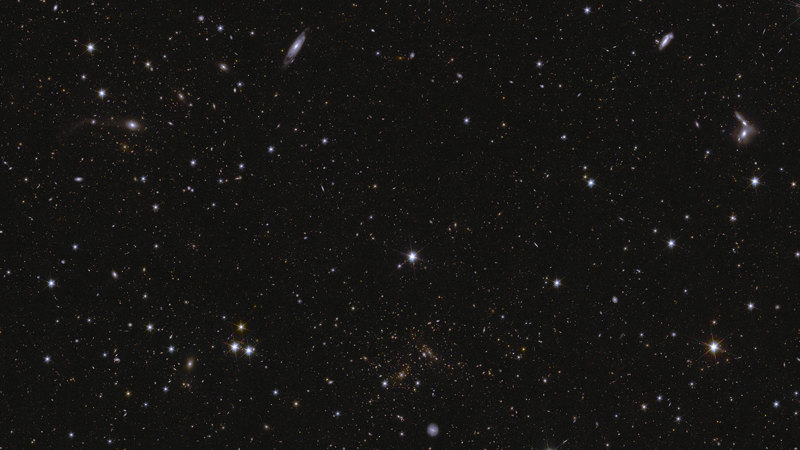
Euclid Deep Field
The Euclid mission — led by ESA (European Space Agency) with contributions from NASA — aims to discover why our universe is expanding at an accelerating rate. Astronomers use the term “dark energy” to refer to the unknown cause of this phenomenon, and Euclid will take images of billions of galaxies to learn more about it. A portion of the mission’s data was released to the public by ESA on Wednesday, March 19. This image shows about 1.5% of Euclid’s Deep Field South, one of three regions of the sky that the telescope will observe for more than 40 weeks over the course of its prime mission, spotting faint and distant galaxies. One galaxy cluster near the center is almost 6 billion light-years away from Earth.
Thursday, 27 March 2025
Credit: NASA, ESA, CSA, STScI
Herbig-Haro 49/50
NASA’s James Webb Space Telescope observed Herbig-Haro 49/50, an outflow from a nearby still-forming star, in high-resolution near- and mid-infrared light. The young star is off to the lower right corner of the Webb image. Intricate features of the outflow, represented in reddish-orange color, provide detailed clues about how young stars form and how their jet activity affects the environment around them. A chance alignment in this direction of the sky provides a beautiful juxtaposition of this nearby Herbig-Haro object (located within our Milky Way) with a face-on spiral galaxy in the distant background.
Protostars are young stars in the process of formation that generally launch narrow jets of material. These jets move through the surrounding environment, in some cases extending to large distances away from the protostar.
Like the water wake generated by a speeding boat, the arcs in this image are created by the fast-moving jet slamming into surrounding dust and gas. This ambient material is compressed and heats up, then cools by emitting light at visible and infrared wavelengths. In particular, the infrared light captured here by Webb highlights molecular hydrogen and carbon monoxide.
The galaxy that appears by happenstance at the tip of Herbig-Haro 49/50 is a much more distant spiral galaxy. It has a prominent central bulge represented in blue that shows the location of older stars. It also displays hints of “side lobes,” suggesting that this could be a barred-spiral galaxy. Reddish clumps within the spiral arms show the locations of warm dust and groups of forming stars.
There are many more galaxies at further distances in the surrounding background, including ones that shine through the diffuse infrared glow of the nearby Herbig-Haro object.
Friday, 28 March 2025
Credit: ESA/Webb, NASA & CSA, G. Mahler
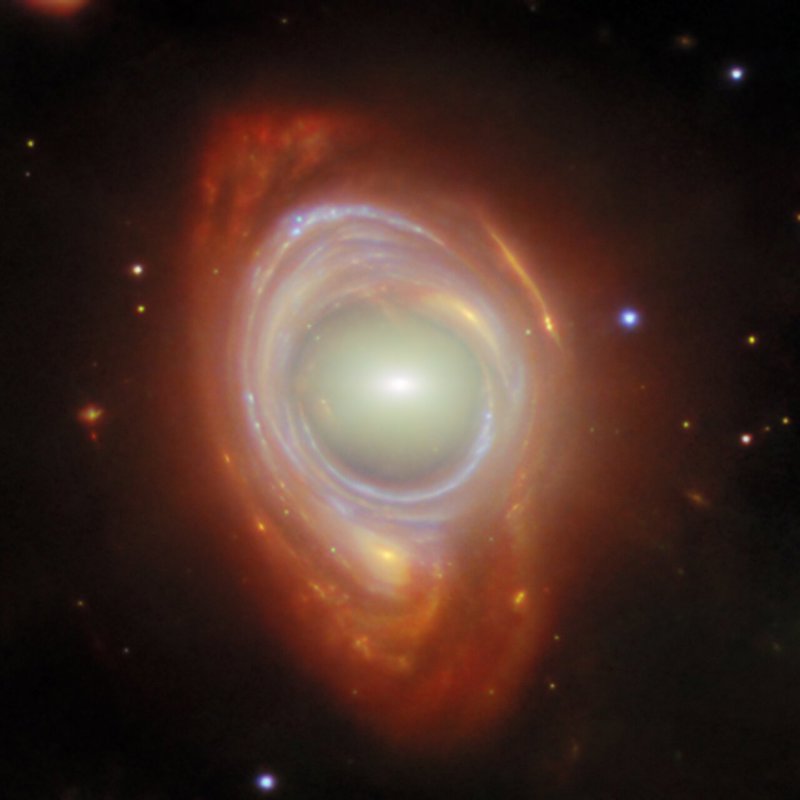
Einstein Ring Illusion
This new NASA/ESA/CSA James Webb Space Telescope image features a rare cosmic phenomenon called an Einstein ring. What at first appears to be a single, strangely shaped galaxy is actually two galaxies that are separated by a large distance. The closer foreground galaxy sits at the center of the image, while the more distant background galaxy appears to be wrapped around the closer galaxy, forming a ring.
The lensing galaxy at the center of this Einstein ring is an elliptical galaxy, as can be seen from the galaxy’s bright core and smooth, featureless body. This galaxy belongs to a galaxy cluster named SMACSJ0028.2-7537. The lensed galaxy wrapped around the elliptical galaxy is a spiral galaxy. Even though its image has been warped as its light traveled around the galaxy in its path, individual star clusters and gas structures are clearly visible.
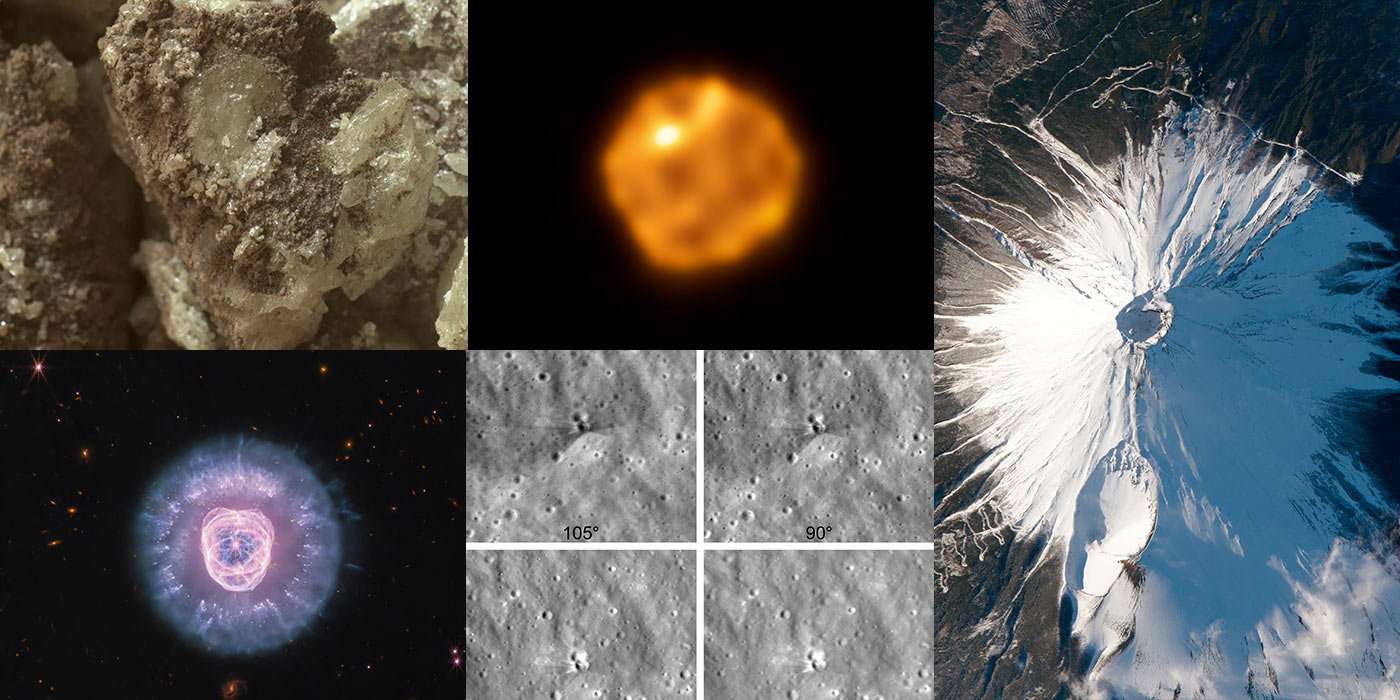
We journey from Mount Fuji as seen from orbit to the bubbling surface of Betelgeuse, exploring the forces that shape planets, moons, and stars across the cosmos. Along the way, JWST reveals the remains of a dying star, Curiosity uncovers clues to Mars’ volcanic past, and a fresh rocket impact on the Moon gives scientists a new opportunity to study how collisions reshape its surface.
#PPOD
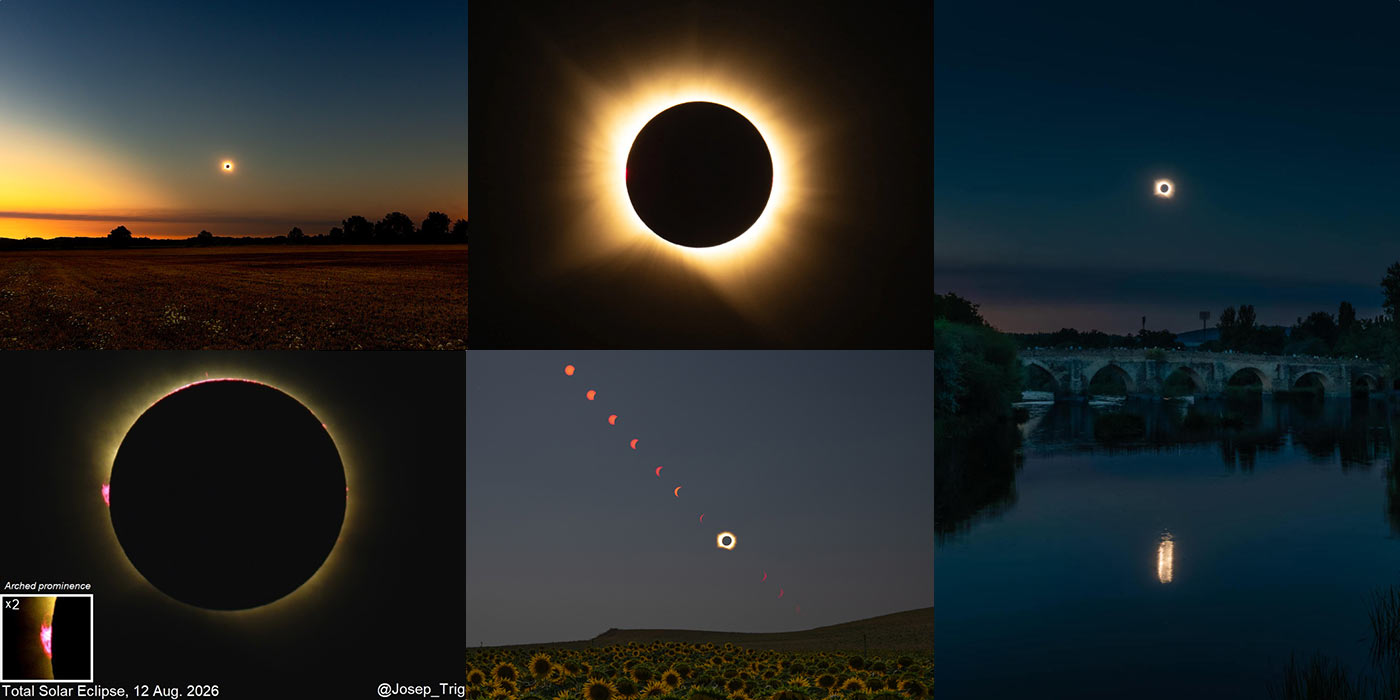
Let's celebrate the August 12 total solar eclipse through the eyes of photographers who experienced the Moon’s shadow sweeping across Spain. From Baily’s Beads and a glowing solar prominence to totality reflected in a river and framed by fields of sunflowers, these images capture both the science and extraordinary beauty of one of nature’s most spectacular celestial events.
#PPOD
#Eclipse
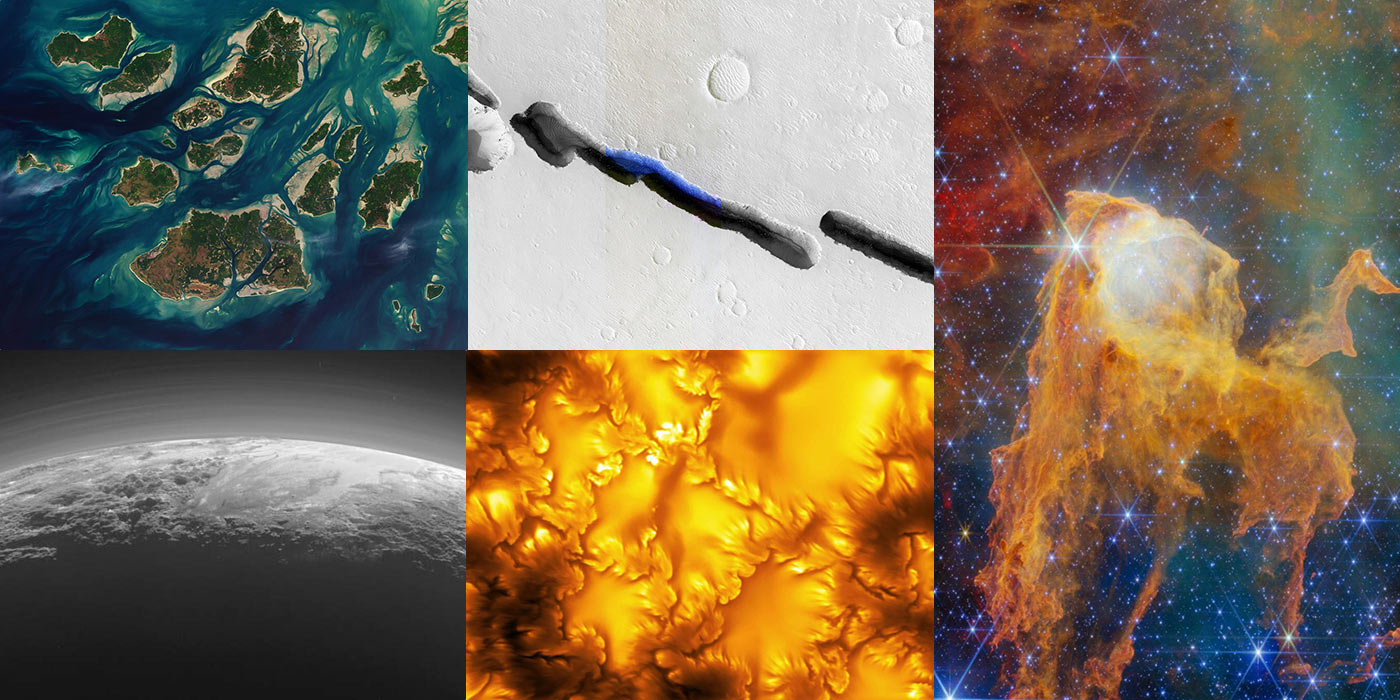
The universe is shaped by forces both immense and intricate, from fractured terrain on Mars and shifting tidal landscapes on Earth to tiny vortices dancing across the surface of the Sun. Farther afield, dramatic views of Pluto’s icy mountains and hazy atmosphere and a treasure chest of newborn stars in the Carina Nebula showcase the remarkable detail revealed by spacecraft and telescopes exploring the cosmos.
#PPOD
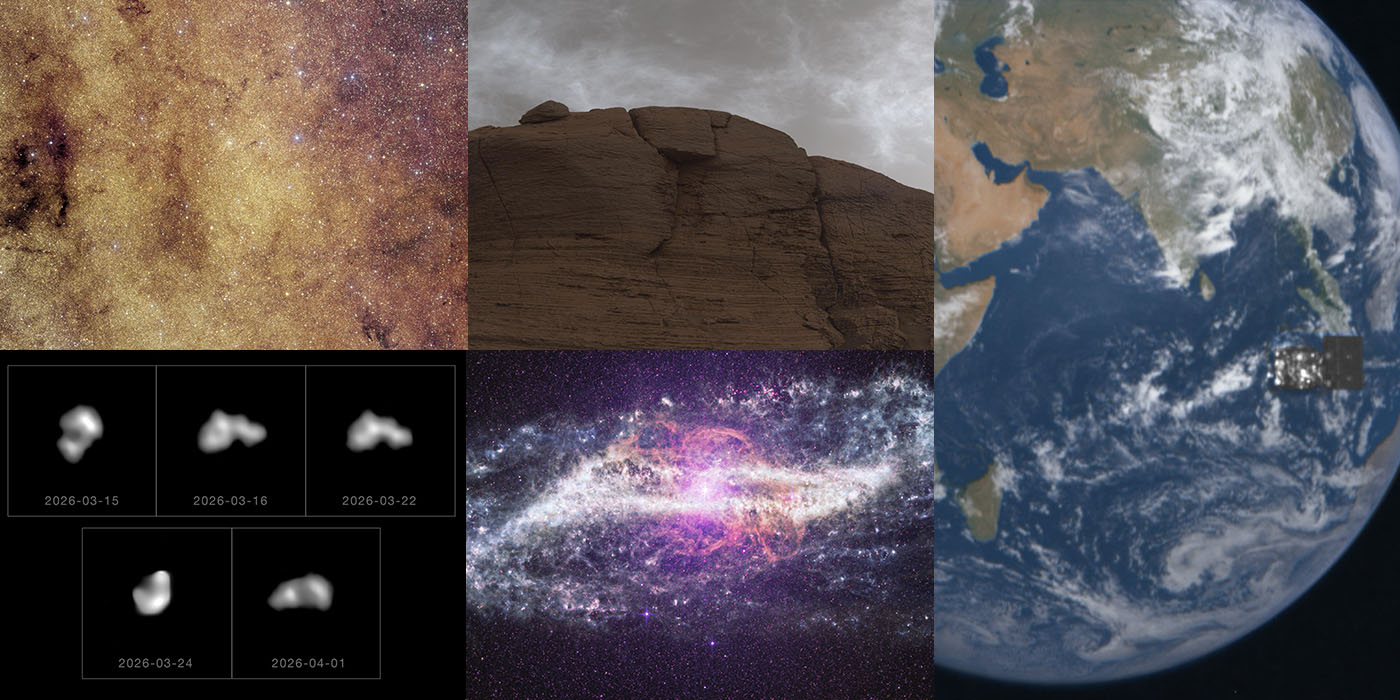
This week, we reveal hidden wonders across the cosmos, from delicate Martian clouds and a dust-shrouded galaxy to an asteroid with a never-before-seen shape and the crowded heart of the Milky Way. Together, these images showcase how new missions and advanced observatories continue to uncover surprising details about our solar system, our galaxy, and the universe beyond.
#PPOD
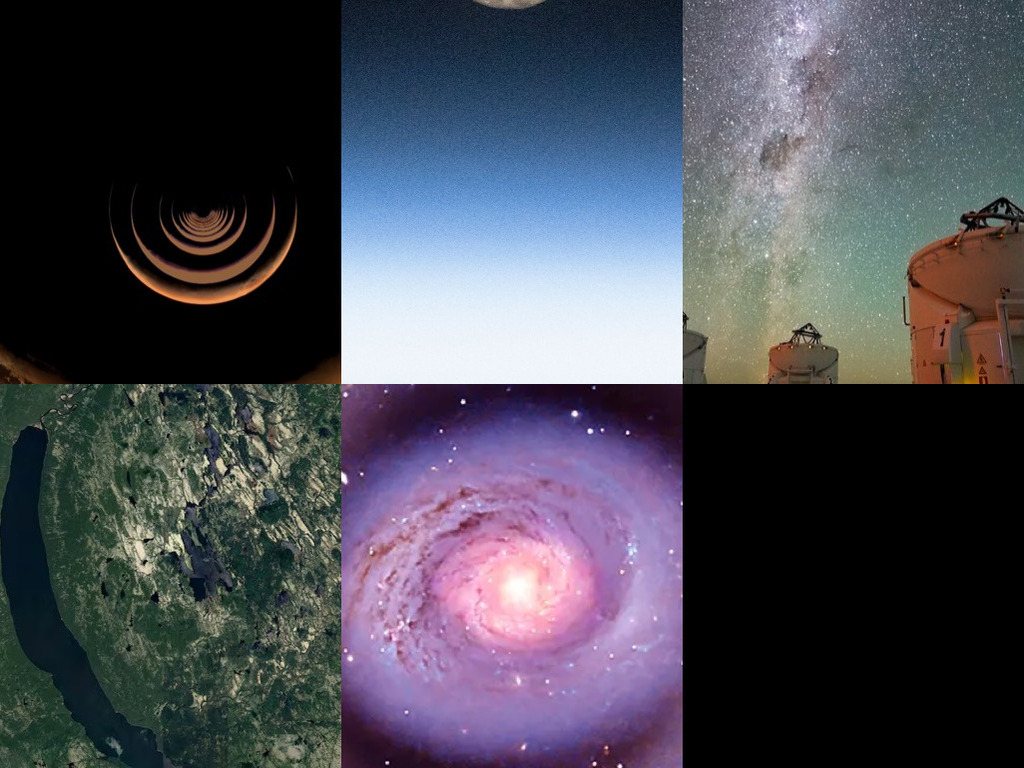
These images span the journey from our own backyard to distant galaxies, featuring Mars, the Moon, breathtaking night skies, and a fresh view of the star-forming galaxy Messier 94. Along the way, we celebrate exploration and discovery—from NASA’s Psyche mission preparing for its asteroid encounter to the revelation of a previously unknown impact crater on Earth —reminding us that there are still new wonders to uncover both on our own planet and across the cosmos.
#PPOD
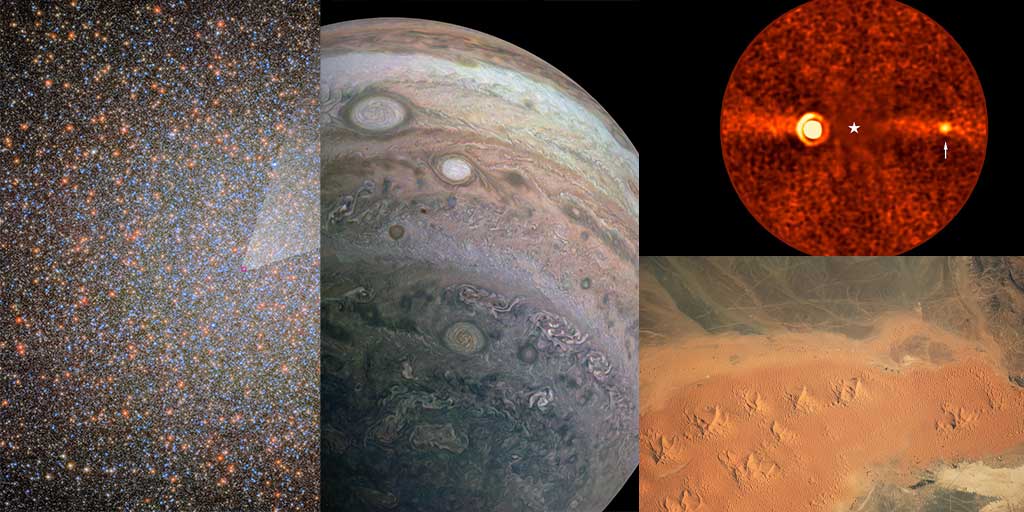
This week, we celebrate fifty years since Viking 1 became the first spacecraft to successfully land on and photograph the surface of Mars, alongside stunning new views of worlds, stars, and galaxies that continue to expand our understanding of the universe. From sculpted Sahara sand dunes and Jupiter’s colorful cloud bands to a newly discovered exoplanet and the first stellar-mass black hole identified in Omega Centauri, these images showcase the remarkable diversity of cosmic exploration.
#PPOD
We journey from Mount Fuji as seen from orbit to the bubbling surface of Betelgeuse, exploring the forces that shape planets, moons, and stars across the cosmos. Along the way, JWST reveals the remains of a dying star, Curiosity uncovers clues to Mars’ volcanic past, and a fresh rocket impact on the Moon gives scientists a new opportunity to study how collisions reshape its surface.
Let's celebrate the August 12 total solar eclipse through the eyes of photographers who experienced the Moon’s shadow sweeping across Spain. From Baily’s Beads and a glowing solar prominence to totality reflected in a river and framed by fields of sunflowers, these images capture both the science and extraordinary beauty of one of nature’s most spectacular celestial events.
The universe is shaped by forces both immense and intricate, from fractured terrain on Mars and shifting tidal landscapes on Earth to tiny vortices dancing across the surface of the Sun. Farther afield, dramatic views of Pluto’s icy mountains and hazy atmosphere and a treasure chest of newborn stars in the Carina Nebula showcase the remarkable detail revealed by spacecraft and telescopes exploring the cosmos.
This week, we reveal hidden wonders across the cosmos, from delicate Martian clouds and a dust-shrouded galaxy to an asteroid with a never-before-seen shape and the crowded heart of the Milky Way. Together, these images showcase how new missions and advanced observatories continue to uncover surprising details about our solar system, our galaxy, and the universe beyond.
These images span the journey from our own backyard to distant galaxies, featuring Mars, the Moon, breathtaking night skies, and a fresh view of the star-forming galaxy Messier 94. Along the way, we celebrate exploration and discovery—from NASA’s Psyche mission preparing for its asteroid encounter to the revelation of a previously unknown impact crater on Earth —reminding us that there are still new wonders to uncover both on our own planet and across the cosmos.
This week, we celebrate fifty years since Viking 1 became the first spacecraft to successfully land on and photograph the surface of Mars, alongside stunning new views of worlds, stars, and galaxies that continue to expand our understanding of the universe. From sculpted Sahara sand dunes and Jupiter’s colorful cloud bands to a newly discovered exoplanet and the first stellar-mass black hole identified in Omega Centauri, these images showcase the remarkable diversity of cosmic exploration.
SkyMapper and the SETI Institute are connecting educators, students and the public to live astronomical observations through a distributed astronomical network.
#SkyMapper
#SETI
#Citizen Science
#Astronomy
What happens if life beyond Earth is discovered? The Discovery and Futures Lab at the SETI Institute fosters novel and anticipatory research at the intersection of science, society, our planet, and the search for life beyond Earth.
#Discovery and Futures Lab
SkyMapper and the SETI Institute are connecting educators, students and the public to live astronomical observations through a distributed astronomical network.
What happens if life beyond Earth is discovered? The Discovery and Futures Lab at the SETI Institute fosters novel and anticipatory research at the intersection of science, society, our planet, and the search for life beyond Earth.
Scientists are getting closer in their search for life beyond earth. But with limited federal funding for the search for extraterrestrial intelligence, supporters are the reason cutting-edge scientists can keep their eyes on the sky.
)