Wednesday, Apr 01, 2026

Credit: NASA/JPL-Caltech/Space Science Institute.

Monday, 23 March 2026

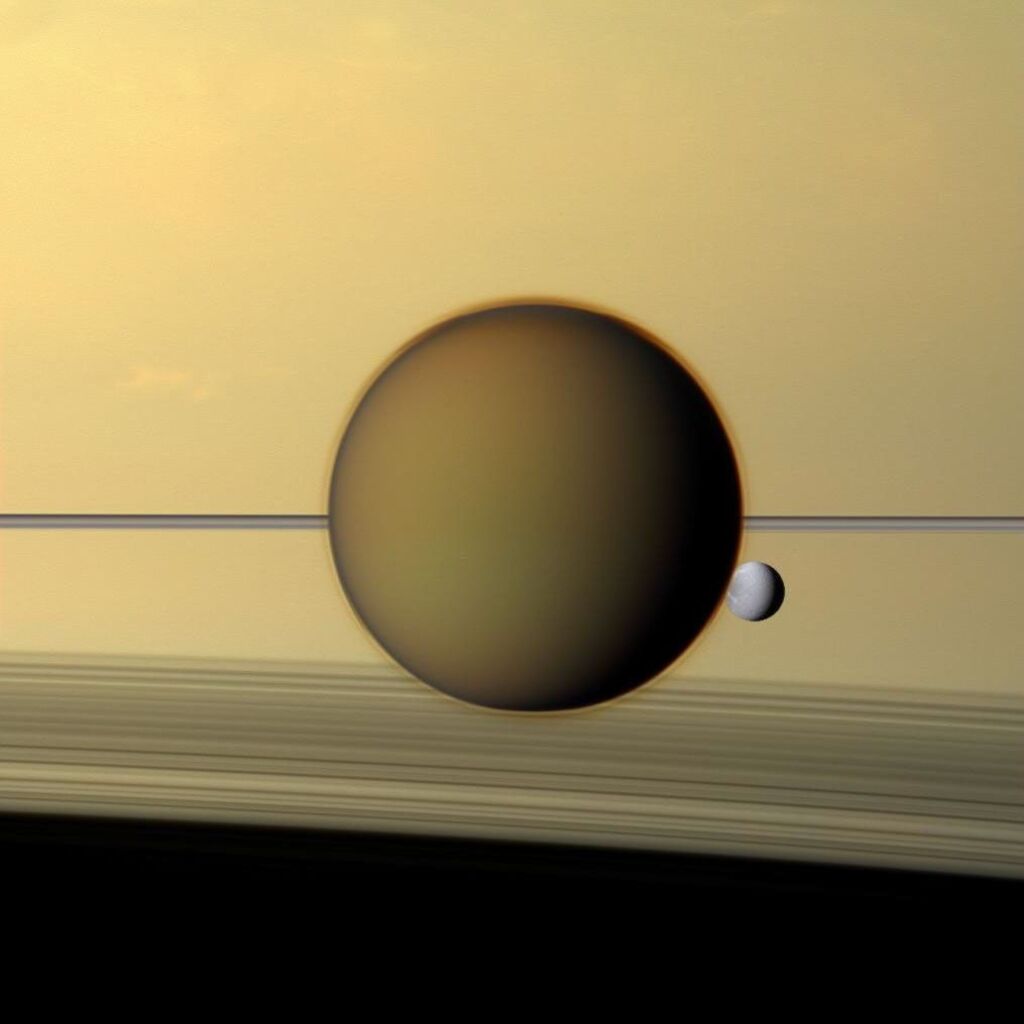
Titan and Dione

Saturn's fourth-largest moon, Dione, can be seen through the haze of the planet's largest moon, Titan, in this view of the two, taken by NASA's Cassini spacecraft on December 22, 2011, with the planet and its rings in the background. The north polar hood is visible on Titan here, appearing as a detached layer at the top of the moon.

This view looks toward the sides of Titan (5,150 kilometers across) and Dione (1,123 kilometers across), which are facing away from Saturn. North is up on the moons. This view looks toward the northern, sunlit side of the rings from just above the ring plane.

Credit: ESA's Mars Express / ESA / DLR / FU Berlin.

Tuesday, 24 March 2026

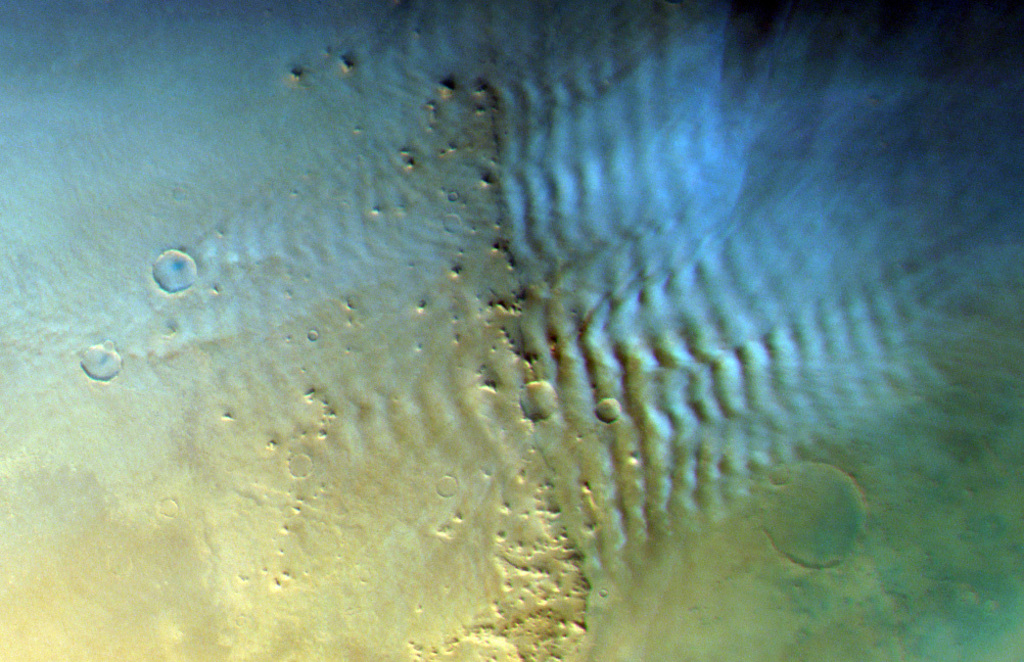
Lee Waves on Mars

Lee waves are atmospheric gravity waves that form when stable air flows over significant topographic obstacles like mountains, volcanoes, or large crater rims. As the wind is forced upward by the terrain, it undergoes adiabatic cooling, causing water vapor or carbon dioxide to condense into visible, ripple-like clouds on the downwind (lee) side. They often appear as "cloud trains" or straight, parallel lines perpendicular to the wind direction.

Some can form "ship-wake" patterns or extend over 1,000 km downwind from large craters. Horizontal wavelengths typically range from 15 km to 50 km, though some massive volcanic structures, such as Arsia Mons, have reached 60 km. These waves are most common during Mars' northern fall and winter, when high near-surface stability and strong wind shear from the winter mid-latitude jet stream create ideal conditions for their formation.

Depending on the temperature and altitude (typically between 10 km and 55 km), these clouds can be composed of water ice crystals or CO2 ice. Recent high-cadence images from the Emirates Mars Mission (EMM) have even shown lee waves rapidly evolving into dust storm features within a single morning.

Credit: NASA, ESA, Dennis Bodewits (AU); Processing: Joseph DePasquale (STScI).

Wednesday, 25 March 2026

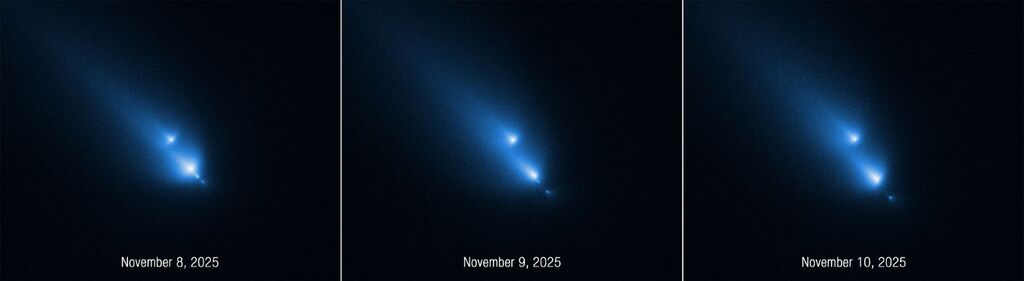
Fragmenting Comet C/2025 K1

This series of images from NASA’s Hubble Space Telescope of the fragmenting comet C/2025 K1 (ATLAS) was taken over the course of three consecutive days: Nov. 8, 9, and 10, 2025. This is the first time Hubble has witnessed a comet so early in the process of breaking up.

Hubble caught K1 fragmenting into at least four pieces, each with a distinct coma, the fuzzy envelope of gas and dust that surrounds a comet’s icy nucleus. Hubble cleanly resolved the fragments, but from the ground, they appeared only as barely distinguishable blobs at that time. Hubble chronicled the sequence of events and showed exactly how the breakup happened.

Credit: NASA/Scott Eckley.

Thursday, 26 March 2026

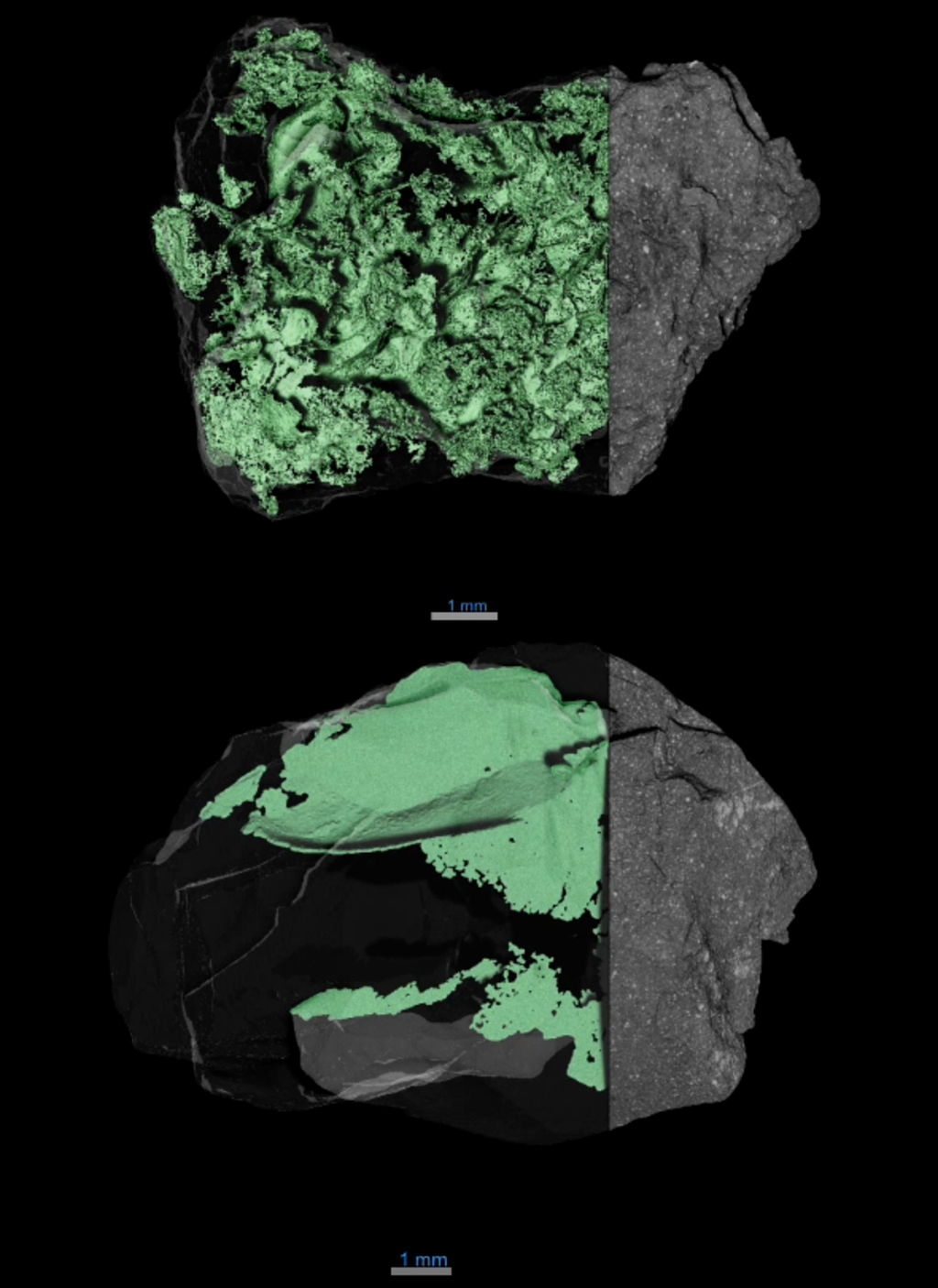
Solving Asteroid Bennu’s Mysteries

These X-ray computed tomography (XCT) scans, released on March 17, 2026, give us a glimpse inside asteroid Bennu. They show the most common types of crack networks observed in Bennu samples. One has an extensive, interconnected framework of curved cracks, whereas the other has sparse, straight, flat fractures.

Credit: NASA/JPL-Caltech.

Friday, 27 March 2026

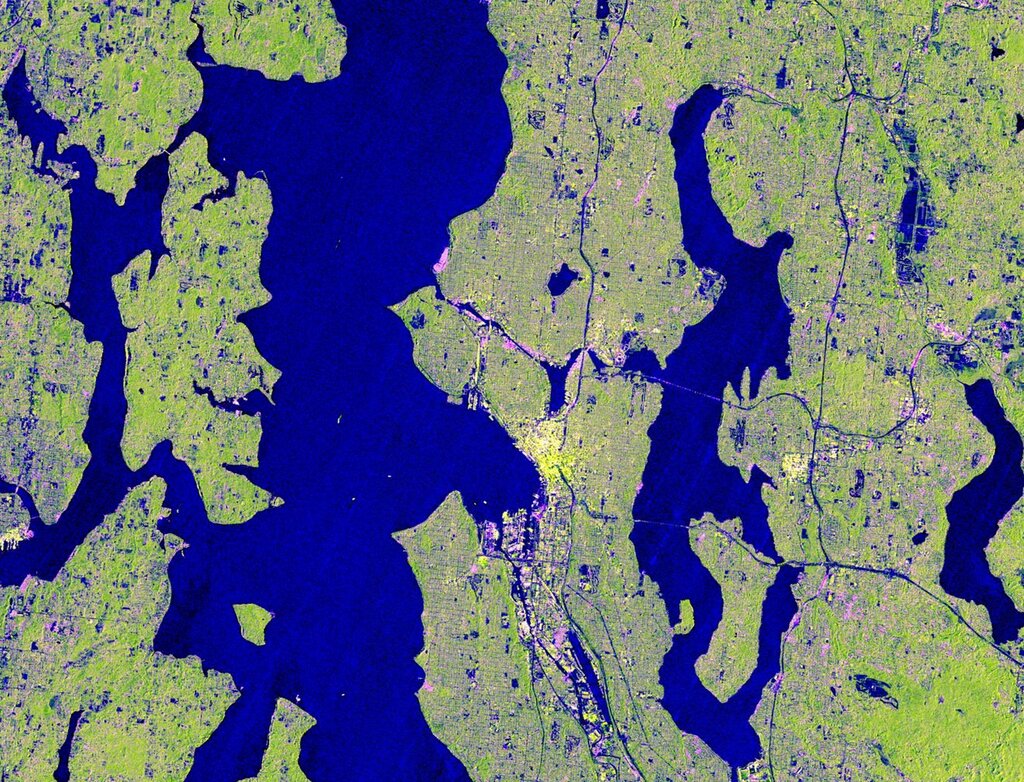
Pacific Northwest Through Clouds

Seattle, Washington, is one of the cloudiest cities in the United States. But that infamous cloud cover is no match for the U.S.-Indian Earth satellite NISAR (NASA-ISRO Synthetic Aperture Radar), which is designed to peer straight through clouds. Doing so allows scientists to study the Pacific Northwest’s natural landmarks and bustling port cities like never before. This image, captured by the L-band SAR instrument on the NISAR mission on Nov. 10, 2025, shows Seattle at the center, with Bainbridge Island to the left.

News

Related News

Featured Image
Sep 2, 2026
Planetary Picture of the Day - Week of August 24, 2026
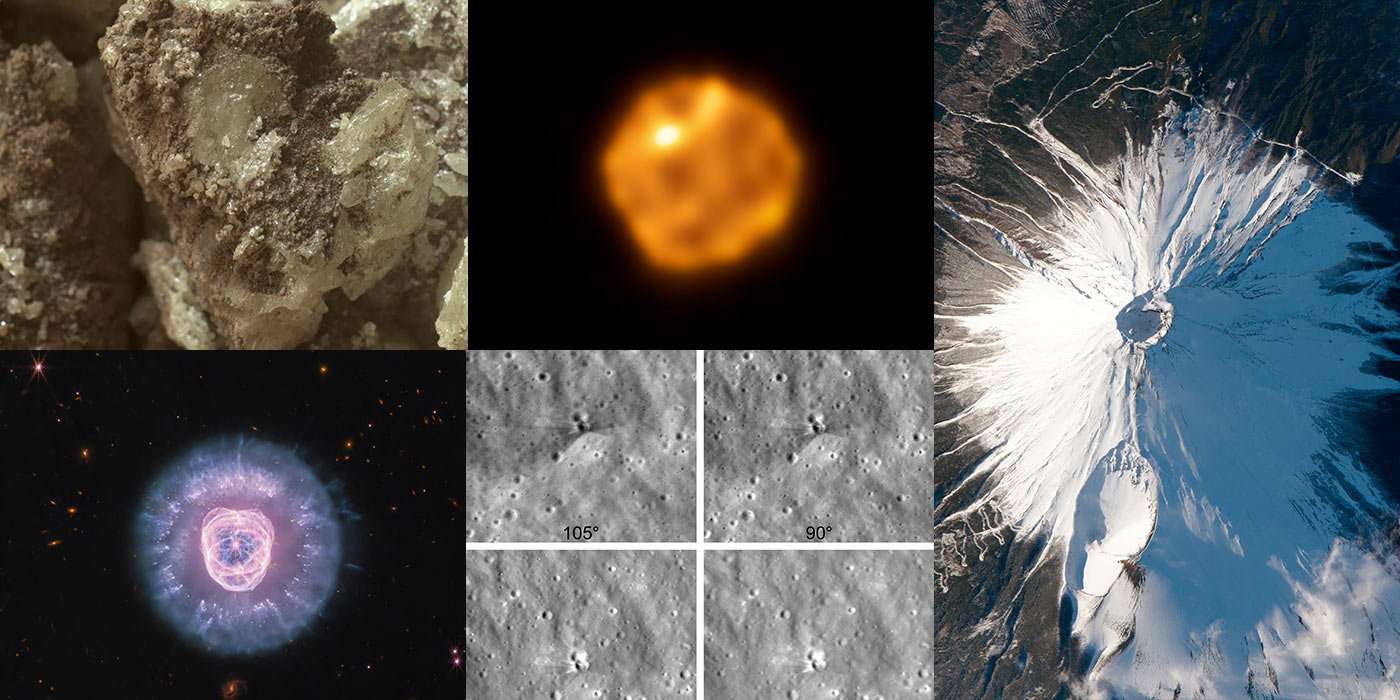
We journey from Mount Fuji as seen from orbit to the bubbling surface of Betelgeuse, exploring the forces that shape planets, moons, and stars across the cosmos. Along the way, JWST reveals the remains of a dying star, Curiosity uncovers clues to Mars’ volcanic past, and a fresh rocket impact on the Moon gives scientists a new opportunity to study how collisions reshape its surface. #PPOD
Featured Image
Aug 26, 2026
Planetary Picture of the Day - Week of August 17, 2026
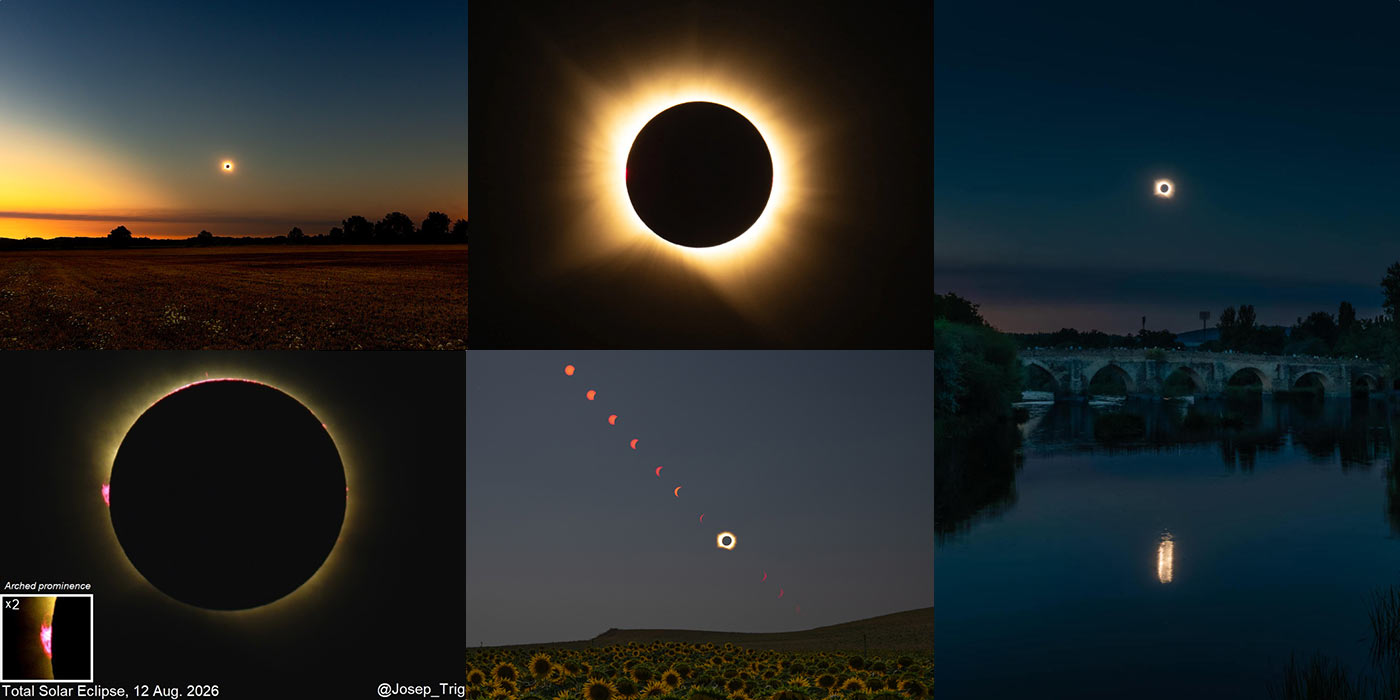
Let's celebrate the August 12 total solar eclipse through the eyes of photographers who experienced the Moon’s shadow sweeping across Spain. From Baily’s Beads and a glowing solar prominence to totality reflected in a river and framed by fields of sunflowers, these images capture both the science and extraordinary beauty of one of nature’s most spectacular celestial events. #PPOD #Eclipse
Featured Image
Aug 19, 2026
Planetary Picture of the Day - Week of August 10, 2026
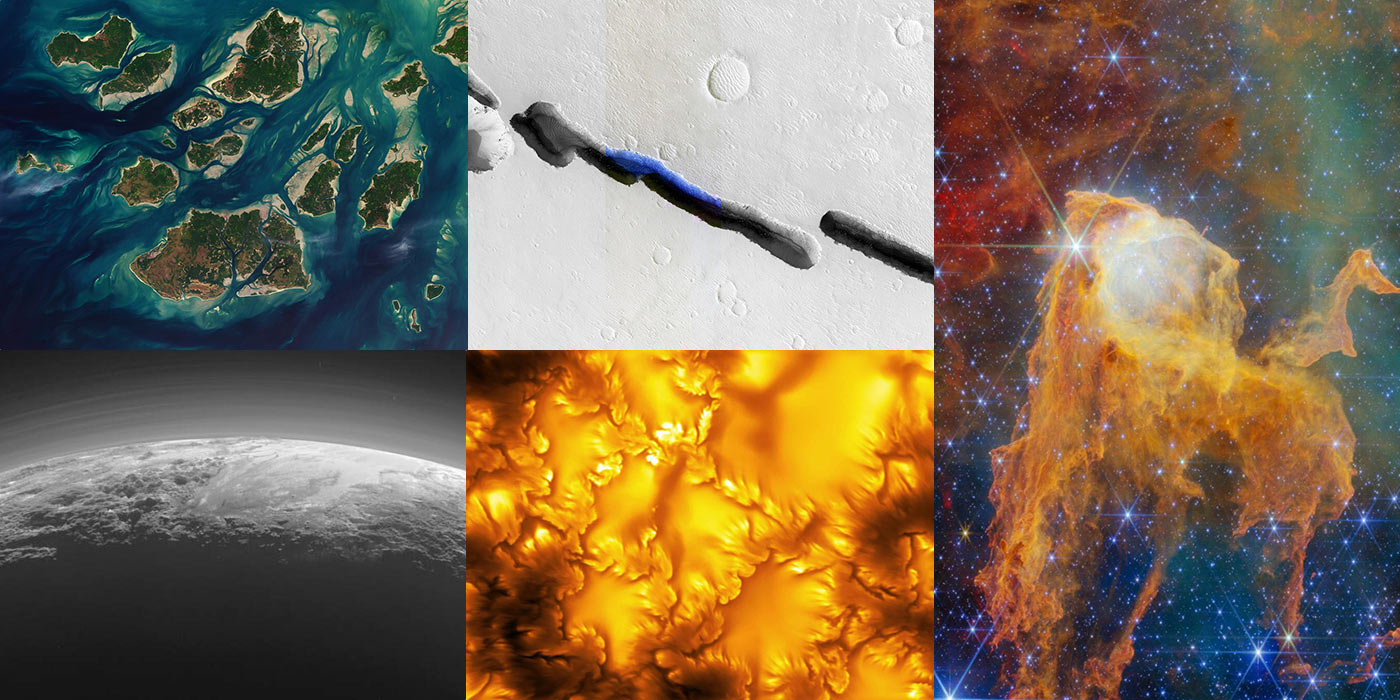
The universe is shaped by forces both immense and intricate, from fractured terrain on Mars and shifting tidal landscapes on Earth to tiny vortices dancing across the surface of the Sun. Farther afield, dramatic views of Pluto’s icy mountains and hazy atmosphere and a treasure chest of newborn stars in the Carina Nebula showcase the remarkable detail revealed by spacecraft and telescopes exploring the cosmos. #PPOD
Featured Image
Aug 12, 2026
Planetary Picture of the Day - August 3, 2026
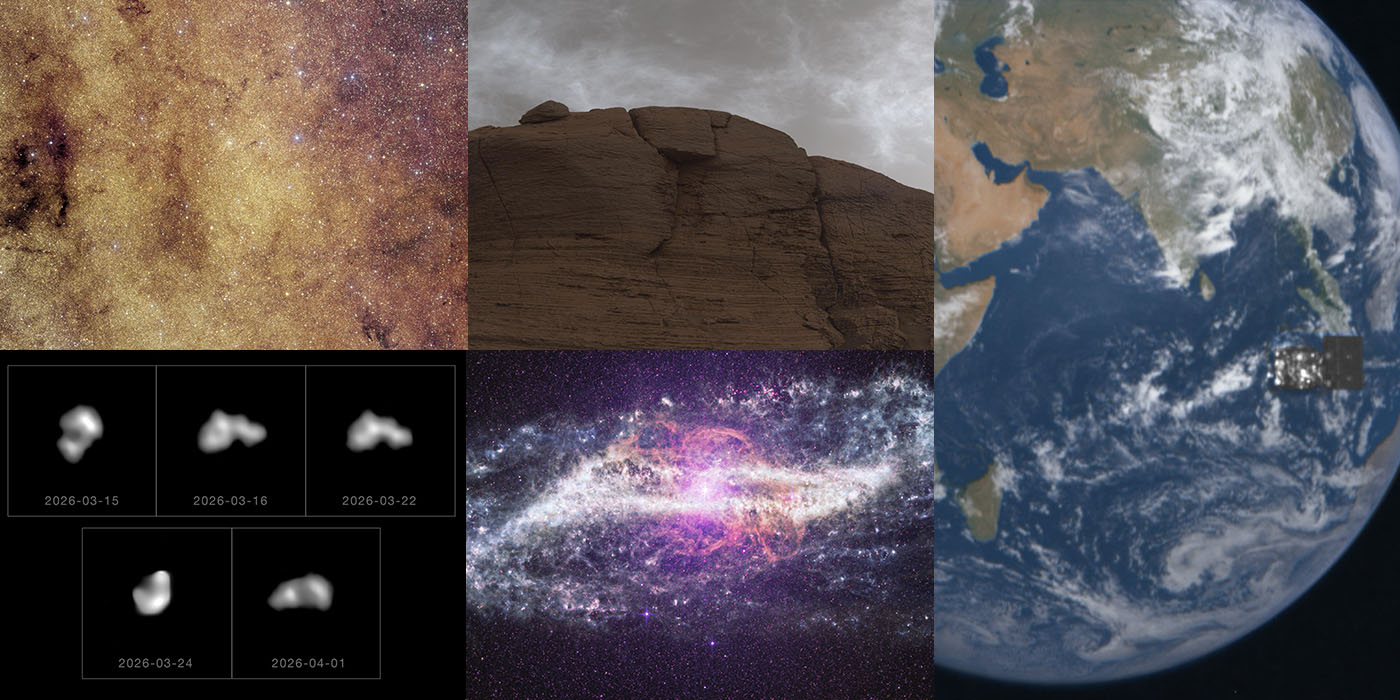
This week, we reveal hidden wonders across the cosmos, from delicate Martian clouds and a dust-shrouded galaxy to an asteroid with a never-before-seen shape and the crowded heart of the Milky Way. Together, these images showcase how new missions and advanced observatories continue to uncover surprising details about our solar system, our galaxy, and the universe beyond. #PPOD
Featured Image
Aug 5, 2026
Planetary Picture of the Day - Week of July 27, 2026
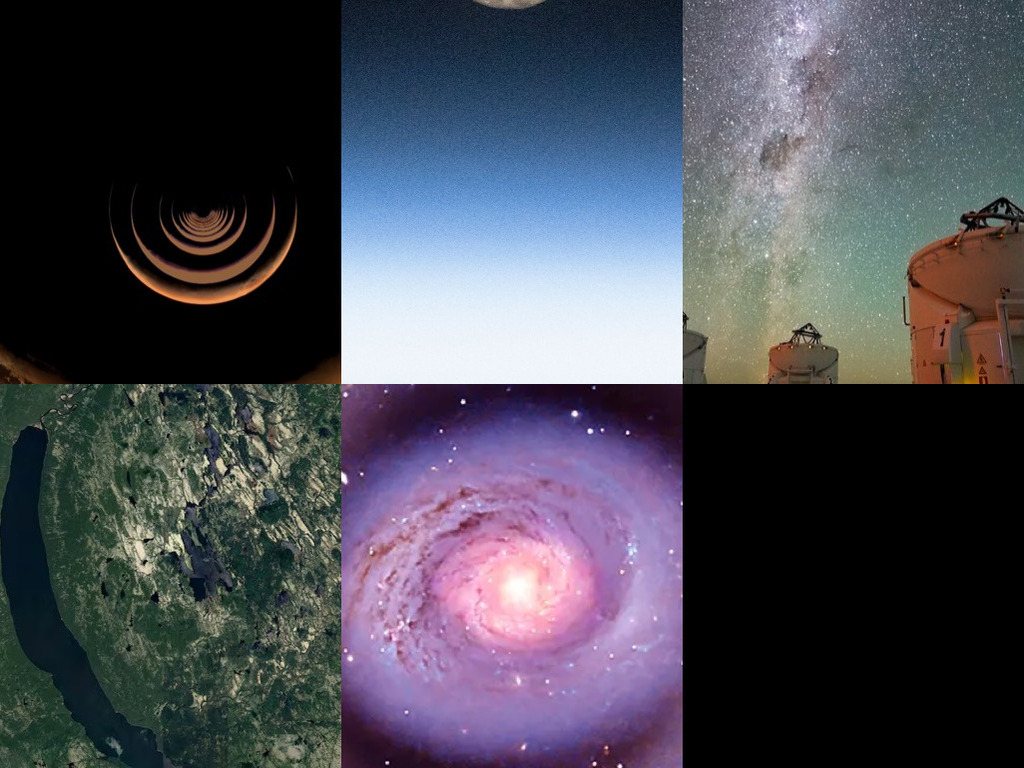
These images span the journey from our own backyard to distant galaxies, featuring Mars, the Moon, breathtaking night skies, and a fresh view of the star-forming galaxy Messier 94. Along the way, we celebrate exploration and discovery—from NASA’s Psyche mission preparing for its asteroid encounter to the revelation of a previously unknown impact crater on Earth —reminding us that there are still new wonders to uncover both on our own planet and across the cosmos. #PPOD
Featured Image
Jul 29, 2026
Planetary Picture of the Day - Week of July 20, 2026
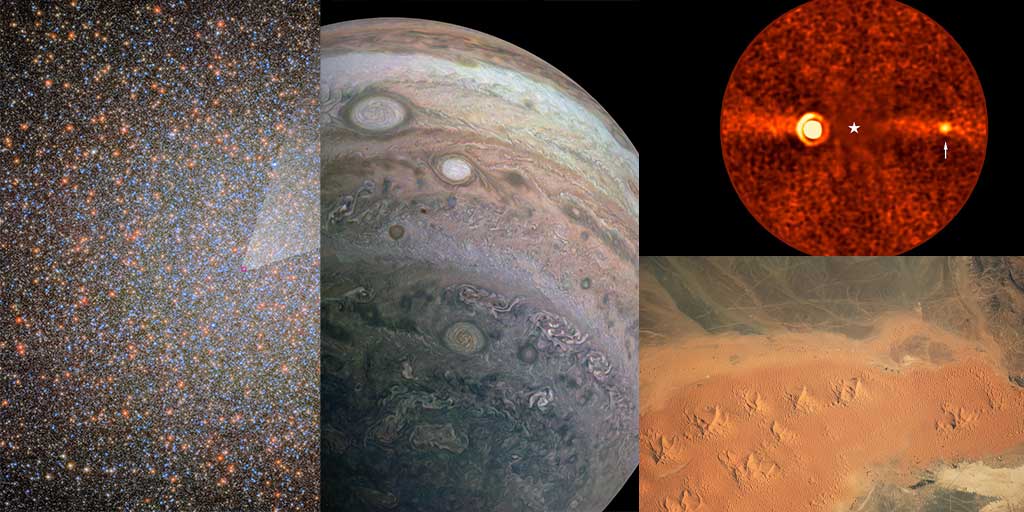
This week, we celebrate fifty years since Viking 1 became the first spacecraft to successfully land on and photograph the surface of Mars, alongside stunning new views of worlds, stars, and galaxies that continue to expand our understanding of the universe. From sculpted Sahara sand dunes and Jupiter’s colorful cloud bands to a newly discovered exoplanet and the first stellar-mass black hole identified in Omega Centauri, these images showcase the remarkable diversity of cosmic exploration. #PPOD
Research

Related Projects

Featured Image
SkyMapper • SETI • Citizen Science • Astronomy
SkyMapper: Expanding Access to Real-time Astronomy Through a Global Astronomical Network
SkyMapper and the SETI Institute are connecting educators, students and the public to live astronomical observations through a distributed astronomical network. #SkyMapper #SETI #Citizen Science #Astronomy
Featured Image
VPL
Virtual Planetary Laboratory
How can we best assess whether an exoplanet supports life? #VPL
Featured Image
Discovery and Futures Lab
What happens if life beyond Earth is discovered? The Discovery and Futures Lab at the SETI Institute fosters novel and anticipatory research at the intersection of science, society, our planet, and the search for life beyond Earth.  #Discovery and Futures Lab
Support Us

Support the
SETI Institute

Scientists are getting closer in their search for life beyond earth. But with limited federal funding for the search for extraterrestrial intelligence, supporters are the reason cutting-edge scientists can keep their eyes on the sky.