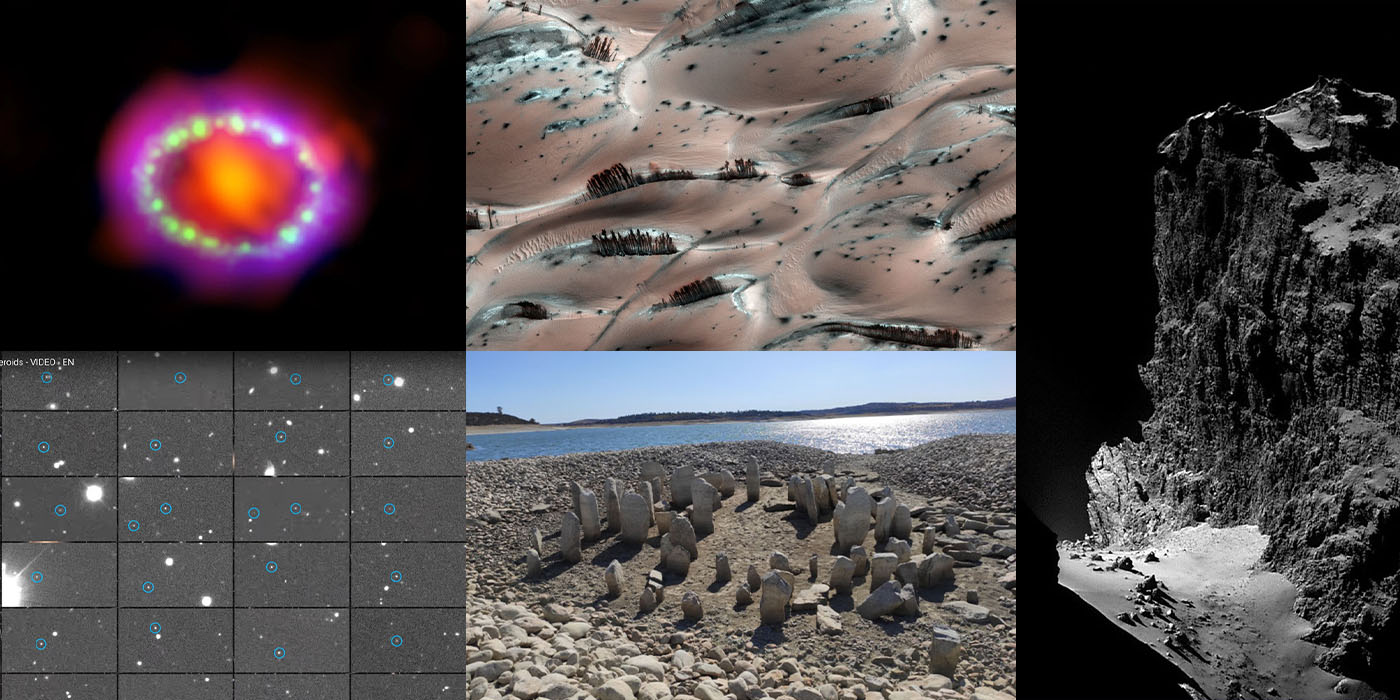







The Vera Rubin Observatory has released its first images, stunning the scientific community, particularly with the discovery of over 2,100 new asteroids. Plus, sublimation on Mars reveals dark, tree-like streaks, and we take a look back at Comet 67P, the target of ESA's Rosetta mission. Speaking of reveals, droughts can cause receding shorelines that expose hidden wonders, such as an ancient stone circle in Spain. Lastly, we celebrate the Fourth of July with the stellar fireworks of supernova 1987a.
Monday, 30 June 2025
Rubin Observatory and Asteroids
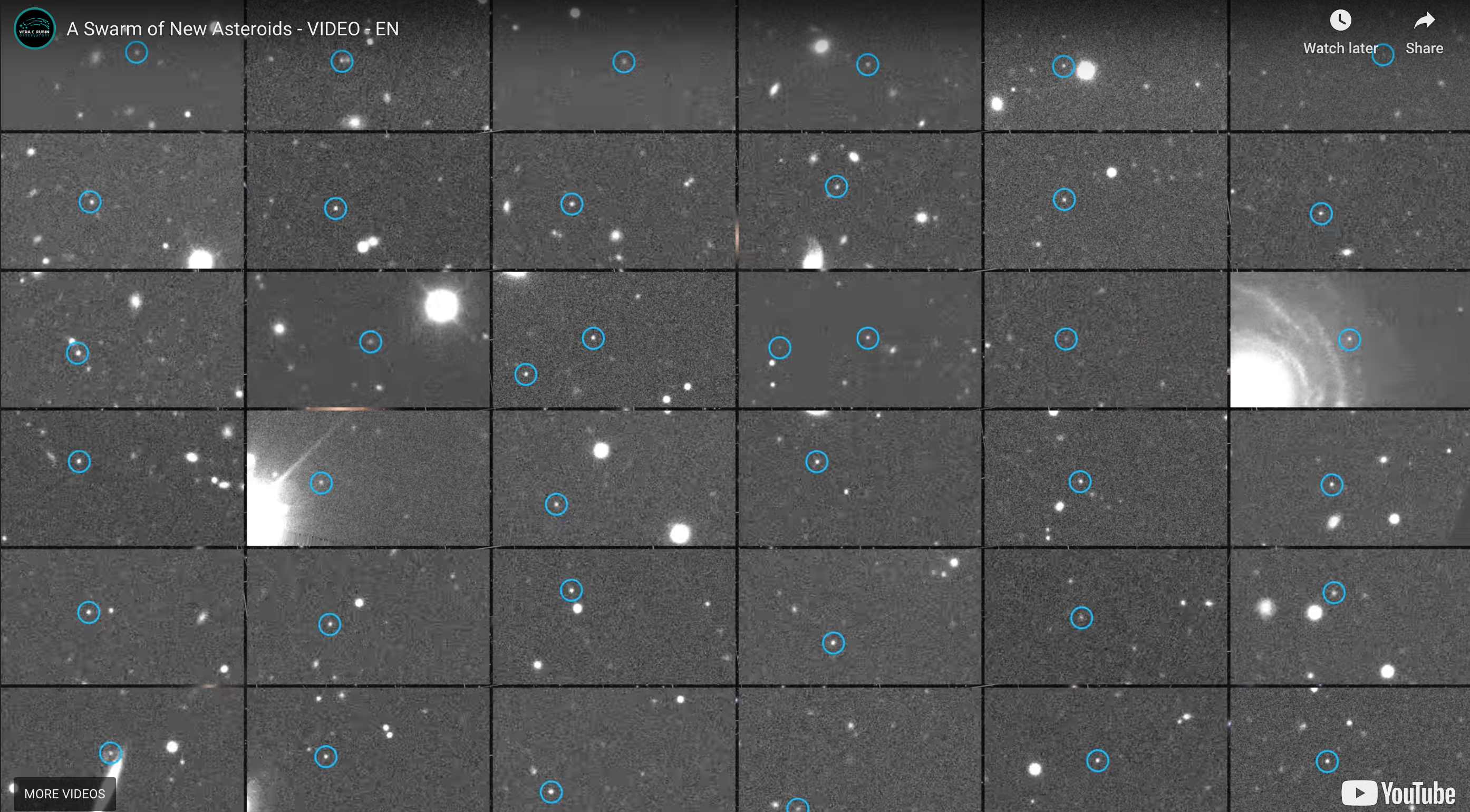
Today is Asteroid Day, the anniversary of the Tunguska Event, when we raise awareness about potentially hazardous asteroids and their possible impacts on Earth. We also celebrate the addition of a new tool in our quest for planetary defense—the Vera Rubin Observatory. During the observatory's First Look last week, a new video revealed the discovery of over 2,100 new asteroids, including seven near-Earth objects (NEOs). This screenshot from the video shows a small portion of those discoveries, taken while looking at a small swath of the sky during this first image release.
Watch the full video: https://www.youtube.com/watch?v=DTuq-vBsDJE
Tuesday, 1 July 2025
Dark Sand Cascades on Mars
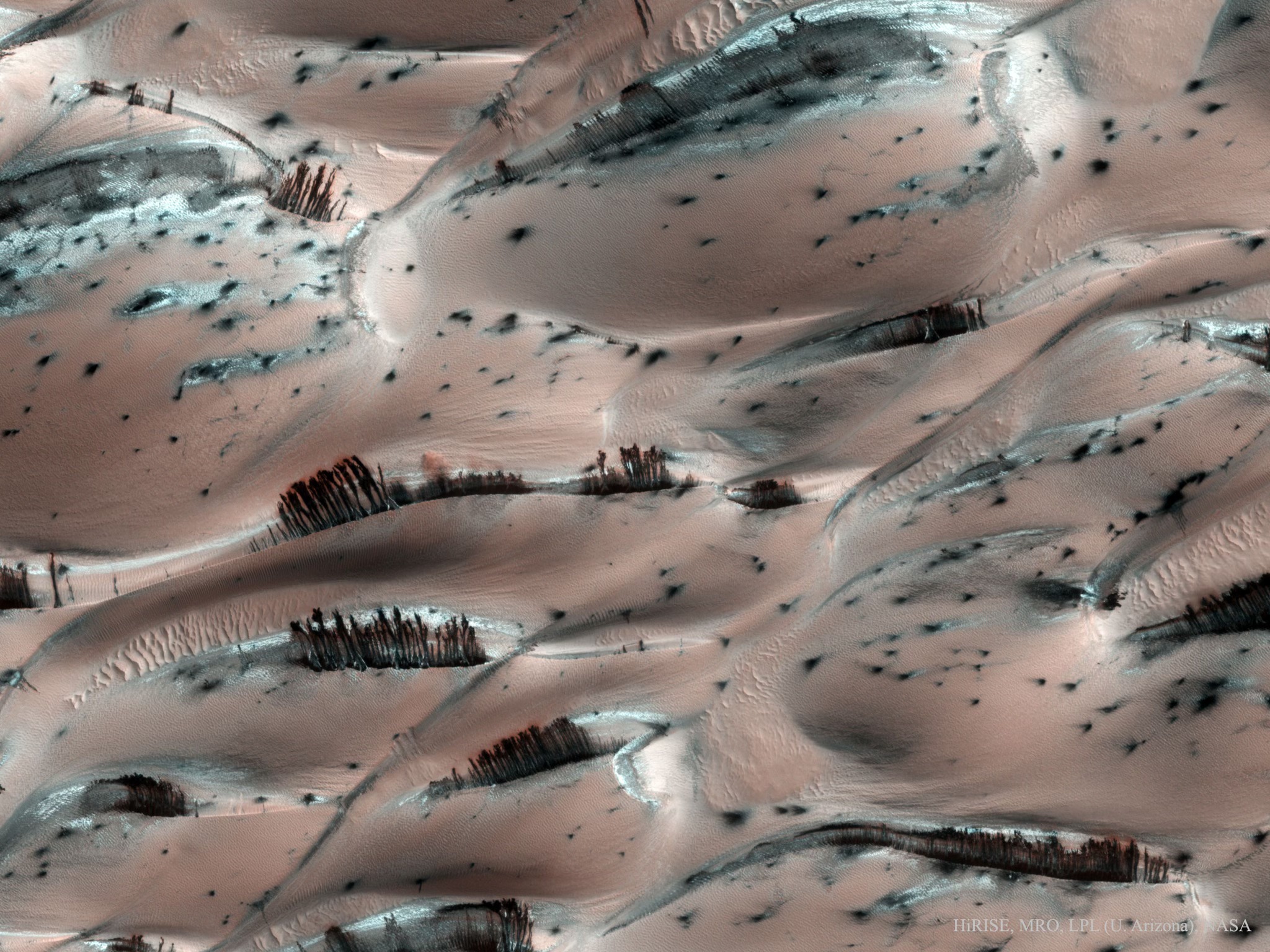
Naturally erupting dust streaks on Mars create structures that look surprisingly like trees near the planet's north pole. These streaks are dark basaltic sand pushed to the surface of sand dunes by sun-heated solid carbon dioxide ice, or dry ice, sublimating directly into vapor. The sand dunes form a nearly complete ring around Mars' north pole and are covered by a thin layer of reddish Martian dust and patches of dry ice.
Wednesday, 2 July 2025
The Cliffs of a Comet
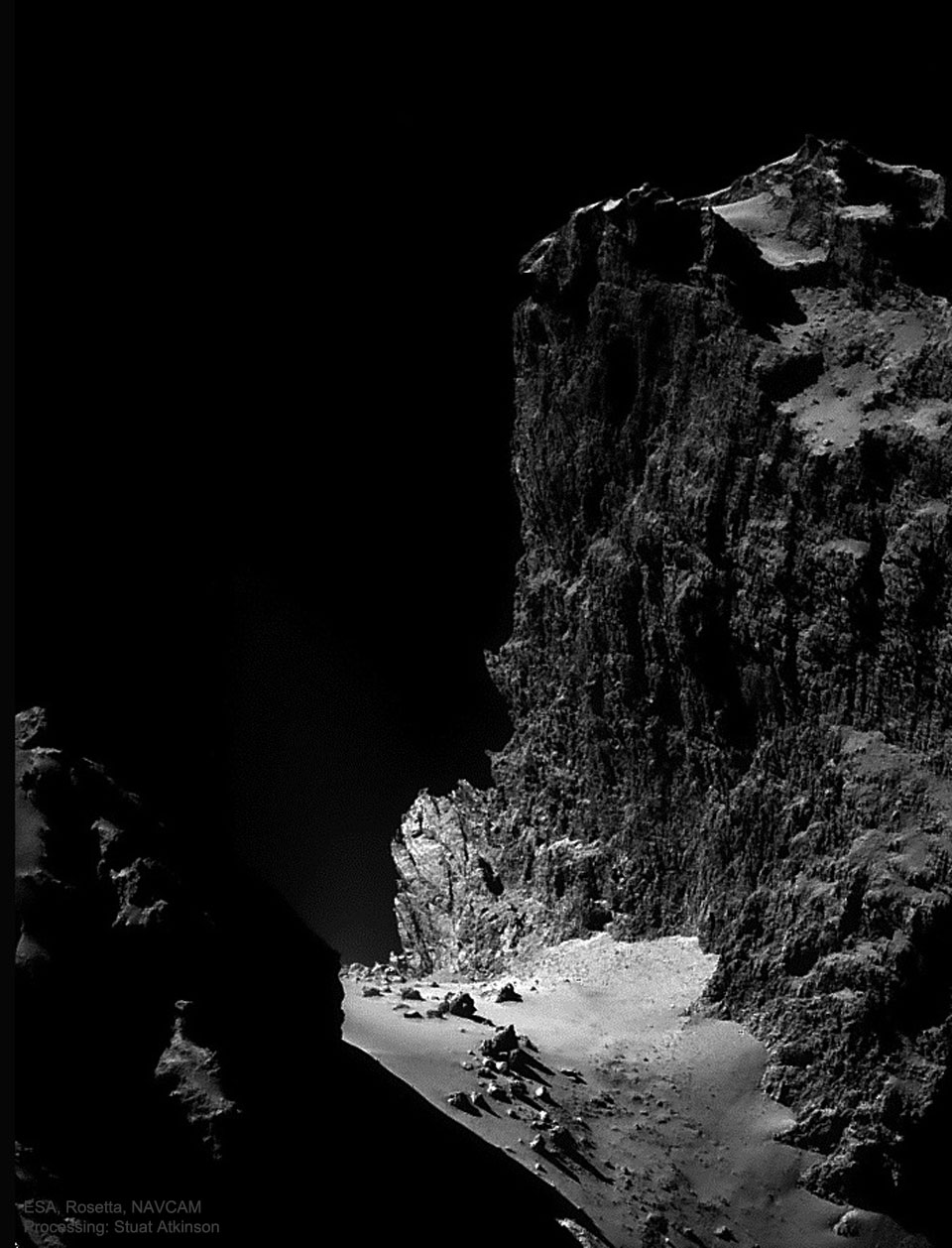
Captured by the Rosetta spacecraft, this incredible image shows a one-kilometer-high cliff on Comet Churyumov–Gerasimenko, better known as 67P. The ragged cliff, as featured here, was imaged by Rosetta early in its mission. Because of the comet's low gravity, you could probably jump from the top of the cliff and fully enjoy the descent and the landing without too much trouble. A relatively smooth icy terrain is dotted with boulders as large as 20 meters across. Data from Rosetta indicates that the ice in 67P has a significantly different deuterium fraction -- and hence likely a different origin -- than the water in Earth's oceans.
Thursday, 3 July 2025
Dolmen of Guadalperal
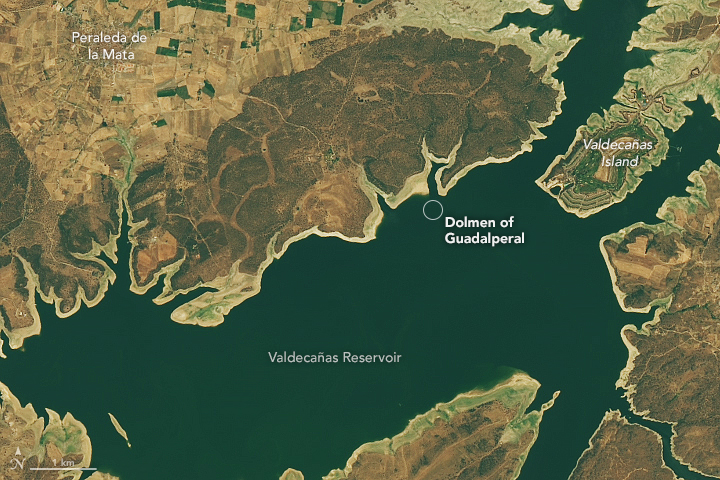
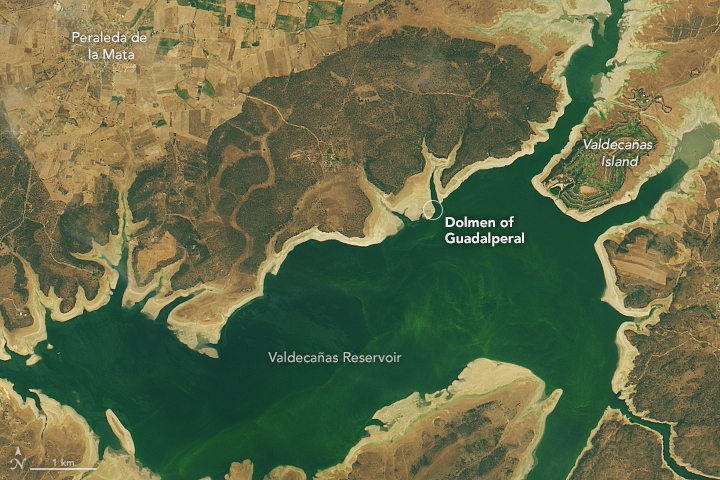
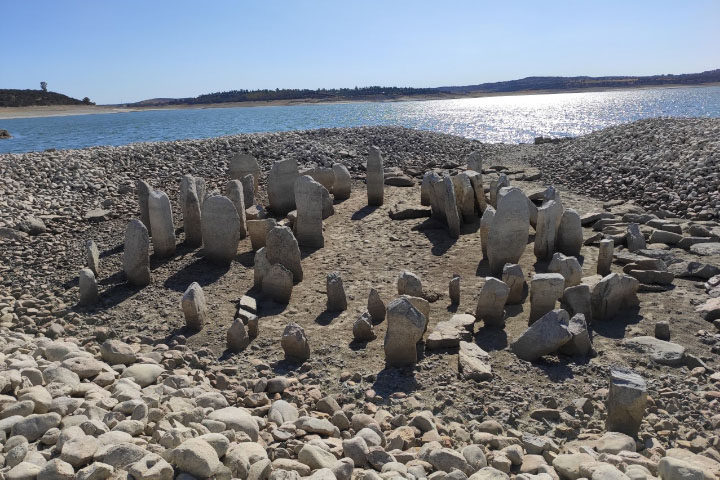
The first two images here were taken by NASA/USGS Landsat satellites on July 24, 2013, and July 25, 2019. They show the Valdecañas Reservoir in western Spain before and during a European-wide drought that caused the shoreline to recede. The circle notes an area revealed during that drought, which contains a set of more than 100 standing granite stones dating back 7,000 years, seen up close in the final picture and known as the "Dolmen of Guadalperal".
Friday, 4 July 2025
Stellar Fireworks
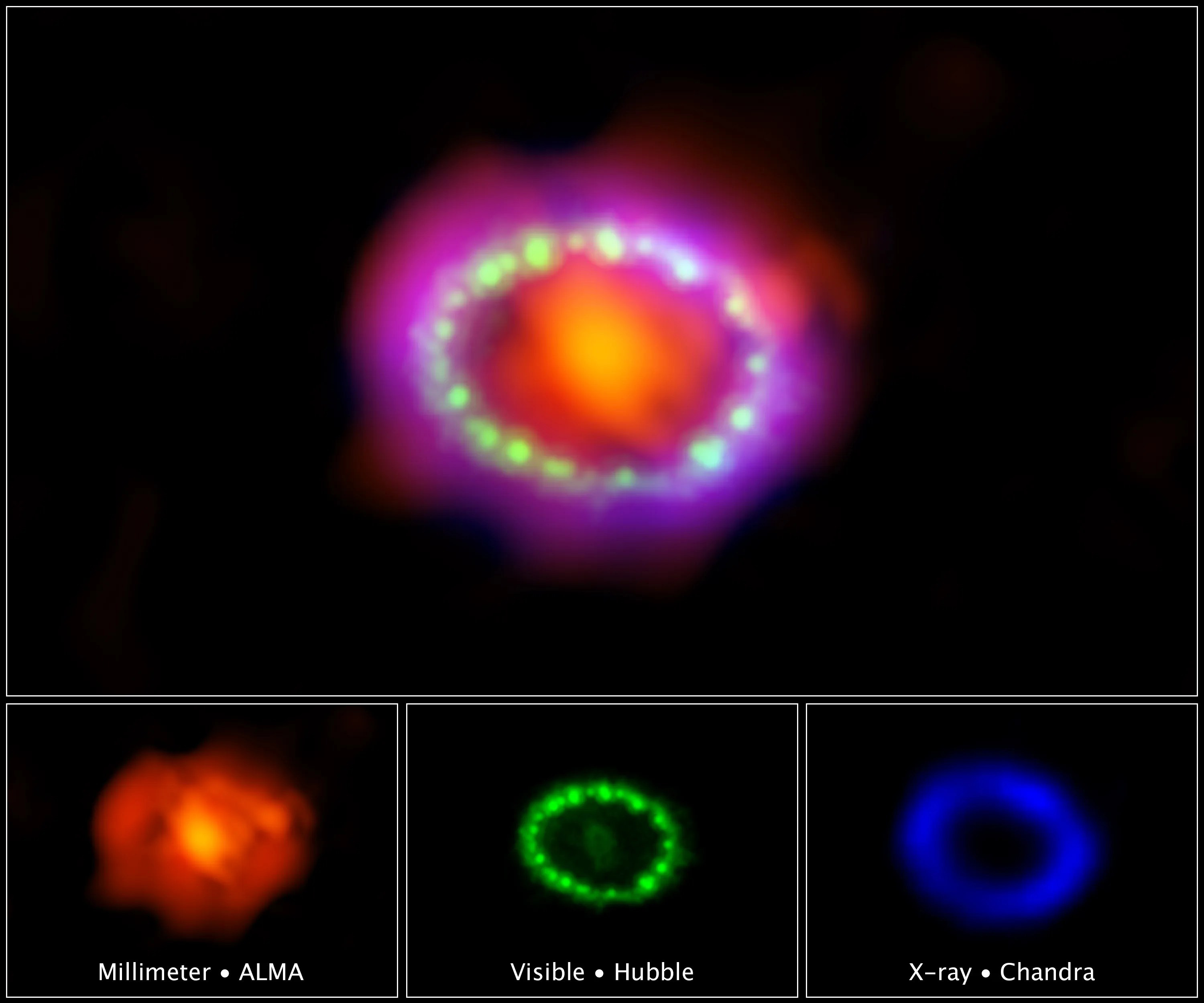
Astronomers combined observations from three different observatories to produce this colorful, multiwavelength image of the intricate remains of Supernova 1987A. The central structure visible inside the ring in the Hubble image has now grown to roughly half a light-year across. Most noticeable are two blobs of debris in the center of the supernova remnant racing away from each other at approximately 20 million miles per hour.
Astronomers also observed a flash of neutrinos from the star just as it erupted. This detection gives astronomers considerable confidence that a compact object formed at the center of the star's collapse — either a neutron star or a black hole — but no telescope has yet uncovered any evidence for one.
News
Related News
Planetary Picture of the Day - Week of August 24, 2026
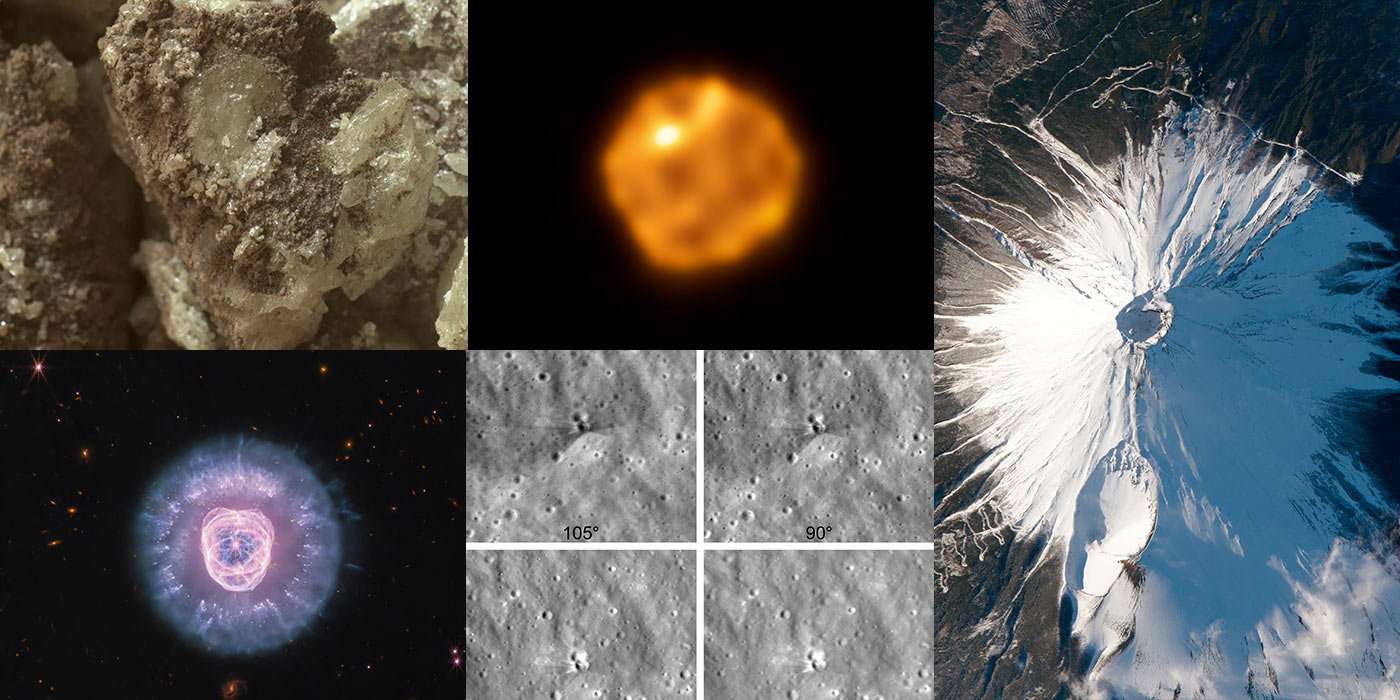
We journey from Mount Fuji as seen from orbit to the bubbling surface of Betelgeuse, exploring the forces that shape planets, moons, and stars across the cosmos. Along the way, JWST reveals the remains of a dying star, Curiosity uncovers clues to Mars’ volcanic past, and a fresh rocket impact on the Moon gives scientists a new opportunity to study how collisions reshape its surface. #PPOD

Planetary Picture of the Day - Week of August 17, 2026
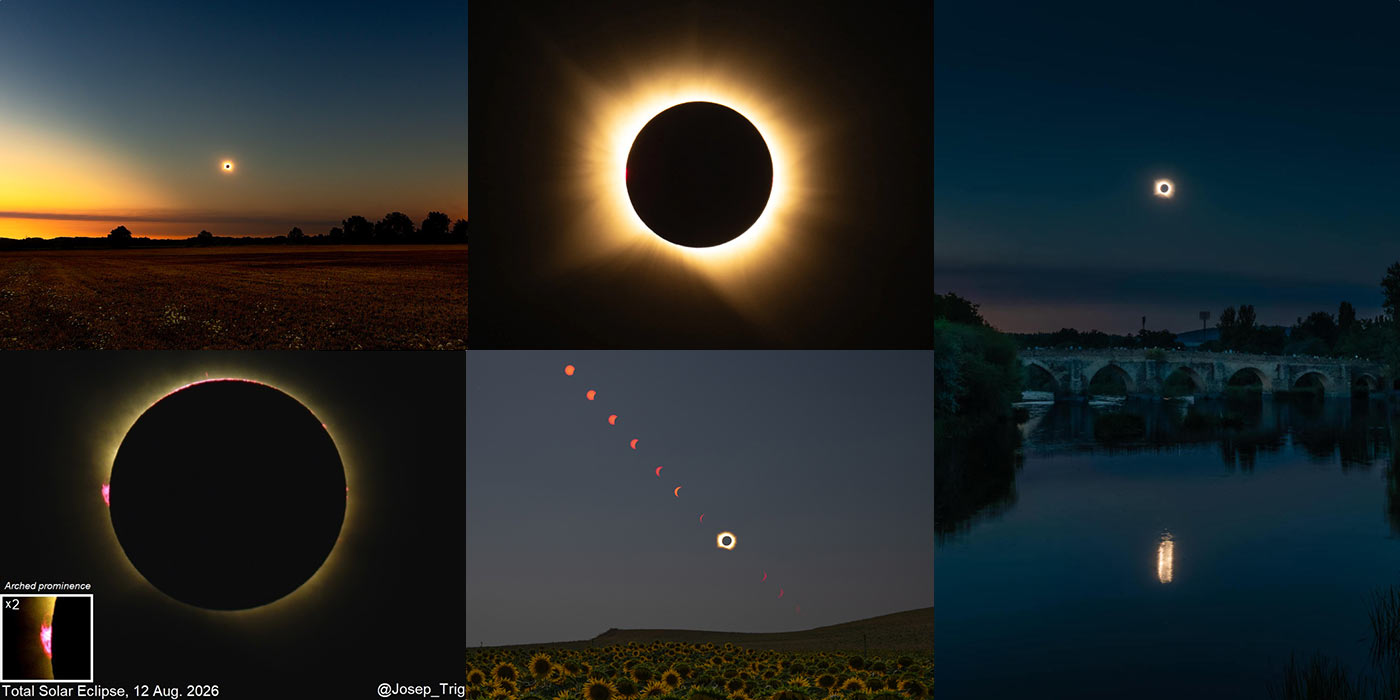
Let's celebrate the August 12 total solar eclipse through the eyes of photographers who experienced the Moon’s shadow sweeping across Spain. From Baily’s Beads and a glowing solar prominence to totality reflected in a river and framed by fields of sunflowers, these images capture both the science and extraordinary beauty of one of nature’s most spectacular celestial events. #PPOD #Eclipse
Planetary Picture of the Day - Week of August 10, 2026
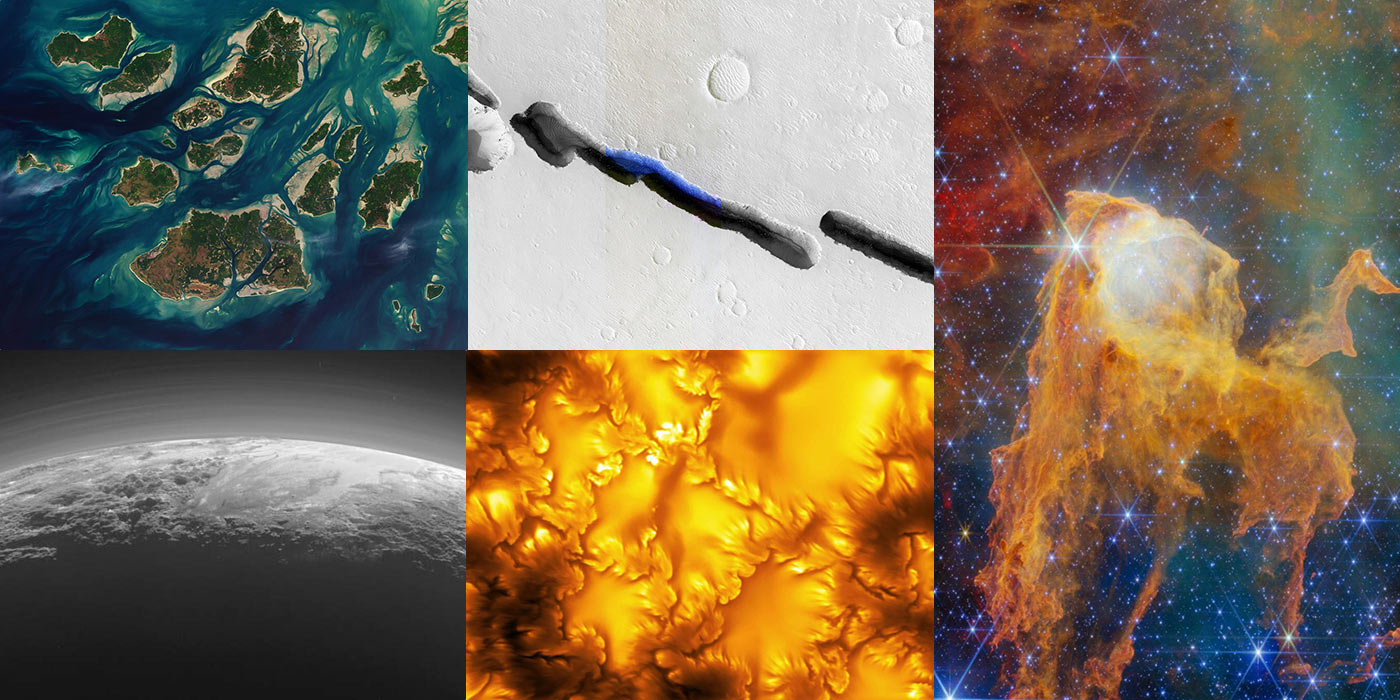
The universe is shaped by forces both immense and intricate, from fractured terrain on Mars and shifting tidal landscapes on Earth to tiny vortices dancing across the surface of the Sun. Farther afield, dramatic views of Pluto’s icy mountains and hazy atmosphere and a treasure chest of newborn stars in the Carina Nebula showcase the remarkable detail revealed by spacecraft and telescopes exploring the cosmos. #PPOD
Planetary Picture of the Day - August 3, 2026
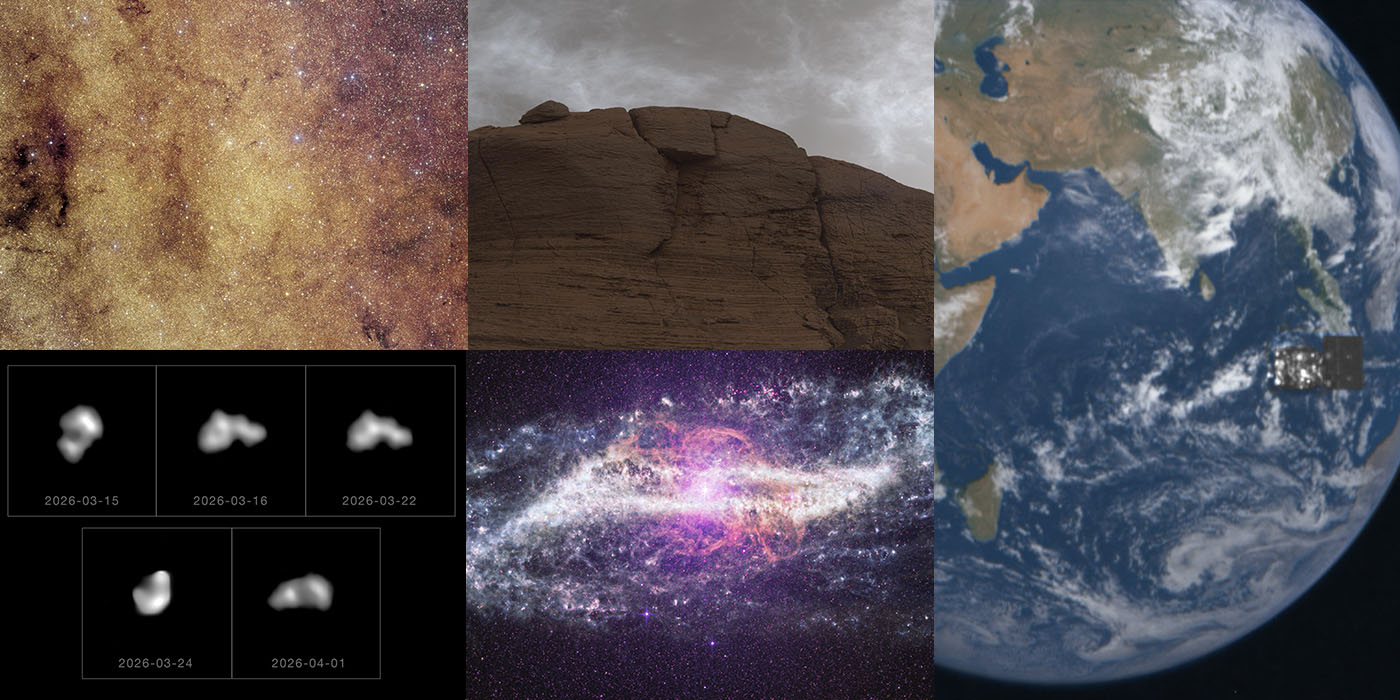
This week, we reveal hidden wonders across the cosmos, from delicate Martian clouds and a dust-shrouded galaxy to an asteroid with a never-before-seen shape and the crowded heart of the Milky Way. Together, these images showcase how new missions and advanced observatories continue to uncover surprising details about our solar system, our galaxy, and the universe beyond. #PPOD
Planetary Picture of the Day - Week of July 27, 2026
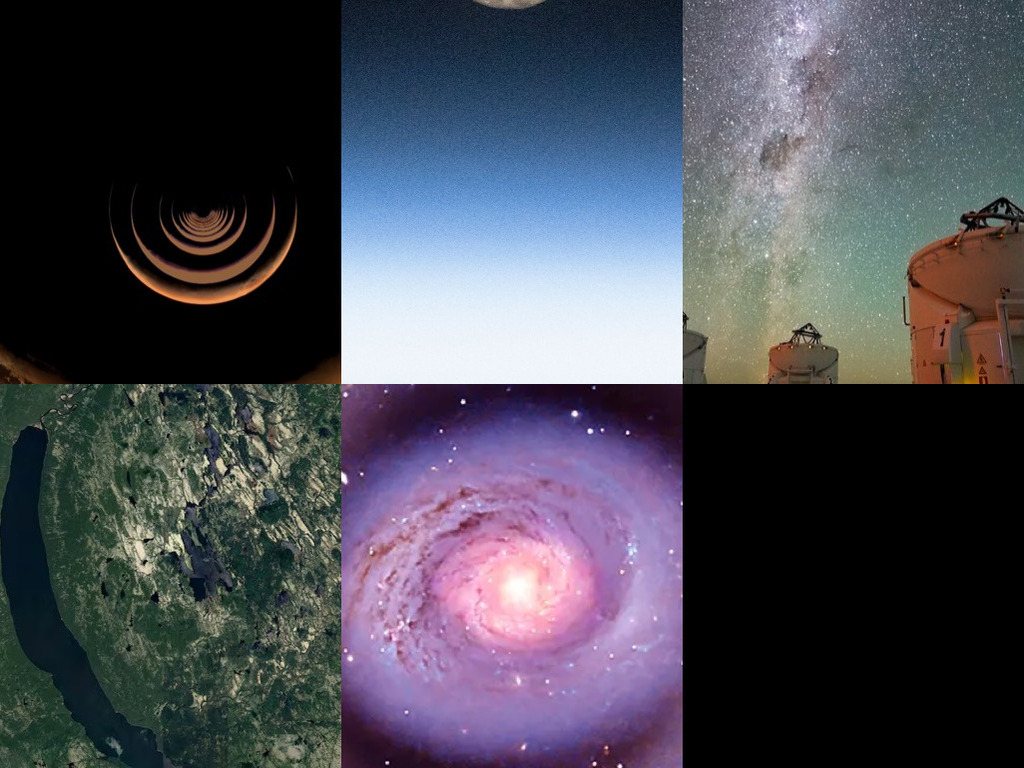
These images span the journey from our own backyard to distant galaxies, featuring Mars, the Moon, breathtaking night skies, and a fresh view of the star-forming galaxy Messier 94. Along the way, we celebrate exploration and discovery—from NASA’s Psyche mission preparing for its asteroid encounter to the revelation of a previously unknown impact crater on Earth —reminding us that there are still new wonders to uncover both on our own planet and across the cosmos. #PPOD
Planetary Picture of the Day - Week of July 20, 2026
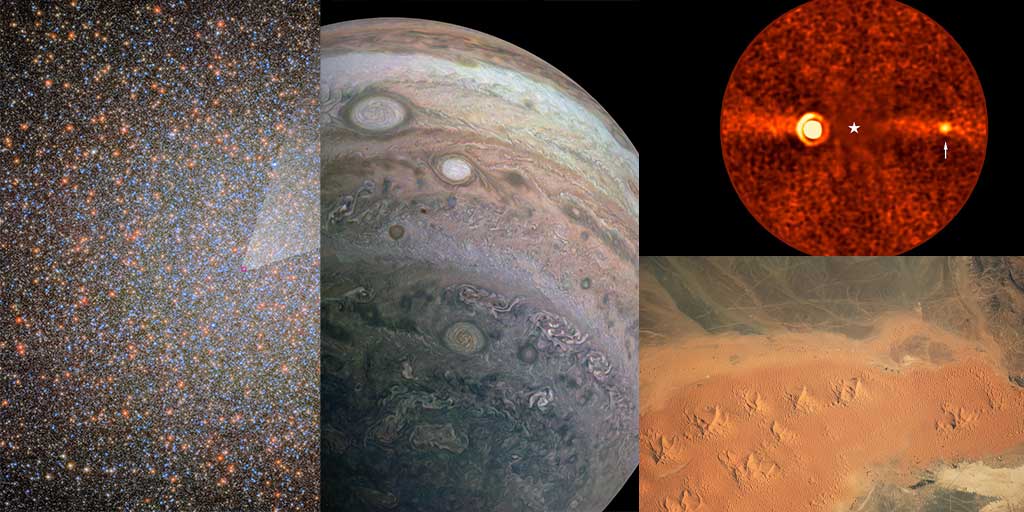
This week, we celebrate fifty years since Viking 1 became the first spacecraft to successfully land on and photograph the surface of Mars, alongside stunning new views of worlds, stars, and galaxies that continue to expand our understanding of the universe. From sculpted Sahara sand dunes and Jupiter’s colorful cloud bands to a newly discovered exoplanet and the first stellar-mass black hole identified in Omega Centauri, these images showcase the remarkable diversity of cosmic exploration. #PPODResearch
Related Projects
SkyMapper: Expanding Access to Real-time Astronomy Through a Global Astronomical Network
SkyMapper and the SETI Institute are connecting educators, students and the public to live astronomical observations through a distributed astronomical network. #SkyMapper #SETI #Citizen Science #Astronomy
Virtual Planetary Laboratory
How can we best assess whether an exoplanet supports life? #VPL
Discovery and Futures Lab
What happens if life beyond Earth is discovered? The Discovery and Futures Lab at the SETI Institute fosters novel and anticipatory research at the intersection of science, society, our planet, and the search for life beyond Earth. #Discovery and Futures LabSupport the
SETI Institute
Scientists are getting closer in their search for life beyond earth. But with limited federal funding for the search for extraterrestrial intelligence, supporters are the reason cutting-edge scientists can keep their eyes on the sky.