Welcome to our weekly recap of our Planetary Picture of the Day (PPOD)! We made it through January! Relax and enjoy some images from around the solar system.
Monday, January 24, 2022
NASA/JPL/University of Arizona
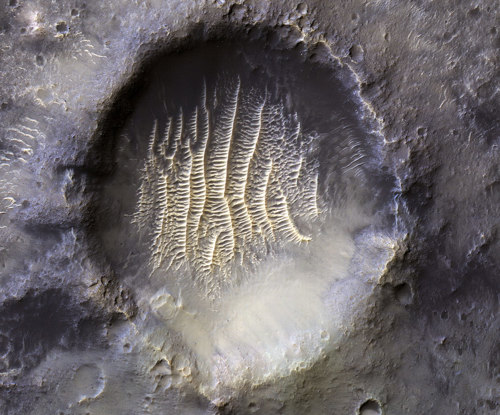
A Prime Meridian for Mars This dune-filled crater, called Airy-0 (zero), defines 0° longitude for the Red Planet, much like the location of the Royal Observatory Greenwich in England does on Earth. The crater is about 43 kilometers in diameter. This enhanced-color look at the crater comes from the Mars Reconnaissance Orbiter.
Tuesday, January 25, 2022
Credit: NASA/JPL/Space Science Institute
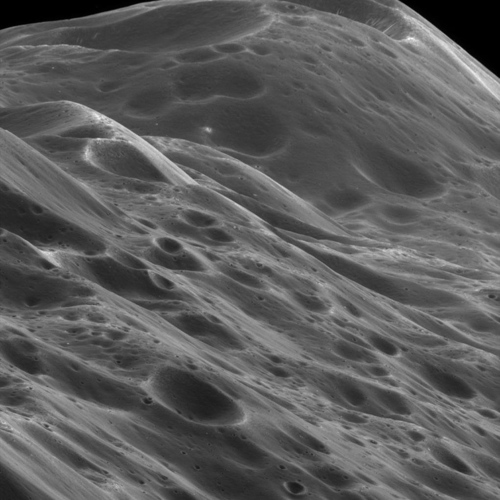
Iapetus, moon of Saturn Iapetus has a diameter of a little under 1,500 kilometers and was discovered in 1671 by Jean-Dominique Cassini. This stunning close-up view shows mountainous terrain that reaches about 10 kilometers high along the moon's equatorial ridge. Taken by the Cassini spacecraft almost three and half centuries later on Sept. 10, 2007.
Three of the white oval storms known as the “String of Pearls” are visible near the top of the image. Each of the alternating light and dark atmospheric bands in this image is wider than Earth, and each rages around Jupiter at hundreds of miles (kilometers) per hour. The lighter areas are regions where gas is rising, and the darker bands are regions where gas is sinking. Juno acquired the image on May 19, 2017, at 11:30 a.m. PST (2:30 p.m. EST) from an altitude of about 20,800 miles (33,400 kilometers) above Jupiter's cloud tops.
Wednesday, January 26, 2022
NASA/JPL; MRO mission/HiRISE Team, The University of Arizona. For more details, see: https://buff.ly/357A3d2
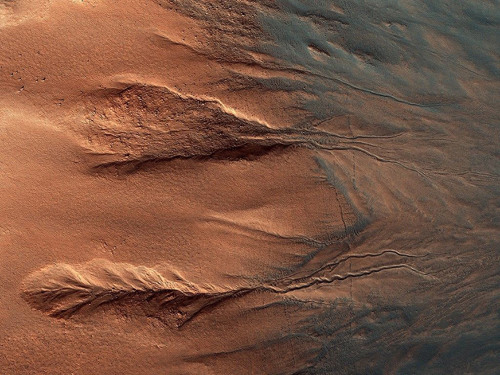
The Contrasting Colors of Crater Dunes and Gullies Gullies are relatively common features in the steep slopes of crater walls, possibly formed by dry debris flows, movement of carbon dioxide frost, or perhaps the melting of ground ice.
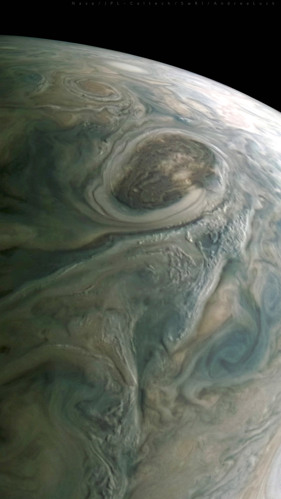
Jupiter by Juno Jupiter storm (Jet N4) in the Northern Hemisphere. Taken by JunoCam aboard NASA's Juno spacecraft from an altitude of 5,432 km on January 12, 2022.
Friday, January 28, 2022
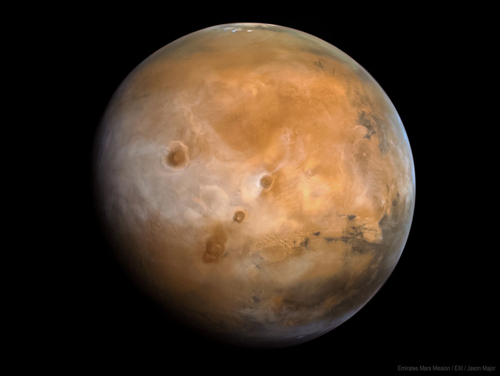
Credit Image: Emirates Mars Mission / EXI / Jason Major
Mars' Olympus Mons Olympus Mons from image data acquired with the EXI camera on UAE's Hope Mars Mission on August 30, 2021, with the entire Tharsis region visible, including the nearly 22 kilometers high Olympus. The mountain is a shield volcano with a diameter of 624 kilometers. Oriented so north is up.
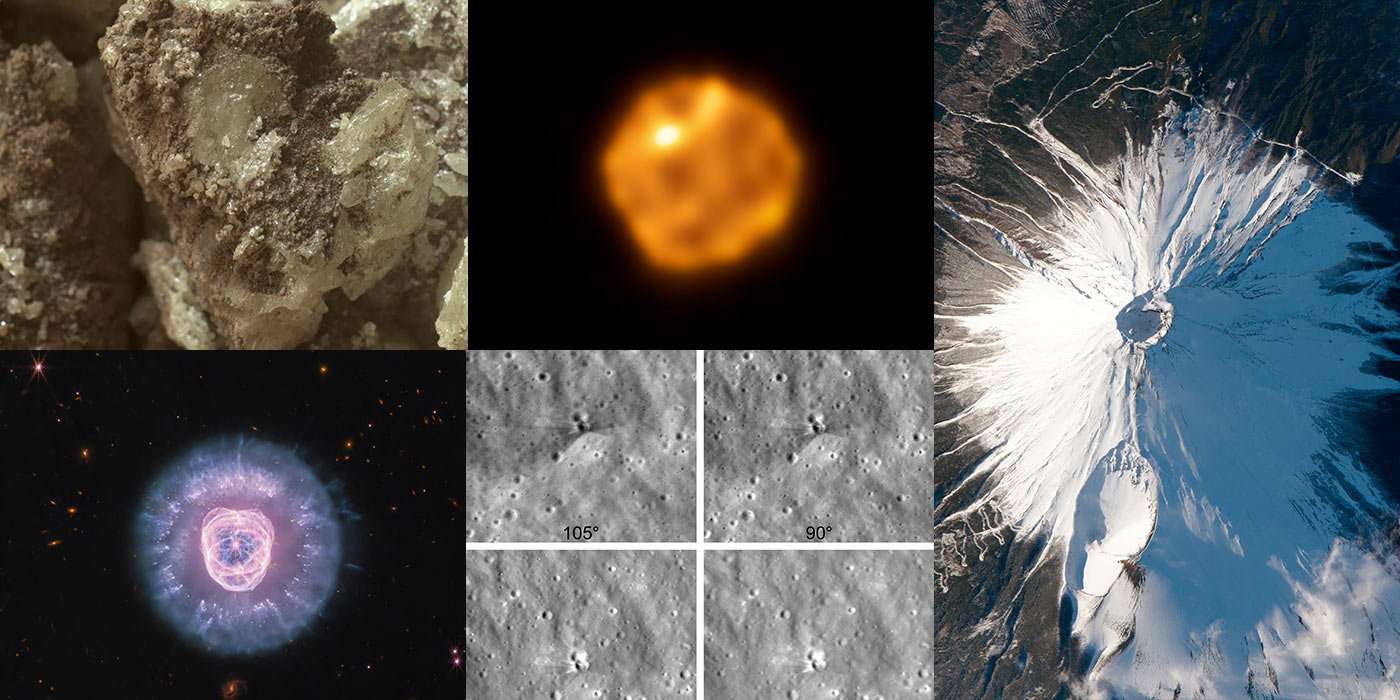
We journey from Mount Fuji as seen from orbit to the bubbling surface of Betelgeuse, exploring the forces that shape planets, moons, and stars across the cosmos. Along the way, JWST reveals the remains of a dying star, Curiosity uncovers clues to Mars’ volcanic past, and a fresh rocket impact on the Moon gives scientists a new opportunity to study how collisions reshape its surface.
#PPOD
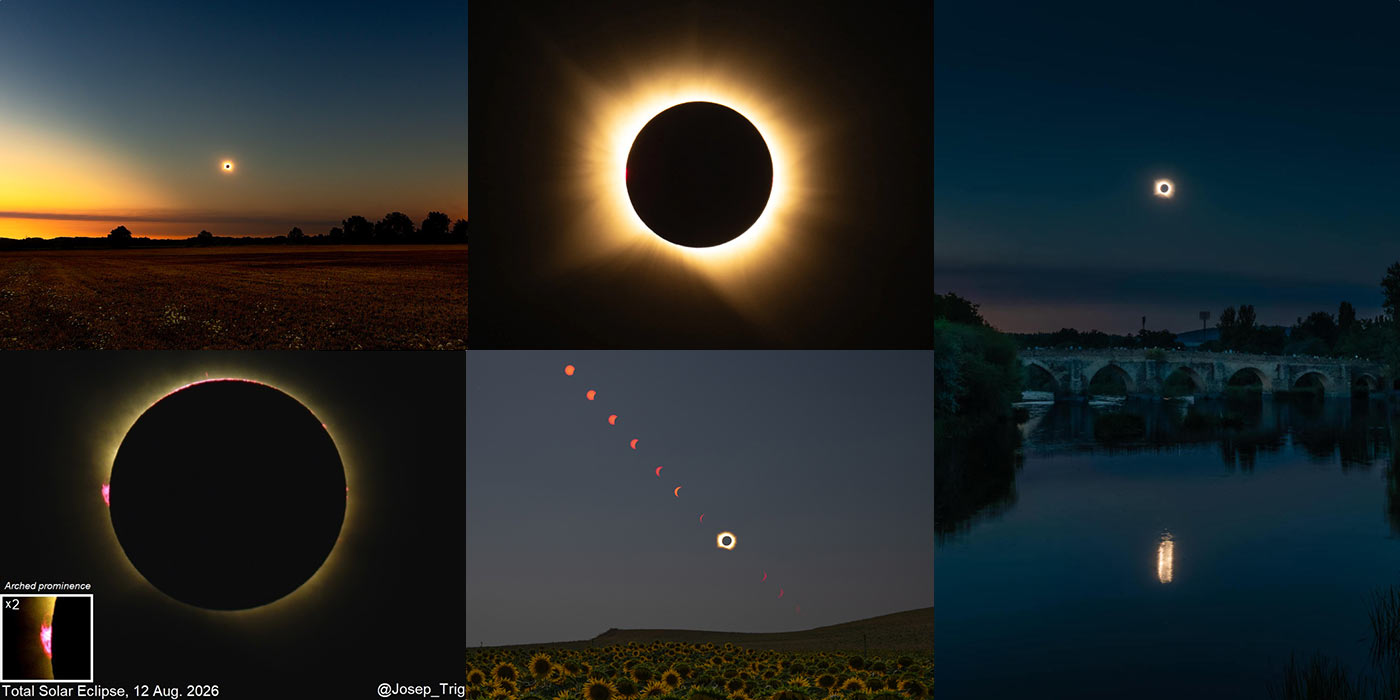
Let's celebrate the August 12 total solar eclipse through the eyes of photographers who experienced the Moon’s shadow sweeping across Spain. From Baily’s Beads and a glowing solar prominence to totality reflected in a river and framed by fields of sunflowers, these images capture both the science and extraordinary beauty of one of nature’s most spectacular celestial events.
#PPOD
#Eclipse
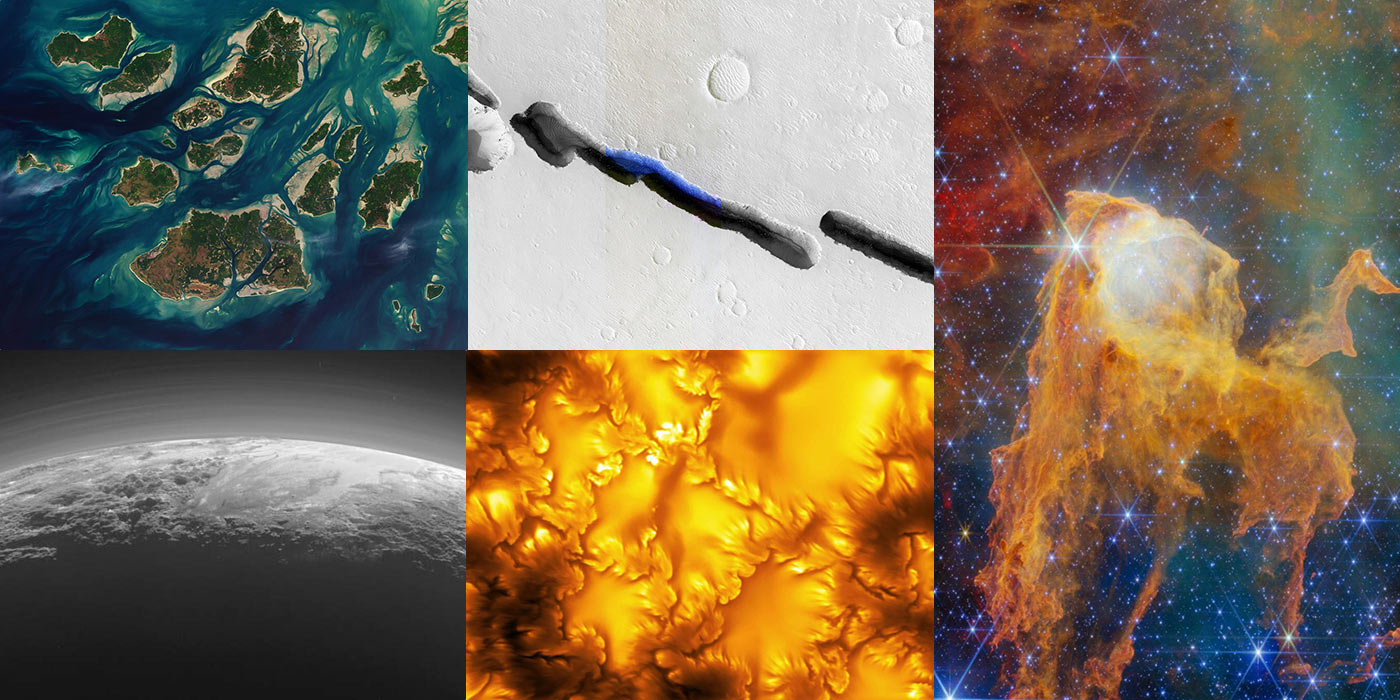
The universe is shaped by forces both immense and intricate, from fractured terrain on Mars and shifting tidal landscapes on Earth to tiny vortices dancing across the surface of the Sun. Farther afield, dramatic views of Pluto’s icy mountains and hazy atmosphere and a treasure chest of newborn stars in the Carina Nebula showcase the remarkable detail revealed by spacecraft and telescopes exploring the cosmos.
#PPOD
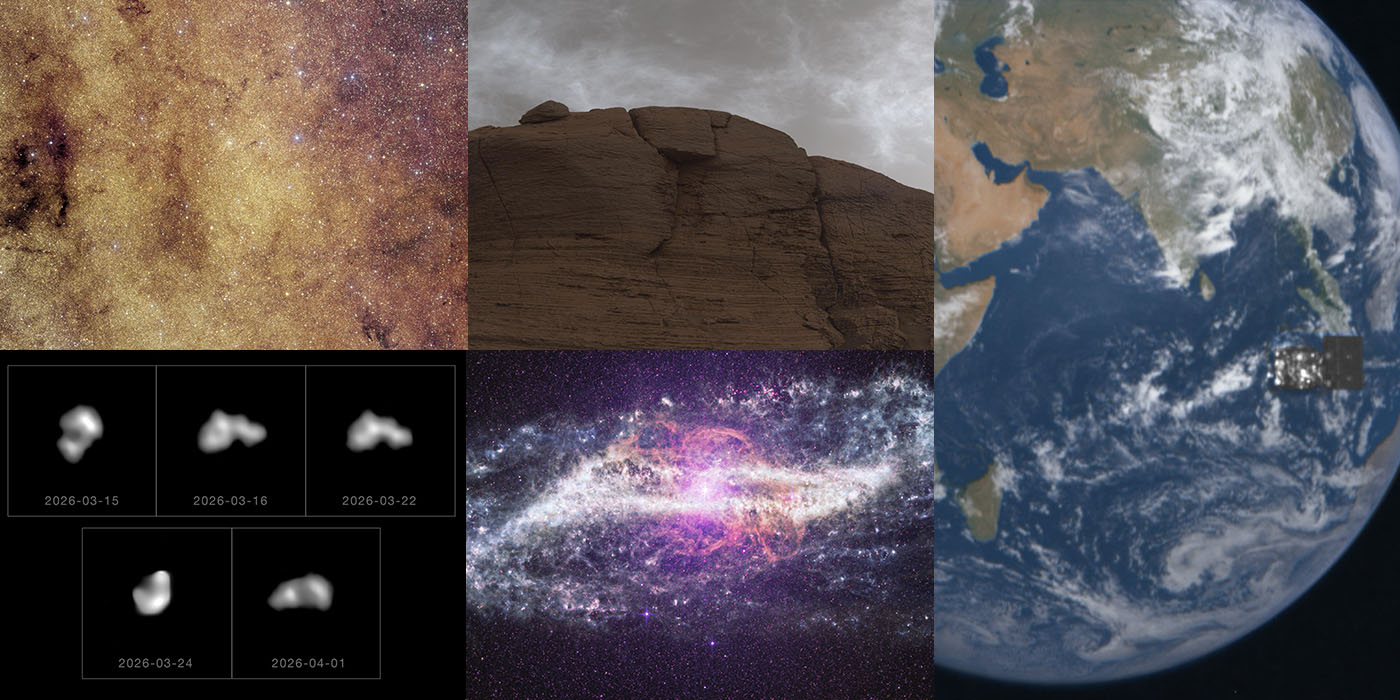
This week, we reveal hidden wonders across the cosmos, from delicate Martian clouds and a dust-shrouded galaxy to an asteroid with a never-before-seen shape and the crowded heart of the Milky Way. Together, these images showcase how new missions and advanced observatories continue to uncover surprising details about our solar system, our galaxy, and the universe beyond.
#PPOD
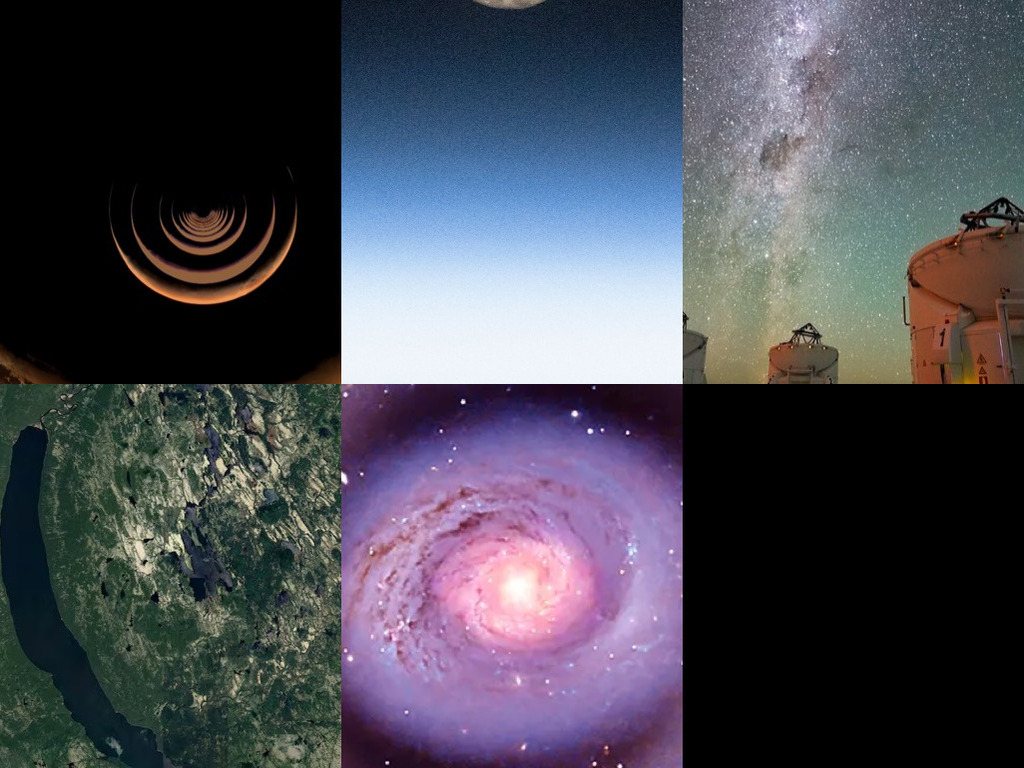
These images span the journey from our own backyard to distant galaxies, featuring Mars, the Moon, breathtaking night skies, and a fresh view of the star-forming galaxy Messier 94. Along the way, we celebrate exploration and discovery—from NASA’s Psyche mission preparing for its asteroid encounter to the revelation of a previously unknown impact crater on Earth —reminding us that there are still new wonders to uncover both on our own planet and across the cosmos.
#PPOD
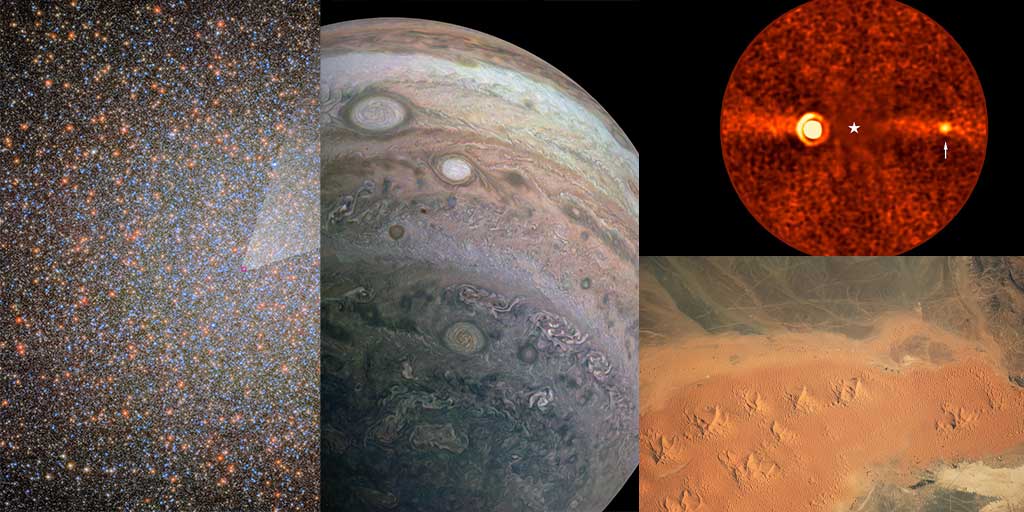
This week, we celebrate fifty years since Viking 1 became the first spacecraft to successfully land on and photograph the surface of Mars, alongside stunning new views of worlds, stars, and galaxies that continue to expand our understanding of the universe. From sculpted Sahara sand dunes and Jupiter’s colorful cloud bands to a newly discovered exoplanet and the first stellar-mass black hole identified in Omega Centauri, these images showcase the remarkable diversity of cosmic exploration.
#PPOD
We journey from Mount Fuji as seen from orbit to the bubbling surface of Betelgeuse, exploring the forces that shape planets, moons, and stars across the cosmos. Along the way, JWST reveals the remains of a dying star, Curiosity uncovers clues to Mars’ volcanic past, and a fresh rocket impact on the Moon gives scientists a new opportunity to study how collisions reshape its surface.
Let's celebrate the August 12 total solar eclipse through the eyes of photographers who experienced the Moon’s shadow sweeping across Spain. From Baily’s Beads and a glowing solar prominence to totality reflected in a river and framed by fields of sunflowers, these images capture both the science and extraordinary beauty of one of nature’s most spectacular celestial events.
The universe is shaped by forces both immense and intricate, from fractured terrain on Mars and shifting tidal landscapes on Earth to tiny vortices dancing across the surface of the Sun. Farther afield, dramatic views of Pluto’s icy mountains and hazy atmosphere and a treasure chest of newborn stars in the Carina Nebula showcase the remarkable detail revealed by spacecraft and telescopes exploring the cosmos.
This week, we reveal hidden wonders across the cosmos, from delicate Martian clouds and a dust-shrouded galaxy to an asteroid with a never-before-seen shape and the crowded heart of the Milky Way. Together, these images showcase how new missions and advanced observatories continue to uncover surprising details about our solar system, our galaxy, and the universe beyond.
These images span the journey from our own backyard to distant galaxies, featuring Mars, the Moon, breathtaking night skies, and a fresh view of the star-forming galaxy Messier 94. Along the way, we celebrate exploration and discovery—from NASA’s Psyche mission preparing for its asteroid encounter to the revelation of a previously unknown impact crater on Earth —reminding us that there are still new wonders to uncover both on our own planet and across the cosmos.
This week, we celebrate fifty years since Viking 1 became the first spacecraft to successfully land on and photograph the surface of Mars, alongside stunning new views of worlds, stars, and galaxies that continue to expand our understanding of the universe. From sculpted Sahara sand dunes and Jupiter’s colorful cloud bands to a newly discovered exoplanet and the first stellar-mass black hole identified in Omega Centauri, these images showcase the remarkable diversity of cosmic exploration.
SkyMapper and the SETI Institute are connecting educators, students and the public to live astronomical observations through a distributed astronomical network.
#SkyMapper
#SETI
#Citizen Science
#Astronomy
What happens if life beyond Earth is discovered? The Discovery and Futures Lab at the SETI Institute fosters novel and anticipatory research at the intersection of science, society, our planet, and the search for life beyond Earth.
#Discovery and Futures Lab
SkyMapper and the SETI Institute are connecting educators, students and the public to live astronomical observations through a distributed astronomical network.
What happens if life beyond Earth is discovered? The Discovery and Futures Lab at the SETI Institute fosters novel and anticipatory research at the intersection of science, society, our planet, and the search for life beyond Earth.
Scientists are getting closer in their search for life beyond earth. But with limited federal funding for the search for extraterrestrial intelligence, supporters are the reason cutting-edge scientists can keep their eyes on the sky.
)