Monday, 19 January 2026
Jupiter and Io
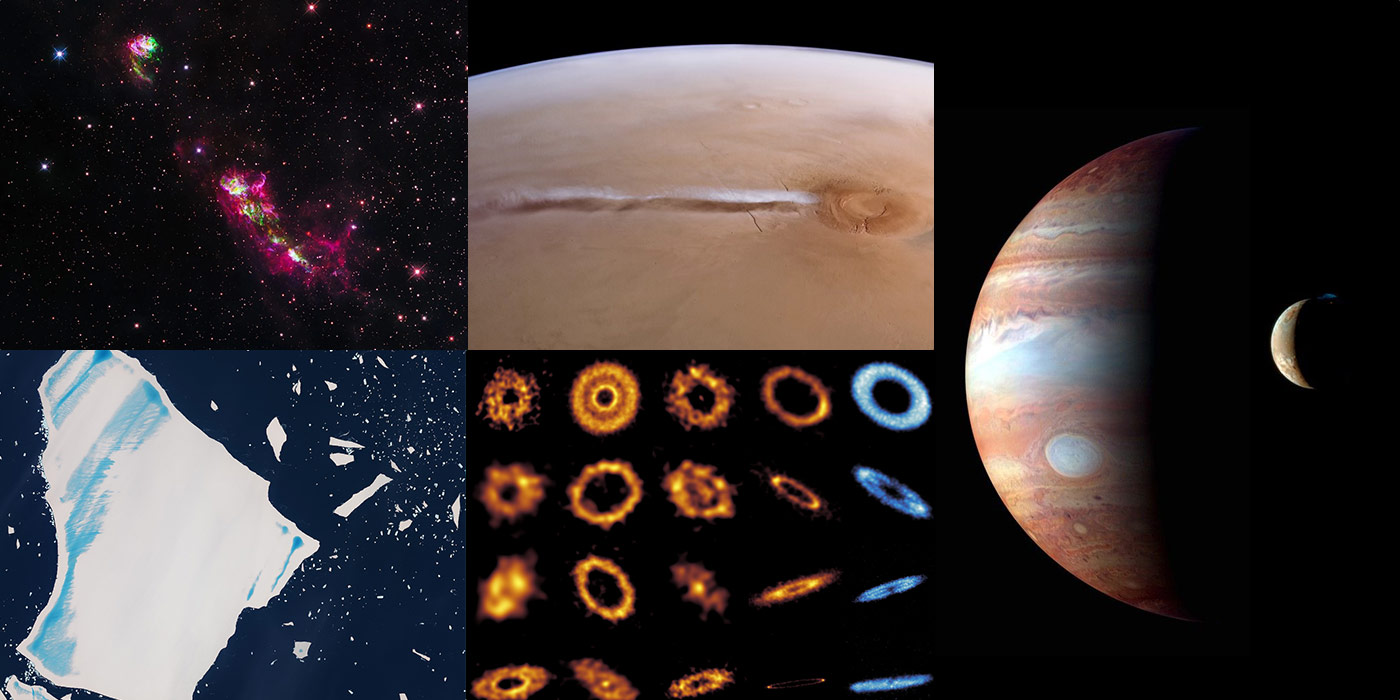
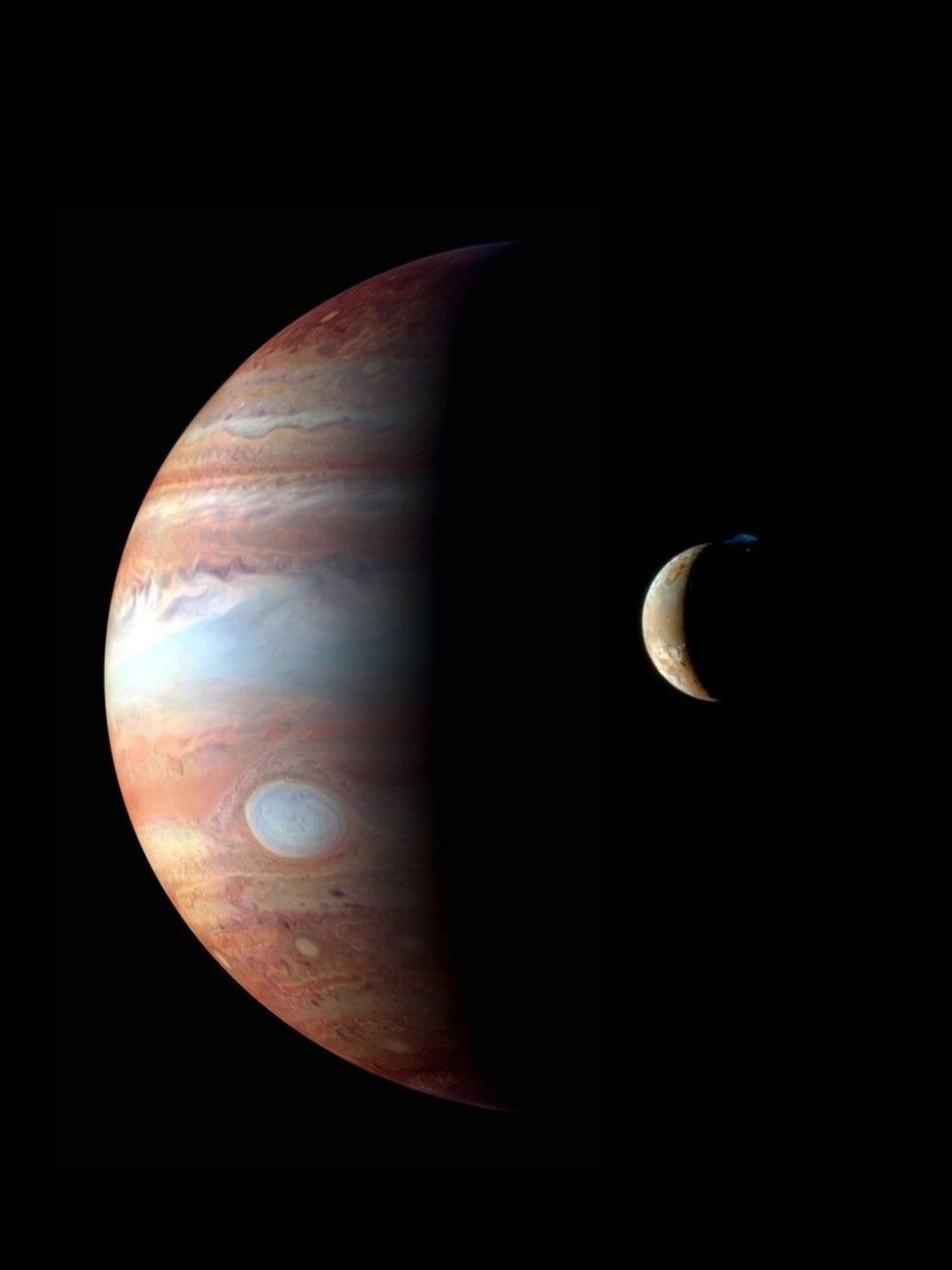
This is a montage of New Horizons images of Jupiter and its volcanic moon Io, taken during the spacecraft’s Jupiter flyby in early 2007.
The Jupiter image is an infrared color composite taken by the spacecraft’s near-infrared imaging spectrometer on Feb. 28, 2007. The infrared wavelengths used highlight variations in the altitude of the Jovian cloud tops, with blue denoting high-altitude clouds and hazes, and red indicating deeper clouds. The prominent bluish-white oval is the Great Red Spot.
The Io image, taken at 00:25 UT on March 1st, 2007, is an approximately true-color composite taken by the panchromatic Long-Range Reconnaissance Imager (LORRI). The image shows a major eruption in progress on Io’s night side, at the northern volcano Tvashtar. Incandescent lava glows red beneath a 330-kilometer-high volcanic plume, whose uppermost portions are illuminated by sunlight. The plume appears blue due to light scattering by small particles within it.
New Horizons passed Jupiter on Feb. 28, 2007, riding the planet’s gravity to boost its speed and shave three years off its trip to Pluto.
Tuesday, 20 January 2026
Arsia Mons Elongated Cloud
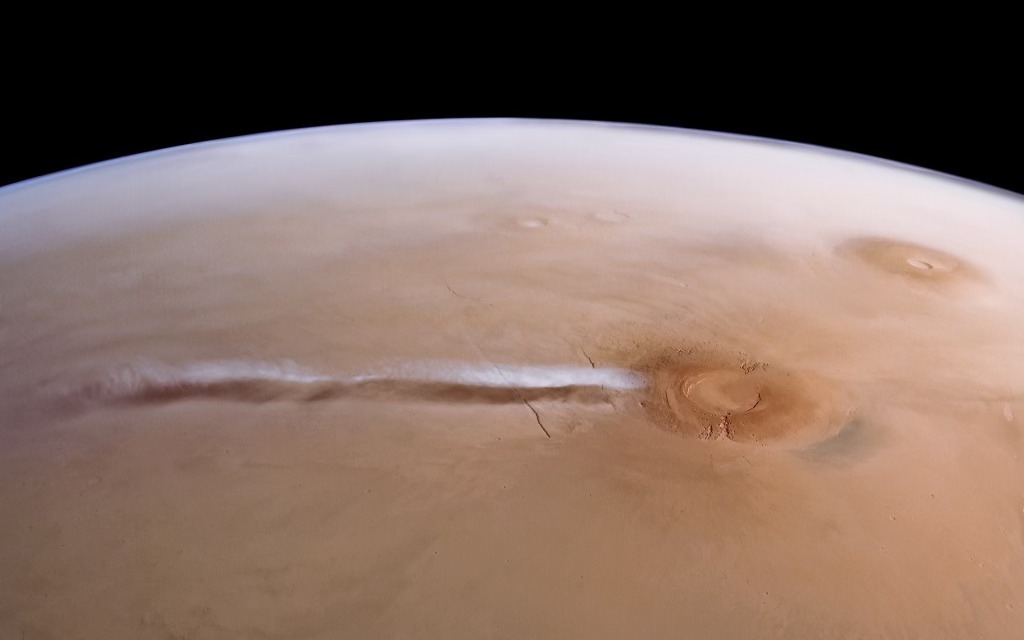
Every spring and summer in the southern part of Mars, the Arsia Mons Elongated Cloud (AMEC) forms daily above the surface, as seen here by ESA's Mars Express orbiter. The cloud rapidly stretches out for hundreds of kilometers before fading away in a few hours. Strangely, Arsia Mons is the only volcano at low-latitudes to create such a cloud.
Wednesday, 21 January 2026
Stellar Blast Sets Clouds Ablaze
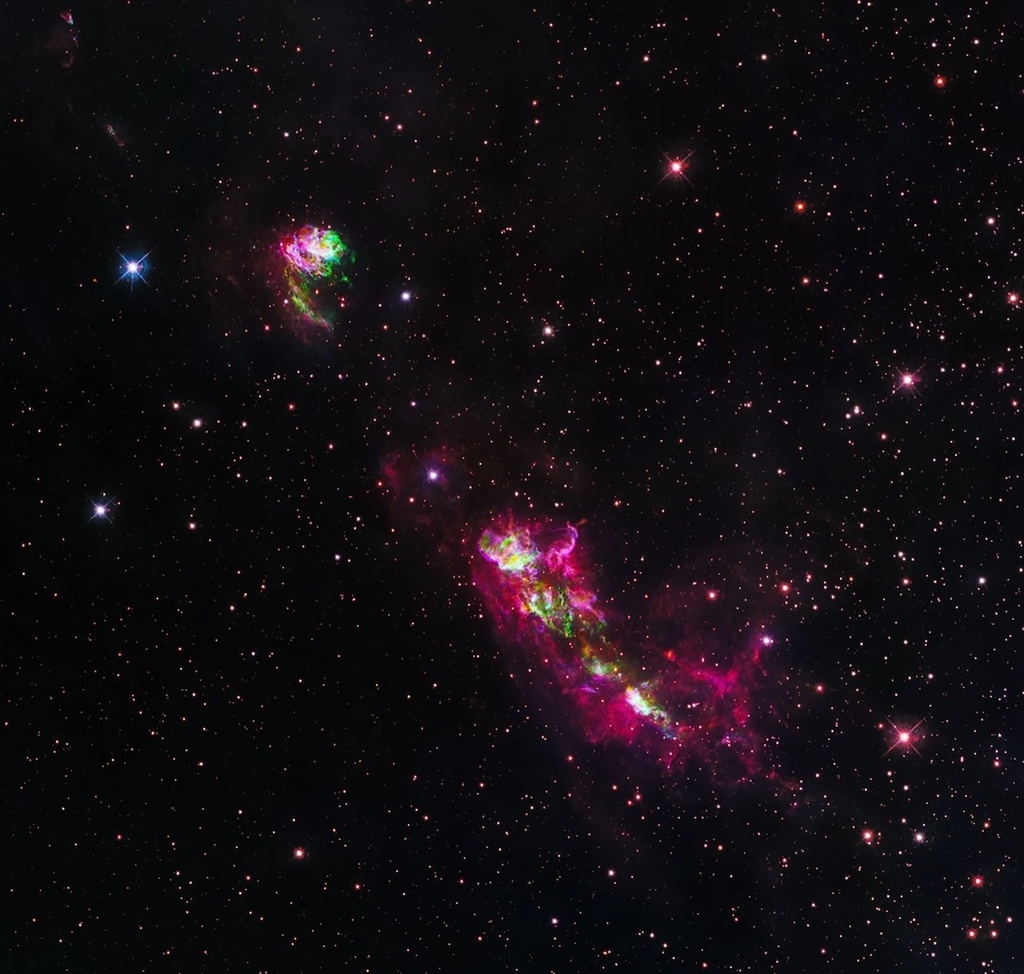
This new NASA Hubble Space Telescope image captures a jet of gas from a forming star shooting across the dark expanse. The bright pink and green patches running diagonally through the image are HH 80/81, a pair of Herbig-Haro (HH) objects previously observed by Hubble in 1995. The patch to the upper left is part of HH 81, and the bottom streak is part of HH 80.
Herbig-Haro objects are bright, glowing regions that occur when jets of ionized gas ejected by a newly forming star collide with slower, previously ejected outflows of gas from that star. HH 80/81’s outflow stretches over 32 light-years, making it the largest protostellar outflow known.
Protostars are fed by infalling gas from the surrounding environment, some of which can be seen in residual “accretion disks” orbiting the forming star. Ionized material within these disks can interact with the protostars’ strong magnetic fields, which channel some of the particles toward the pole and outward in the form of jets.
As the jets eject material at high speeds, they can produce strong shock waves when the particles collide with previously ejected gas. These shocks heat the clouds of gas and excite the atoms, causing them to glow in what we see as HH objects.
Thursday, 22 January 2026
The Fate of a Giant
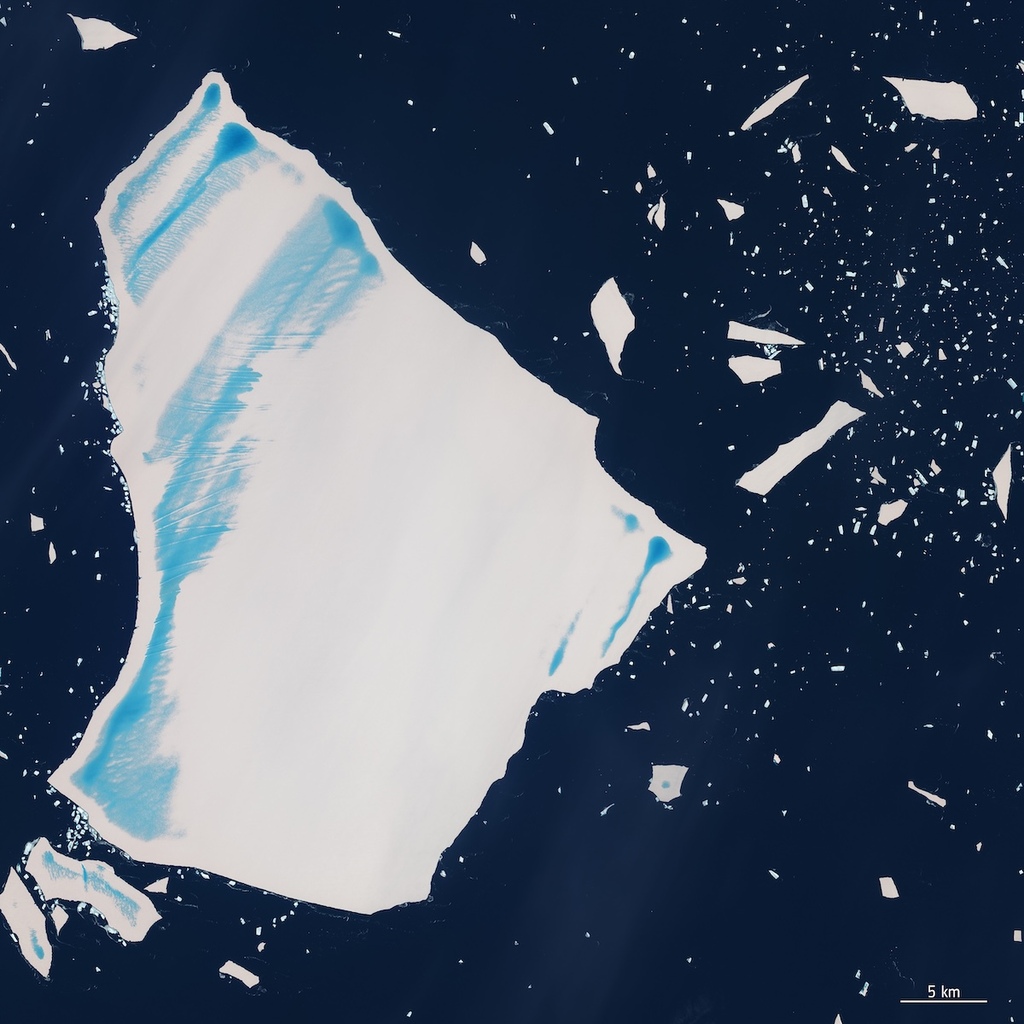
This Copernicus Sentinel-2 image over the South Atlantic Ocean features a close-up view of the A23a iceberg, once the world’s largest. The unusually cloud-free image shows the first signs that the iceberg will soon disintegrate completely.
A23a calved from the Filchner-Ronne ice shelf in West Antarctica in 1986. At the time, it measured around 4000 sq km – more than three times the size of Rome – making it the largest iceberg in the world. After being grounded on the ocean floor for decades, in 2020, it lost its grip and began floating in the Weddell Sea until, in November 2023, it started drifting quickly away from Antarctic waters.
Driven by winds and currents, the iceberg travelled about 2000 km further north towards the warmer waters of the South Atlantic Ocean, reaching South Georgia Island in May 2025, where it began to disintegrate.
Throughout 2025, A23a has been breaking into smaller blocks of ice, significantly reducing its size. In this image from 20 December 2025, the iceberg is approximately 150 km northwest of South Georgia, surrounded by numerous icebergs of different sizes. Although it has lost about three-quarters of its surface area, A23a is still one of the largest icebergs floating in open waters, covering roughly 1000 sq km.
The bright blue areas visible on its surface and on the icebergs to its south are ponds of meltwater, which are clear signs of the iceberg’s rapid demise.
Friday, 23 January 2026
ALMA Reveals Teen Years of Forming Worlds
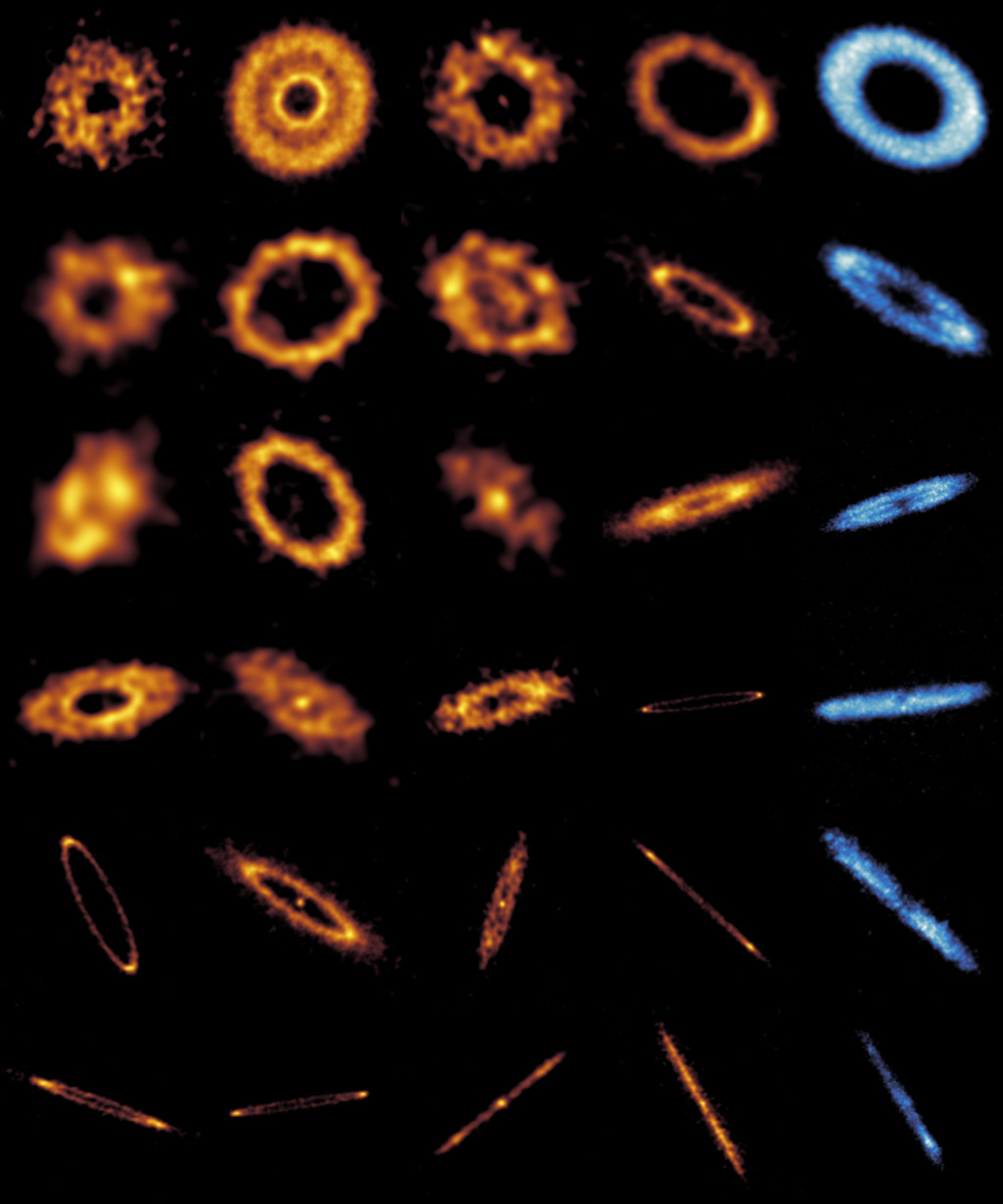
This ALMA survey to Resolve exoKuiper belt Substructures (ARKS) gallery of faint debris disks reveals details about their shape: belts with multiple rings, wide smooth halos, sharp edges, and unexpected arcs and clumps, which hint at the presence of planets shaping these disks; and chemical make-up: the amber colors highlight the location and abundance of the dust in the 24 disks surveyed, while the blue their carbon monoxide gas location and abundance in the six gas-rich disks.
News
Related News
Planetary Picture of the Day - Week of August 24, 2026
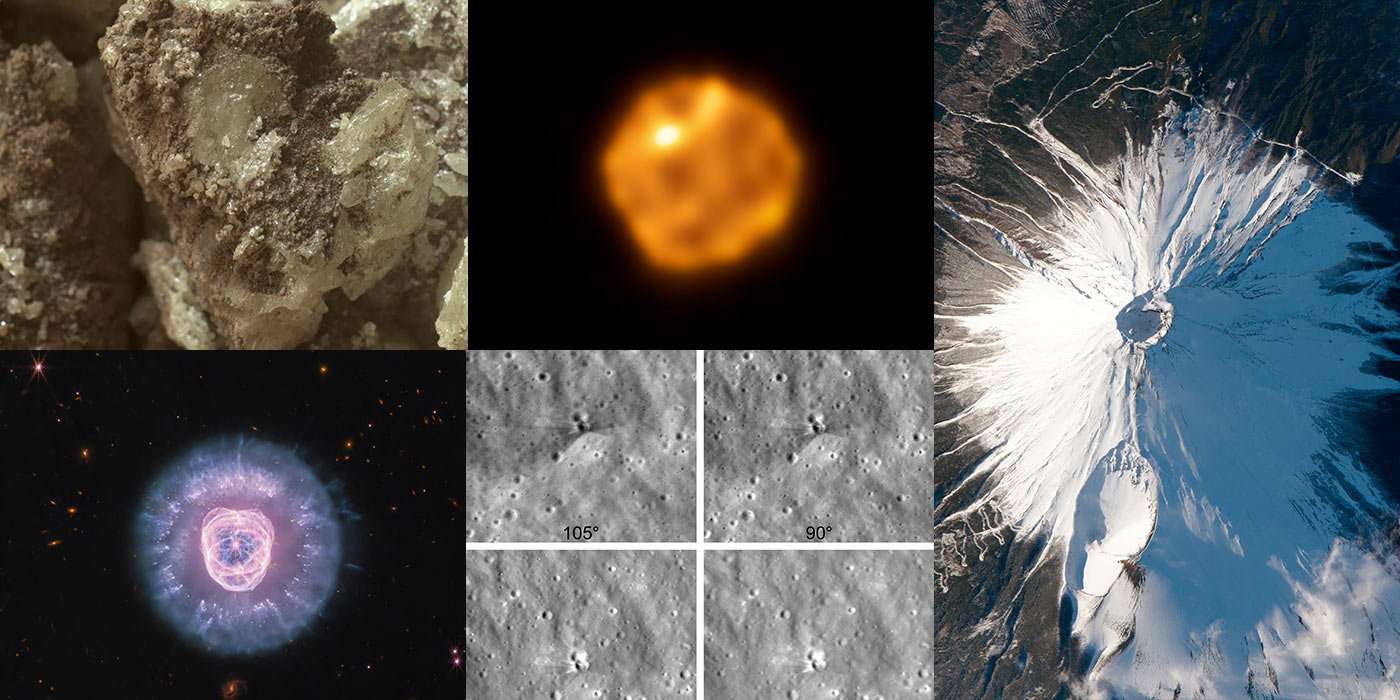
We journey from Mount Fuji as seen from orbit to the bubbling surface of Betelgeuse, exploring the forces that shape planets, moons, and stars across the cosmos. Along the way, JWST reveals the remains of a dying star, Curiosity uncovers clues to Mars’ volcanic past, and a fresh rocket impact on the Moon gives scientists a new opportunity to study how collisions reshape its surface. #PPOD
Planetary Picture of the Day - Week of August 17, 2026
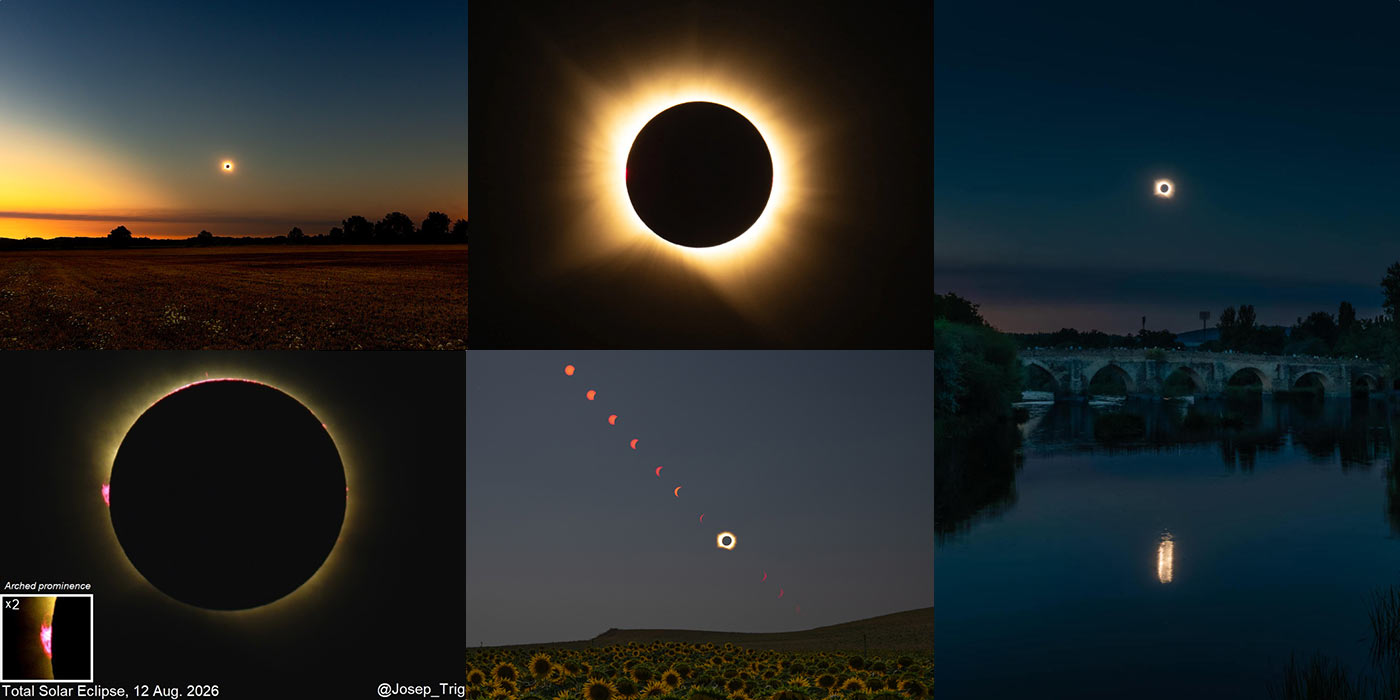
Let's celebrate the August 12 total solar eclipse through the eyes of photographers who experienced the Moon’s shadow sweeping across Spain. From Baily’s Beads and a glowing solar prominence to totality reflected in a river and framed by fields of sunflowers, these images capture both the science and extraordinary beauty of one of nature’s most spectacular celestial events. #PPOD #Eclipse
Planetary Picture of the Day - Week of August 10, 2026
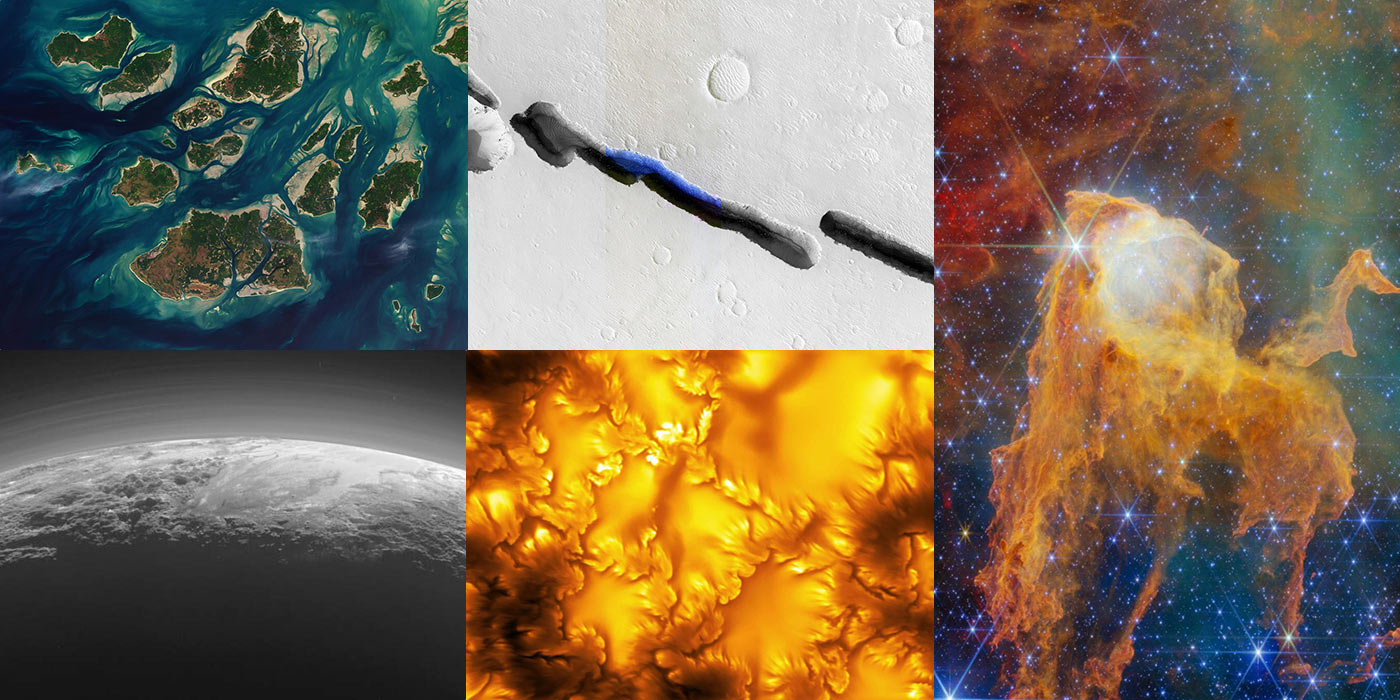
The universe is shaped by forces both immense and intricate, from fractured terrain on Mars and shifting tidal landscapes on Earth to tiny vortices dancing across the surface of the Sun. Farther afield, dramatic views of Pluto’s icy mountains and hazy atmosphere and a treasure chest of newborn stars in the Carina Nebula showcase the remarkable detail revealed by spacecraft and telescopes exploring the cosmos. #PPOD
Planetary Picture of the Day - August 3, 2026
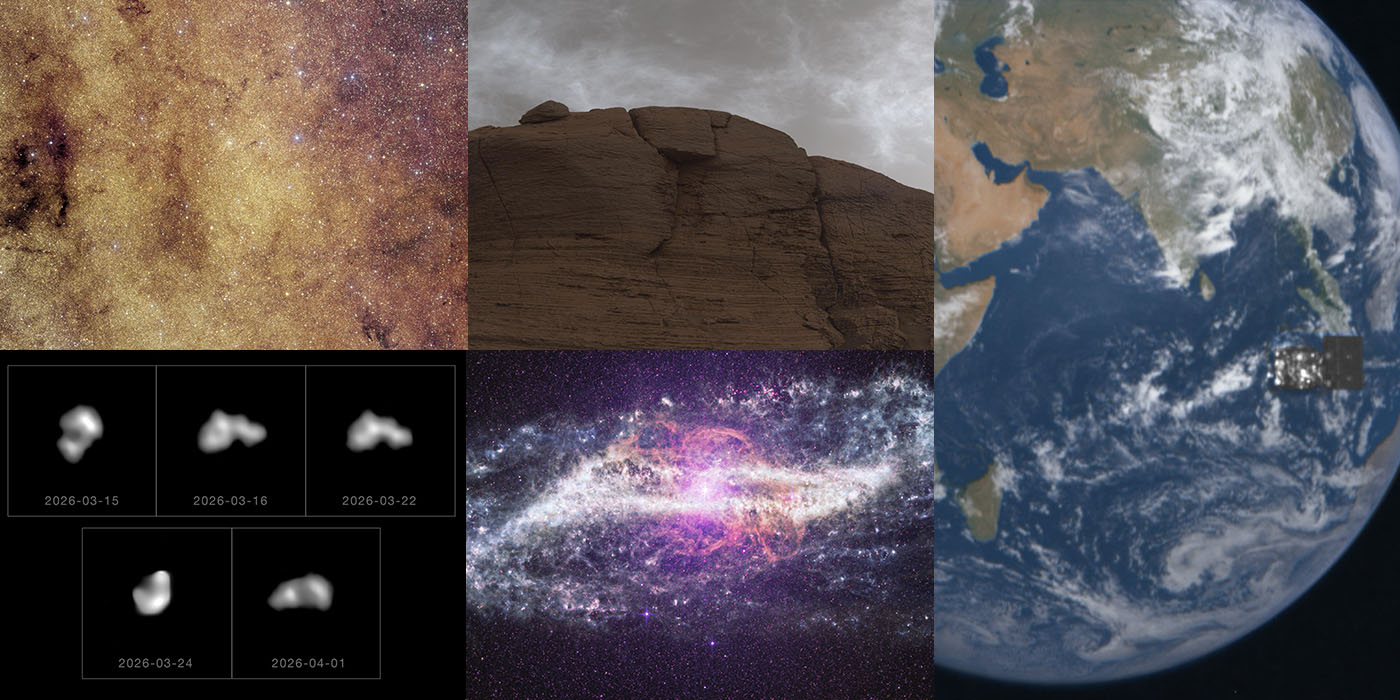
This week, we reveal hidden wonders across the cosmos, from delicate Martian clouds and a dust-shrouded galaxy to an asteroid with a never-before-seen shape and the crowded heart of the Milky Way. Together, these images showcase how new missions and advanced observatories continue to uncover surprising details about our solar system, our galaxy, and the universe beyond. #PPOD
Planetary Picture of the Day - Week of July 27, 2026
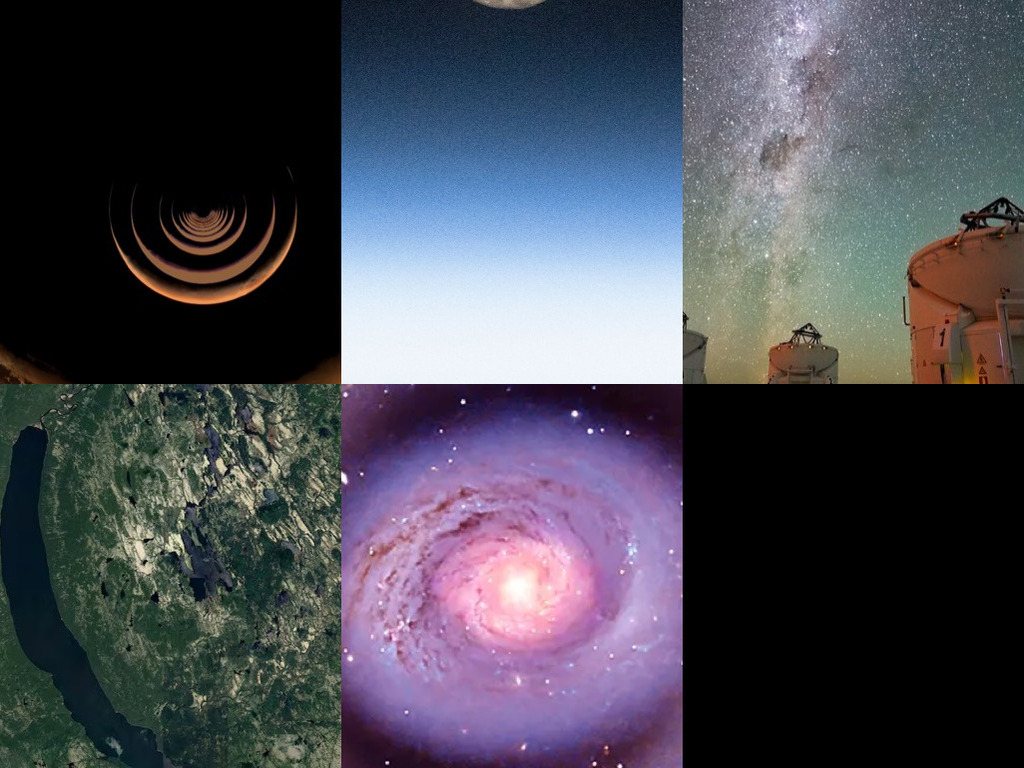
These images span the journey from our own backyard to distant galaxies, featuring Mars, the Moon, breathtaking night skies, and a fresh view of the star-forming galaxy Messier 94. Along the way, we celebrate exploration and discovery—from NASA’s Psyche mission preparing for its asteroid encounter to the revelation of a previously unknown impact crater on Earth —reminding us that there are still new wonders to uncover both on our own planet and across the cosmos. #PPOD
Planetary Picture of the Day - Week of July 20, 2026
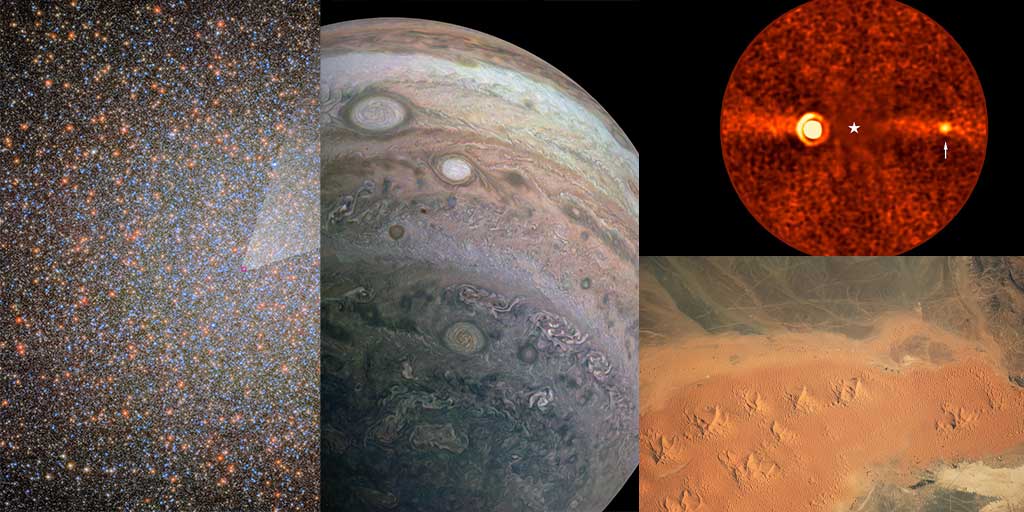
This week, we celebrate fifty years since Viking 1 became the first spacecraft to successfully land on and photograph the surface of Mars, alongside stunning new views of worlds, stars, and galaxies that continue to expand our understanding of the universe. From sculpted Sahara sand dunes and Jupiter’s colorful cloud bands to a newly discovered exoplanet and the first stellar-mass black hole identified in Omega Centauri, these images showcase the remarkable diversity of cosmic exploration. #PPODResearch
Related Projects
SkyMapper: Expanding Access to Real-time Astronomy Through a Global Astronomical Network
SkyMapper and the SETI Institute are connecting educators, students and the public to live astronomical observations through a distributed astronomical network. #SkyMapper #SETI #Citizen Science #Astronomy
Virtual Planetary Laboratory
How can we best assess whether an exoplanet supports life? #VPL
Discovery and Futures Lab
What happens if life beyond Earth is discovered? The Discovery and Futures Lab at the SETI Institute fosters novel and anticipatory research at the intersection of science, society, our planet, and the search for life beyond Earth. #Discovery and Futures LabSupport the
SETI Institute
Scientists are getting closer in their search for life beyond earth. But with limited federal funding for the search for extraterrestrial intelligence, supporters are the reason cutting-edge scientists can keep their eyes on the sky.