Planetary Picture of the Day Week of February 3, 2025
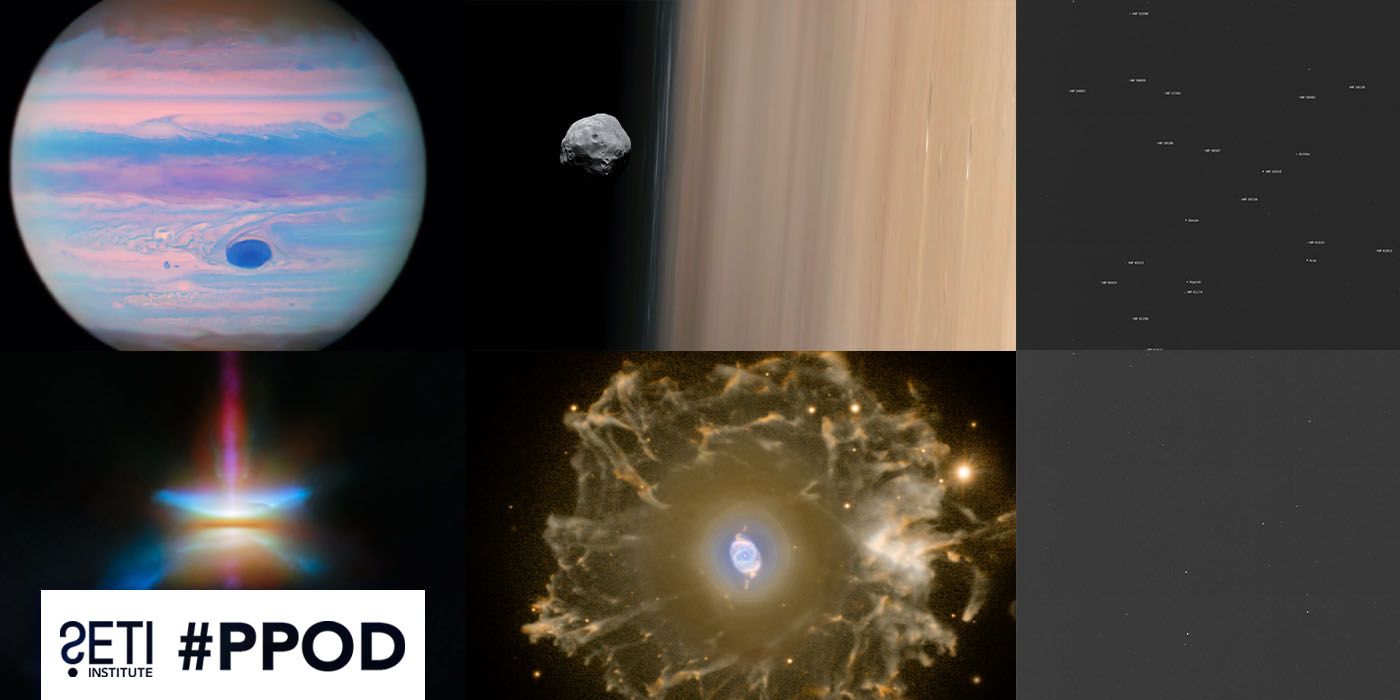
This week, we feature Mars and Jupiter, the first image from Europa Clipper, a new picture from JWST, and a celebration of the wondrous Cat's Eye Nebula.
Monday, 3 February 2025
Credit: ESA/DLR/FUBerlin; Andrea Luck
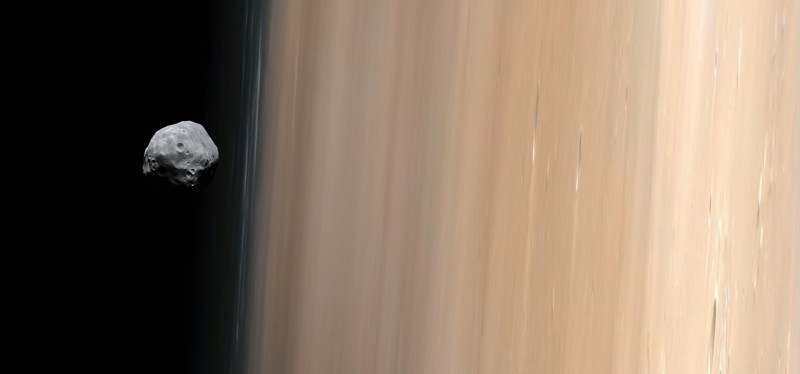
Phobos Over Mars Phobos, the larger of Mars's two moons, measures 27 x 22 x 18 kilometers. It orbits Mars three times a day and is so close to the surface that it is not always visible from certain locations on Mars. Phobos came close to being destroyed by a significant impact and is scarred by numerous meteorite strikes.
The moon's trajectory will eventually bring it into contact with Mars, drawing nearer at a rate of 1.8 meters every hundred years. Within 50 million years, Phobos will either crash into Mars or break apart, forming a ring around the planet.
This colorized image was created using a single shot from ESA's Mars Express, not a composite image. The satellite's camera scans the Martian surface, stretching the view as it moves by.
Tuesday, 4 February 2025
Image credit: NASA, ESA, and M. Wong (University of California – Berkeley); Processing: Gladys Kober (NASA/Catholic University of America)
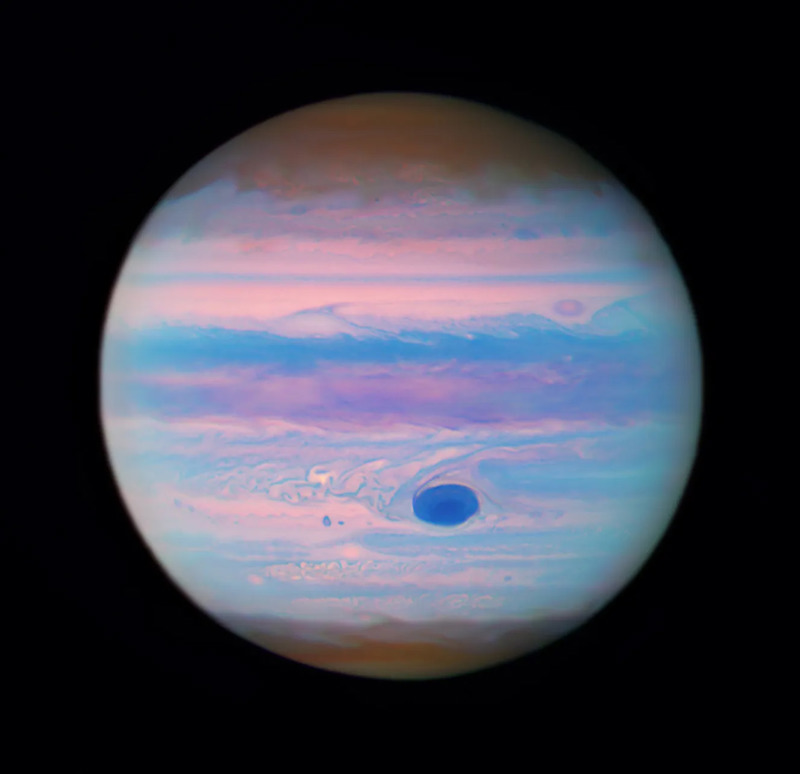
Jupiter in Ultraviolet Light This NASA Hubble Space Telescope image shows the planet Jupiter in a color composite of ultraviolet wavelengths. Released on Nov. 3, 2023, in honor of Jupiter reaching opposition, which occurs when the planet and the Sun are on opposite sides of the sky, this view of the gas giant planet includes the iconic, massive storm called the “Great Red Spot.” Though the storm appears red to the human eye, this ultraviolet image appears darker because high-altitude haze particles absorb light at these wavelengths. The reddish, wavy polar hazes absorb slightly less of this light due to particle size, composition, or altitude differences.
Wednesday, 5 February 2025
Credit: ESA/Webb, NASA & CSA, Tazaki et al.
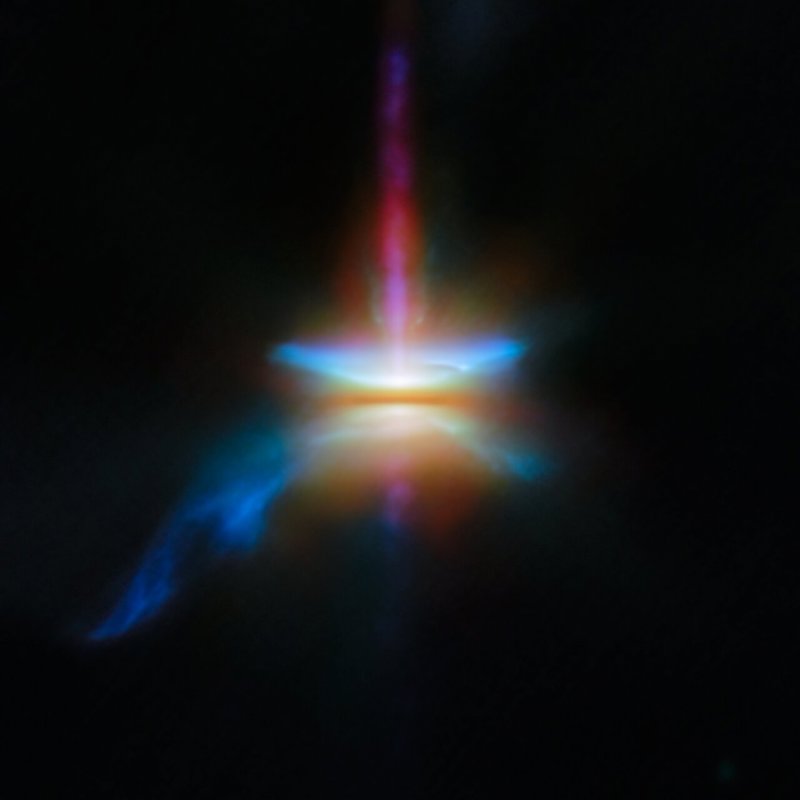
A Dusty and Dynamic Disc This new NASA/ESA/CSA James Webb Space Telescope Picture of the Month presents HH 30 in unprecedented resolution. This target is an edge-on protoplanetary disc surrounded by jets and a disc wind. It is located in the dark cloud LDN 1551 in the Taurus Molecular Cloud.
Herbig-Haro objects are small nebulae found in star formation regions. They mark the locations where gas outflowing from young stars is heated into luminescence by shockwaves. HH 30 is an example of this outflowing gas, which takes the form of a narrow jet. The source star is located on one end of the jet, hidden behind an edge-on protoplanetary disc that the star illuminates.
Thursday, 6 February 2025
Credit: NASA/JPL-Caltech
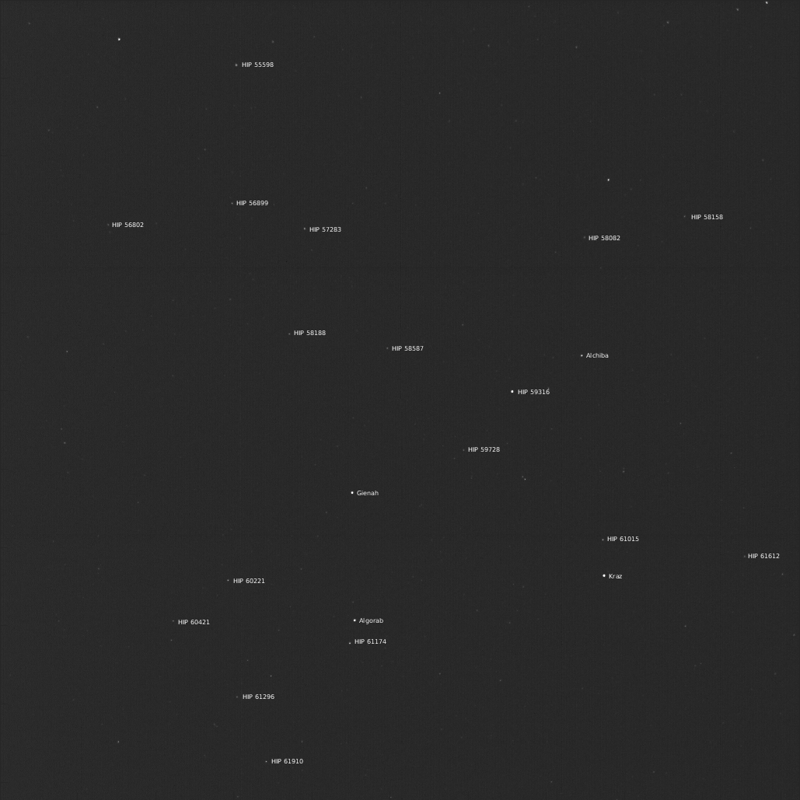
First Images From NASA's Europa Clipper This mosaic of a star field was made from three images captured on Dec. 4, 2024, by star tracker cameras aboard NASA's Europa Clipper spacecraft. The pair of star trackers (formally known as the stellar reference units) captured and transmitted Europa Clipper's first imagery of space. The picture, composed of three shots, shows tiny pinpricks of light from stars 150 to 300 light-years away. The starfield represents only about 0.1% of the full sky around the spacecraft, but by mapping the stars in just that small slice of sky, the orbiter is able to determine where it is pointed and orient itself correctly.
The starfield includes the four brightest stars – Gienah, Algorab, Kraz, and Alchiba – of the constellation Corvus, which is Latin for "crow," a bird in Greek mythology that was associated with Apollo. Besides being interesting to stargazers, the photos signal the successful checkout of the star trackers. The spacecraft checkout phase has been going on since Europa Clipper launched on a SpaceX Falcon Heavy rocket on Oct. 14, 2024.
Friday, 7 February 2025
Credit: Nordic Optical Telescope and Romano Corradi (Isaac Newton Group of Telescopes, Spain)
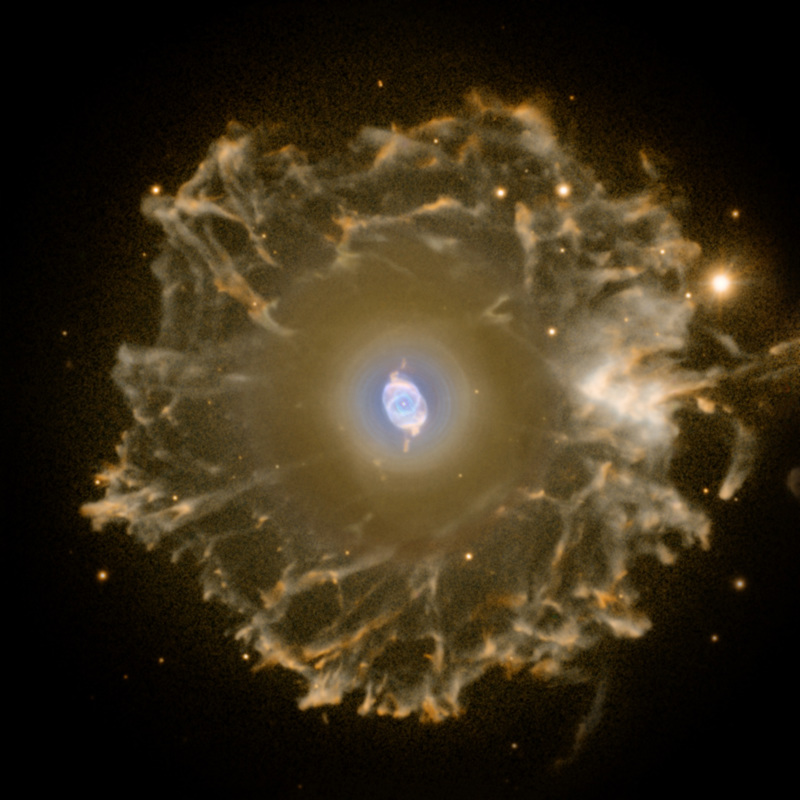
Cat's Eye Nebula The Cat's Eye Nebula (NGC 6543) was determined to be composed of ionized gases by Sir William Huggins, born on this date in 1824. Alongside his wife Margaret, the pair were the first to use a spectroscope to view the nebula's spectrum. At the center of the Cat's Eye Nebula is a dying Wolf Rayet star.
An enormous but extremely faint halo of gaseous material, over three light-years across, surrounds the Cat's Eye Nebula. In recent years, some planetary nebulae have been found to have halos like this one, likely formed of material ejected during earlier active episodes in the star's evolution—most likely some 50,000 to 90,000 years ago.
This image was taken by Romano Corradi with the Nordic Optical Telescope on La Palma, in the Canary Islands. It is constructed from two narrow-band exposures, showing oxygen atoms (1800 seconds, in blue) and nitrogen atoms (1800 seconds, in red).
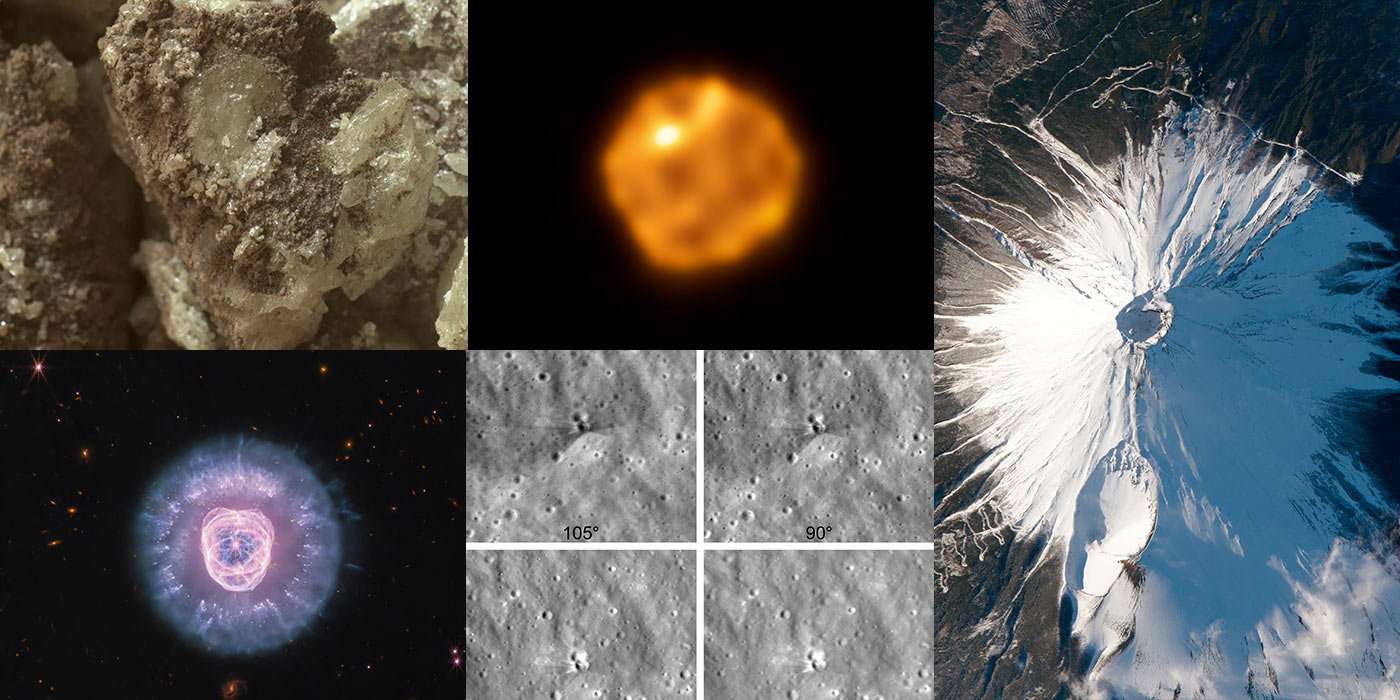
We journey from Mount Fuji as seen from orbit to the bubbling surface of Betelgeuse, exploring the forces that shape planets, moons, and stars across the cosmos. Along the way, JWST reveals the remains of a dying star, Curiosity uncovers clues to Mars’ volcanic past, and a fresh rocket impact on the Moon gives scientists a new opportunity to study how collisions reshape its surface.
#PPOD
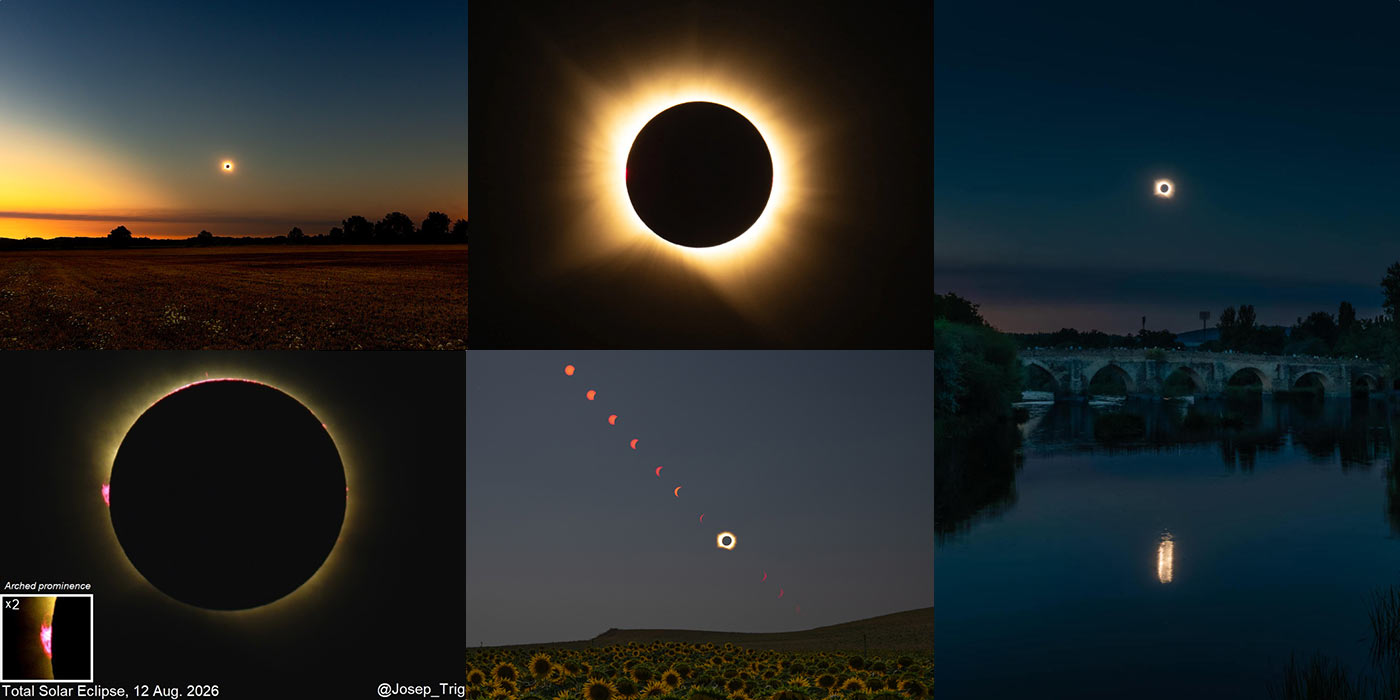
Let's celebrate the August 12 total solar eclipse through the eyes of photographers who experienced the Moon’s shadow sweeping across Spain. From Baily’s Beads and a glowing solar prominence to totality reflected in a river and framed by fields of sunflowers, these images capture both the science and extraordinary beauty of one of nature’s most spectacular celestial events.
#PPOD
#Eclipse
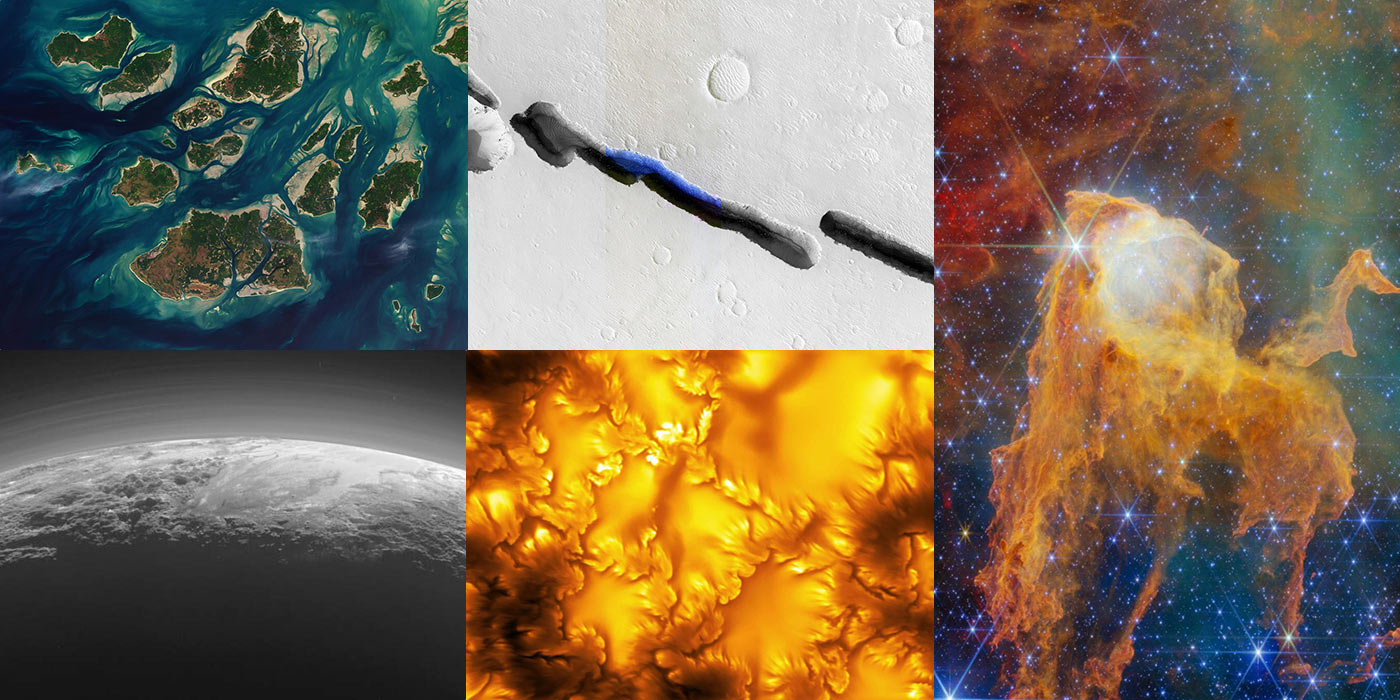
The universe is shaped by forces both immense and intricate, from fractured terrain on Mars and shifting tidal landscapes on Earth to tiny vortices dancing across the surface of the Sun. Farther afield, dramatic views of Pluto’s icy mountains and hazy atmosphere and a treasure chest of newborn stars in the Carina Nebula showcase the remarkable detail revealed by spacecraft and telescopes exploring the cosmos.
#PPOD
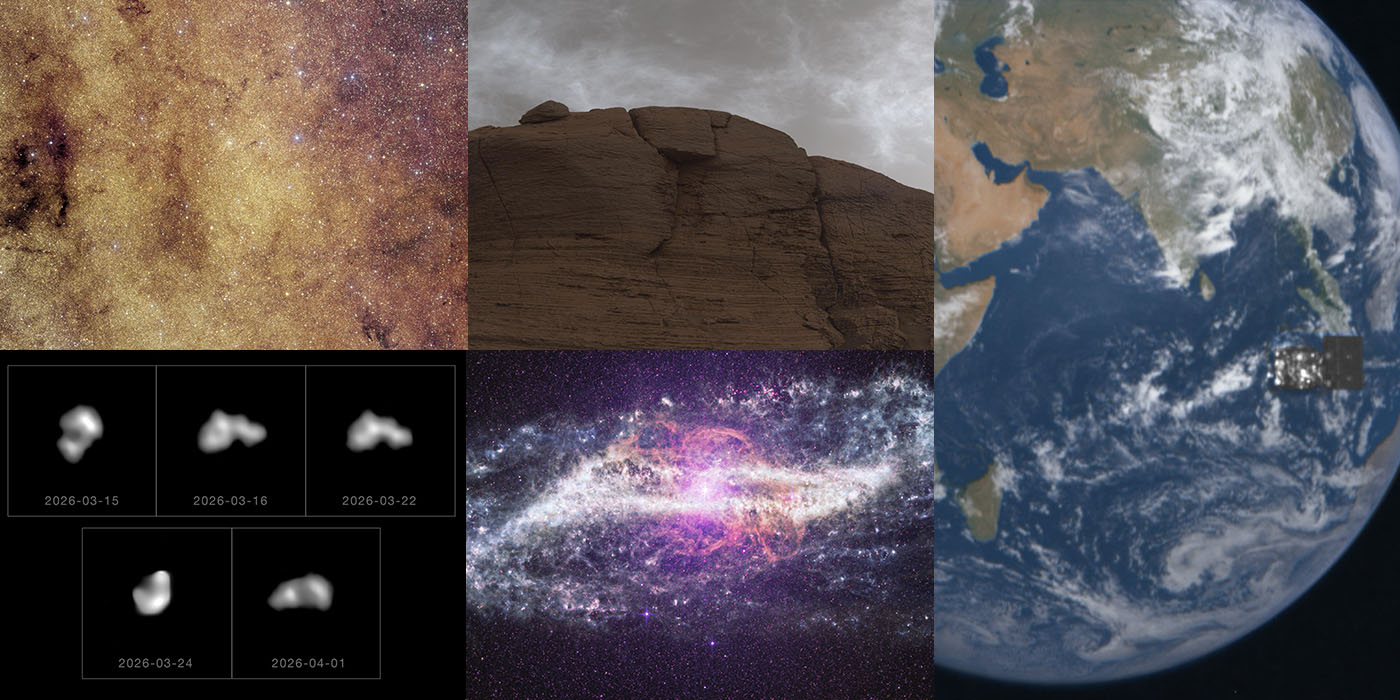
This week, we reveal hidden wonders across the cosmos, from delicate Martian clouds and a dust-shrouded galaxy to an asteroid with a never-before-seen shape and the crowded heart of the Milky Way. Together, these images showcase how new missions and advanced observatories continue to uncover surprising details about our solar system, our galaxy, and the universe beyond.
#PPOD
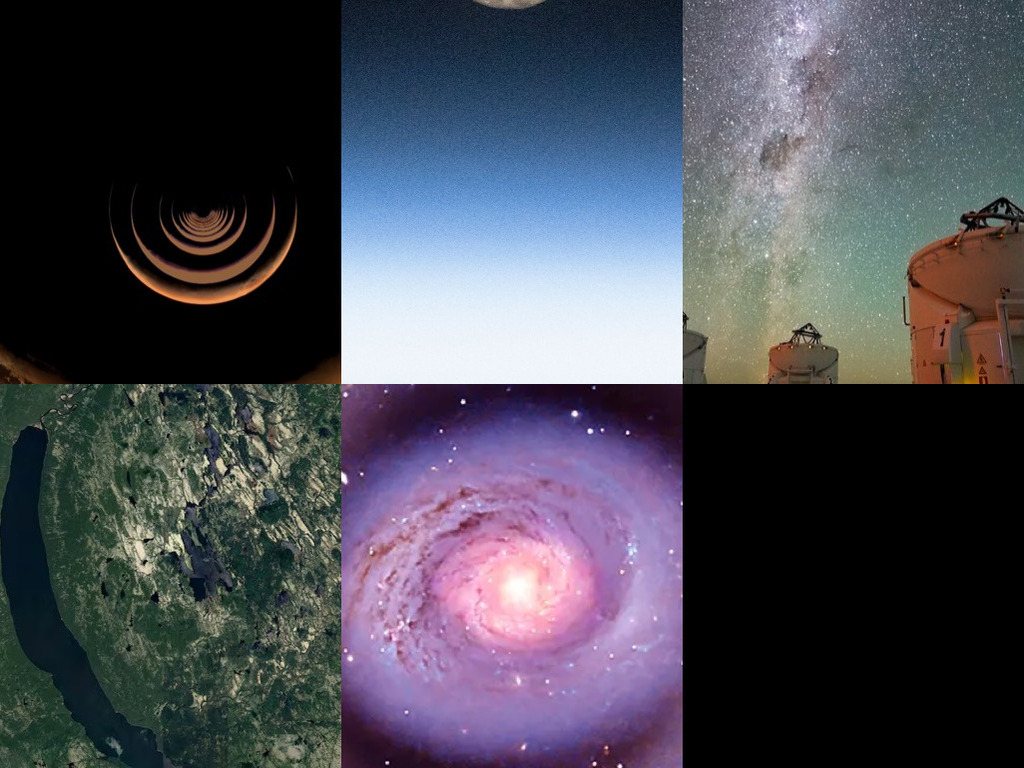
These images span the journey from our own backyard to distant galaxies, featuring Mars, the Moon, breathtaking night skies, and a fresh view of the star-forming galaxy Messier 94. Along the way, we celebrate exploration and discovery—from NASA’s Psyche mission preparing for its asteroid encounter to the revelation of a previously unknown impact crater on Earth —reminding us that there are still new wonders to uncover both on our own planet and across the cosmos.
#PPOD
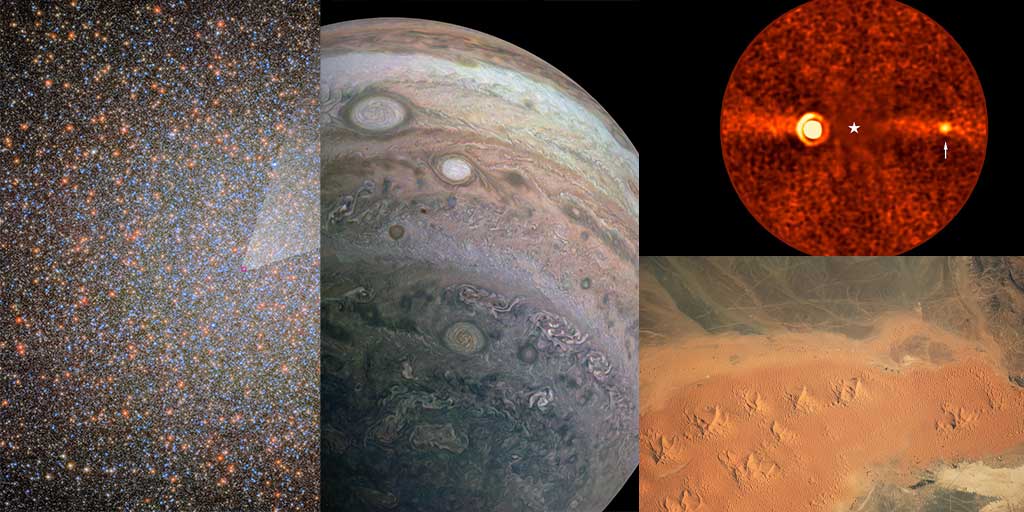
This week, we celebrate fifty years since Viking 1 became the first spacecraft to successfully land on and photograph the surface of Mars, alongside stunning new views of worlds, stars, and galaxies that continue to expand our understanding of the universe. From sculpted Sahara sand dunes and Jupiter’s colorful cloud bands to a newly discovered exoplanet and the first stellar-mass black hole identified in Omega Centauri, these images showcase the remarkable diversity of cosmic exploration.
#PPOD
We journey from Mount Fuji as seen from orbit to the bubbling surface of Betelgeuse, exploring the forces that shape planets, moons, and stars across the cosmos. Along the way, JWST reveals the remains of a dying star, Curiosity uncovers clues to Mars’ volcanic past, and a fresh rocket impact on the Moon gives scientists a new opportunity to study how collisions reshape its surface.
Let's celebrate the August 12 total solar eclipse through the eyes of photographers who experienced the Moon’s shadow sweeping across Spain. From Baily’s Beads and a glowing solar prominence to totality reflected in a river and framed by fields of sunflowers, these images capture both the science and extraordinary beauty of one of nature’s most spectacular celestial events.
The universe is shaped by forces both immense and intricate, from fractured terrain on Mars and shifting tidal landscapes on Earth to tiny vortices dancing across the surface of the Sun. Farther afield, dramatic views of Pluto’s icy mountains and hazy atmosphere and a treasure chest of newborn stars in the Carina Nebula showcase the remarkable detail revealed by spacecraft and telescopes exploring the cosmos.
This week, we reveal hidden wonders across the cosmos, from delicate Martian clouds and a dust-shrouded galaxy to an asteroid with a never-before-seen shape and the crowded heart of the Milky Way. Together, these images showcase how new missions and advanced observatories continue to uncover surprising details about our solar system, our galaxy, and the universe beyond.
These images span the journey from our own backyard to distant galaxies, featuring Mars, the Moon, breathtaking night skies, and a fresh view of the star-forming galaxy Messier 94. Along the way, we celebrate exploration and discovery—from NASA’s Psyche mission preparing for its asteroid encounter to the revelation of a previously unknown impact crater on Earth —reminding us that there are still new wonders to uncover both on our own planet and across the cosmos.
This week, we celebrate fifty years since Viking 1 became the first spacecraft to successfully land on and photograph the surface of Mars, alongside stunning new views of worlds, stars, and galaxies that continue to expand our understanding of the universe. From sculpted Sahara sand dunes and Jupiter’s colorful cloud bands to a newly discovered exoplanet and the first stellar-mass black hole identified in Omega Centauri, these images showcase the remarkable diversity of cosmic exploration.
SkyMapper and the SETI Institute are connecting educators, students and the public to live astronomical observations through a distributed astronomical network.
#SkyMapper
#SETI
#Citizen Science
#Astronomy
What happens if life beyond Earth is discovered? The Discovery and Futures Lab at the SETI Institute fosters novel and anticipatory research at the intersection of science, society, our planet, and the search for life beyond Earth.
#Discovery and Futures Lab
SkyMapper and the SETI Institute are connecting educators, students and the public to live astronomical observations through a distributed astronomical network.
What happens if life beyond Earth is discovered? The Discovery and Futures Lab at the SETI Institute fosters novel and anticipatory research at the intersection of science, society, our planet, and the search for life beyond Earth.
Scientists are getting closer in their search for life beyond earth. But with limited federal funding for the search for extraterrestrial intelligence, supporters are the reason cutting-edge scientists can keep their eyes on the sky.
)