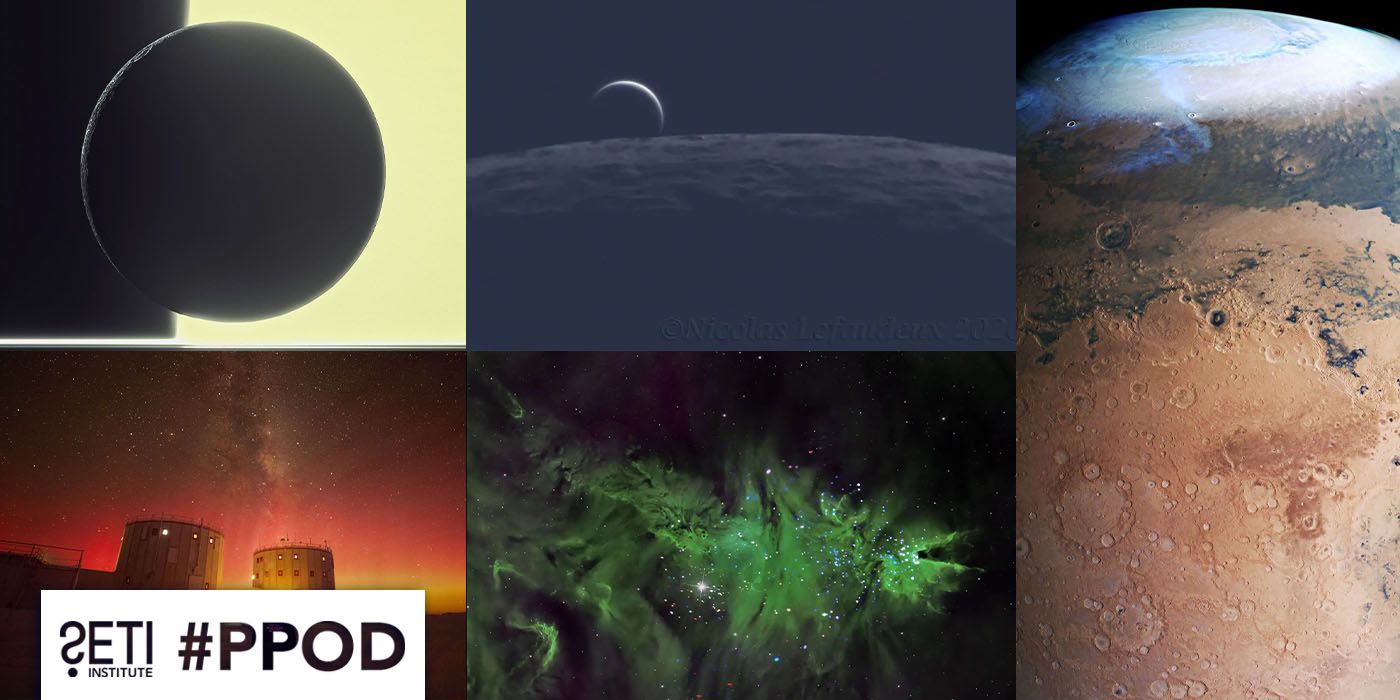
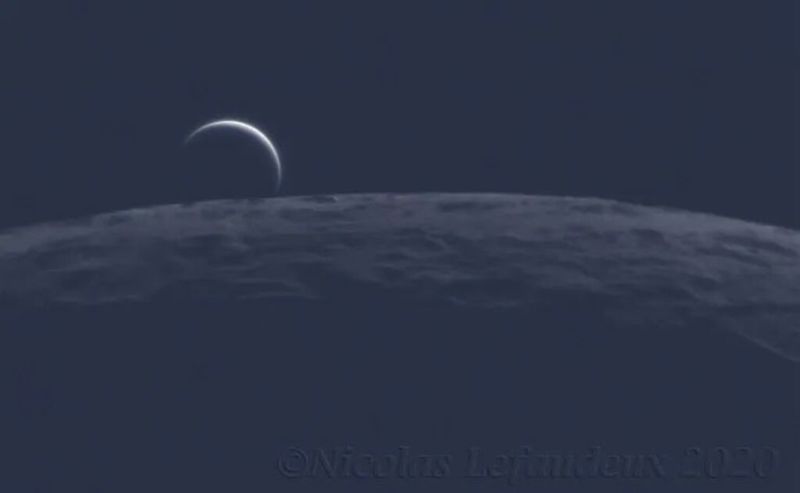
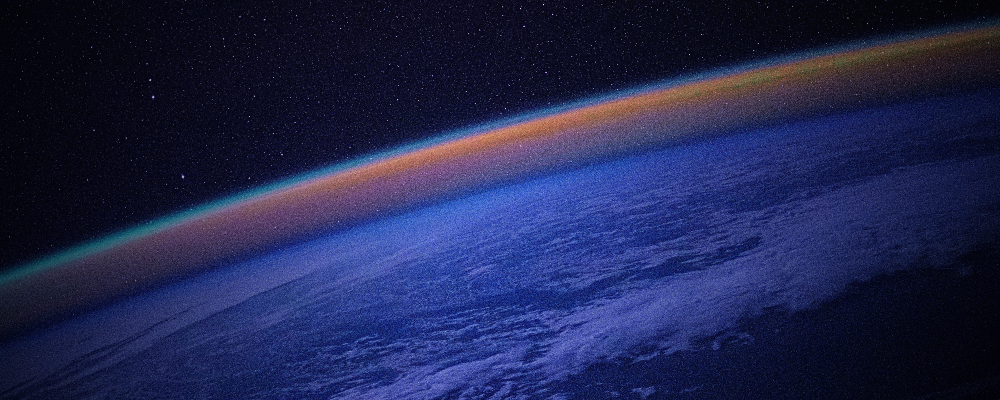
Venus Setting Venus setting behind the Moon as seen from Earth. This wonderful perspective is reminiscent of the iconic images of the planet Earth captured by the Apollo astronauts. Taken on June 19, 2020, as the crescent moon was about to occult the planet Venus. This is the winning photo in the "Our Moon" category in the 2021 Astronomy Photographer of the Year competition, taken by Nicolas Lefaudeux from Forges-les-Bains, Île-de-France, France.
Tuesday, 31 December 2024
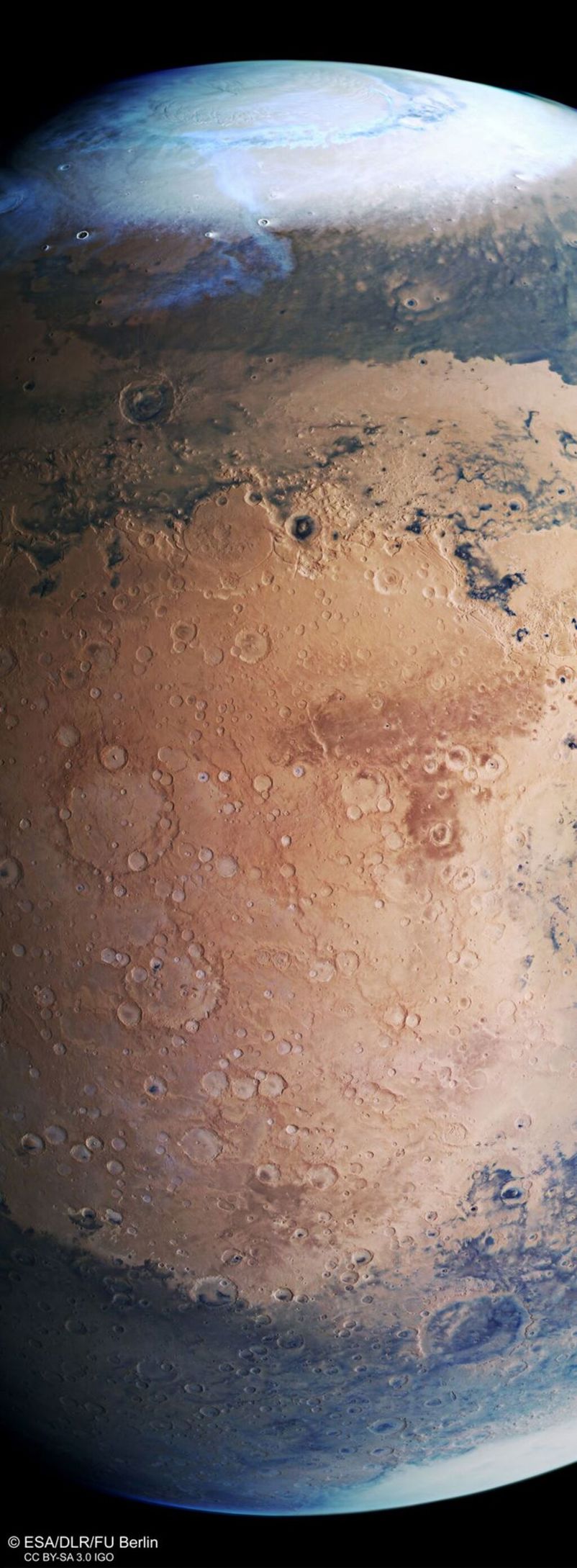
Credit: ESA/DLR/FU Berlin
Mars Express view of Terra Sabaea and Arabia Terra This image from ESA’s Mars Express shows a beautiful slice of the red planet from the northern polar cap downwards, and highlights cratered, pockmarked swathes of the Terra Sabaea and Arabia Terra regions. It comprises data gathered on 17 June 2019 during orbit 19550. The ground resolution at the center of the image is approximately 1 km/pixel, and the images are centered at about 44°E/26°N. This image was created using data from the nadir and color channels of the High-Resolution Stereo Camera. The nadir channel is aligned perpendicular to the surface of Mars as if looking straight down at the surface. North is up.
Wednesday, 1 January 2025
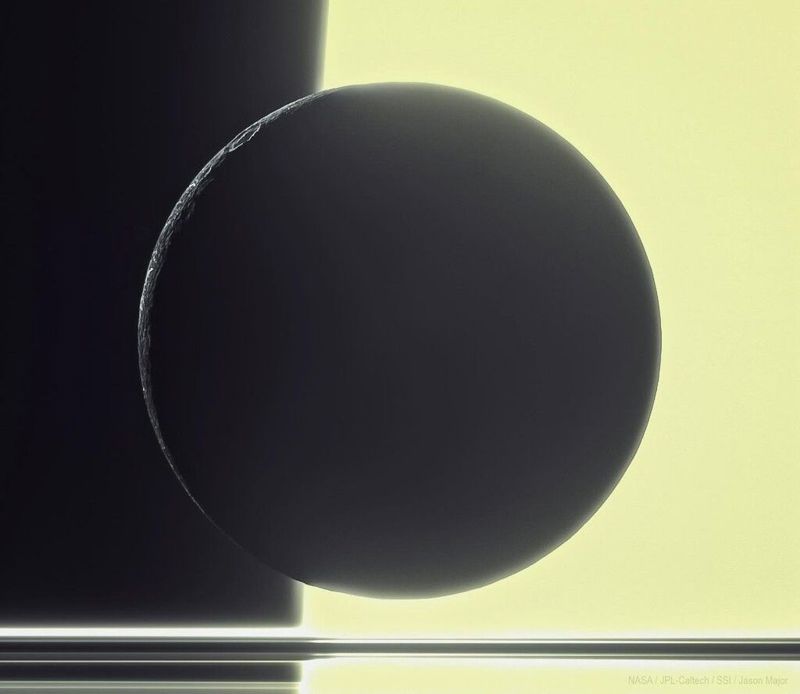
Credit: NASA / JPL-Caltech / SSI / CICLOPS / Jason Major
Dione This is the silhouette of the 1,122-km-wide moon Dione in front of Saturn: a view captured with NASA's Cassini spacecraft just over 14 years ago on December 20, 2010. Synthesized color from a single clear-filter greyscale image.
Thursday, 2 January 2025
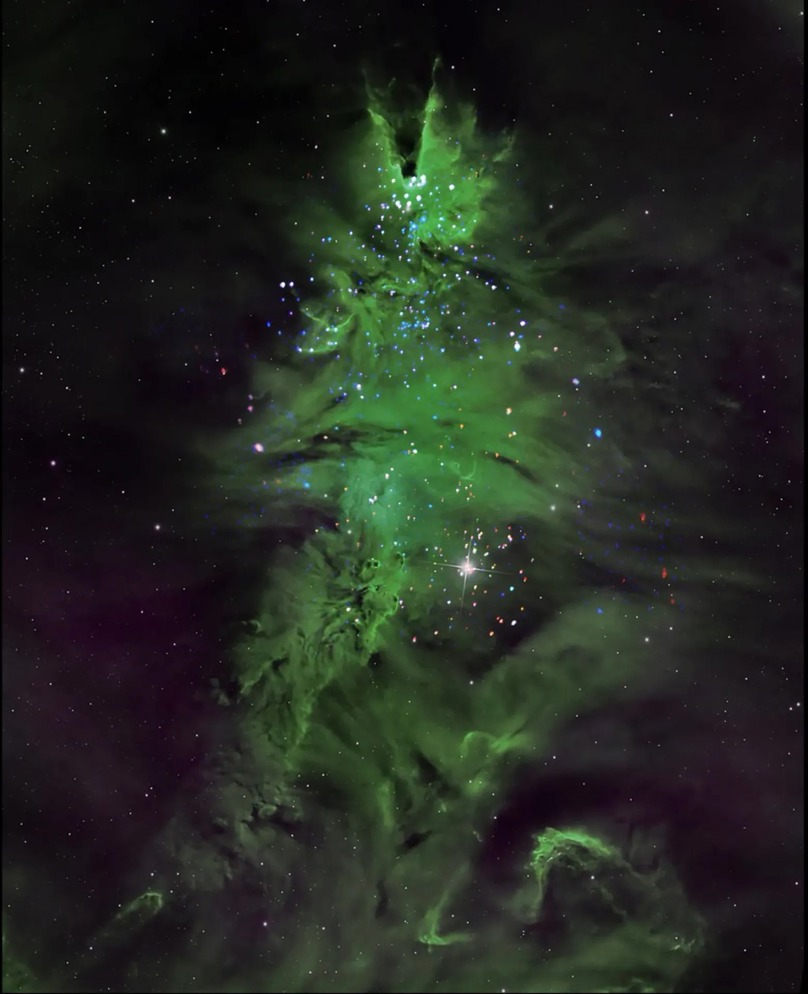
Credit: X-ray: NASA/CXC/SAO; Optical: Clow, M.; Image Processing: NASA/CXC/SAO/L. Frattare and K. Arcand
Hang a Shining Star Upon the Highest Bough This new view of the “Christmas tree cluster” NGC 2264, released on Dec. 17, 2024, combines data from NASA’s Chandra X-ray Observatory and optical data from astrophotographer Michael Clow’s telescope in Arizona. Chandra data is represented in red, purple, blue, and white, while optical data is in green and violet.
Located about 2,500 light-years from Earth, NGC 2264 is a cluster of young stars between one and five million years old. The stars are seen here as blue and white lights surrounded by swirls of gas—the “pine needles” of the tree—with green representing light in the visible spectrum.
Friday, 3 January 2025
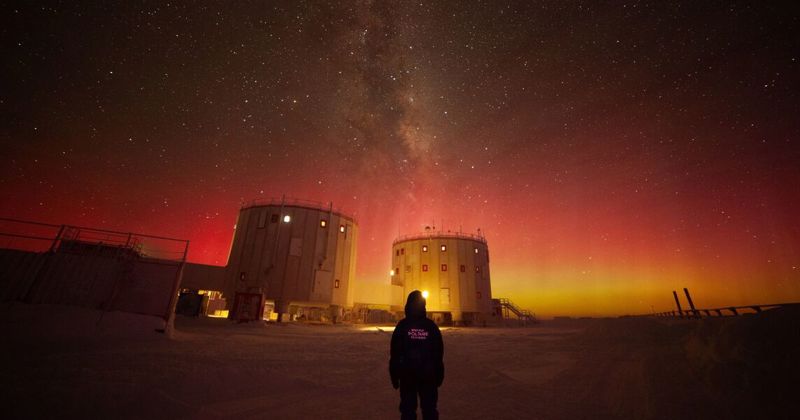
Credit: ESA/IPEV/PNRA-J. Studer
Aurora Australis in Antarctica A mesmerizing display of Aurora Australis (southern lights) glows over the Concordia research station in Antarctica, with yellow hues shimmering near the horizon and red lights stretching upwards into the vast polar sky.
Standing beneath this incredible natural phenomenon is Jessica Studer, the ESA-sponsored medical doctor for Concordia's 2024 winter-over. Jessica lived with a small team in complete isolation during the harsh Antarctic winter, where the Sun doesn't rise for four months and temperatures plunge as low as –85°C.
The aurorae visible here were captured in May 2024.
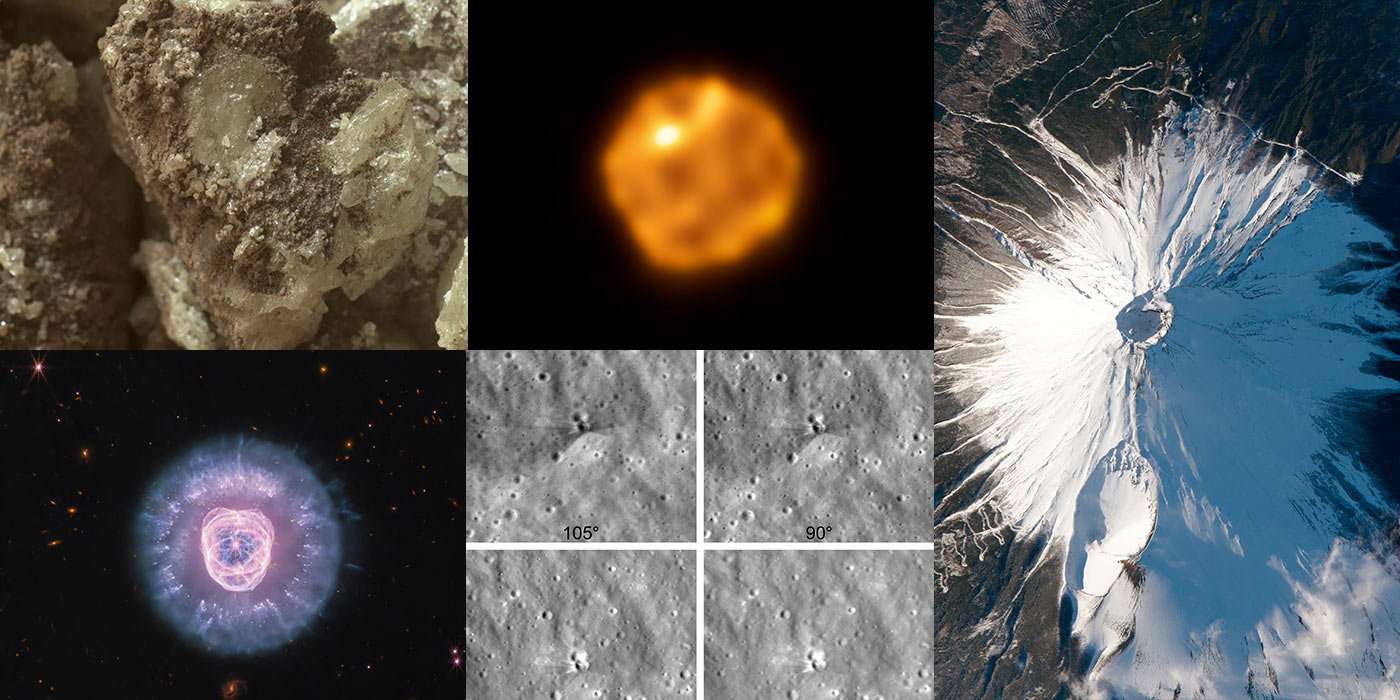
We journey from Mount Fuji as seen from orbit to the bubbling surface of Betelgeuse, exploring the forces that shape planets, moons, and stars across the cosmos. Along the way, JWST reveals the remains of a dying star, Curiosity uncovers clues to Mars’ volcanic past, and a fresh rocket impact on the Moon gives scientists a new opportunity to study how collisions reshape its surface.
#PPOD
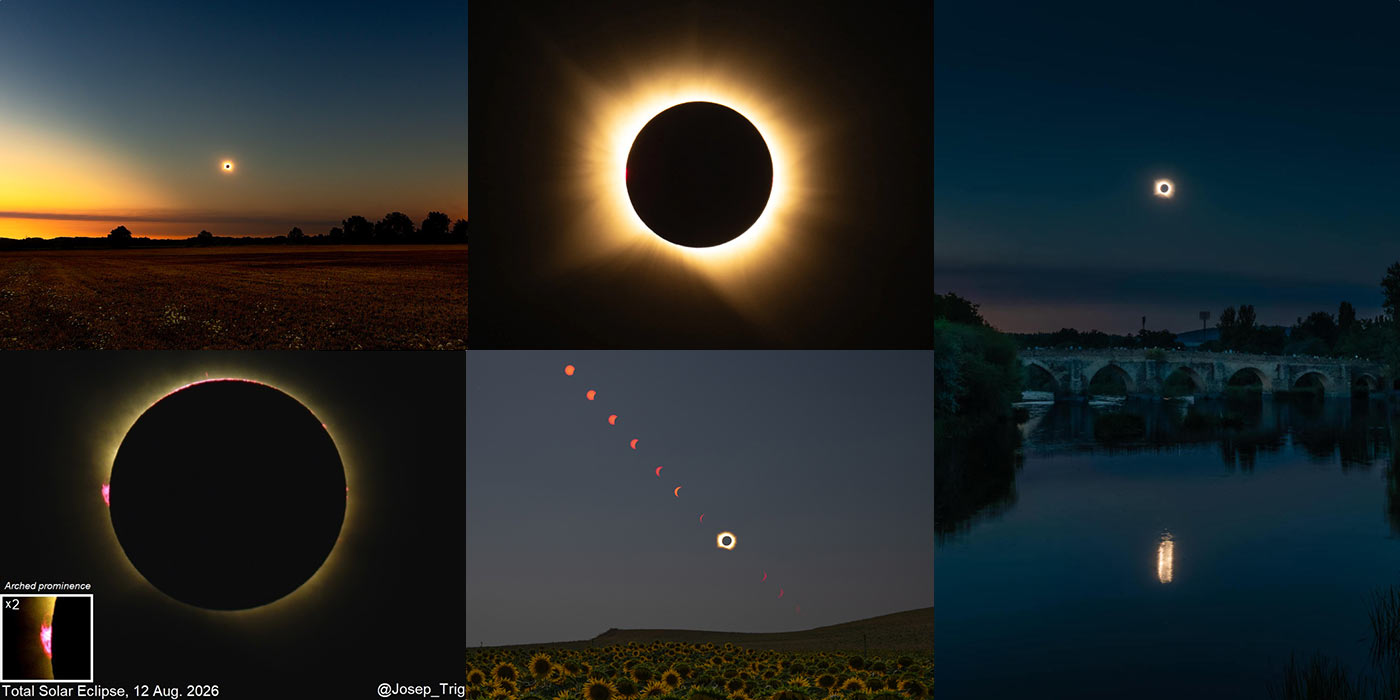
Let's celebrate the August 12 total solar eclipse through the eyes of photographers who experienced the Moon’s shadow sweeping across Spain. From Baily’s Beads and a glowing solar prominence to totality reflected in a river and framed by fields of sunflowers, these images capture both the science and extraordinary beauty of one of nature’s most spectacular celestial events.
#PPOD
#Eclipse
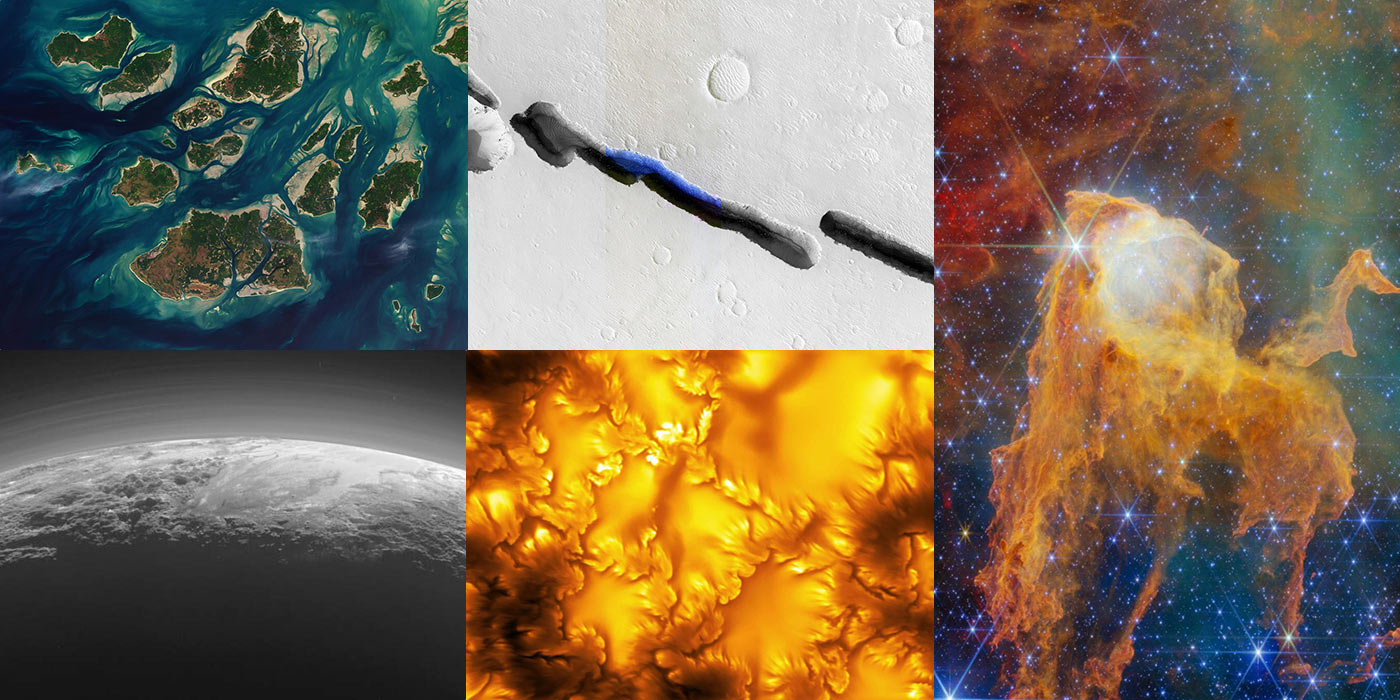
The universe is shaped by forces both immense and intricate, from fractured terrain on Mars and shifting tidal landscapes on Earth to tiny vortices dancing across the surface of the Sun. Farther afield, dramatic views of Pluto’s icy mountains and hazy atmosphere and a treasure chest of newborn stars in the Carina Nebula showcase the remarkable detail revealed by spacecraft and telescopes exploring the cosmos.
#PPOD
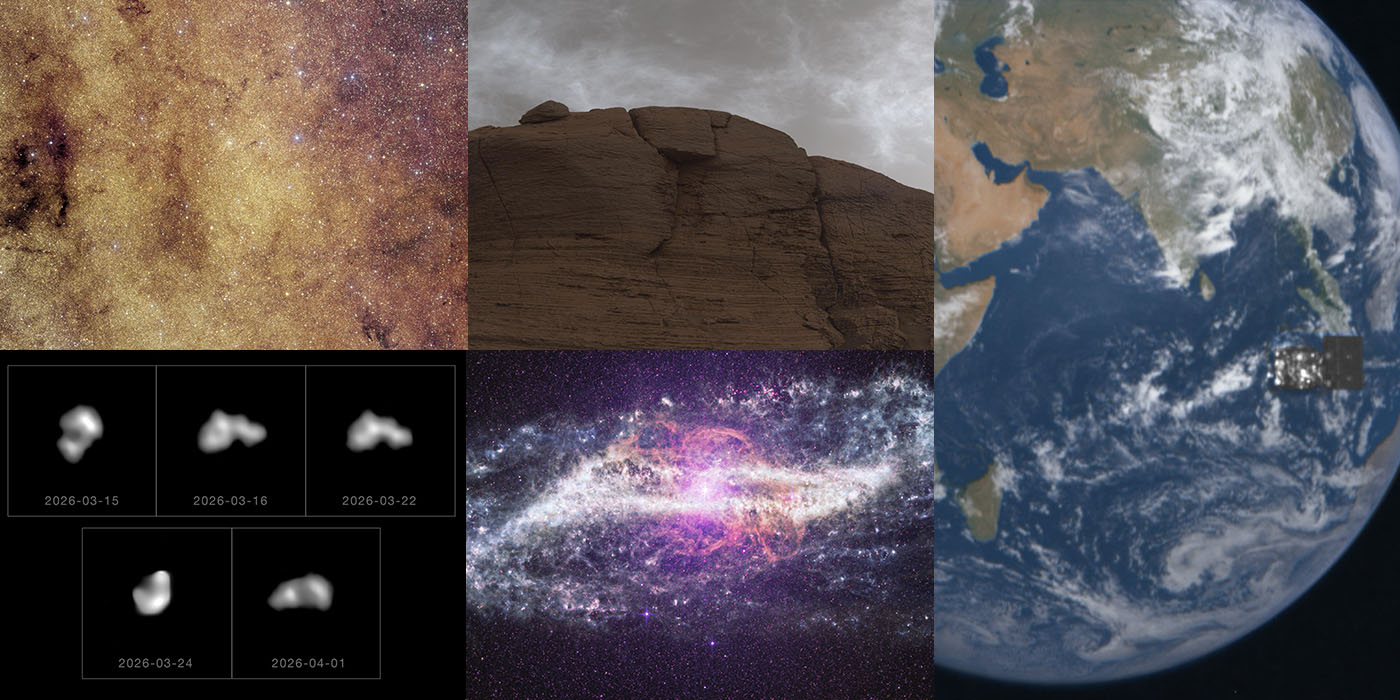
This week, we reveal hidden wonders across the cosmos, from delicate Martian clouds and a dust-shrouded galaxy to an asteroid with a never-before-seen shape and the crowded heart of the Milky Way. Together, these images showcase how new missions and advanced observatories continue to uncover surprising details about our solar system, our galaxy, and the universe beyond.
#PPOD
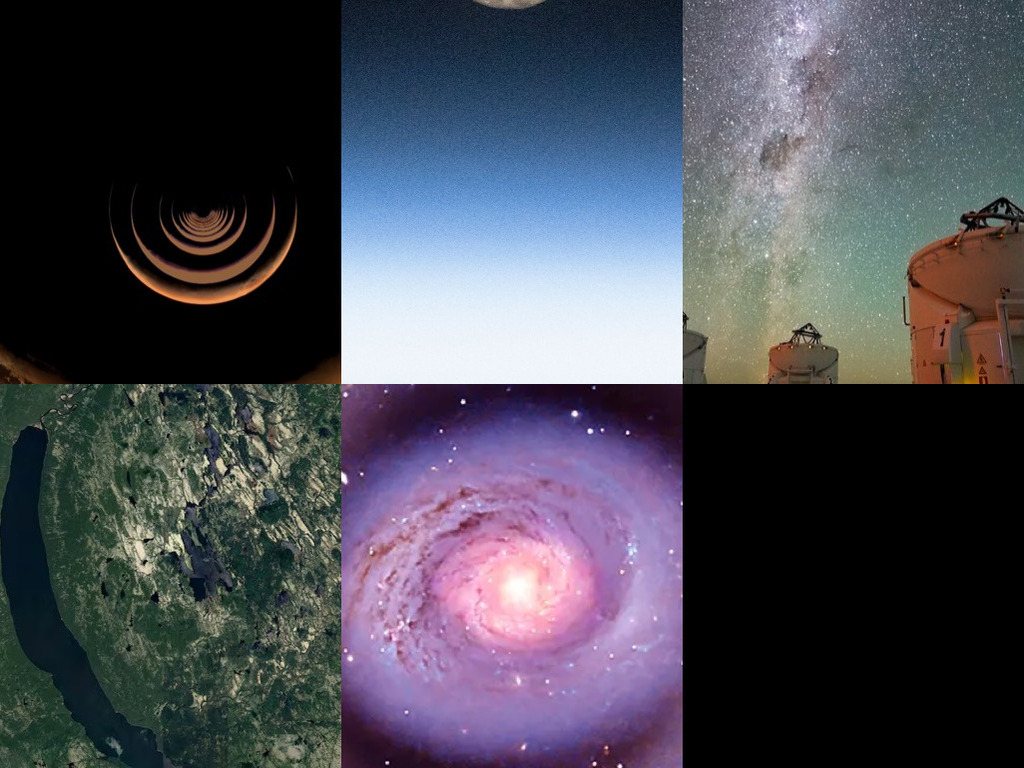
These images span the journey from our own backyard to distant galaxies, featuring Mars, the Moon, breathtaking night skies, and a fresh view of the star-forming galaxy Messier 94. Along the way, we celebrate exploration and discovery—from NASA’s Psyche mission preparing for its asteroid encounter to the revelation of a previously unknown impact crater on Earth —reminding us that there are still new wonders to uncover both on our own planet and across the cosmos.
#PPOD
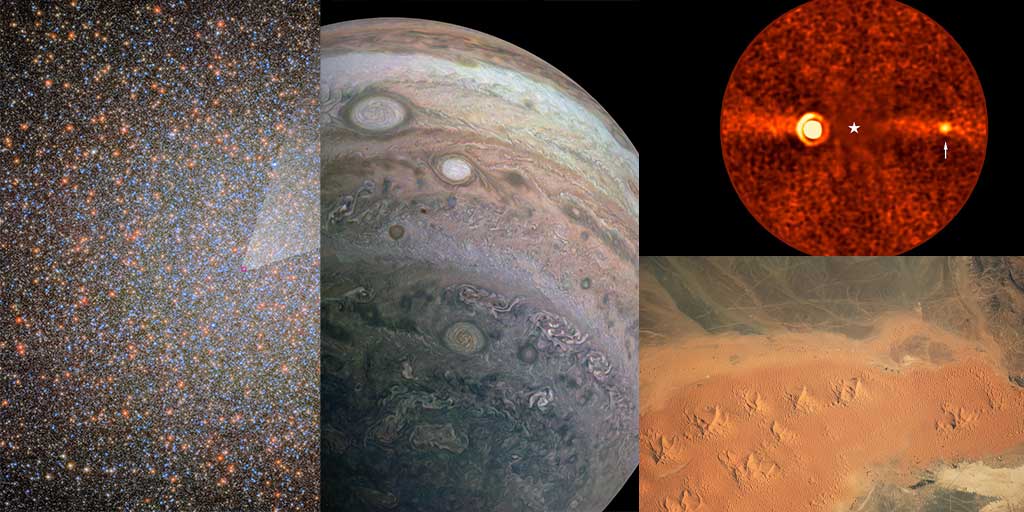
This week, we celebrate fifty years since Viking 1 became the first spacecraft to successfully land on and photograph the surface of Mars, alongside stunning new views of worlds, stars, and galaxies that continue to expand our understanding of the universe. From sculpted Sahara sand dunes and Jupiter’s colorful cloud bands to a newly discovered exoplanet and the first stellar-mass black hole identified in Omega Centauri, these images showcase the remarkable diversity of cosmic exploration.
#PPOD
We journey from Mount Fuji as seen from orbit to the bubbling surface of Betelgeuse, exploring the forces that shape planets, moons, and stars across the cosmos. Along the way, JWST reveals the remains of a dying star, Curiosity uncovers clues to Mars’ volcanic past, and a fresh rocket impact on the Moon gives scientists a new opportunity to study how collisions reshape its surface.
Let's celebrate the August 12 total solar eclipse through the eyes of photographers who experienced the Moon’s shadow sweeping across Spain. From Baily’s Beads and a glowing solar prominence to totality reflected in a river and framed by fields of sunflowers, these images capture both the science and extraordinary beauty of one of nature’s most spectacular celestial events.
The universe is shaped by forces both immense and intricate, from fractured terrain on Mars and shifting tidal landscapes on Earth to tiny vortices dancing across the surface of the Sun. Farther afield, dramatic views of Pluto’s icy mountains and hazy atmosphere and a treasure chest of newborn stars in the Carina Nebula showcase the remarkable detail revealed by spacecraft and telescopes exploring the cosmos.
This week, we reveal hidden wonders across the cosmos, from delicate Martian clouds and a dust-shrouded galaxy to an asteroid with a never-before-seen shape and the crowded heart of the Milky Way. Together, these images showcase how new missions and advanced observatories continue to uncover surprising details about our solar system, our galaxy, and the universe beyond.
These images span the journey from our own backyard to distant galaxies, featuring Mars, the Moon, breathtaking night skies, and a fresh view of the star-forming galaxy Messier 94. Along the way, we celebrate exploration and discovery—from NASA’s Psyche mission preparing for its asteroid encounter to the revelation of a previously unknown impact crater on Earth —reminding us that there are still new wonders to uncover both on our own planet and across the cosmos.
This week, we celebrate fifty years since Viking 1 became the first spacecraft to successfully land on and photograph the surface of Mars, alongside stunning new views of worlds, stars, and galaxies that continue to expand our understanding of the universe. From sculpted Sahara sand dunes and Jupiter’s colorful cloud bands to a newly discovered exoplanet and the first stellar-mass black hole identified in Omega Centauri, these images showcase the remarkable diversity of cosmic exploration.
SkyMapper and the SETI Institute are connecting educators, students and the public to live astronomical observations through a distributed astronomical network.
#SkyMapper
#SETI
#Citizen Science
#Astronomy
What happens if life beyond Earth is discovered? The Discovery and Futures Lab at the SETI Institute fosters novel and anticipatory research at the intersection of science, society, our planet, and the search for life beyond Earth.
#Discovery and Futures Lab
SkyMapper and the SETI Institute are connecting educators, students and the public to live astronomical observations through a distributed astronomical network.
What happens if life beyond Earth is discovered? The Discovery and Futures Lab at the SETI Institute fosters novel and anticipatory research at the intersection of science, society, our planet, and the search for life beyond Earth.
Scientists are getting closer in their search for life beyond earth. But with limited federal funding for the search for extraterrestrial intelligence, supporters are the reason cutting-edge scientists can keep their eyes on the sky.
)