Planetary Picture of the Day Week of April 28, 2025
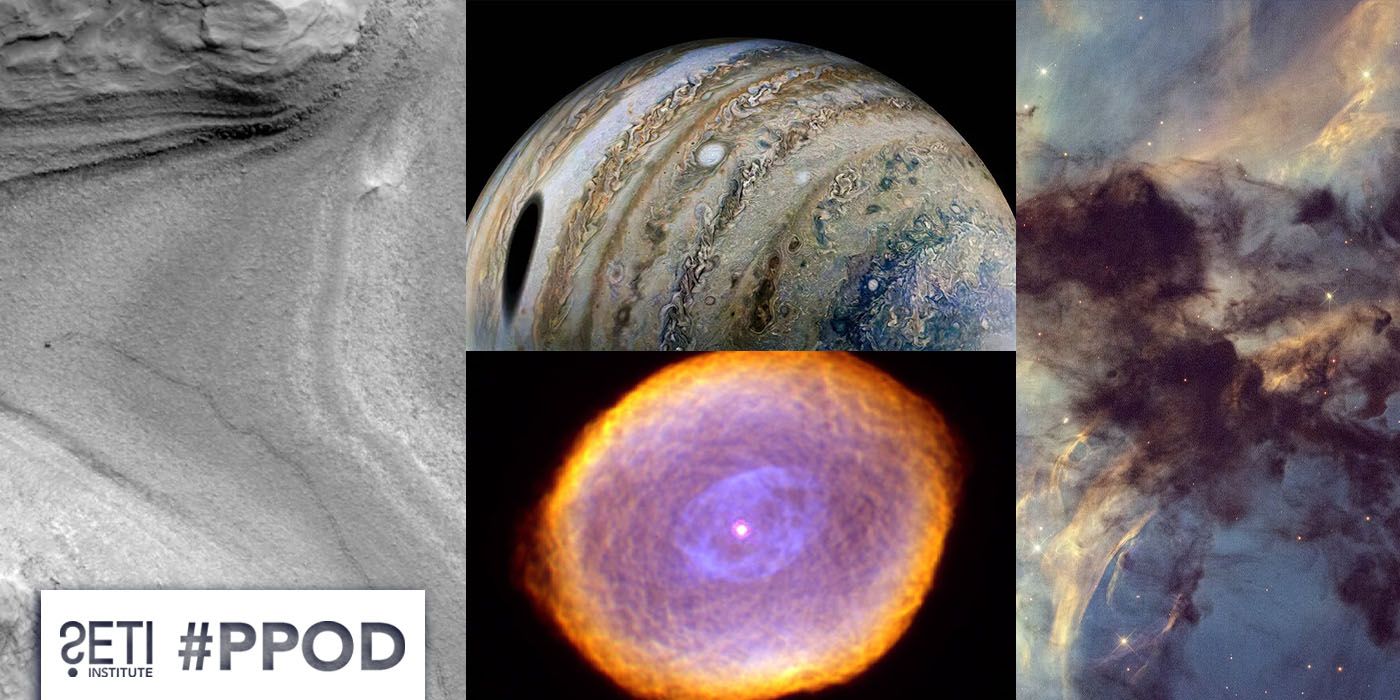
This week, we spied objects from a distance with MRO seeing Curiosity, Hubble capturing a couple of unusual nebulae, and NASA's Juno spying the shadow of Ganymede.
Monday, 28 April 2025
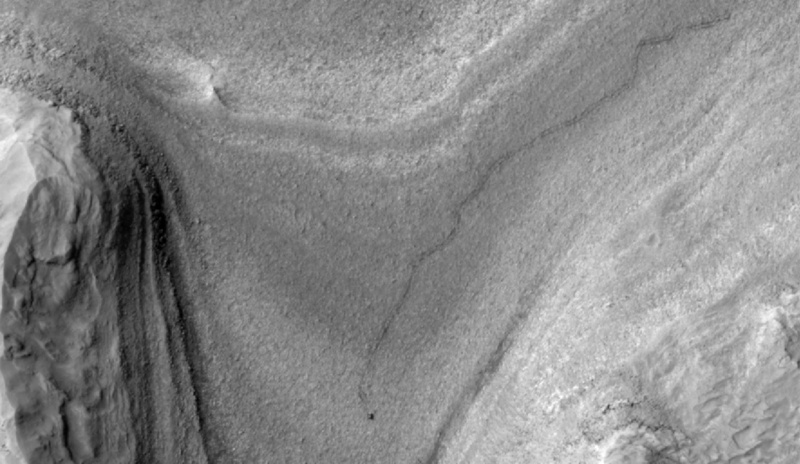
Credit: NASA/JPL-Caltech/University of Arizona
NASA Orbiter Spots Curiosity Rover NASA’s Curiosity rover appears as a dark speck in this contrast-enhanced view captured on Feb. 28, 2025, by the HiRISE camera aboard NASA’s Mars Reconnaissance Orbiter. Trailing Curiosity are the rover’s tracks, which can linger on the Martian surface for months before being erased by the wind.
Tuesday, 29 April 2025
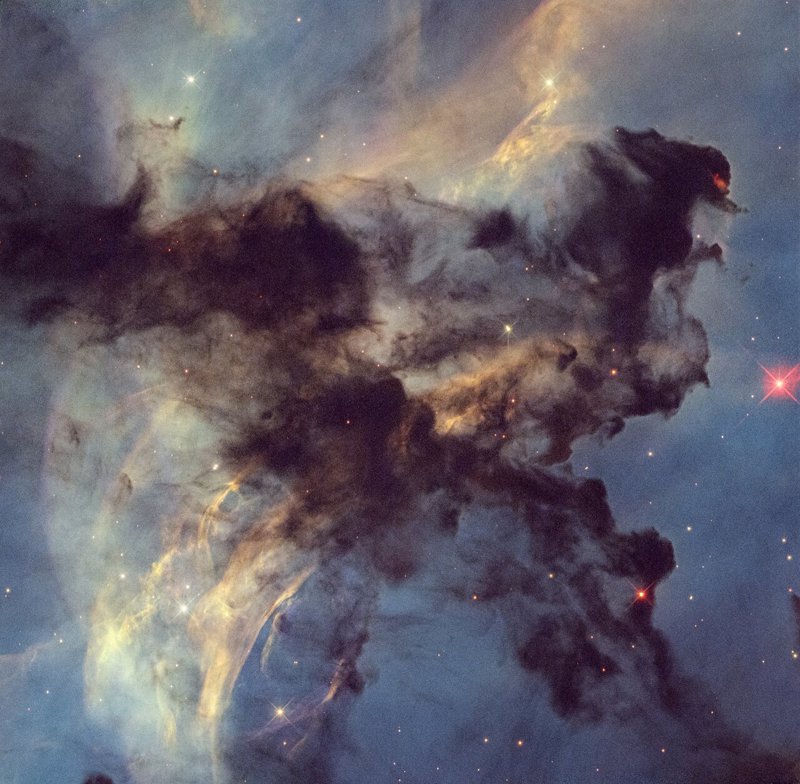
Credit: NASA, ESA, STScI
Rosette Nebula This is a Hubble Space Telescope image of a small portion of the Rosette Nebula, a vast star-forming region spanning approximately 100 light-years and located 5,200 light-years away. Hubble zooms into a small portion of the nebula that is only 4 light-years across (the approximate distance between our Sun and the neighbouring Alpha Centauri star system).
Dark clouds of hydrogen gas laced with dust are silhouetted across the image. The clouds are being eroded and shaped by the seething radiation from the cluster of larger stars at the center of the nebula (NGC 2440). An embedded star, visible at the tip of a dark cloud in the upper right portion of the image, is launching jets of plasma that are crashing into the surrounding cold cloud. The resulting shock wave is causing a red glow. The colors come from the presence of hydrogen, oxygen, and nitrogen.
Wednesday, 30 April 2025
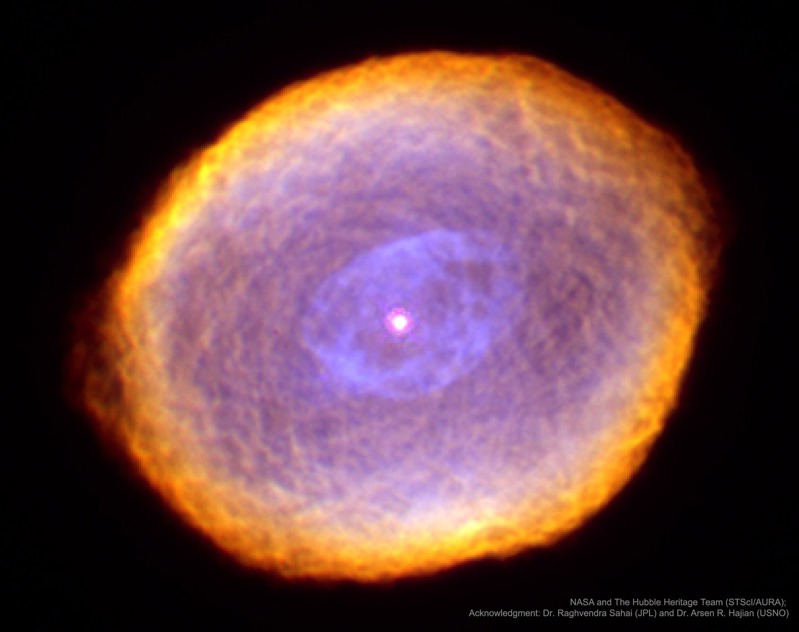
Credit: NASA, ESA, and the Hubble Heritage Team (STScI/AURA); Acknowledgement: R. Sahai (JPL) et al.
Spirograph Nebula Dubbed the Spirograph Nebula for its resemblance to drawings from a cyclical drawing tool, planetary nebula IC 418 shows poorly understood patterns. Perhaps they are related to chaotic winds from the variable central star, which changes brightness unpredictably in just a few hours.
IC 418 was probably a common red giant star only a few thousand years ago. Since running out of nuclear fuel, the outer envelope has begun expanding outward, leaving a hot remnant core destined to become a white-dwarf star, visible at the image center. The light from the central core excites surrounding atoms in the nebula, causing them to glow.
IC 418 lies about 2000 light-years away and spans 0.3 light-years across. This false-color image taken from the Hubble Space Telescope reveals the unusual details.
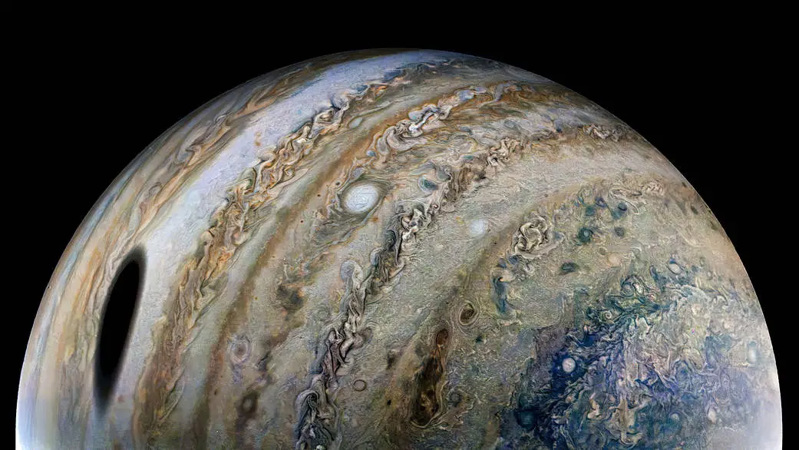
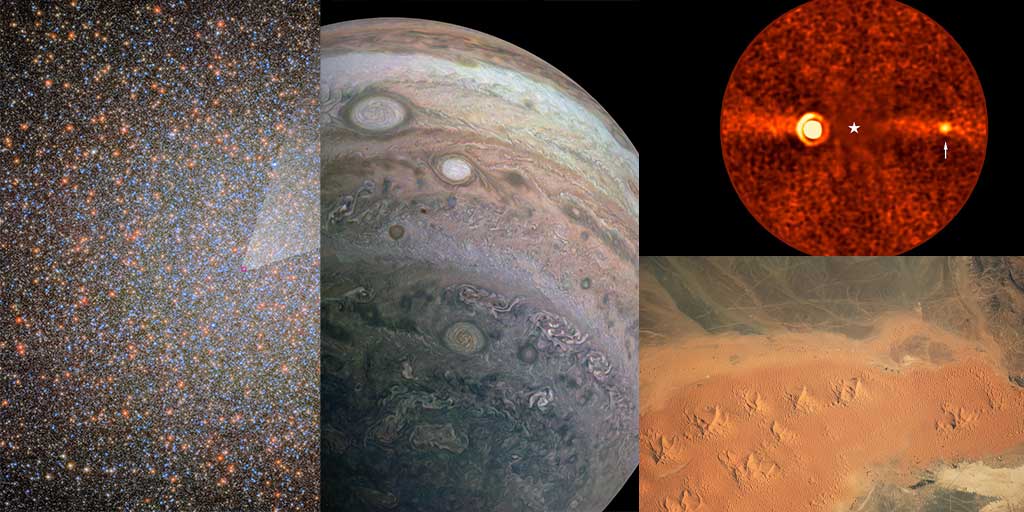
Moon Shadow NASA’s Juno spacecraft captured this view of Jupiter during the mission’s 40th close pass by the giant planet on Feb. 25, 2022. The large, dark shadow on the left side of the image was cast by Jupiter’s moon Ganymede.
An observer at Jupiter’s cloud tops within the oval shadow would experience a total eclipse of the Sun. Total eclipses are more common on Jupiter than on Earth for several reasons. Jupiter has four major moons, known as the Galilean satellites, that often pass between Jupiter and the Sun. In seven days, Ganymede transits once, Europa transits twice, and Io four times. Since Jupiter’s moons orbit in a plane close to Jupiter’s orbital plane, moon shadows are often cast upon the planet.
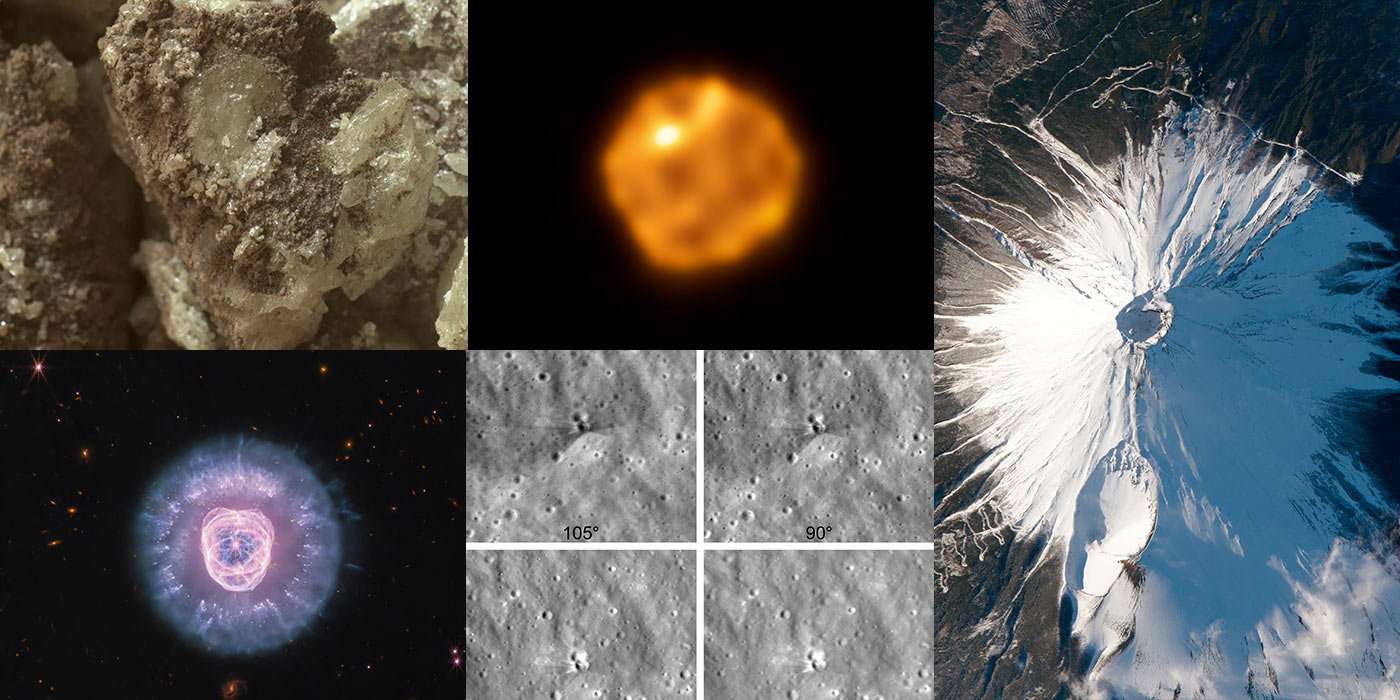
We journey from Mount Fuji as seen from orbit to the bubbling surface of Betelgeuse, exploring the forces that shape planets, moons, and stars across the cosmos. Along the way, JWST reveals the remains of a dying star, Curiosity uncovers clues to Mars’ volcanic past, and a fresh rocket impact on the Moon gives scientists a new opportunity to study how collisions reshape its surface.
#PPOD
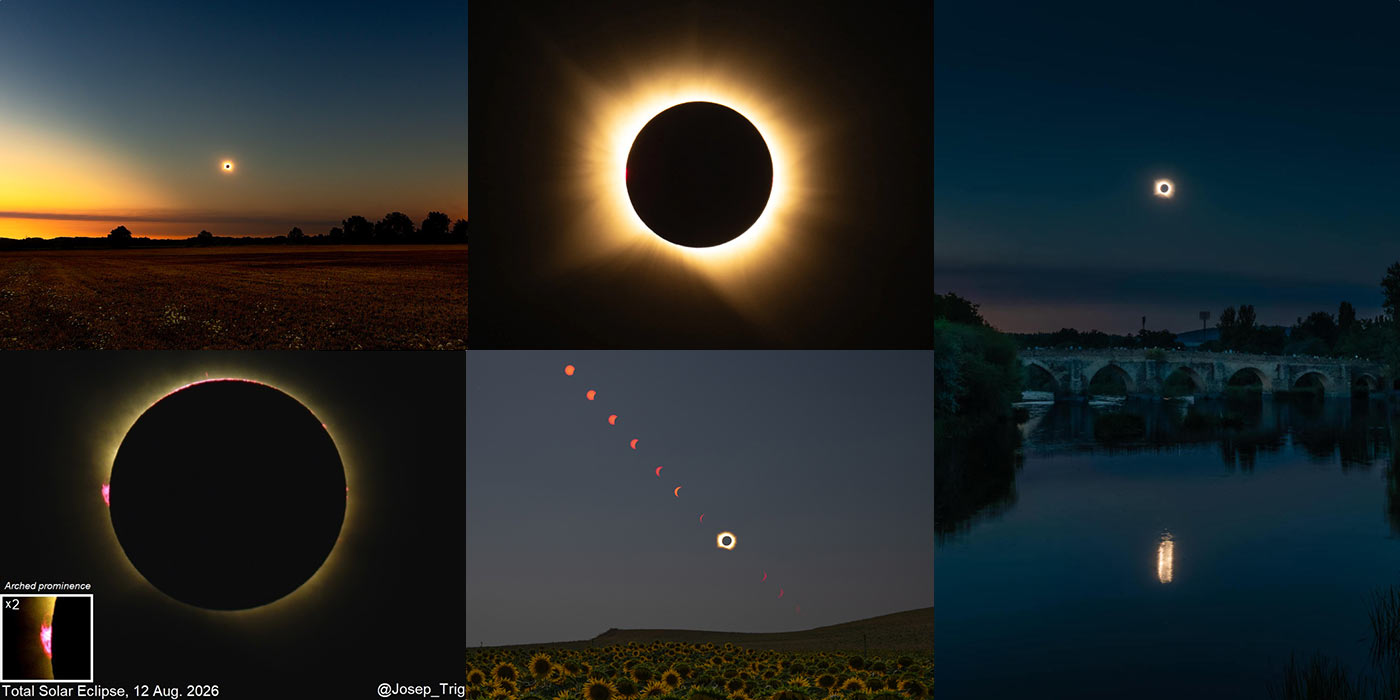
Let's celebrate the August 12 total solar eclipse through the eyes of photographers who experienced the Moon’s shadow sweeping across Spain. From Baily’s Beads and a glowing solar prominence to totality reflected in a river and framed by fields of sunflowers, these images capture both the science and extraordinary beauty of one of nature’s most spectacular celestial events.
#PPOD
#Eclipse
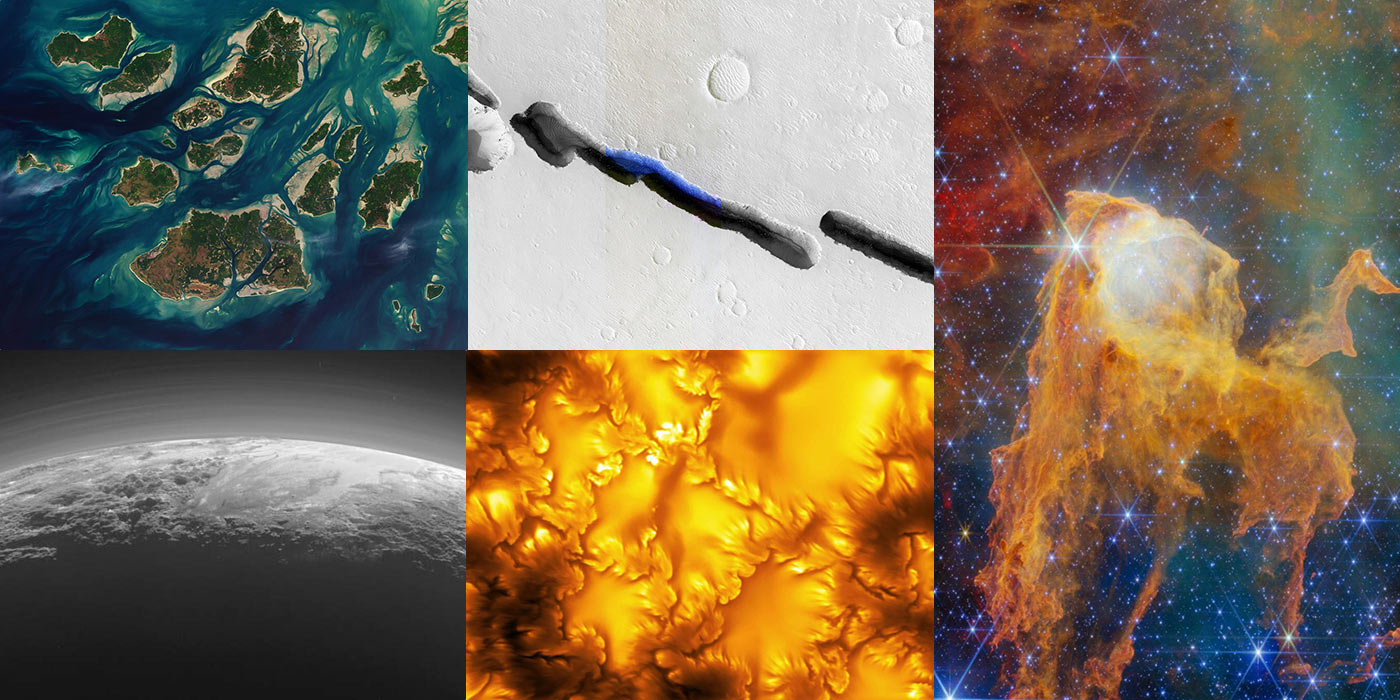
The universe is shaped by forces both immense and intricate, from fractured terrain on Mars and shifting tidal landscapes on Earth to tiny vortices dancing across the surface of the Sun. Farther afield, dramatic views of Pluto’s icy mountains and hazy atmosphere and a treasure chest of newborn stars in the Carina Nebula showcase the remarkable detail revealed by spacecraft and telescopes exploring the cosmos.
#PPOD
This week, we reveal hidden wonders across the cosmos, from delicate Martian clouds and a dust-shrouded galaxy to an asteroid with a never-before-seen shape and the crowded heart of the Milky Way. Together, these images showcase how new missions and advanced observatories continue to uncover surprising details about our solar system, our galaxy, and the universe beyond.
#PPOD
These images span the journey from our own backyard to distant galaxies, featuring Mars, the Moon, breathtaking night skies, and a fresh view of the star-forming galaxy Messier 94. Along the way, we celebrate exploration and discovery—from NASA’s Psyche mission preparing for its asteroid encounter to the revelation of a previously unknown impact crater on Earth —reminding us that there are still new wonders to uncover both on our own planet and across the cosmos.
#PPOD
This week, we celebrate fifty years since Viking 1 became the first spacecraft to successfully land on and photograph the surface of Mars, alongside stunning new views of worlds, stars, and galaxies that continue to expand our understanding of the universe. From sculpted Sahara sand dunes and Jupiter’s colorful cloud bands to a newly discovered exoplanet and the first stellar-mass black hole identified in Omega Centauri, these images showcase the remarkable diversity of cosmic exploration.
#PPOD
We journey from Mount Fuji as seen from orbit to the bubbling surface of Betelgeuse, exploring the forces that shape planets, moons, and stars across the cosmos. Along the way, JWST reveals the remains of a dying star, Curiosity uncovers clues to Mars’ volcanic past, and a fresh rocket impact on the Moon gives scientists a new opportunity to study how collisions reshape its surface.
Let's celebrate the August 12 total solar eclipse through the eyes of photographers who experienced the Moon’s shadow sweeping across Spain. From Baily’s Beads and a glowing solar prominence to totality reflected in a river and framed by fields of sunflowers, these images capture both the science and extraordinary beauty of one of nature’s most spectacular celestial events.
The universe is shaped by forces both immense and intricate, from fractured terrain on Mars and shifting tidal landscapes on Earth to tiny vortices dancing across the surface of the Sun. Farther afield, dramatic views of Pluto’s icy mountains and hazy atmosphere and a treasure chest of newborn stars in the Carina Nebula showcase the remarkable detail revealed by spacecraft and telescopes exploring the cosmos.
This week, we reveal hidden wonders across the cosmos, from delicate Martian clouds and a dust-shrouded galaxy to an asteroid with a never-before-seen shape and the crowded heart of the Milky Way. Together, these images showcase how new missions and advanced observatories continue to uncover surprising details about our solar system, our galaxy, and the universe beyond.
These images span the journey from our own backyard to distant galaxies, featuring Mars, the Moon, breathtaking night skies, and a fresh view of the star-forming galaxy Messier 94. Along the way, we celebrate exploration and discovery—from NASA’s Psyche mission preparing for its asteroid encounter to the revelation of a previously unknown impact crater on Earth —reminding us that there are still new wonders to uncover both on our own planet and across the cosmos.
This week, we celebrate fifty years since Viking 1 became the first spacecraft to successfully land on and photograph the surface of Mars, alongside stunning new views of worlds, stars, and galaxies that continue to expand our understanding of the universe. From sculpted Sahara sand dunes and Jupiter’s colorful cloud bands to a newly discovered exoplanet and the first stellar-mass black hole identified in Omega Centauri, these images showcase the remarkable diversity of cosmic exploration.
SkyMapper and the SETI Institute are connecting educators, students and the public to live astronomical observations through a distributed astronomical network.
#SkyMapper
#SETI
#Citizen Science
#Astronomy
What happens if life beyond Earth is discovered? The Discovery and Futures Lab at the SETI Institute fosters novel and anticipatory research at the intersection of science, society, our planet, and the search for life beyond Earth.
#Discovery and Futures Lab
SkyMapper and the SETI Institute are connecting educators, students and the public to live astronomical observations through a distributed astronomical network.
What happens if life beyond Earth is discovered? The Discovery and Futures Lab at the SETI Institute fosters novel and anticipatory research at the intersection of science, society, our planet, and the search for life beyond Earth.
Scientists are getting closer in their search for life beyond earth. But with limited federal funding for the search for extraterrestrial intelligence, supporters are the reason cutting-edge scientists can keep their eyes on the sky.
)