








Mawrth Vallis (Mawrth means Mars in Welsh) is a valley on the planet Mars, with a deep channel formed by water in Mars’ ancient past. In 2016, SETI Institute chemist and planetary scientist Janice Bishop made an interesting discovery about the composition of rock layers that form the valley using data collected by the Compact Reconnaissance Imaging Spectrometer for Mars (CRISM).
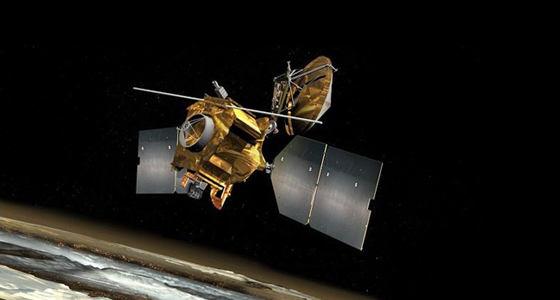
CRISM is an instrument on the Mars Reconnaissance Orbiter (MRO) which was launched in 2005 and remains in orbit around Mars searching for evidence of past water. From an altitude of 186 miles above the surface of Mars, CRISM collects visible and infrared signatures of certain minerals, including those that hold traces of past water. Using this orbital spectral data from CRISM, Janice identified a unique material sandwiched between two clay-bearing strata. This new phase appears to be mixtures of sulfates and acid-altered clays. One of the puzzling parts of this investigation is that two kinds of sulfates have been identified here: an acidic Fe-sulfate called jarosite and a neutral Ca-sulfate called gypsum. These two sulfates are not normally found together because of their different pH requirements.
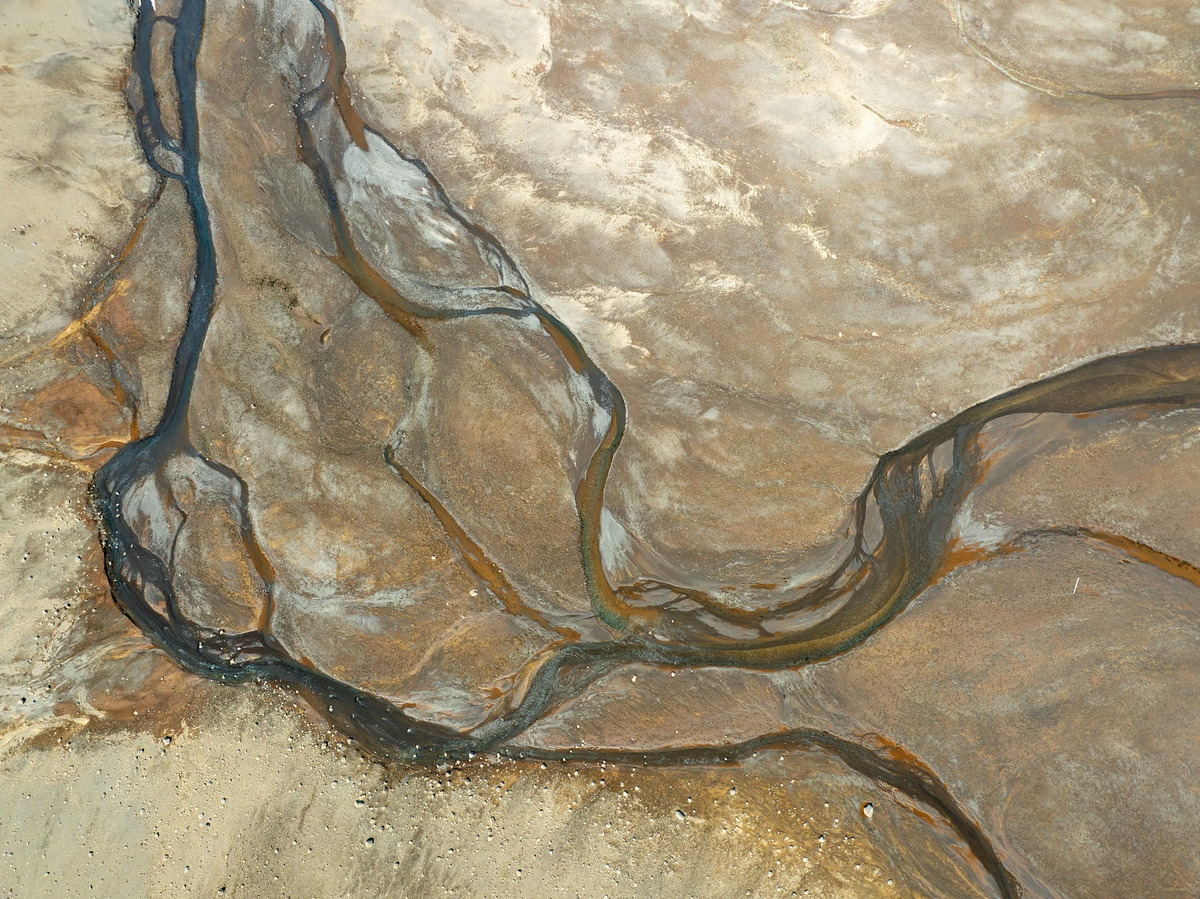
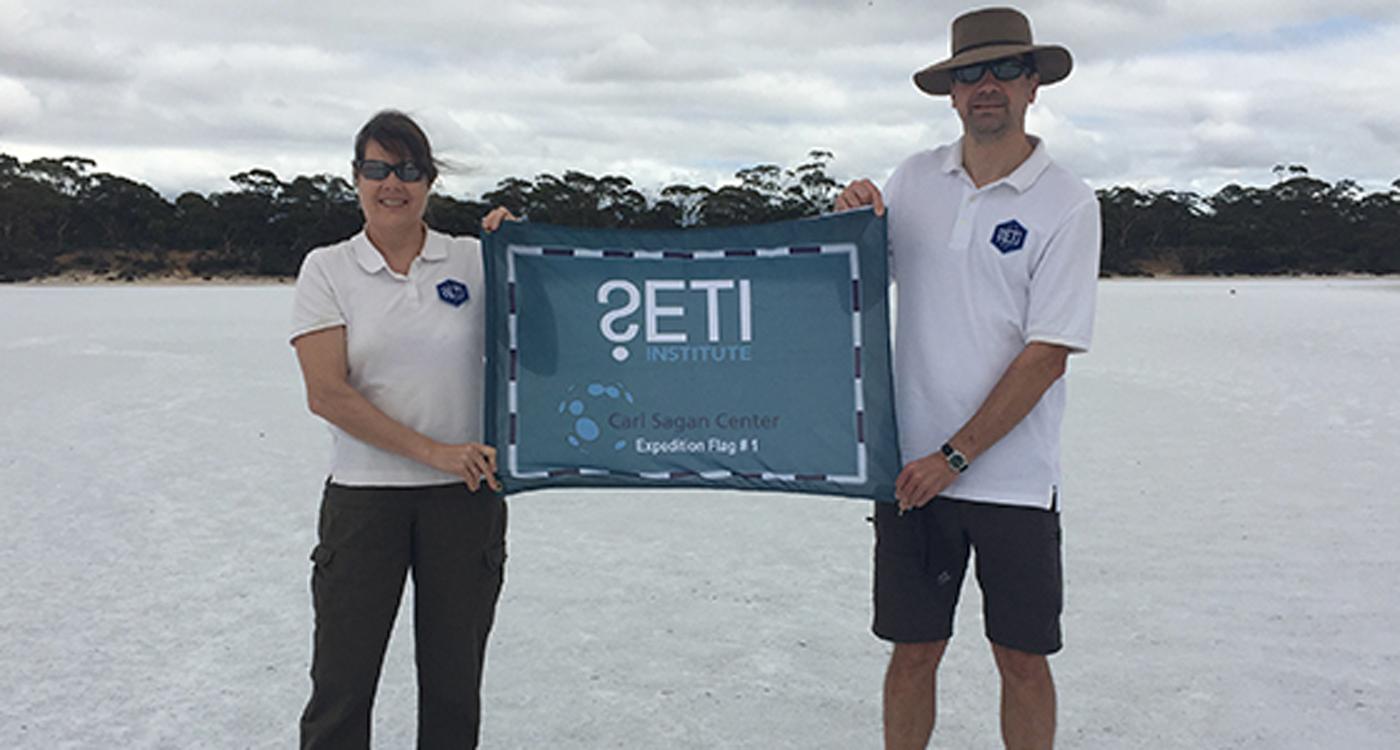
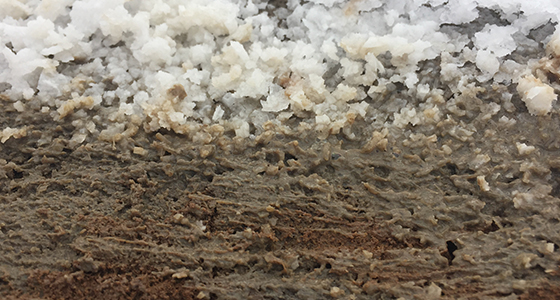
Here on Earth, other scientists have found combinations of jarosite, gypsum, as well as halite and clays in the highly saline ponds found in the desert of Western Australia. Apparently, the high salt (S, Cl) level enables formation of these sulfates in this kind of environment. Janice and SETI Institute colleague Lukas Gruendler recently visited these salt ponds in the Archean Yilgarn Craton region of Western Australia looking for mixtures of clays and sulfates similar to those Janice discovered in some of the clay-rich regions of Mars.
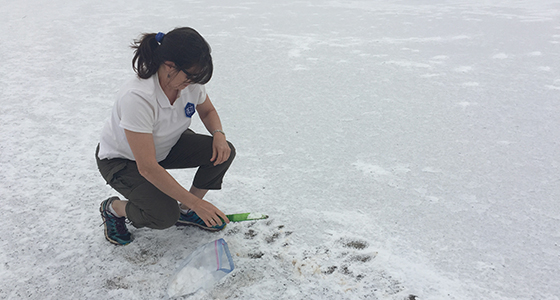
Janice and Lukas decided to study samples from three of these sites in order to characterize the mineralogy of the surface crust and the material down a few centimeters in the hopes of learning about environments that could help us understand this puzzling salty outcrop on Mars.
Sample analysis will continue in Janice’s mineral lab here at the SETI Institute and will help learn more about both Earth and Mars.
News
Related News
Researchers Propose Searching the Moon for Microscopic Technosignatures
New study outlines the first quantitative framework for searching lunar regolith for microscopic technosignatures. #Press Releases #Moon #Technosignatures #Lewis Pinault #Andrew Siemion #Astrobiology #SETI #Solar System #AI and Machine Learning #Bill Diamond

SETI Institute Team Looks for a New Way to Find Resources in Space
#Press Releases #Pablo Sobron #Moon #Asteroids #Planetary Exploration #Spectroscopy #Astrobiology
SETI Institute In the News: July Roundup 2026
#SETI Institute in the News #SETI Institute #Community #Peter Jenniskens #Lucian Walkowicz #Chelsea Haramia #Pascal Lee #Bill Diamond #Seth Shostak #Meteorites #SETI #UAPs #NASA Missions and Observatories #Discovery and Futures Lab #Mars
Hide the Star: How Roman Will See Exoplanets
#Blog #Franck Marchis #Margaret Turnbull #Nancy Grace Roman Space Telescope #Planetary Exploration #NASA Missions and Observatories #Exoplanets #Spectroscopy #Astronomy
50 Years on Mars: From Viking to Today's Rovers
#Blog #Simon Steel #Pascal Lee #Mars
Celebrating 25 Years of Exoplanet Astrobiology: Welcoming the Virtual Planetary Laboratory to its New Home at the SETI Institute
#VPL #Astrobiology #SETI Institute #Victoria Meadows #Andrew Lincowski #Eric Wolf #Nicholas Wogan #Kimberly Bott #Hannah DawsonResearch
Related Projects
SkyMapper: Expanding Access to Real-time Astronomy Through a Global Astronomical Network
SkyMapper and the SETI Institute are connecting educators, students and the public to live astronomical observations through a distributed astronomical network. #SkyMapper #SETI #Citizen Science #Astronomy
Virtual Planetary Laboratory
How can we best assess whether an exoplanet supports life? #VPL
Discovery and Futures Lab
What happens if life beyond Earth is discovered? The Discovery and Futures Lab at the SETI Institute fosters novel and anticipatory research at the intersection of science, society, our planet, and the search for life beyond Earth. #Discovery and Futures LabSupport the
SETI Institute
Scientists are getting closer in their search for life beyond earth. But with limited federal funding for the search for extraterrestrial intelligence, supporters are the reason cutting-edge scientists can keep their eyes on the sky.