)

Tuesday, Aug 11, 2026
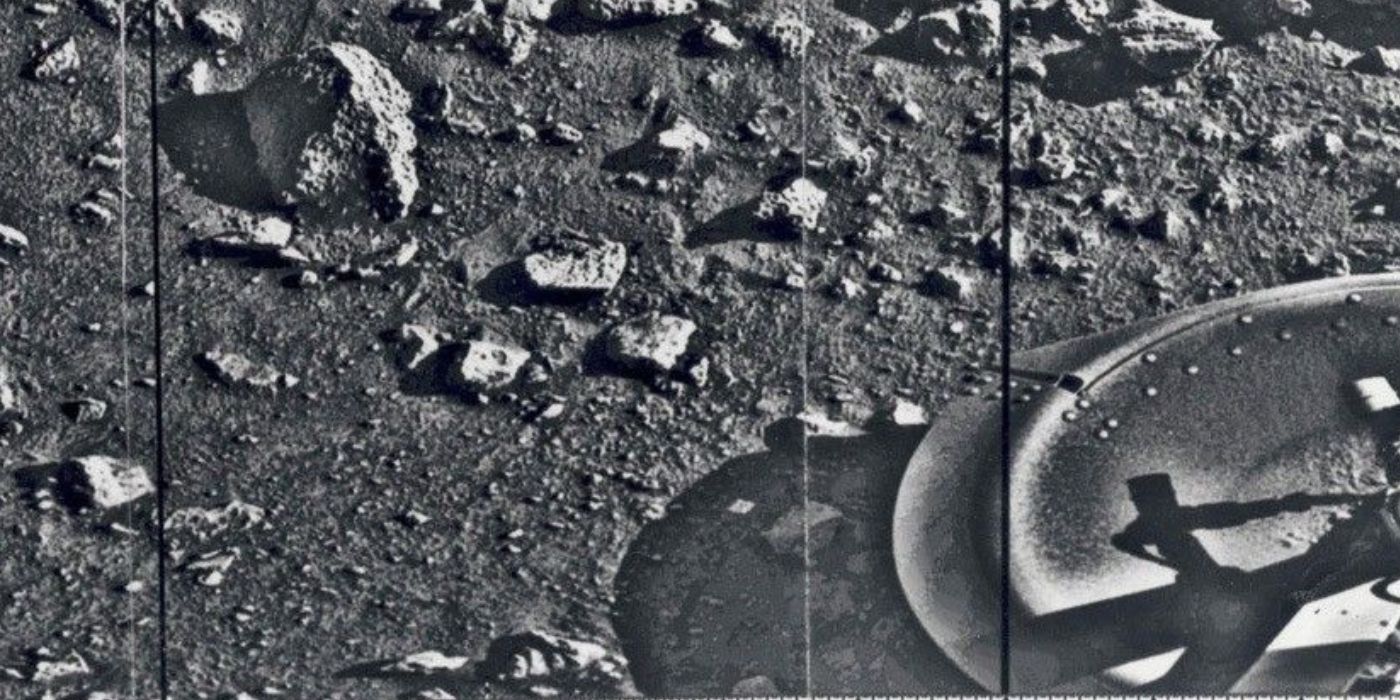
On the morning of July 20, 1976, roughly 40 minutes after mission controllers received word that the Viking 1 lander had successfully touched down on the surface of Mars, this photo gave us our first view from the surface of the Red Planet. Credit: NASA/JPL
At a Glance
|
On July 20, 1976, NASA achieved a historical milestone with the successful landing of Viking 1 on Mars. The timing made the achievement even more significant: it came on the anniversary of Apollo 11’s Moon landing and during the United States Bicentennial year, adding to the sense that humanity was reaching another major frontier. More importantly, Viking transformed the exploration of Mars, ushering in a new era of planetary science by enabling researchers to study the Red Planet directly from its surface rather than solely from orbit.
In a recent SETI Live broadcast, Dr. Simon Steel, Deputy Director of the Carl Sagan Center at the SETI Institute, sat down with planetary scientist Dr. Pascal Lee to reflect on this landmark event.
Dr. Lee emphasized that Viking 1 was not merely revolutionary for its era. It stands as a unique milestone in the history of planetary science: it is the only mission ever dispatched to actively search for extant life on another world. Modern rovers search for past habitability and fossilized biosignatures, but none have since replicated Viking’s bold focus on searching for living microbes crawling around in the soil.
Before Viking, robotic probes like NASA's Mariner 9 mapped the surface from orbit. Lander attempts by the Soviet Union, including Mars 2 and Mars 3, ended in premature failure due to the high elevation and thin atmosphere of the southern hemisphere. Viking 1 became the first spacecraft from any nation to successfully operate on the Martian surface.
Each Viking lander traveled to Mars attached to its own orbiter. Before releasing the landers, the orbiters spent time mapping the surface in greater detail, allowing mission planners to select safer landing sites than originally planned. Engineers targeted smooth lowland plains in the northern hemisphere. Viking 1 landed in Chryse Planitia. Viking 2 landed a few months later in Utopia Planitia.
One of Viking’s earliest images was not a sweeping landscape panorama. Engineers first wanted a picture of the landing footpad to confirm that the spacecraft had survived touchdown and had not sunk into unstable ground. The first panorama was then built slowly, one column of pixels at a time, revealing humanity’s first detailed view from the Martian surface.
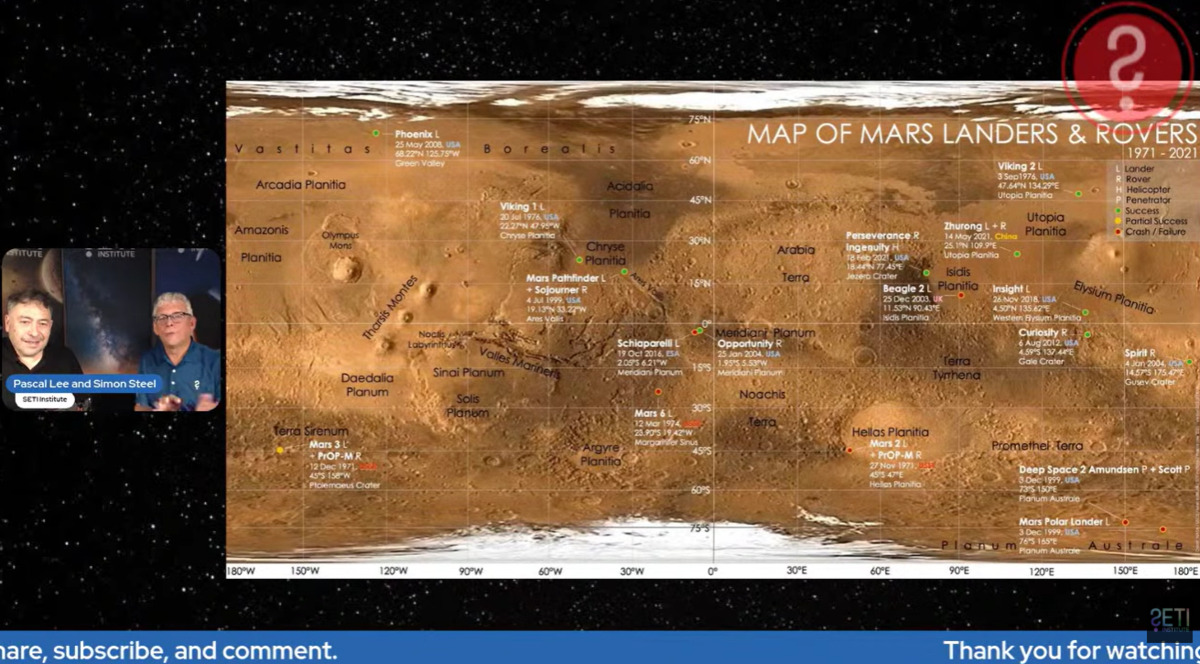
See full map here.
Seeking Active Life on the Red Planet
Among the mission's strongest advocates was SETI Institute co-founder Dr. Carl Sagan, who helped shape Viking's ambitious goal of searching directly for living organisms on Mars. Later in his career, Sagan also argued that future missions needed greater mobility, believing that even limited movement beyond a single landing site would dramatically expand the science that could be accomplished.
The spacecraft carried three distinct biology experiments to test Martian soil for microbial activity.
The Three Biological Experiments
The first onboard test was the Pyrolytic Release experiment. It sought photosynthetic organisms by exposing soil to light and carbon dioxide labeled with radioactive carbon-14. Soil samples absorbed the labeled gas and released it upon heating. However, control samples preheated to sterilizing temperatures yielded similar releases, suggesting chemical reactions rather than biological activity.
The second test, the Gas Exchange experiment, exposed soil samples to nutrient solutions and monitored the gases released. The instrument detected sudden releases of oxygen and carbon dioxide. Once again, pre-heated control samples produced the same gas releases, confirming that the reactions were non-biological.
The third experiment, Labeled Release, yielded more ambiguous results. A nutrient solution containing carbon-14 was added to the soil, producing a steady release of radioactive gas. When the control sample was heated to kill potential microbes, the gas release ceased. While principal investigator Gilbert Levine maintained that this result indicated microbial life, the broader scientific community concluded that reactive surface chemistry was responsible.
Engineering Challenges and Soil Chemistry
Scientists now understand that the Martian soil contains highly oxidizing compounds. These reactive compounds produce fizzing and gas evolution upon exposure to liquid nutrients or moisture, mimicking metabolic processes.
The harsh environment on the surface posed additional challenges. High solar ultraviolet radiation and oxidants render the top layer of regolith hostile to organic molecules.
Furthermore, avoiding contamination from Earth required unprecedented sterilization procedures, including exposing the spacecraft to ultraviolet light to reduce the chance of carrying Earth microbes to Mars. This process added tens of millions of dollars to the budget, ensuring that any detected life would be genuinely native to Mars.
The Legacy of Viking and the Evolution of Rovers
The lack of definitive evidence for life, combined with Viking’s cost and complexity, created a prolonged lull in surface exploration. It would be more than two decades before the United States returned to Mars with a successful surface mission.
In 1997, surface missions returned to Mars with the Mars Pathfinder mission, which deployed the Sojourner rover. As Dr. Lee explained, Pathfinder was designed largely as a technology demonstration, showing that a smaller rover could be delivered to Mars and operated remotely on the surface.
Subsequent solar-powered rovers, Spirit and Opportunity, explored different regions of Mars, demonstrating the value of mobility and extended surface investigations. As payload requirements grew more complex, NASA transitioned to radioisotope thermoelectric generators. Heavy rovers like Curiosity and Perseverance rely on these power systems to operate heavy instruments and drill systems.
Viking's static landers highlighted the limitations of exploring Mars from a single location. A lander cannot move past its landing footpad, limiting its ability to investigate surrounding geological features.
Dr. Pascal Lee recalled Dr. Carl Sagan expressing a similar frustration after Viking, saying that even if the landers could simply “stand up on their toes” and see a little farther, they would have transformed what they could explore. That idea helped reinforce the importance of mobility in future Mars missions.
Subsurface Horizons: Caves and Volcanoes
To find extant life today, researchers must look beneath the surface. Subsurface environments could be shielded from radiation and toxic oxidants found at the Martian surface, making places such as caves and volcanic structures intriguing targets in the search for living organisms.
Dr. Lee discussed the discovery of the massive Noctis volcano, a feature identified near the Martian equator that could become an interesting target for future exploration. Volcanic caves and geothermal regions could provide shelter from surface radiation and highly oxidizing soils while also maintaining more stable temperatures and potentially liquid water. These protected environments are among the most promising places to continue the search for living organisms.
Proposed missions involve deploying autonomous hoppers or drones into volcanic vents to sample sheltered environments.
Dr. Lee also pointed out that many areas of Mars are now mapped in remarkable detail, sometimes in greater detail than parts of Earth, because Mars lacks the persistent cloud cover and vegetation that often obscure our own planet’s surface.
Future biological tests may help resolve some of the ambiguities left by Viking by analyzing organic chirality. Biological systems on Earth exclusively use left-handed amino acids to construct proteins. Identifying a clear preference for left- or right-handed molecular symmetry in Martian soil would provide decisive evidence of biological activity and clues to its planetary origin.
Fifty years after Viking 1 first touched the Martian surface, the mission remains a reminder of both the ambition and uncertainty involved in searching for life beyond Earth. As Dr. Lee explained, the next major breakthrough may come from looking in places Viking could never reach, from beneath the surface, inside caves, or within volcanic environments that could preserve clues hidden from the harsh Martian landscape.
Watch the full SETI Live conversation here.
Final questions
1. Why did Soviet landers fail on Mars before Viking 1?
Soviet landers like Mars 2 and Mars 3 targeted the southern hemisphere of Mars without high-resolution topographic maps. The southern hemisphere sits one to two kilometers higher in elevation than the northern plains. The thin atmosphere gave their parachutes insufficient time to slow down the craft before impact.
2. Why was Viking’s first image from Mars a picture of its landing footpad?
The first image from Viking 1 was intentionally focused on the spacecraft’s landing footpad rather than the wider landscape. Engineers wanted to confirm that the lander had survived touchdown and had not sunk into unstable ground. The image also captured the immediate aftermath of landing, including dust that had not yet settled from the spacecraft’s arrival. The full Martian panorama was then gradually assembled, one column of pixels at a time.
3. Why did Carl Sagan believe mobility was important for Mars exploration?
Carl Sagan understood that a stationary lander could only investigate the small area immediately around its touchdown site. Pascal Lee recalled Sagan’s thought that even if the Viking landers could simply “stand up on their toes” and see a little farther, they would have been able to explore much more. That idea helped shape the move toward mobile explorers like Pathfinder, Spirit, Opportunity, Curiosity, and Perseverance.







News
Related News
Sep 4, 2026
Why Do Some Solar Eruptions Fail?
#Blog #Rebecca Robinson
Aug 17, 2026
JWST’s Salty Pink Planet Surprise
#Blog #Moiya McTier
Aug 13, 2026
SETI Institute In the News: July Roundup 2026
#SETI Institute in the News #SETI Institute #Community #Peter Jenniskens #Lucian Walkowicz #Chelsea Haramia #Pascal Lee #Bill Diamond #Seth Shostak #Meteorites #SETI #UAPs #NASA Missions and Observatories #Discovery and Futures Lab #Mars
Aug 12, 2026
Hide the Star: How Roman Will See Exoplanets
#Blog #Franck Marchis #Margaret Turnbull #Nancy Grace Roman Space Telescope #Planetary Exploration #NASA Missions and Observatories #Exoplanets #Spectroscopy #Astronomy
Jul 24, 2026
A New Way to Search for Alien Civilizations
#Blog #Lauren Sgro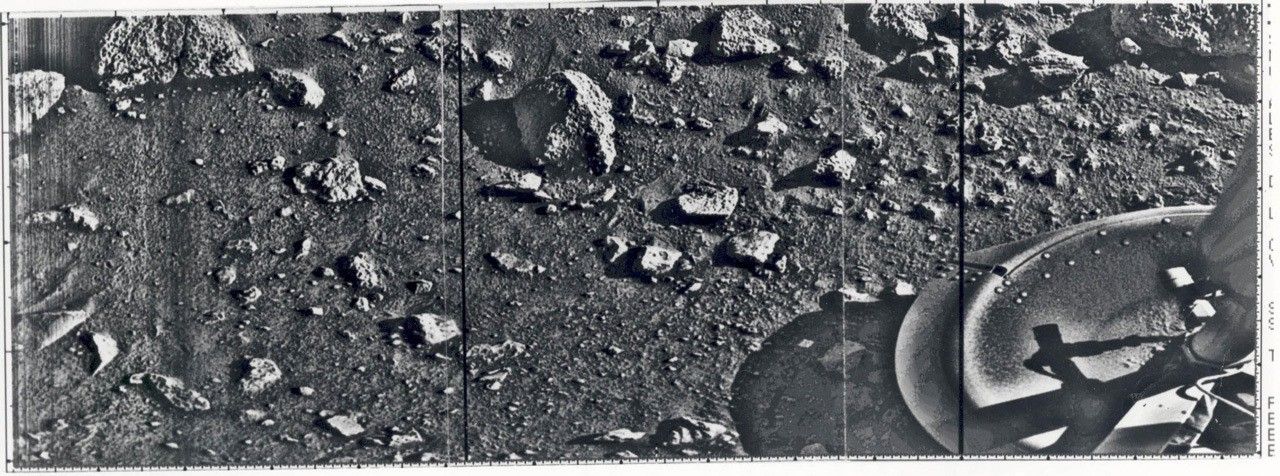
Jul 20, 2026
50 Years After Viking 1: The Mission That Changed the Search for Life on Mars
Half a century after the first successful Mars landing, Viking's greatest legacy may be the questions it taught us to ask. #Mars #NASA Missions and Observatories #Anniversary
Sep 4, 2026
#Blog
#Rebecca Robinson
Aug 17, 2026
#Blog
#Moiya McTier
JWST’s Salty Pink Planet Surprise
Aug 13, 2026
#SETI Institute in the News
#SETI Institute
#Community
#Peter Jenniskens
#Lucian Walkowicz
#Chelsea Haramia
#Pascal Lee
#Bill Diamond
#Seth Shostak
#Meteorites
#SETI
#UAPs
#NASA Missions and Observatories
#Discovery and Futures Lab
#Mars
SETI Institute In the News: July Roundup 2026
Aug 12, 2026
#Blog
#Franck Marchis
#Margaret Turnbull
#Nancy Grace Roman Space Telescope
#Planetary Exploration
#NASA Missions and Observatories
#Exoplanets
#Spectroscopy
#Astronomy
Hide the Star: How Roman Will See Exoplanets
Jul 24, 2026
#Blog
#Lauren Sgro
A New Way to Search for Alien Civilizations
Jul 20, 2026
50 Years After Viking 1: The Mission That Changed the Search for Life on Mars
Half a century after the first successful Mars landing, Viking's greatest legacy may be the questions it taught us to ask.
#Mars
#NASA Missions and Observatories
#Anniversary
Research
Related Projects
SkyMapper • SETI • Citizen Science • Astronomy
SkyMapper: Expanding Access to Real-time Astronomy Through a Global Astronomical Network
SkyMapper and the SETI Institute are connecting educators, students and the public to live astronomical observations through a distributed astronomical network. #SkyMapper #SETI #Citizen Science #Astronomy
VPL
Virtual Planetary Laboratory
How can we best assess whether an exoplanet supports life? #VPL
Discovery and Futures Lab
Discovery and Futures Lab
What happens if life beyond Earth is discovered? The Discovery and Futures Lab at the SETI Institute fosters novel and anticipatory research at the intersection of science, society, our planet, and the search for life beyond Earth. #Discovery and Futures Lab
May 17, 2026
SkyMapper: Expanding Access to Real-time Astronomy Through a Global Astronomical Network
SkyMapper and the SETI Institute are connecting educators, students and the public to live astronomical observations through a distributed astronomical network.
#SkyMapper
#SETI
#Citizen Science
#Astronomy
May 5, 2026
Virtual Planetary Laboratory
How can we best assess whether an exoplanet supports life?
#VPL
Apr 16, 2026
Discovery and Futures Lab
What happens if life beyond Earth is discovered? The Discovery and Futures Lab at the SETI Institute fosters novel and anticipatory research at the intersection of science, society, our planet, and the search for life beyond Earth.
#Discovery and Futures Lab
Support Us
Support the
SETI Institute
Scientists are getting closer in their search for life beyond earth. But with limited federal funding for the search for extraterrestrial intelligence, supporters are the reason cutting-edge scientists can keep their eyes on the sky.