)

Friday, Sep 04, 2026
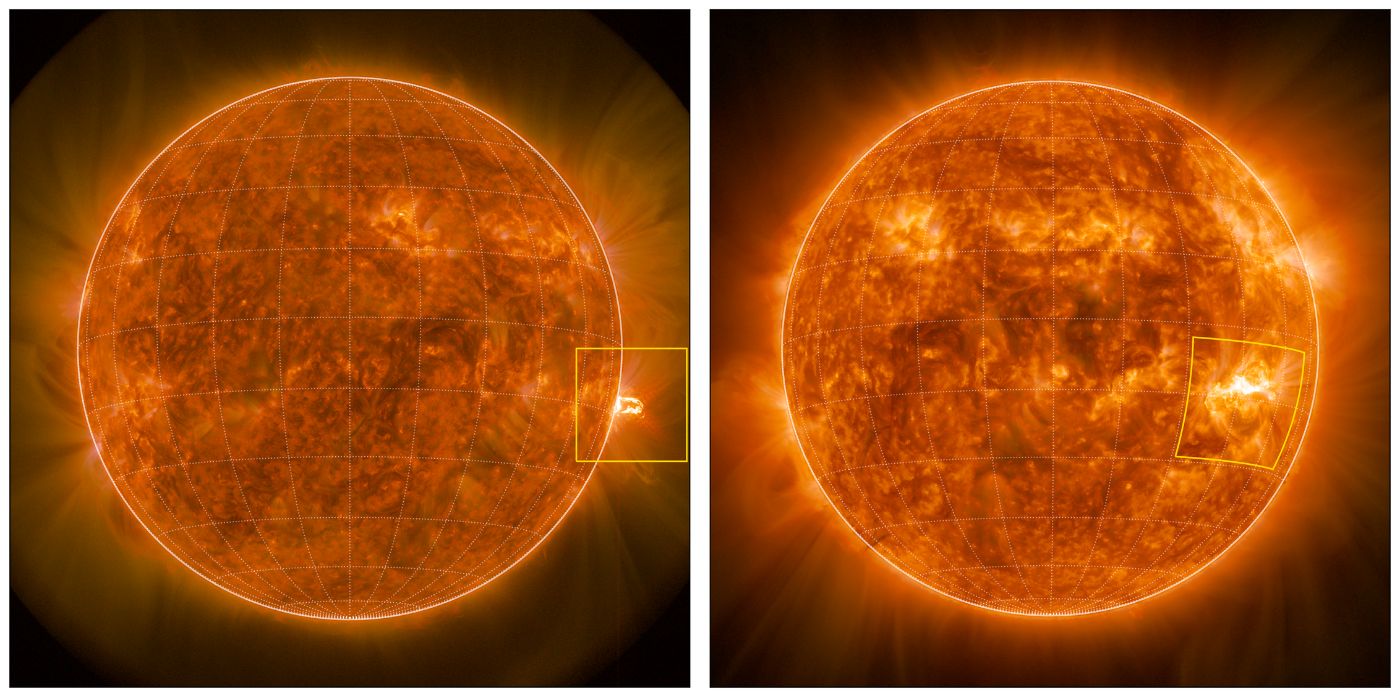
Full sun views from different NASA solar cameras of a failed solar eruption from data collected in March 2024. Credit: Tingyu Gou
At a Glance
|
A solar eruption begins to rise from the Sun. Then, instead of continuing outward, it stops. Why? What makes one eruption escape while another never makes it out?
That was the question at the center of a recent SETI Live conversation between host Dr. Becca Robinson, heliophysicist, Director of Education, and MUSE Outreach Lead at the SETI Institute, and Dr. Kathy Reeves, a senior astrophysicist at the Center for Astrophysics | Harvard & Smithsonian.
Dr. Reeves studies solar eruptions using both observations and simulations. In the conversation, she discussed research based on data collected from a particularly well-observed failed solar eruption, one that gave her team an unusually detailed view of what happens when an eruption begins to rise but does not make it out into space.
A Flare Is Not the Same as an Eruption
If scientists see a solar flare, does that mean an eruption is coming? Not necessarily.
As Dr. Reeves explained, a solar flare is a sudden brightening in the corona, the outermost layer of the Sun. It produces a burst of electromagnetic energy across a broad range of wavelengths, from visible light to X-rays. An eruption is different. In an eruption, material actually leaves the Sun. Eruptions that eject large amounts of plasma and magnetic field into space are called coronal mass ejections, or CMEs.
The two phenomena are related, but they do not have to occur together. A flare can happen without an eruption, and an eruption can happen without a flare. Large flares are often accompanied by eruptions, but exceptions exist. Those exceptions are particularly useful for researchers trying to understand what determines whether material actually escapes the Sun.
"If you know, 'Oh, I have the conditions for no eruption, even though I might get a big flare,' that's an important piece of information," said Dr. Reeves. This particular failed eruption provided an unusually good opportunity to investigate those conditions.
An Eruption Watched From Different Vantage Points
Part of what made this event so valuable was how much data researchers had. Four spacecraft were observing the Sun: NASA's Solar Dynamics Observatory, NASA’s STEREO, JAXA’s Hinode, and the ESA’s Solar Orbiter. The spacecraft were not all viewing the Sun from the same location, giving researchers different perspectives on the eruption.
The observations also covered different types of information.
Solar Dynamics Observatory, STEREO, and Solar Orbiter provided extreme ultraviolet, or EUV, observations. Hinode observed the Sun in X-rays and obtained EUV spectroscopic observations. The researchers also had magnetic-field data from Solar Dynamics Observatory and Solar Orbiter. Additionally, NASA’s IRIS provided more observational data.
The coordination was not accidental. Getting several spacecraft and instruments to observe the same region of the Sun required planning across missions and teams, since some instruments observe relatively small portions of the Sun, making timing and pointing especially important. The result was a dataset that allowed the researchers to examine the eruption from several perspectives with different types of measurements.
Dr. Reeves’ postdoctoral researcher, Dr. Tingyu Guo, brought the observations together to study what was happening as the eruption developed.
Spectroscopy Added Motion to the Picture
One particularly important part of the observations came from spectroscopy, a field of study that measures and interprets how light interacts with matter. Dr. Robinson asked Dr. Reeves what EUV spectroscopy could show that ordinary EUV images could not. Her answer was motion.
Spectroscopy can reveal Doppler shifts, which show whether material is moving toward or away from the observer. Dr. Reeves compared it to the change in pitch you hear when an ambulance passes by.
For this eruption, those spectroscopic measurements helped the researchers identify plasma flows and see where the magnetic field was reconfiguring itself. The eruption was not simply a structure moving upward until it encountered an obstacle. The magnetic field itself was changing during the event.
The combination of imaging, spectroscopy, and magnetic-field observations allowed the team to follow more of that process. Together, the observations showed evidence of magnetic-field changes alongside the plasma flows associated with the event.
A Race Between Magnetic Fields
Dr. Reeves described what was happening as a race between forces.
The magnetic field underneath the eruption was helping push it upward. At the same time, the overlying magnetic field was holding it down. In this case, the eruption looked like a loop that was trying to rise but eventually stopped.
As the magnetic field continued to reconfigure, Dr. Reeves and her collaborators think the overlying magnetic field began "eating into" the erupting loop. As the overlying magnetic field reconfigured into the erupting loop, the force driving the eruption outward became weaker, allowing the overlying field to hold it down.
The eruption therefore failed to escape the Sun, and no material was ejected in this case.
Why a Failed Eruption Matters
A failed eruption might sound less dramatic than one that sends material racing away from the Sun, but for solar physicists it can be just as informative.
If an eruption escapes the Sun and eventually reaches Earth, it can disturb Earth's magnetic field. Dr. Reeves explained that the resulting space weather can set up currents in transmission lines, create problems for satellites, and pose hazards for astronauts in space. The interaction can also produce auroras, giving us one of the more spectacular visible effects of solar activity. That makes the distinction between eruptions that escape and eruptions that fail more than a question about what happens on the Sun.
Understanding why eruptions do not happen is part of understanding why they do. If scientists can distinguish the conditions associated with the two outcomes, that could improve predictions of when an eruption is likely to occur.
One Event Is Not the Whole Story
The team now has a detailed case study, but Dr. Reeves was careful not to treat it as the explanation for every failed eruption. Multiple reasons could cause an eruption to fail. The magnetic field is central to the process, but the details may not be the same from one event to another. That is why Dr. Guo's next project will look at a much larger collection of events.
The Solar Dynamics Observatory has been observing the Sun for roughly 15 years. Dr. Guo plans to use that archive to identify cases where a large flare occurred, but no eruption followed. The goal is to look for common characteristics among these failed eruptions.
That longer record also covers more than one solar cycle, the periodic 11-year change in the Sun's activity, giving the researchers an opportunity to compare failed eruptions at different stages of activity.
Once those events have been identified, the team can also look back to see what other observations are available for individual cases. Some may have been observed by other spacecraft or instruments, allowing researchers to build a more complete picture of each event.
This particularly well-observed eruption can therefore serve as a starting point for a much broader search.
The MUSE Connection
The conversation turned to the future of solar-eruption observations and to MUSE, the Multi-slit Solar Explorer mission. Dr. Robinson is the Outreach Lead for MUSE, and Dr. Reeves is looking forward to the data it will provide.
For this failed eruption, the EUV spectrometer on Hinode happened to be scanning the right region at the right time, but Hinode's instrument does not scan as quickly or cover an area in the same way MUSE will.
MUSE is designed with 35 slits that can build up spectroscopic information across a much larger area of the Sun. Its faster observations could make it much easier to obtain the kind of spectroscopic data that helped Dr. Reeves and her collaborators. Spectroscopy provides information about plasma flows, while the broader observations help researchers understand how the magnetic field is changing.
Dr. Reeves described the possibilities enthusiastically: MUSE could provide this kind of spectroscopic information about solar eruptions much more frequently and more easily.
For Dr. Robinson, that is exactly the point of developing new solar instruments: to make observations that were previously difficult to obtain more accessible and to explore the solar atmosphere in greater detail.
The failed eruption does not answer every question about why some solar eruptions escape and others do not. What it does provide is an unusually detailed example of an eruption caught in the process of trying to rise and then being held down by the overlying magnetic field.
By combining observations from multiple spacecraft and vantage points with spectroscopy, the researchers could track plasma flows and changes in the Sun’s magnetic field as the process unfolded.
Now the team can ask whether other failed eruptions show similar behavior.
Dr. Guo's planned search through roughly 15 years of Solar Dynamics Observatory observations will provide a much larger sample to examine. And MUSE could eventually make the kind of spectroscopic observations used in this study easier to obtain across a broader region of the solar atmosphere.
For now, the key question remains deceptively simple: when a solar eruption begins to rise, what allows it to escape?
The answer appears to depend, at least in part, on the competition between magnetic fields. By studying more failed eruptions, researchers can test whether the behavior seen here is part of a broader pattern—and potentially improve our understanding of why some eruptions remain confined while others escape the Sun and affect the space environment around Earth.
Watch the full SETI Live conversation here.
Final questions
1. Can a solar flare happen without a solar eruption?
Yes. Dr. Reeves explained that a solar flare and a solar eruption are related but distinct phenomena. A flare is a sudden brightening in the solar corona, while an eruption involves material actually leaving the Sun. A flare can occur without an eruption, although very large flares are usually associated with one.
2. What is the difference between a solar prominence and a filament?
They are the same type of structure viewed from different perspectives. Dr. Reeves explained that a prominence is cooler gas suspended in the Sun's corona by magnetic fields. When viewed against the disk of the Sun, the structure is called a filament; when viewed along the edge, or limb, of the Sun, it is called a prominence.
3. What will researchers look for in other failed eruptions?
Dr. Guo plans to search roughly 15 years of Solar Dynamics Observatory observations for cases in which a large flare occurred without an eruption. The researchers will then look for characteristics that these failed events may have in common and determine what additional observations are available for individual cases.







News
Related News
Aug 17, 2026
JWST’s Salty Pink Planet Surprise
#Blog #Moiya McTier
Aug 12, 2026
Hide the Star: How Roman Will See Exoplanets
#Blog #Franck Marchis #Margaret Turnbull #Nancy Grace Roman Space Telescope #Planetary Exploration #NASA Missions and Observatories #Exoplanets #Spectroscopy #Astronomy
Aug 11, 2026
50 Years on Mars: From Viking to Today's Rovers
#Blog #Simon Steel #Pascal Lee #Mars
Jul 24, 2026
A New Way to Search for Alien Civilizations
#Blog #Lauren Sgro
Jul 17, 2026
How Clouds Hide Alien Worlds—and How Astronomers See Through Them
#Blog #Moiya McTier
Jul 2, 2026
How Clouds Hide Alien Worlds—and How Astronomers See Through Them
#Blog #Lauren Sgro
Aug 17, 2026
#Blog
#Moiya McTier
Aug 12, 2026
#Blog
#Franck Marchis
#Margaret Turnbull
#Nancy Grace Roman Space Telescope
#Planetary Exploration
#NASA Missions and Observatories
#Exoplanets
#Spectroscopy
#Astronomy
Hide the Star: How Roman Will See Exoplanets
Aug 11, 2026
#Blog
#Simon Steel
#Pascal Lee
#Mars
50 Years on Mars: From Viking to Today's Rovers
Jul 24, 2026
#Blog
#Lauren Sgro
A New Way to Search for Alien Civilizations
Jul 17, 2026
#Blog
#Moiya McTier
How Clouds Hide Alien Worlds—and How Astronomers See Through Them
Jul 2, 2026
#Blog
#Lauren Sgro
How Clouds Hide Alien Worlds—and How Astronomers See Through Them
Research
Related Projects

SkyMapper • SETI • Citizen Science • Astronomy
SkyMapper: Expanding Access to Real-time Astronomy Through a Global Astronomical Network
SkyMapper and the SETI Institute are connecting educators, students and the public to live astronomical observations through a distributed astronomical network. #SkyMapper #SETI #Citizen Science #Astronomy
VPL
Virtual Planetary Laboratory
How can we best assess whether an exoplanet supports life? #VPL
Discovery and Futures Lab
Discovery and Futures Lab
What happens if life beyond Earth is discovered? The Discovery and Futures Lab at the SETI Institute fosters novel and anticipatory research at the intersection of science, society, our planet, and the search for life beyond Earth. #Discovery and Futures Lab
May 17, 2026
SkyMapper: Expanding Access to Real-time Astronomy Through a Global Astronomical Network
SkyMapper and the SETI Institute are connecting educators, students and the public to live astronomical observations through a distributed astronomical network.
#SkyMapper
#SETI
#Citizen Science
#Astronomy
May 5, 2026
Virtual Planetary Laboratory
How can we best assess whether an exoplanet supports life?
#VPL
Apr 16, 2026
Discovery and Futures Lab
What happens if life beyond Earth is discovered? The Discovery and Futures Lab at the SETI Institute fosters novel and anticipatory research at the intersection of science, society, our planet, and the search for life beyond Earth.
#Discovery and Futures Lab
Support Us
Support the
SETI Institute
Scientists are getting closer in their search for life beyond earth. But with limited federal funding for the search for extraterrestrial intelligence, supporters are the reason cutting-edge scientists can keep their eyes on the sky.