)

Monday, Aug 17, 2026
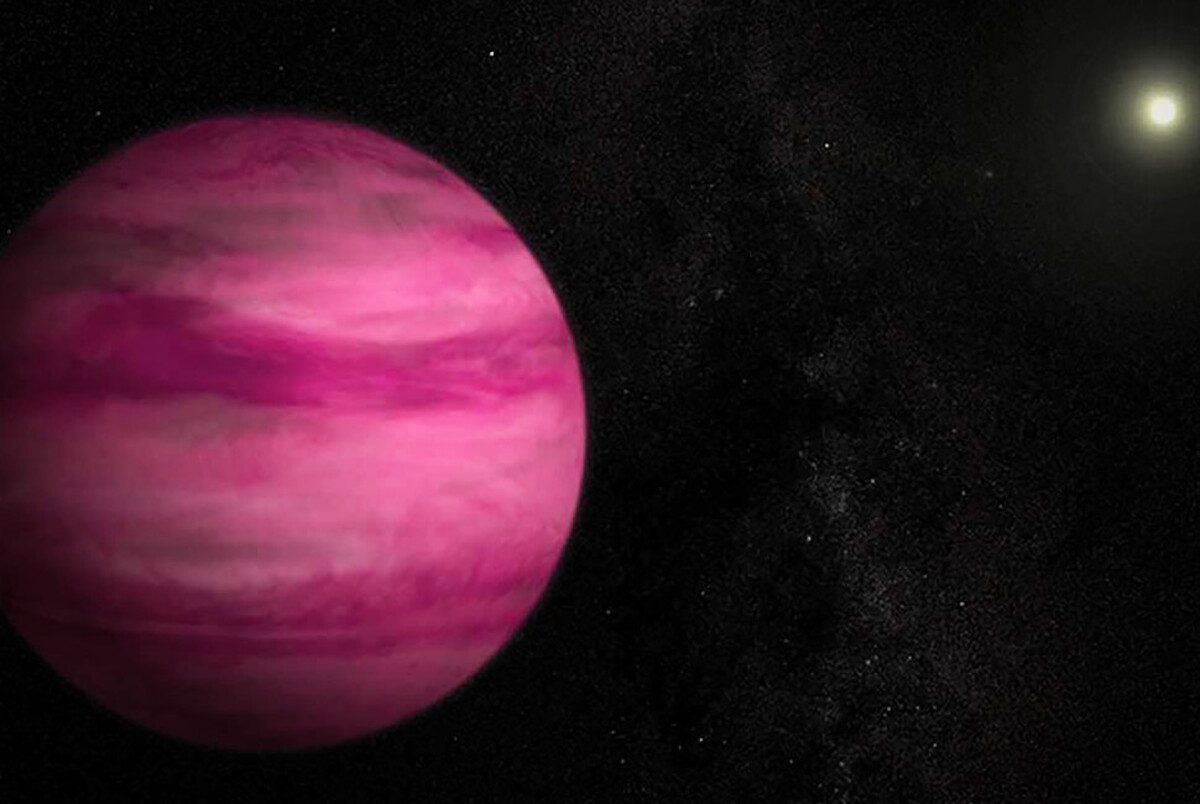
Illustration Credit: NASA/Goddard Space Flight Center
At a Glance
|
GJ 504 b is unusual. It is cold. It is faint. It sits roughly 43 astronomical units from its star, which is 43 times the Earth-Sun distance and would put it in our system’s Kuiper Belt. And despite being discovered more than a decade ago, astronomers still cannot say with certainty whether it is actually a planet or a brown dwarf.
Now, thanks to the James Webb Space Telescope, astronomers have a much better look at the object's atmosphere through its infrared spectrum.
In a recent SETI Live conversation, host Dr. Moiya McTier spoke with Northwestern University postdoctoral researcher Dr. Aneesh Baburaj about his recent work on the object, including its clouds, atmospheric composition, and the long-standing question of what GJ 504 b actually is.
The object has even picked up a colorful nickname along the way: the “pink planet.” But as he explained, even that description comes with a caveat.
The Cold Companion That Was Hard to See
GJ 504 b was discovered in 2013 and, at the time, stood out for several reasons.
GJ 504 b is about 43 astronomical units (AU) from its star. For comparison, Neptune's orbit is around 25–30 AU. At such a large distance, astronomers cannot rely on light from the star reflected off the object to find an exoplanet. Instead, they have to detect the object's own infrared heat.
However, GJ 504 b is extremely cold, with temperatures around 500–550 Kelvin, and that coldness creates a problem for astronomers because it produces very little infrared radiation. So it was detected through direct imaging around its Sun-like star.
Now, while astronomers imaged the object from the ground, obtaining useful spectroscopy was even more difficult. Dr. Baburaj explained that attempts included observing it for an entire night without detecting a spectrum at all.
Then the James Webb Space Telescope (JWST) arrived, and that changed the situation. Because the telescope operates in space, it avoids the complications associated with observing through Earth's atmosphere, such as atmospheric particles and sunlight. As an object this faint and cold, GJ 504 b was an obvious target for JWST.
Two and a Half Hours Changed the Picture
The JWST observations gave researchers something they had never had before: continuous spectral coverage of GJ 504 b from roughly 3 to 5 microns – roughly the mid-infrared part of the electromagnetic spectrum.
Before JWST, astronomers had only four data points in this region. The new observations provided a much more complete picture of how the object's spectrum changes across that wavelength range. And the object was detected with an exceptionally high signal-to-noise ratio: greater than 100. All of this came from only about 2.5 hours of observation.
The spectrum was also full of information about the object’s composition.
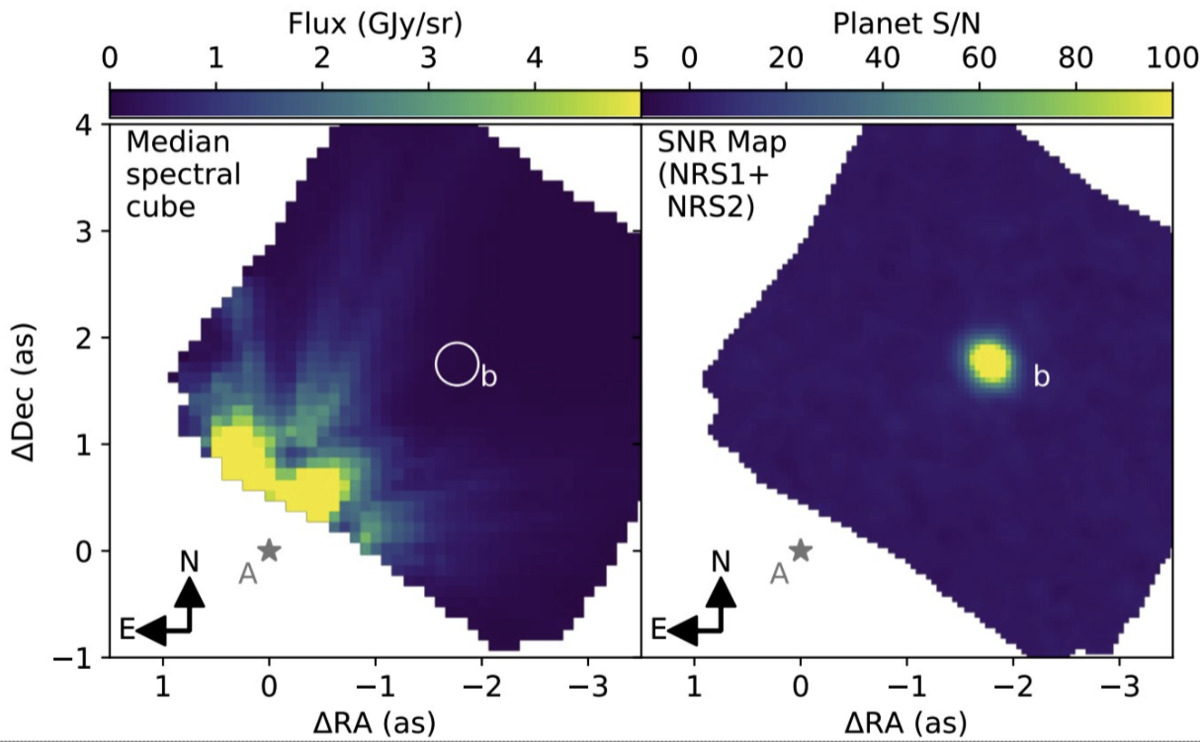
Detection map of companion GJ 504 b around the primary GJ 504 A using the medium-resolution IFU mode of JWST/NIRSpec in the 2.9–5.3 μm range. (Left) Median spectral cube before starlight subtraction generated using Stage 3 of the JWST science calibration pipeline (H. Bushouse et al. 2024). (Right) Signal-to-noise (S/N) detection maps for GJ 504 using the BREADS forward-modeling framework introduced in J.-B. Ruffio et al. (2024). GJ 504 b is detected with an S/N of 357.
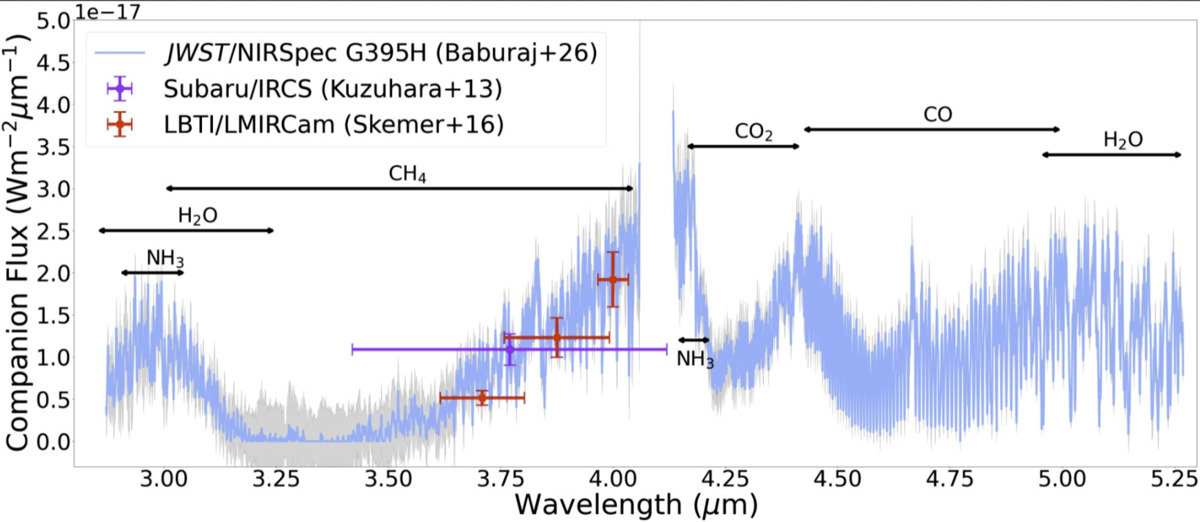
Post-ADI NIRSpec G395H spectrum of GJ 504 b (cyan) with the dominant molecular opacity sources — H2O, CO, CH4, CO2, and NH3 marked. The gray-shaded region indicates the 1σ error on the extracted flux. Ground-based photometric points from M. Kuzuhara et al. (2013) and A. J. Skemer et al. (2016) are marked for reference.
Dr. Baburaj and his collaborators identified signatures of water, methane, carbon monoxide, ammonia, and carbon dioxide. The carbon dioxide feature was particularly striking.
That strong feature - around 4.2–4.25 microns - is important because carbon dioxide can provide information about the metallicity of an atmosphere. In these cold objects, a strong carbon dioxide signature can point to a higher-metallicity atmosphere, which is more consistent with a planetary atmosphere.
But that does not settle the question of what GJ 504 b actually is.
The Planet-or-Brown-Dwarf Problem
When GJ 504 b was first discovered, astronomers interpreted it as a planet.
Part of that interpretation came from the estimated age of the system. At the time, the system was thought to be relatively young, and the estimated mass of the companion was about 4 times Jupiter's mass.
Later, astronomers revised the estimated age of the system. Instead of being only hundreds of millions of years old, the system appeared to be a few billion years old. With that older age, the estimated mass of the companion increased to around 25 times the mass of Jupiter.
That put GJ 504 b into a much less straightforward region–an object whose estimated mass could potentially make it a brown dwarf or a very massive planet. Still, the atmospheric spectrum offered another clue.
GJ 504 b appears to have high metallicity. Planetary atmospheres can have higher metallicity than their host stars, while brown dwarfs are expected to have metallicities more similar to their stars.
That sounds as though the atmospheric composition might solve the mystery. But there is a complication: the host star itself is also metal-rich.
When Dr. Baburaj and his collaborators compared the companion with its host star, the uncertainties were too large to make a definitive classification. The data tentatively pointed toward a planetary interpretation, but not strongly enough to rule out a brown dwarf.
The age of the host star remains another source of uncertainty. It is what astronomers call a field star, meaning it is not part of a recognizable group of stars whose shared properties could help establish its age. That makes determining its age particularly difficult.
For now, the mystery remains. Dr. Baburaj said he leans toward a planetary interpretation, but he was careful not to claim that the question has been settled.
The Mystery of the Suspected Salt Clouds
The planet-or-brown-dwarf question was not the only surprise in the JWST data.
When Dr. Baburaj began modeling GJ 504 b's atmosphere, he initially assumed a clear atmosphere, without clouds playing an important role in the spectrum. That model produced a strange result.
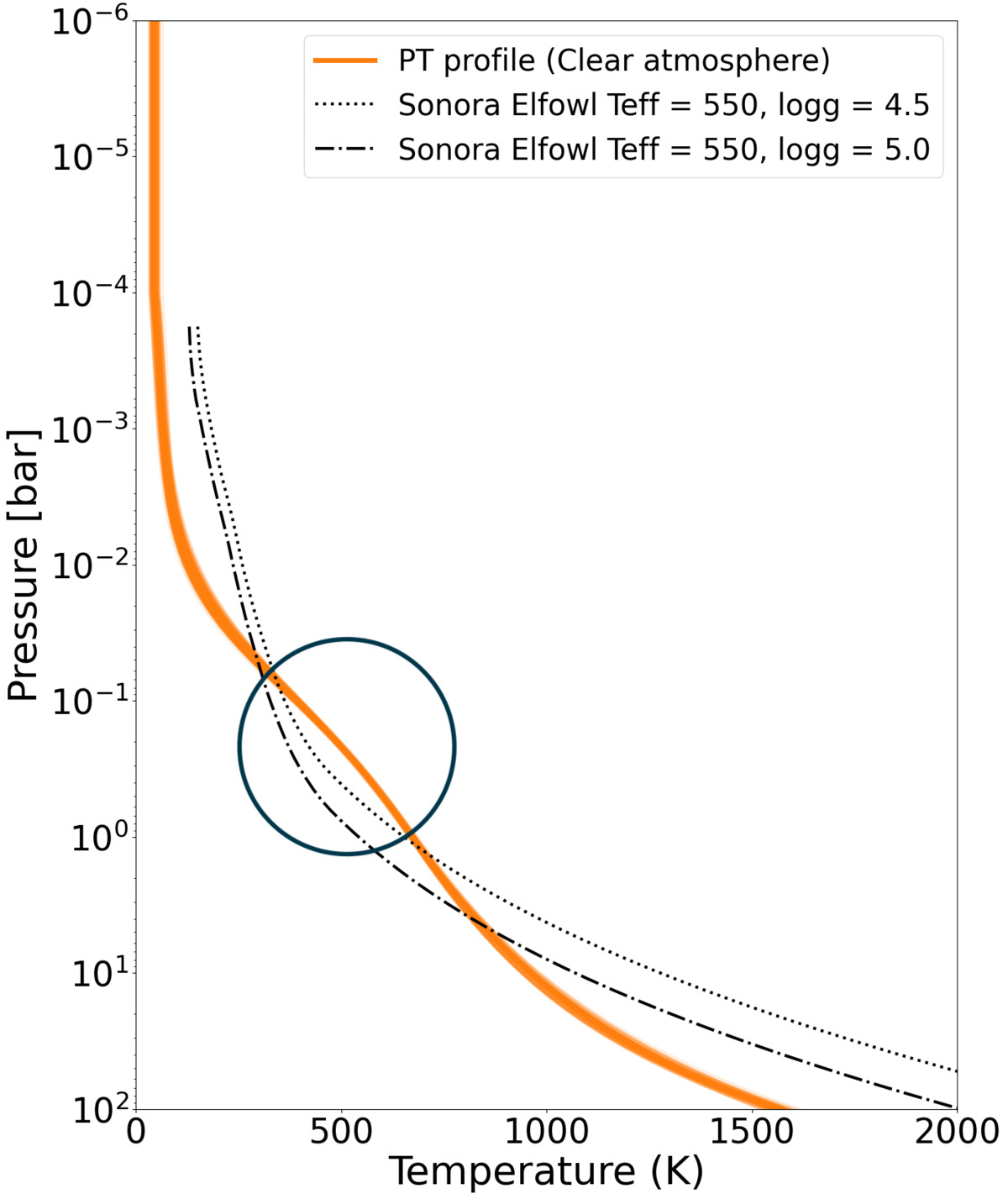
Pressure–temperature profile from a clear retrieval (no clouds) depicted using 200 randomly drawn P–T curves (orange) from the posterior chains. The P–T profile for a precomputed radiative-convective equilibrium (RCE) model from the Sonora Elfowl grid (black-dotted/-dotted–dashed lines; S. Mukherjee et al. 2024) is shown for reference. The retrieved profile deviates from RCE around 0.1−1 bar, indicating missing opacity sources in that region. The cloud condensation curves for different condensates are also indicated. KCl and ZnS clouds coincide best with the base of the isothermal region.
The thermal structure generated by the clear-atmosphere model had a noticeable kink (circled in blue). Dr. Baburaj compared that structure with predictions from more complex atmospheric models and found a discrepancy. He discussed the problem with his collaborators, who suggested trying clouds in the model.
When he included clouds, the unusual feature in the thermal structure was resolved. The resulting model aligned much better with the predictions from the more complicated atmospheric models.
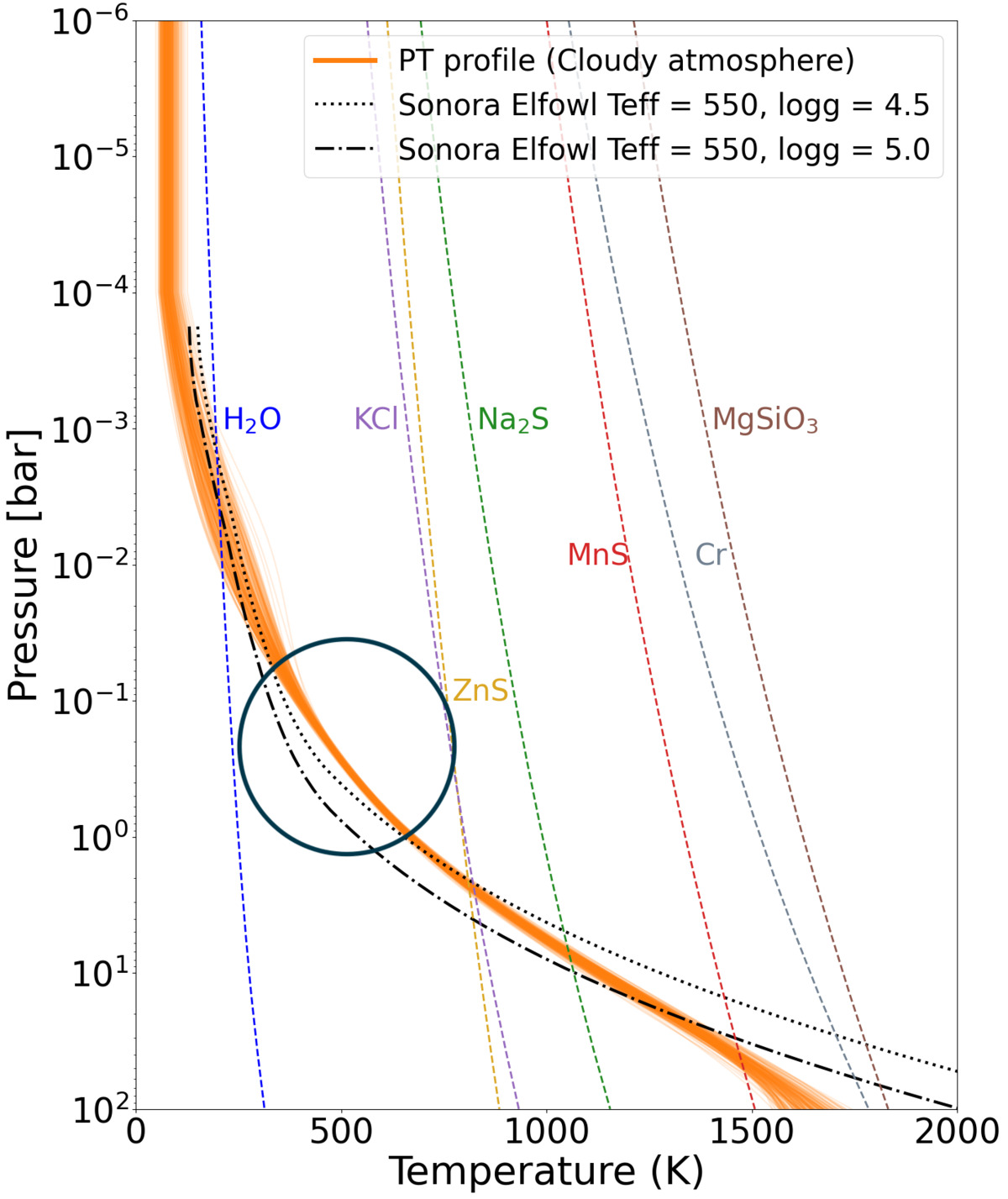
Same as above but for retrievals with KCl and ZnS clouds. The additional opacity brings the P–T profile into better agreement with RCE models. We also indicate the cloud condensation curves for different cloud species. The gray-dashed line indicates the wavelength-weighted contribution to the emergent flux at different pressures and highlights the preference for cloud-base pressures ∼of 1 bar.
That raised the next question: what kind of clouds could exist at these temperatures?
Hotter directly imaged planets and brown dwarfs can have silicate clouds. But GJ 504 b is much colder, making silicate clouds an unlikely explanation.
Dr. Baburaj instead examined where different possible cloud species would intersect the atmospheric temperature structure. That analysis pointed toward salt clouds as a possible explanation for the discrepancy. But the clouds have not been directly detected.
The proposed salt clouds are inferred from their effect on the object's emitted light. In the atmospheric model, a cloud layer blocks radiation coming from deeper layers of the atmosphere. That changes the spectrum that eventually reaches JWST.
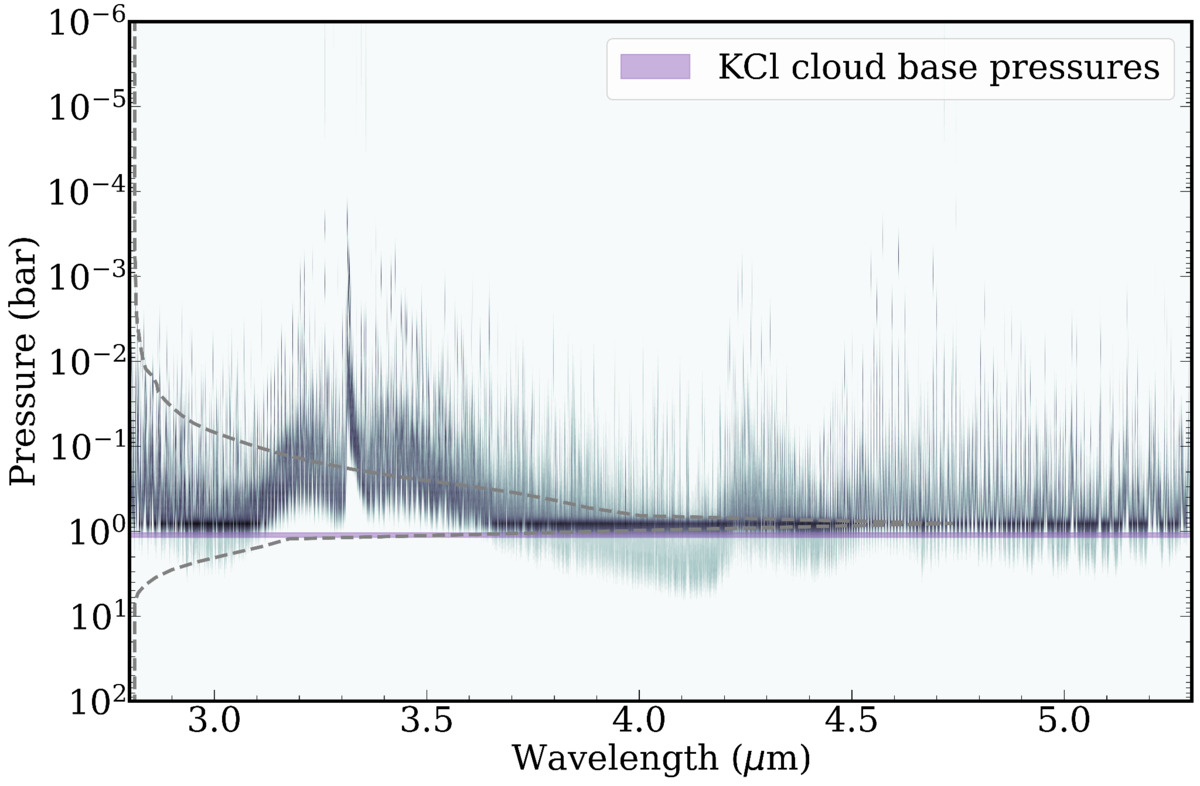
Emission contribution function for a cloudy retrieval with KCl and ZnS clouds. The gray-dashed line indicates the wavelength-weighted contribution function. The KCl cloud deck at ∼1 bar blocks the flux emerging from deeper in the atmosphere from reaching the surface, reducing the contribution of molecular opacities to the overall flux. The reduced contribution is also witnessed in the sharp decrease in the retrieved abundances between the clear and cloudy retrievals (Table 4). The cloud-base pressures and abundances of the ZnS cloud deck are poorly constrained by our retrievals (Figure C2), with the wavelength-weighted contribution function indicating that it does not significantly impact the emergent flux. Hence, we do not mark it on this figure.
In other words, JWST does not see a photograph of salt clouds. Instead, astronomers can look for changes in the spectrum that are consistent with clouds affecting the radiation emerging from the atmosphere.
Salt clouds have been proposed for cold objects like this before. The JWST observations now provide an opportunity to investigate their possible effects in much greater detail.
For GJ 504 b, the suspected clouds may help explain something that a clear-atmosphere model could not.
Is the Pink Planet Actually Pink?
GJ 504 b has another nickname that sounds almost too perfect: the pink planet. But nobody has actually photographed a pink world.
The nickname came from NASA's interpretation at the time of its discovery. Based on the object's estimated temperature, models suggested that it might appear something like cherry blossom or deep magenta.
Discovered in 2013, the Pink Planet orbits a sun-like star located 57 light-years from Earth. At roughly 25 times the mass of Jupiter, it sits near the fuzzy boundary between giant planets and brown dwarfs. So, astronomers refer to it as a “planetary-mass companion,” meaning that it’s a planet-sized object orbiting a star. Illustration courtesy of NASA/Goddard Space Flight Center
There is an important caveat, though: astronomers have not detected GJ 504 b at visible wavelengths.
During his analysis, Dr. Baburaj used atmospheric models and Python software to convert the modeled spectrum into an equivalent color, the kind of color that might be perceived by the human eye. The result was inconclusive.
So GJ 504 b could be pink. But at this point, astronomers simply do not know what the object would look like in visible light. The “pink planet” nickname remains a model-based possibility rather than an observed fact.
Could the Salt Clouds Tell Us How It Formed?
The conversation also turned to an intriguing possibility: could the atmosphere of GJ 504 b reveal something about how the object formed?
One audience question asked whether the atmospheric salt signature might be evidence that the object had consumed volatile-rich bodies, such as icy objects, during an earlier period of orbital chaos. Dr. Baburaj was cautious about making that connection. He explained that a stronger indication of such a history would be enhanced metallicity compared with the host star. The salt-cloud signature itself is not enough to establish that GJ 504 b consumed icy bodies.
There is an interesting possibility worth investigating: If a cold object has a higher metal content, it has more material available to form unusual clouds such as the proposed salt clouds. But the science has not yet reached the point where astronomers can establish a specific connection between consuming icy bodies and producing salt clouds. More research would be needed to determine whether such a relationship exists.
For now, the idea remains a possibility rather than an established explanation for GJ 504 b's atmosphere.
The Question Dr. Baburaj Most Wants Answered
So, after all of this, what would Dr. Baburaj want to know most about GJ 504 b? If he had unlimited funding and could answer one question immediately, he would want to know whether the object really has the salt clouds suggested by the models.
That question matters because these kinds of cold, high-metallicity objects have not been extensively studied. More JWST observations could help determine whether the proposed clouds are genuinely present and give astronomers a better understanding of their atmospheres.
GJ 504 b is not the only object on Dr. Baburaj's research list. He is also working on another object estimated at around 20 Jupiter masses, which he hopes to investigate to determine whether it formed as a planet.
Another project will examine a planet orbiting a binary star system, with the goal of investigating whether those worlds form differently from those orbiting single stars.
A Bigger Future for Exoplanet Atmospheres
For Dr. Baburaj, GJ 504 b is part of a much larger shift in what astronomers can investigate.
JWST is helping astronomers study objects that were previously extremely difficult to characterize. Instead of simply detecting faint companions, researchers can now begin examining what their atmospheres contain and how atmospheric processes such as clouds affect the light they emit. That work could also help prepare for future space observatories.
During the conversation, Dr. Baburaj mentioned the planned Habitable Worlds Observatory, a future observatory aimed at detecting Earth-like planets. The atmospheric studies being carried out with JWST could help inform the work that comes next.
For now, GJ 504 b remains unresolved. It may be a planet. It may be a brown dwarf. The salt clouds are still a hypothesis. And its famous pink color exists only as a model-based possibility. What JWST has provided is not a final answer, but a much clearer view of an object that was previously extraordinarily difficult to study and a new set of questions about what its atmosphere is actually like.
More observations may eventually reveal whether GJ 504 b really has the proposed salt clouds and what those clouds can tell us about this unusual companion.
Watch the full SETI Live conversation here. Read the published paper.
Read the Northwestern University story.
Final questions
1. Why couldn't astronomers get a spectrum of GJ 504 b from the ground?
GJ 504 b is extremely faint because of its low temperature. Although astronomers could image the object, attempts to obtain useful spectroscopy from the ground were unsuccessful, even after observations lasting an entire night. JWST's position in space avoids the complications of observing through Earth's atmosphere, making it much better suited to studying the object's faint infrared emission.
2. How long did the JWST observation of GJ 504 b take?
The JWST observations discussed in the interview took about 2.5 hours. Despite that relatively short observing time, the companion was detected with a very high signal-to-noise ratio greater than 100.
3. Can JWST actually see the salt clouds directly?
No. JWST does not directly see or photograph the proposed salt clouds. Their presence is inferred from their effect on the object's spectrum. Dr. Baburaj's initial clear-atmosphere model produced an unusual kink in the atmospheric thermal structure. Adding clouds resolved the discrepancy, and examining possible cloud species suggested that salt clouds were responsible. So the salt clouds remain suspected or proposed, rather than directly observed.







News
Related News
Sep 4, 2026
Why Do Some Solar Eruptions Fail?
#Blog #Rebecca Robinson
Aug 12, 2026
Hide the Star: How Roman Will See Exoplanets
#Blog #Franck Marchis #Margaret Turnbull #Nancy Grace Roman Space Telescope #Planetary Exploration #NASA Missions and Observatories #Exoplanets #Spectroscopy #Astronomy
Aug 11, 2026
50 Years on Mars: From Viking to Today's Rovers
#Blog #Simon Steel #Pascal Lee #Mars
Jul 24, 2026
A New Way to Search for Alien Civilizations
#Blog #Lauren Sgro
Jul 17, 2026
How Clouds Hide Alien Worlds—and How Astronomers See Through Them
#Blog #Moiya McTier
Jul 2, 2026
How Clouds Hide Alien Worlds—and How Astronomers See Through Them
#Blog #Lauren Sgro
Sep 4, 2026
#Blog
#Rebecca Robinson
Aug 12, 2026
#Blog
#Franck Marchis
#Margaret Turnbull
#Nancy Grace Roman Space Telescope
#Planetary Exploration
#NASA Missions and Observatories
#Exoplanets
#Spectroscopy
#Astronomy
Hide the Star: How Roman Will See Exoplanets
Aug 11, 2026
#Blog
#Simon Steel
#Pascal Lee
#Mars
50 Years on Mars: From Viking to Today's Rovers
Jul 24, 2026
#Blog
#Lauren Sgro
A New Way to Search for Alien Civilizations
Jul 17, 2026
#Blog
#Moiya McTier
How Clouds Hide Alien Worlds—and How Astronomers See Through Them
Jul 2, 2026
#Blog
#Lauren Sgro
How Clouds Hide Alien Worlds—and How Astronomers See Through Them
Research
Related Projects

SkyMapper • SETI • Citizen Science • Astronomy
SkyMapper: Expanding Access to Real-time Astronomy Through a Global Astronomical Network
SkyMapper and the SETI Institute are connecting educators, students and the public to live astronomical observations through a distributed astronomical network. #SkyMapper #SETI #Citizen Science #Astronomy
VPL
Virtual Planetary Laboratory
How can we best assess whether an exoplanet supports life? #VPL
Discovery and Futures Lab
Discovery and Futures Lab
What happens if life beyond Earth is discovered? The Discovery and Futures Lab at the SETI Institute fosters novel and anticipatory research at the intersection of science, society, our planet, and the search for life beyond Earth. #Discovery and Futures Lab
May 17, 2026
SkyMapper: Expanding Access to Real-time Astronomy Through a Global Astronomical Network
SkyMapper and the SETI Institute are connecting educators, students and the public to live astronomical observations through a distributed astronomical network.
#SkyMapper
#SETI
#Citizen Science
#Astronomy
May 5, 2026
Virtual Planetary Laboratory
How can we best assess whether an exoplanet supports life?
#VPL
Apr 16, 2026
Discovery and Futures Lab
What happens if life beyond Earth is discovered? The Discovery and Futures Lab at the SETI Institute fosters novel and anticipatory research at the intersection of science, society, our planet, and the search for life beyond Earth.
#Discovery and Futures Lab
Support Us
Support the
SETI Institute
Scientists are getting closer in their search for life beyond earth. But with limited federal funding for the search for extraterrestrial intelligence, supporters are the reason cutting-edge scientists can keep their eyes on the sky.