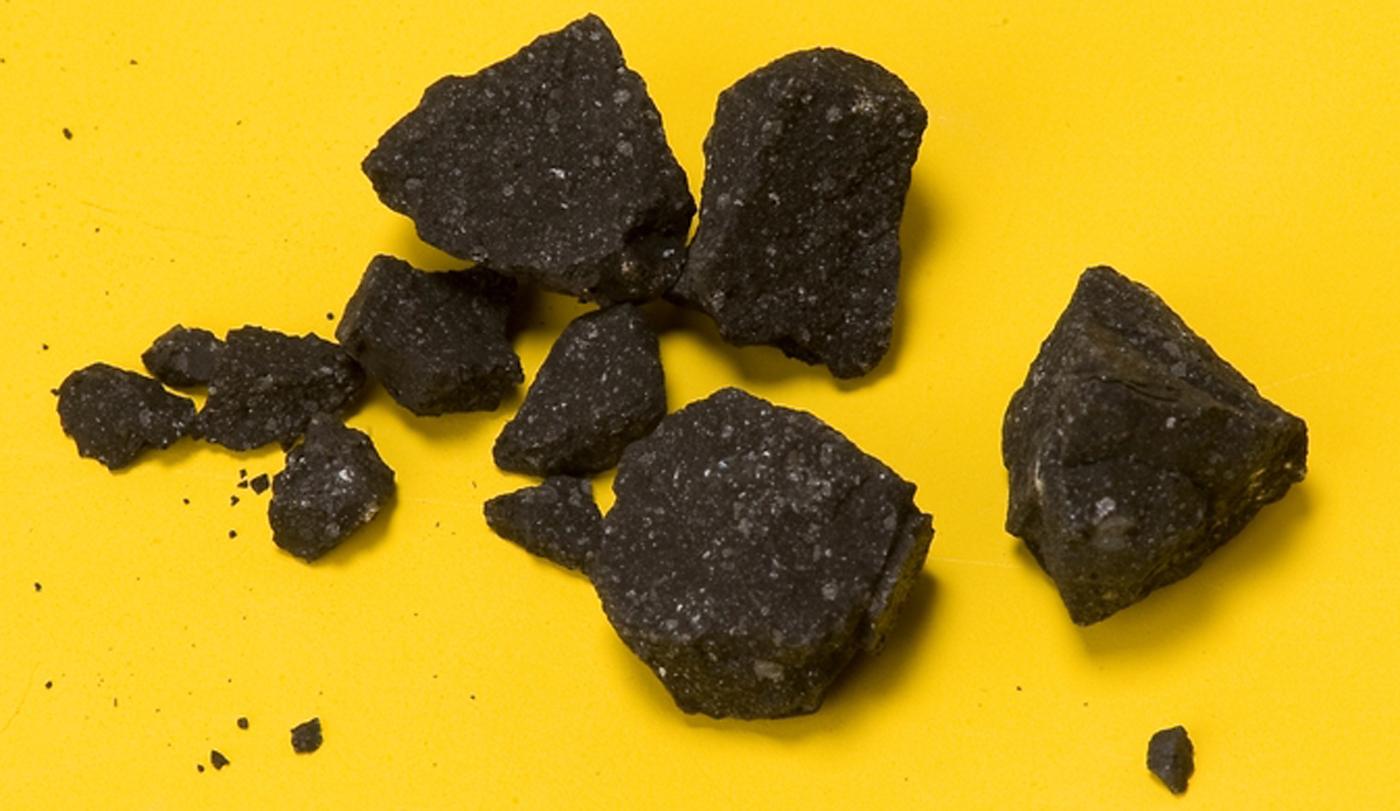







Fragments of the Sutter’s Mill meteorite fall collected by NASA Ames and SETI Institute meteor astronomer Peter Jenniskens on the evening of Tuesday April 24, 2012, two days after the fall. This was the second recovered find. Image Credit: NASA Ames/Eric
SETI Institute meteor astronomer Peter Jenniskens found one of the first and one of the most unusual of the Sutter's Mill meteorites that fell on April 22nd, 2012 in California's Gold Country. The pristine sample was collected and rushed to meteorite researchers and laboratories around the world. Now, these scientists report their results in 13 papers in the journal Meteoritics and Planetary Science.
They found that the meteorite contained a host of "xenoliths", chunks of matter that can only have an other-worldly reason for being there. Those included two 10-micron sized diamonds, huge compared to the usual nano-sized diamond star-stuff found in such meteorites. Where did they come from? Perhaps from the interior of a much larger parent body that got smashed, scattering debris all over.
Much of the meteorite appears to have some star-stuff memory. A particularly interesting result of the analysis so far concerns the abundance of various isotopes of chromium within the samples. These suggest that debris from five different stars may have contributed to the material from which our Solar System was formed. Astronomers like to say that “we are star stuff,” and this result suggests that both we and our world contain the detritus of not one, but many stars.
You can read the press release describing their work here:
https://www.nasa.gov/ames/nasa-scientists-find-diamonds-and-other-treasures-in-gold-rush-meteorite/
News
Related News
Researchers Propose Searching the Moon for Microscopic Technosignatures
New study outlines the first quantitative framework for searching lunar regolith for microscopic technosignatures. #Press Releases #Moon #Technosignatures #Lewis Pinault #Andrew Siemion #Astrobiology #SETI #Solar System #AI and Machine Learning #Bill Diamond

New Meteor Shower Identifies Asteroid as a Cloaked Comet
#Comets, Meteors, and Asteroids #CAMS #Peter Jenniskens
SETI Institute Achievements: Q2 2026 Activity Report
During the second quarter of 2026, the SETI Institute was especially active and made strong progress in research, education, outreach, and public engagement. Our scientists published over 80 peer-reviewed papers in fields such as SETI, astrobiology, planetary science, exoplanets, and heliophysics. #Activity Reports #Carl Sagan Center #Outreach #Education #AIR #Community #Research #SETI Institute
New study reveals how space rocks become meteorites
Analysis of the atmospheric passage of 75 meteorite falls identifies seven distinct processes as space rocks melt, fragment and slow before they fall as meteorites #Press Releases #Comets, Meteors, and Asteroids #Peter Jenniskens #Meteorites #Astronomy #Stuart Pilorz
SETI Institute In the News: July Roundup 2026
#SETI Institute in the News #SETI Institute #Community #Peter Jenniskens #Lucian Walkowicz #Chelsea Haramia #Pascal Lee #Bill Diamond #Seth Shostak #Meteorites #SETI #UAPs #NASA Missions and Observatories #Discovery and Futures Lab #Mars
SETI Institute In the News: June Roundup 2026
Throughout June 2026, SETI Institute scientists, affiliates, and collaborators contributed to discussions spanning interstellar visitors, planetary science, technosignature searches, animal cognition, and the scientific process guiding the search for life beyond Earth. #SETI Institute in the News #SETI Institute #Community #Eduardo Bendek #Optical SETI #SETI #3I/ATLAS #ATA #Comets, Meteors, and Asteroids #Solar System #Franck Marchis #Ariel Graykowski #Jill Tarter #Vishal Gajjar #Radio Astronomy #Bill Diamond #Lori MarinoResearch
Related Projects
SkyMapper: Expanding Access to Real-time Astronomy Through a Global Astronomical Network
SkyMapper and the SETI Institute are connecting educators, students and the public to live astronomical observations through a distributed astronomical network. #SkyMapper #SETI #Citizen Science #Astronomy
Virtual Planetary Laboratory
How can we best assess whether an exoplanet supports life? #VPL
Discovery and Futures Lab
What happens if life beyond Earth is discovered? The Discovery and Futures Lab at the SETI Institute fosters novel and anticipatory research at the intersection of science, society, our planet, and the search for life beyond Earth. #Discovery and Futures LabSupport the
SETI Institute
Scientists are getting closer in their search for life beyond earth. But with limited federal funding for the search for extraterrestrial intelligence, supporters are the reason cutting-edge scientists can keep their eyes on the sky.