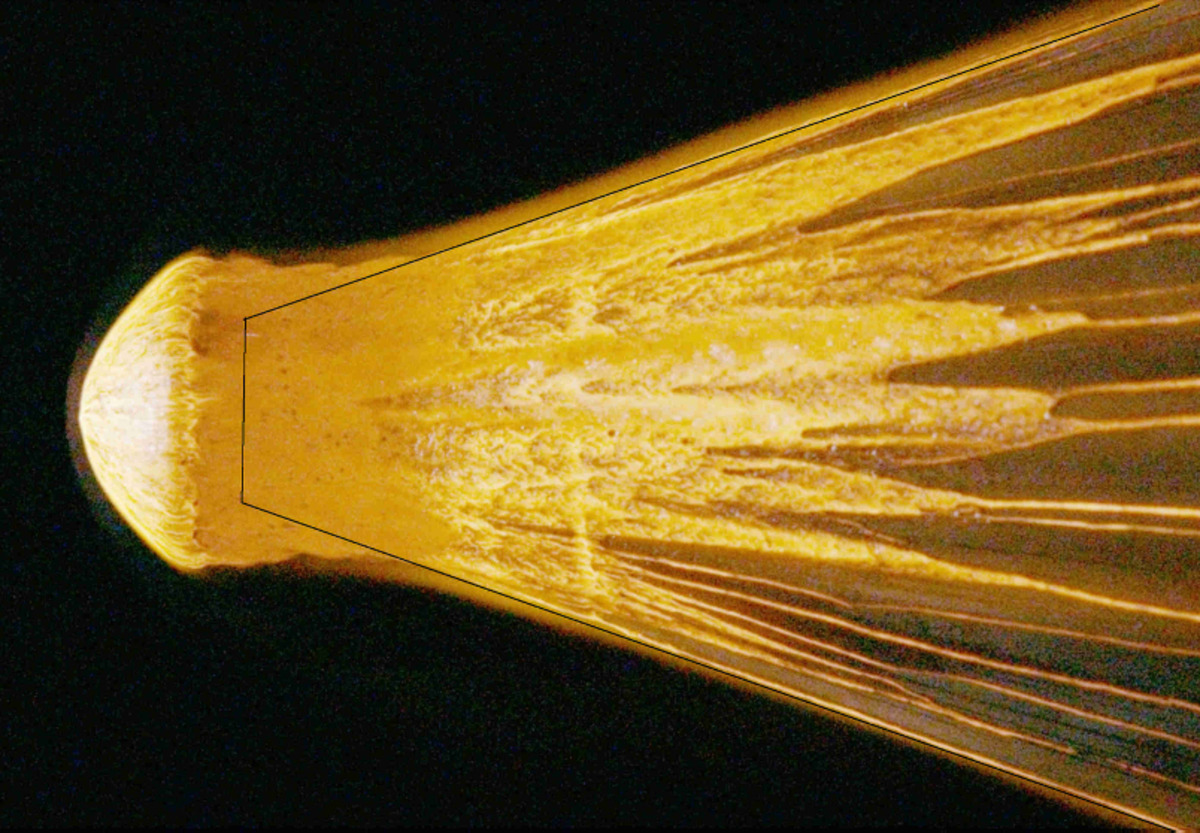
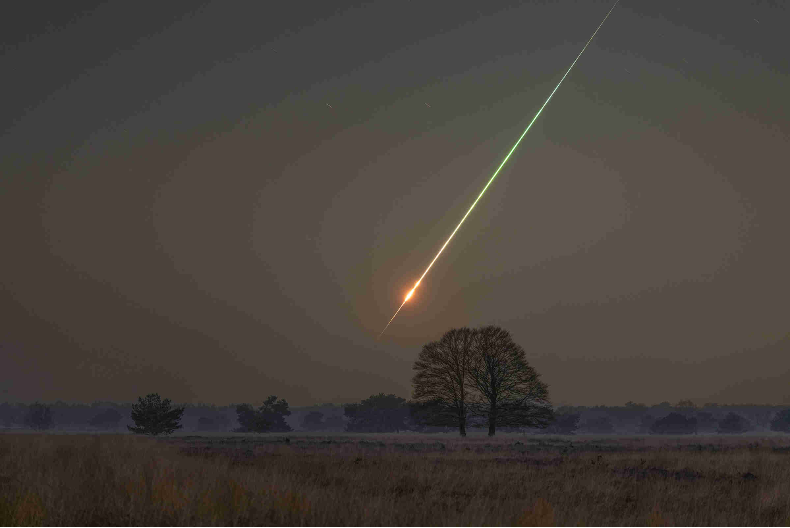
In Phase 3, the meteor gets much brighter and turns into a fireball. The researchers found that melting now causes most of the rock’s mass loss. The fast-moving air pulls melted material off the surface, leaving droplets behind that keep evaporating.
"In the laboratory, we cannot generate the amount of radiation that occurs in a natural atmospheric entry at those speeds," said Eric Stern, formerly at NASA Ames and now chief scientist at Hyperspace Technologies, Inc. "Rock could aggressively fragment and erode instead, but then we would not expect the observed systematics in how fireballs brighten.”
At around 60 kilometers (around 40 miles) above Earth, the fireball reaches Phase 4 by settling into a melting equilibrium. Its brightness stays the same or grows at a steady pace. The rock ultimately can lose up to 40 percent of its mass just from melting.
Breaking apart on the way down
Deeper in the atmosphere, higher pressure makes the rock break apart, starting Phase 5. The fireball may flare up several times as pieces break off.
The researchers discovered that rocks start to break apart when the air pressure in front of the rock is only about one-fifth of the strength measured in meteorites found on Earth. They think that heat and cracks from earlier collisions in space can explain why the rocks break earlier than expected.
Only at this time does the remaining rock quickly become smaller and slows down significantly, more rapidly if the rock breaks aggressively.
"We were able to tie that slow-down from fragmentation to the previous mathematical descriptions based on ablation," said co-author Stu Pilorz of the SETI Institute.
If the back of the main rock stays whole, it creates a low-pressure area behind it that pulls smaller pieces along.
"Our modeling shows that as long as the back of the space rock remains intact, that rock pulls a vacuum in its wake into which fragments tend to flow," says co-author Darrel Robertson of NASA Ames Research Center. "Those small meteorites fall in a narrow strip on the ground."
When the back of the rock finally breaks apart in Phase 6, the fireball gives off a last bright flare and sends pieces flying out faster. Since the rock has already slowed down, these late flares are usually red instead of the bright green seen earlier.
"That final disruption sends fragments flying at higher relative speeds," said Jenniskens. "In past falls, we noticed that meteorites larger than about 20g tended to be scattered wider and many came from close to the surface of the original space rock, which must have been its backside."
The meteorites that reach the ground started as larger pieces, but they went through more melting and broke apart further before slowing down enough to land.
In Phase 7, melting and fragmentation keep happening until the last pieces slow down enough to stop glowing. Melting ends, leaving a thin fusion crust on their surfaces. Winds can then blow the darkened fragments off course as they finish falling to the ground as meteorites.
What meteorites can tell us about larger asteroids
The 75 investigated meteorite falls included several different meteorite types. The study identified the altitudes at which these different materials went through the seven phases.
By studying the atmospheric slow-down of small solid space rocks of different types, insight was gained also into what happens to more dangerous airbursting asteroids the size of cars to city blocks.
"Asteroids up to tens of meters in size are also solid rocks because they tend to spin faster than do the larger rubble pile asteroids," said Jenniskens. "The 20-m diameter asteroid that caused the airburst over Chelyabinsk, Russia, in 2013 went through the same phases."
Paper link: https://onlinelibrary.wiley.com/doi/10.1111/maps.70203
About the SETI Institute
Founded in 1984, the SETI Institute is a non-profit, multi-disciplinary research and education organization whose mission is to lead humanity’s quest to understand the origins and prevalence of life and intelligence in the Universe and to share that knowledge with the world. Our research encompasses the physical and biological sciences and leverages expertise in data analytics, machine learning and advanced signal detection technologies. The SETI Institute is a distinguished research partner for industry, academia and government agencies, including NASA and NSF.
Contact information
Rebecca McDonald
Director of Communications
SETI Institute
[email protected]
)