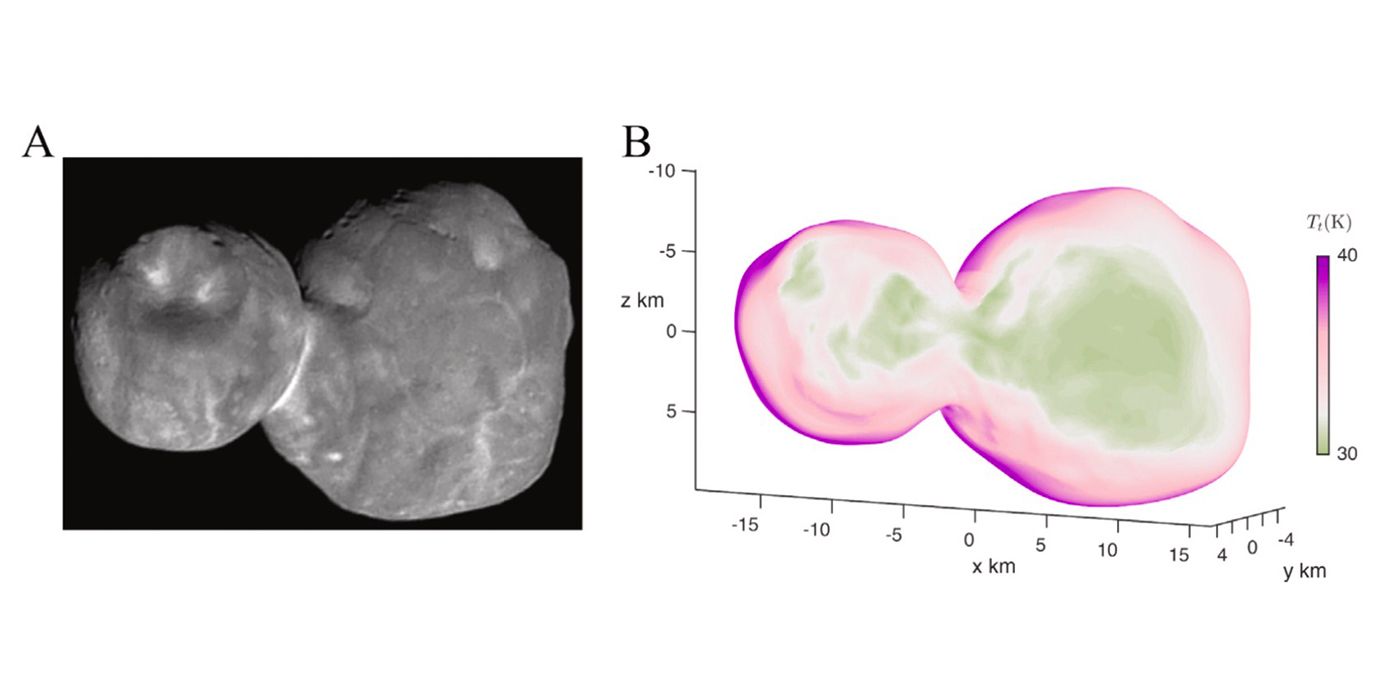







Left image was captured by the Multicolor Visible Imaging Camera (MVIC), a part of the ralph instrument aboard New Horizons. Taken on January 1, 2019, just 7 minutes before its closest approach, the spacecraft was only about 6700 km from the surface. Credit for this remarkable capture goes to NASA, Johns Hopkins University Applied Physics Laboratory, and Southwest Research Institute. Right image shows the orbitally averaged temperature at the seasonal skin depth of Arrokoth, calculated based on Umurhan et al.’s 2022 method. The scale is in kilometers, and the view orientation is similar to image on left, looking down towards the south pole.
March 14, 2024, Mountain View, CA -- A paper recently accepted by Icarus presents findings about the Kuiper Belt Object 486958 Arrokoth, shedding new light on the preservation of volatile substances like carbon monoxide (CO) in such distant celestial bodies. Co-authored by Dr. Samuel Birch at Brown University and SETI Institute senior research scientist Dr. Orkan Umurhan, the paper “Retention of CO Ice and Gas Within 486958 Arrokoth” uses Arrokoth as a case study to propose that many Kuiper Belt Objects (KBOs) - remnants from the dawn of our solar system - could still retain their original volatile ices, challenging previous notions about the evolutionary path of these ancient entities.
Previous KBO evolution models have needed help predicting the fate of volatiles in these cold, distant objects. Many relied on cumbersome simulations or flawed assumptions, underestimating how long these substances could last. The new research offers a simpler yet effective approach, likening the process to how gas escapes through porous rock. It suggests that KBOs like Arrokoth can maintain their volatile ices for billions of years, forming a kind of subsurface atmosphere that slows further ice loss.
“I want to emphasize that the key thing is that we corrected a deep error in the physical model people had been assuming for decades for these very cold and old objects,” said Umurhan. “This study could be the initial mover for re- evaluating the comet interior evolution and activity theory.”
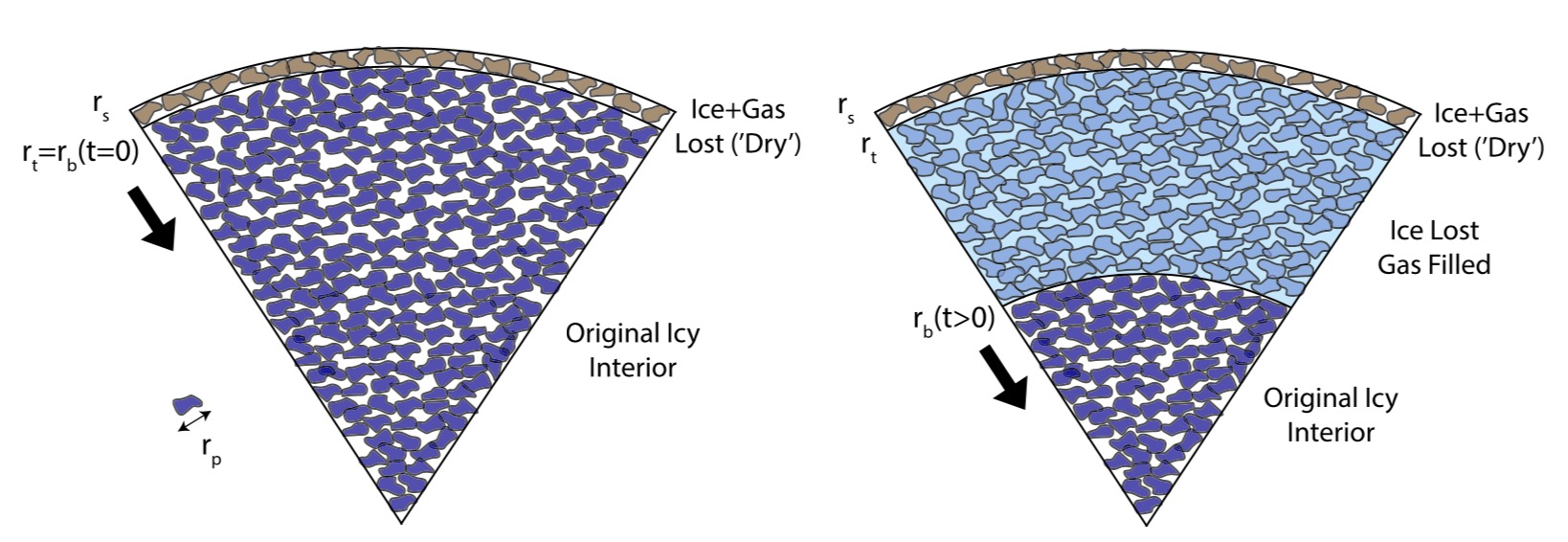
Our model features a porous rubble pile, made up of a mix of CO and refractory amorphous H2O ice, with specific pore radii 𝑟𝑝. The top layer, depicted in brown, undergoes thermal processing in just one orbit, resulting in the loss of CO (both ice and gas) in this layer. Below the sublimation front 𝑟𝑏, shown in dark blue, the original CO ice volume remains intact. Over time, as the sublimation front progresses downward (to the right in the model), CO ice embedded in the amorphous H2O ice matrix begins to sublimate. The gas produced, indicated in light blue, then fills the pores and moves upward, away from the sublimation front.
This study challenges existing predictions and opens up new avenues for understanding the nature of comets and their origins. The presence of such volatile ices in KBOs supports a fascinating narrative of these objects as “ice bombs,” which activate and display cometary behavior upon altering their orbit closer to the sun.
This hypothesis could help explain phenomena like the intense outburst activity of comet 29P/Schwassmann– Wachmann, potentially changing the understanding of comets.
As co-investigators on the upcoming CAESAR mission proposal, the researchers are taking a fresh approach to understanding the evolution and activity of cometary bodies. This study has implications for future explorations and is a reminder of the enduring mysteries of our solar system, waiting to be uncovered.
The paper can be found in Icarus here: https://doi.org/10.1016/j.icarus.2024.116027
About the SETI Institute
Founded in 1984, the SETI Institute is a non-profit, multi-disciplinary research and education organization whose mission is to lead humanity’s quest to understand the origins and prevalence of life and intelligence in the Universe and to share that knowledge with the world. Our research encompasses the physical and biological sciences and leverages expertise in data analytics, machine learning and advanced signal detection technologies. The SETI Institute is a distinguished research partner for industry, academia and government agencies, including NASA and NSF.
Contact information
Rebecca McDonald
Director of Communications
SETI Institute
[email protected]
News
Related News
Researchers Propose Searching the Moon for Microscopic Technosignatures
New study outlines the first quantitative framework for searching lunar regolith for microscopic technosignatures. #Press Releases #Moon #Technosignatures #Lewis Pinault #Andrew Siemion #Astrobiology #SETI #Solar System #AI and Machine Learning #Bill Diamond
The SETI Institute and ETH Zurich join forces to search for the origin of life
ETH Zurich and the SETI Institute announced a strategic scientific partnership today. The US-based research organization will provide start-up funding for a new assistant professorship and associated research activities at ETH Zurich. #Press Releases #SETI Institute #Partnerships #ETH Zurich #Bill Diamond
JWST Reveals a Race Against Time for Forming Planets
SETI Institute scientist Uma Gorti co-authors one of the largest JWST studies of how planet-forming disks lose their gas #Press Releases #JWST #Astronomy #Astrophysics #Uma Gorti
New study reveals how space rocks become meteorites
Analysis of the atmospheric passage of 75 meteorite falls identifies seven distinct processes as space rocks melt, fragment and slow before they fall as meteorites #Press Releases #Comets, Meteors, and Asteroids #Peter Jenniskens #Meteorites #Astronomy #Stuart Pilorz
SETI Institute Team Looks for a New Way to Find Resources in Space
#Press Releases #Pablo Sobron #Moon #Asteroids #Planetary Exploration #Spectroscopy #Astrobiology
Hide the Star: How Roman Will See Exoplanets
#Blog #Franck Marchis #Margaret Turnbull #Nancy Grace Roman Space Telescope #Planetary Exploration #NASA Missions and Observatories #Exoplanets #Spectroscopy #AstronomyResearch
Related Projects
SkyMapper: Expanding Access to Real-time Astronomy Through a Global Astronomical Network
SkyMapper and the SETI Institute are connecting educators, students and the public to live astronomical observations through a distributed astronomical network. #SkyMapper #SETI #Citizen Science #Astronomy
Virtual Planetary Laboratory
How can we best assess whether an exoplanet supports life? #VPL
Discovery and Futures Lab
What happens if life beyond Earth is discovered? The Discovery and Futures Lab at the SETI Institute fosters novel and anticipatory research at the intersection of science, society, our planet, and the search for life beyond Earth. #Discovery and Futures LabSupport the
SETI Institute
Scientists are getting closer in their search for life beyond earth. But with limited federal funding for the search for extraterrestrial intelligence, supporters are the reason cutting-edge scientists can keep their eyes on the sky.