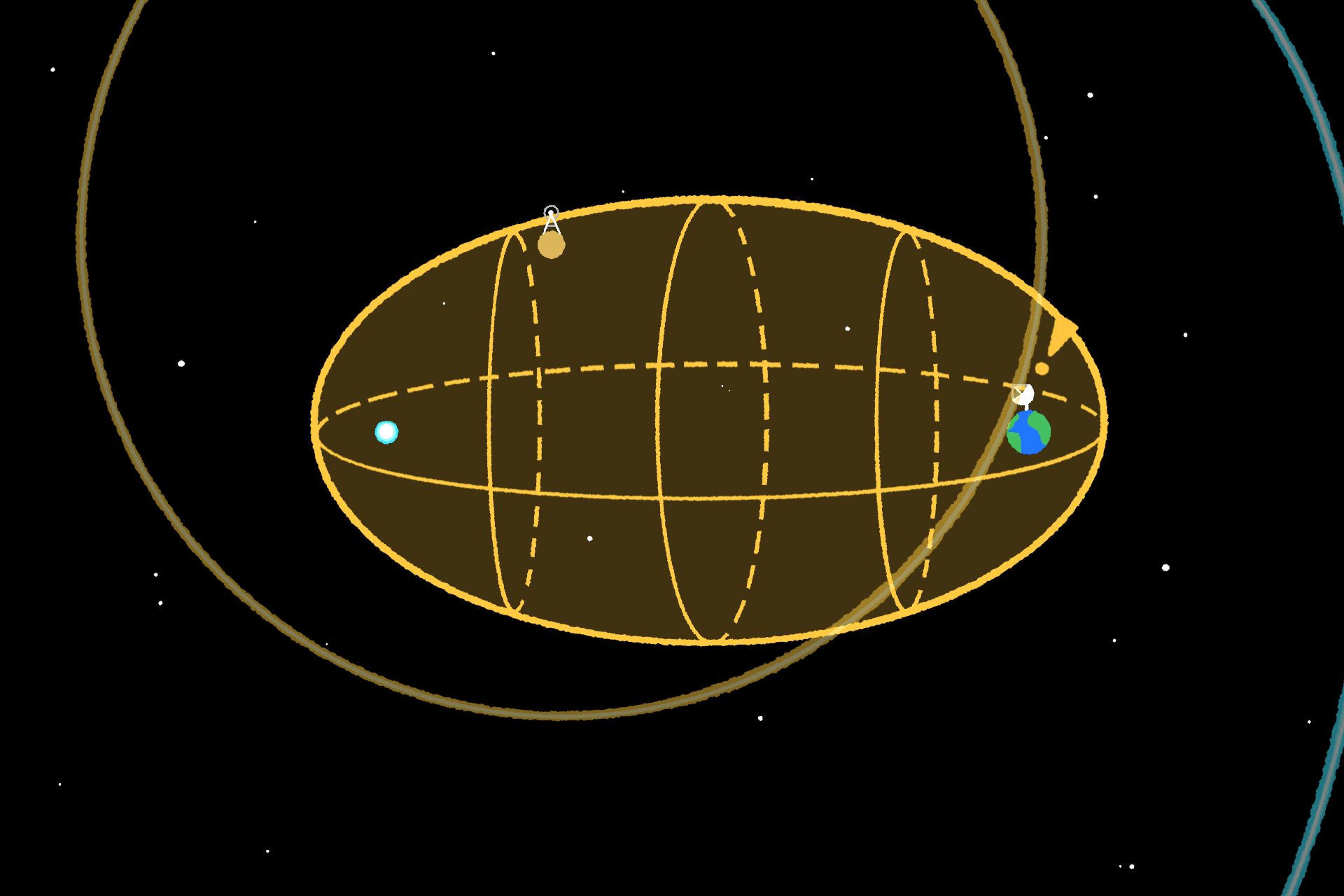
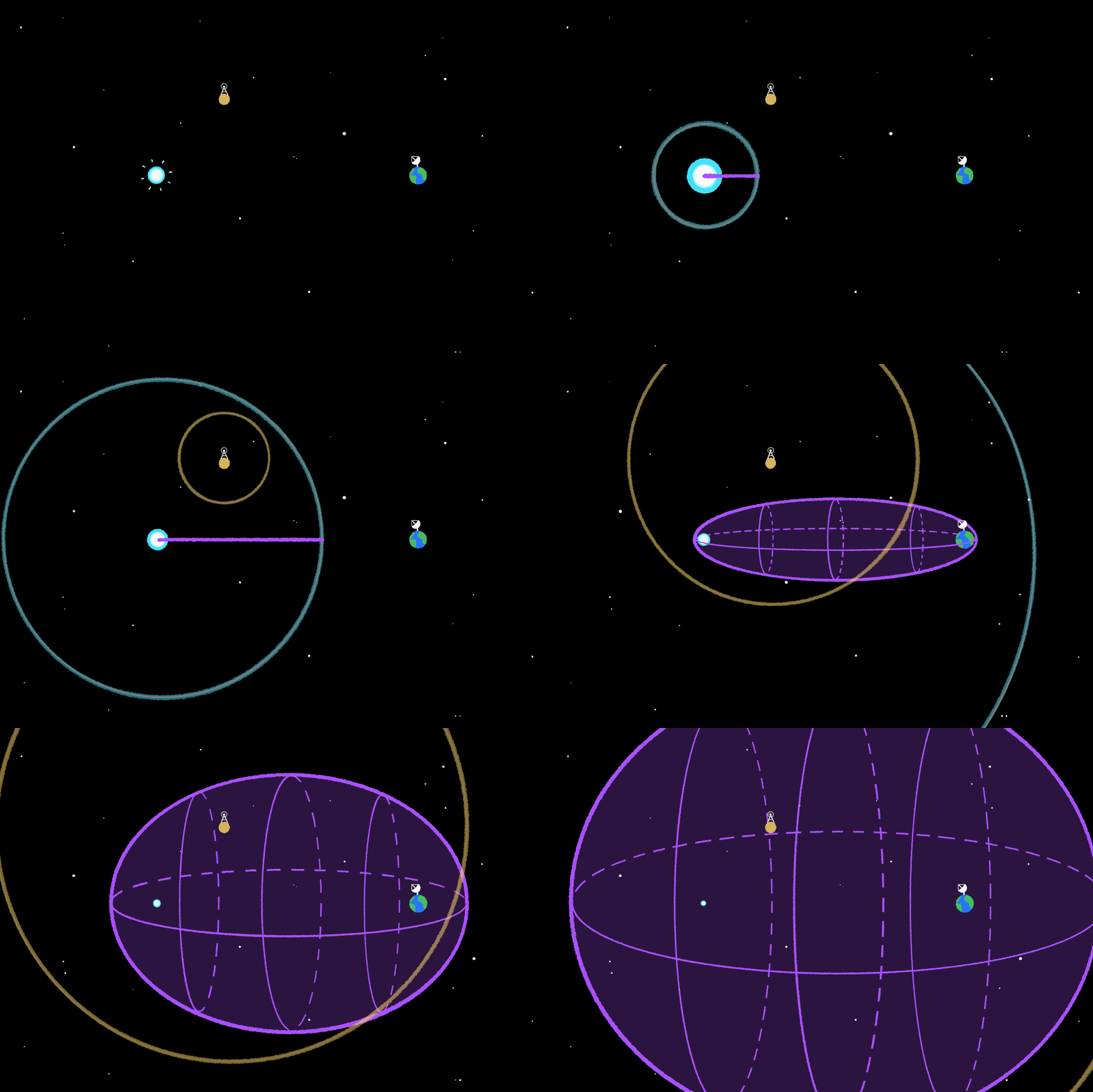
February 12, 2024, Mountain View, CA -- In a paper published in the Astronomical Journal, a team of researchers from the SETI Institute, Berkeley SETI Research Center and the University of Washington reported an exciting development for the field of astrophysics and the search for extraterrestrial intelligence (SETI), using observations from the Transiting Exoplanet Survey Satellite (TESS) mission to monitor the SETI Ellipsoid, a method for identifying potential signals from advanced civilizations in the cosmos. The SETI Ellipsoid is a strategic approach for selecting potential technosignature candidates based on the hypothesis that extraterrestrial civilizations, upon observing significant galactic events such as supernova 1987A, might use these occurrences as a focal point to emit synchronized signals to announce their presence.
In this work, researchers show that the SETI Ellipsoid method can leverage continuous, wide-field sky surveys, significantly enhancing our ability to detect these potential signals. By compensating for the uncertainties in the estimated time-of-arrival of such signals using observations that span up to a year, the team implements the SETI Ellipsoid strategy in an innovative way using state-of-the-arc technology.
“New surveys of the sky provide groundbreaking opportunities to search for technosignatures coordinated with supernovae.” said co-author Bárbara Cabrales. “The typical timing uncertainties involved are of a couple months, so we want to cover our bases by finding targets that are well-documented over the course of about a year. In addition to that, it’s important to have as many observations as possible for each target of interest, so that we can determine what looks like normal behavior and what might look like a potential technosignature.”
In examining data from the TESS continuous viewing zone, covering 5% of all TESS data from the first three years of its mission, researchers utilized the advanced 3D location data from Gaia Early Data Release 3. This analysis identified 32 prime targets within the SETI Ellipsoid in the southern TESS continuous viewing zone, all with uncertainties refined to better than 0.5 light-years. While the initial examination of TESS light curves during the Ellipsoid crossing event revealed no anomalies, the groundwork laid by this initiative paves the way for expanding the search to other surveys, a broader array of targets, and exploring diverse potential signal types.
Applying the SETI Ellipsoid technique to scrutinize large archival databases signifies a monumental step forward in the search for technosignatures. Utilizing Gaia's highly precise distance estimates, the study demonstrates the feasibility of cross-matching these distances with other time-domain surveys like TESS to enhance monitoring and anomaly detection capabilities in SETI research.
The SETI Ellipsoid method, combined with Gaia's distance measurements, offers a robust and adaptable framework for future SETI searches. Researchers can retrospectively apply it to sift through archival data for potential signals, proactively select targets, and schedule future monitoring campaigns.
“As Dr. Jill Tarter often points out, SETI searches are like looking for a needle in a 9-D haystack,” said co-author Dr. Sofia Sheikh. “Any technique that can help us prioritize where to look, such as the SETI Ellipsoid, could potentially give us a shortcut to the most promising parts of the haystack. This work is the first step in searching those newly-highlighted parts of parameter space, and is an exciting precedent for upcoming large survey projects like LSST.”
As humanity continues to explore the mysteries of the universe, the SETI Institute remains at the forefront, employing innovative techniques like the SETI Ellipsoid to bridge cosmic distances and connect with potential civilizations among the stars.
Paper: https://doi.org/10.3847/1538-3881/ad2064 .
About the SETI Institute
Founded in 1984, the SETI Institute is a non-profit, multi-disciplinary research and education organization whose mission is to lead humanity’s quest to understand the origins and prevalence of life and intelligence in the Universe and to share that knowledge with the world. Our research encompasses the physical and biological sciences and leverages expertise in data analytics, machine learning and advanced signal detection technologies. The SETI Institute is a distinguished research partner for industry, academia and government agencies, including NASA and NSF.
Contact information
Rebecca McDonald
Director of Communications
SETI Institute
[email protected]
News
Related News
Researchers Propose Searching the Moon for Microscopic Technosignatures
New study outlines the first quantitative framework for searching lunar regolith for microscopic technosignatures. #Press Releases #Moon #Technosignatures #Lewis Pinault #Andrew Siemion #Astrobiology #SETI #Solar System #AI and Machine Learning #Bill Diamond
The SETI Institute and ETH Zurich join forces to search for the origin of life
ETH Zurich and the SETI Institute announced a strategic scientific partnership today. The US-based research organization will provide start-up funding for a new assistant professorship and associated research activities at ETH Zurich. #Press Releases #SETI Institute #Partnerships #ETH Zurich #Bill Diamond
JWST Reveals a Race Against Time for Forming Planets
SETI Institute scientist Uma Gorti co-authors one of the largest JWST studies of how planet-forming disks lose their gas #Press Releases #JWST #Astronomy #Astrophysics #Uma Gorti
New study reveals how space rocks become meteorites
Analysis of the atmospheric passage of 75 meteorite falls identifies seven distinct processes as space rocks melt, fragment and slow before they fall as meteorites #Press Releases #Comets, Meteors, and Asteroids #Peter Jenniskens #Meteorites #Astronomy #Stuart Pilorz
SETI Institute Team Looks for a New Way to Find Resources in Space
#Press Releases #Pablo Sobron #Moon #Asteroids #Planetary Exploration #Spectroscopy #Astrobiology
SETI Institute In the News: July Roundup 2026
#SETI Institute in the News #SETI Institute #Community #Peter Jenniskens #Lucian Walkowicz #Chelsea Haramia #Pascal Lee #Bill Diamond #Seth Shostak #Meteorites #SETI #UAPs #NASA Missions and Observatories #Discovery and Futures Lab #MarsResearch
Related Projects
SkyMapper: Expanding Access to Real-time Astronomy Through a Global Astronomical Network
SkyMapper and the SETI Institute are connecting educators, students and the public to live astronomical observations through a distributed astronomical network. #SkyMapper #SETI #Citizen Science #Astronomy
Virtual Planetary Laboratory
How can we best assess whether an exoplanet supports life? #VPL
Discovery and Futures Lab
What happens if life beyond Earth is discovered? The Discovery and Futures Lab at the SETI Institute fosters novel and anticipatory research at the intersection of science, society, our planet, and the search for life beyond Earth. #Discovery and Futures LabSupport the
SETI Institute
Scientists are getting closer in their search for life beyond earth. But with limited federal funding for the search for extraterrestrial intelligence, supporters are the reason cutting-edge scientists can keep their eyes on the sky.