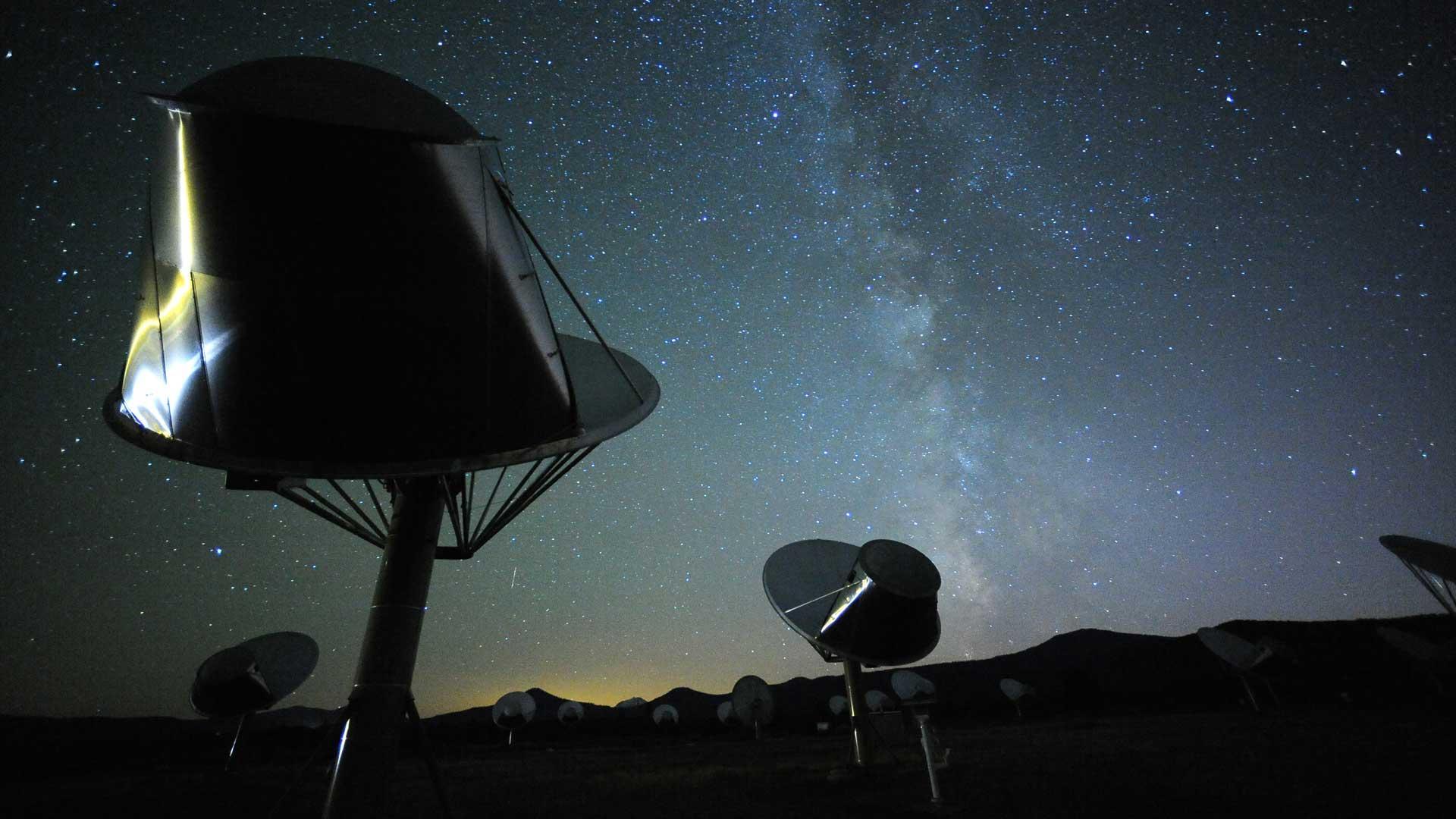
September 16, 2019, Mountain View, CA – The SETI Institute announced a new gift by Qualcomm founder Franklin Antonio that funds the first phase of a 3-year initiative to revitalize the Allen Telescope Array (ATA). These upgrades will significantly increase the sensitivity of ATA's receivers and permit the development of a new digital processing system that will bring enhanced capabilities.
The three-year initiative includes:
- Revision to the existing feed design to improve reliability and sensitivity
- Design and construction of a novel multi-mode digital signal processing system allowing the ATA to cover the radio spectrum 10 times faster, operate in new ultra-wide-field observing modes and target new classes of signals, including fast radio bursts (FRBs)
- The hiring of additional scientific and engineering staff to fully realize the ATA’s potential to contribute to technosignature science.
Early commissioning observations using upgraded receivers and new digital signal processing systems are underway now, with the first phase of the new observing campaign expected to begin in 2020.
"The ATA was a visionary design when it was built decade ago” said Antonio. “It was designed to grow in capability as digital signal processing advanced. Taking advantage of this requires ongoing sources of funding. Too often government and institutional funding sources have aimed at construction of new facilities rather than supporting and advancing existing ones. Its time now for a bit of an ATA technology upgrade. The ATA was designed to be especially good at what the astronomers call 'surveys' -- astronomy lingo for an experiment where you don't know where to look. Although SETI is the classic survey science, because we don't know where in the sky ET might be hiding, astronomers routinely use survey techniques to study other phenomena. An example which has recently received much press is the search for fast radio bursts (FRBs). One of the goals of this upgrade is to allow more kinds of astronomical surveys to operate side-by-side with ATA's primary SETI mission, leading to more collaborative engagements between the ATA and other institutions. By the way, funding science is fun. I urge others to give it a try."
Dr. Andrew P. V. Siemion, Bernard M. Oliver Chair for SETI at the SETI Institute said, "The SETI Institute constructed the ATA with a radical vision: build a telescope optimized for tomorrow’s digital technologies, rather than today’s. Today has arrived. We are thrilled to be adding upgrades to the array that will improve its capabilities in three crucial dimensions: radio bandwidth, sensitivity and instantaneous sky coverage.” Siemion, who also serves as Director of the Berkeley SETI Research Center and Principal Investigator of the Breakthrough Listen Initiative, continued: “these upgrades re-emphasize the ATA’s role in serving as a technology pathfinder for next-generation SETI searches on upcoming array telescopes like the Square Kilometre Array (SKA) and Next Generation VLA (ngVLA).”
New team member Dr. Alex Pollak joined the SETI Institute ATA team in July 2019, bringing expertise in analog and digital signal processing and cryogenically cooled receiver systems.
Other collaborating institutions on the project include the University of California, Berkeley and the California Institute of Technology. The SETI Institute expects to make additional hires in the coming months.
About Franklin Antonio
Franklin Antonio is co-founder of Qualcomm, where he currently serves as Chief Scientist Emeritus. He holds 378 granted and pending patents worldwide.
Antonio has been a long-time collaborator with the SETI Institute, and previously funded upgrades to the backend feeds of the ATA, known as the Antonio feeds in 2015. In addition to vital financial support, Antonio is a core member of the ATA science and engineering team, offering invaluable advice, insights, and future vision.
About the ATA
The ATA, located in Hat Creek, CA, is a 42-dish radio telescope array and was designed to search for radio emission from extraterrestrial technologies. Initially funded through a gift from Microsoft co-founder Paul Allen, the ATA excels at surveys of large areas of the sky. In recent years, the ATA has completed SETI searches of nearby stars, bright extragalactic radio sources and known extrasolar planets. After the interstellar comet ‘Oumuamua was detected, scientists at the ATA attempted to measure whether the object emitted any artificial radio transmissions that might have been of alien origin.
Unlike much of the research conducted by scientists at the SETI Institute, SETI research is funded wholly through individual donations or grants from private foundations. The SETI Institute receives no government funding for SETI research.
For more information about the ATA, click here.
About the SETI Institute
Founded in 1984, the SETI Institute is a non-profit, multi-disciplinary research and education organization whose mission is to lead humanity’s quest to understand the origins and prevalence of life and intelligence in the Universe and to share that knowledge with the world. Our research encompasses the physical and biological sciences and leverages expertise in data analytics, machine learning and advanced signal detection technologies. The SETI Institute is a distinguished research partner for industry, academia and government agencies, including NASA and NSF.
Contact information
Rebecca McDonald
Director of Communications
SETI Institute
189 Bernardo Ave., Suite 200
Mountain View, CA 94043
[email protected]
)