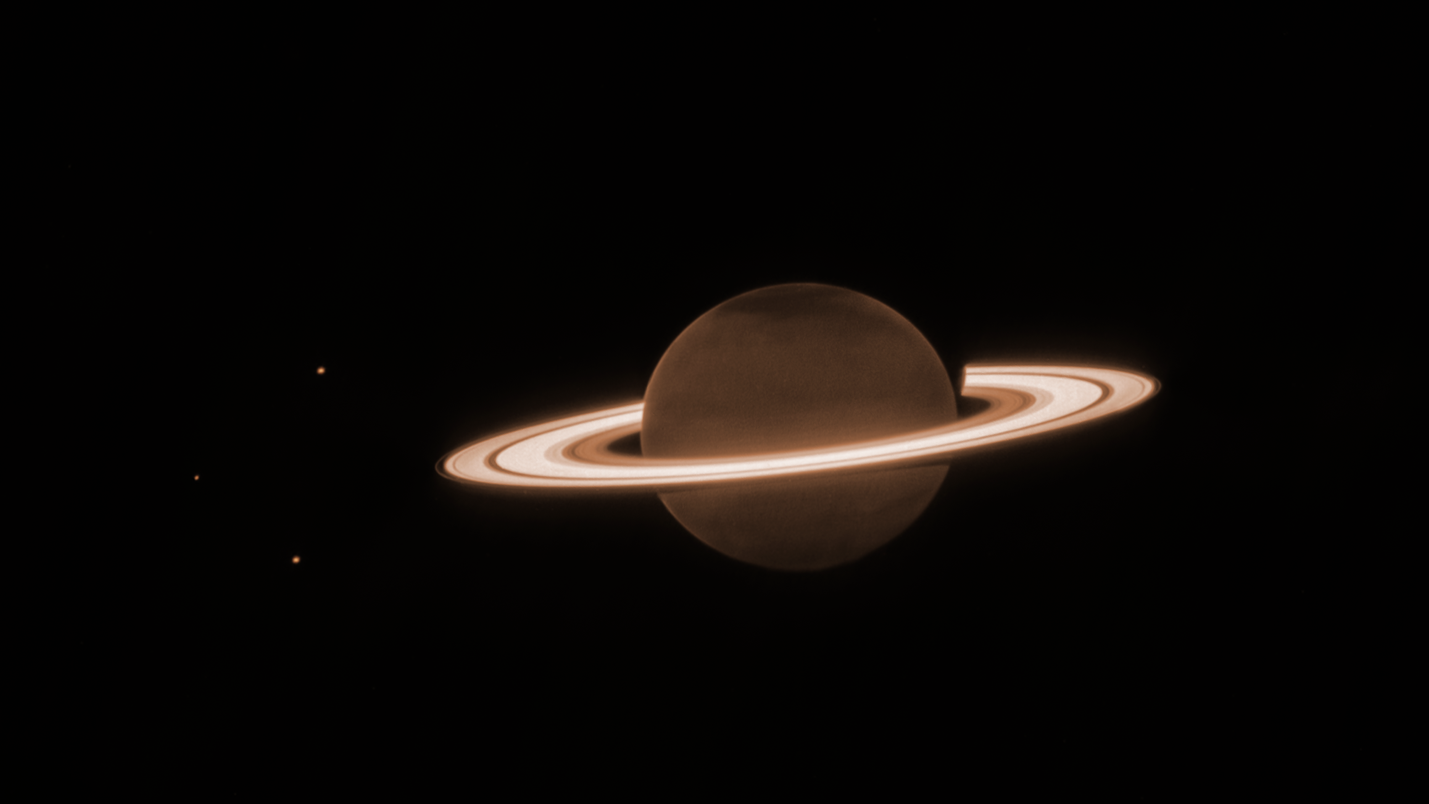
June 30, 2023, Mountain View, CA – Get ready to be amazed by the latest James Webb Space Telescope (JWST) image. Saturn’s iconic rings seem to glow eerily in this incredible infrared picture, which also unveils unexpected features in Saturn’s atmosphere.
This image serves as context for an observing program that will test the telescope’s capacity to detect faint moons around the planet and its bright rings. Any newly discovered moons could help scientists put together a more complete picture of the current system of Saturn, as well as its past.
Methane gas absorbs almost all the sunlight falling on the atmosphere at this picture’s specific infrared wavelength (3.23 microns). As a result, Saturn’s familiar striped patterns aren’t visible because the methane-rich upper atmosphere blocks our view of the primary clouds. Instead, Saturn’s disk appears dark, and we see features associated with high-altitude stratospheric aerosols, including large, dark, and diffuse structures in Saturn’s northern hemisphere that don’t align with the planet’s lines of latitude. Interestingly, researchers previously spotted similar wave-like features in early JWST NIRCam observations of Jupiter.
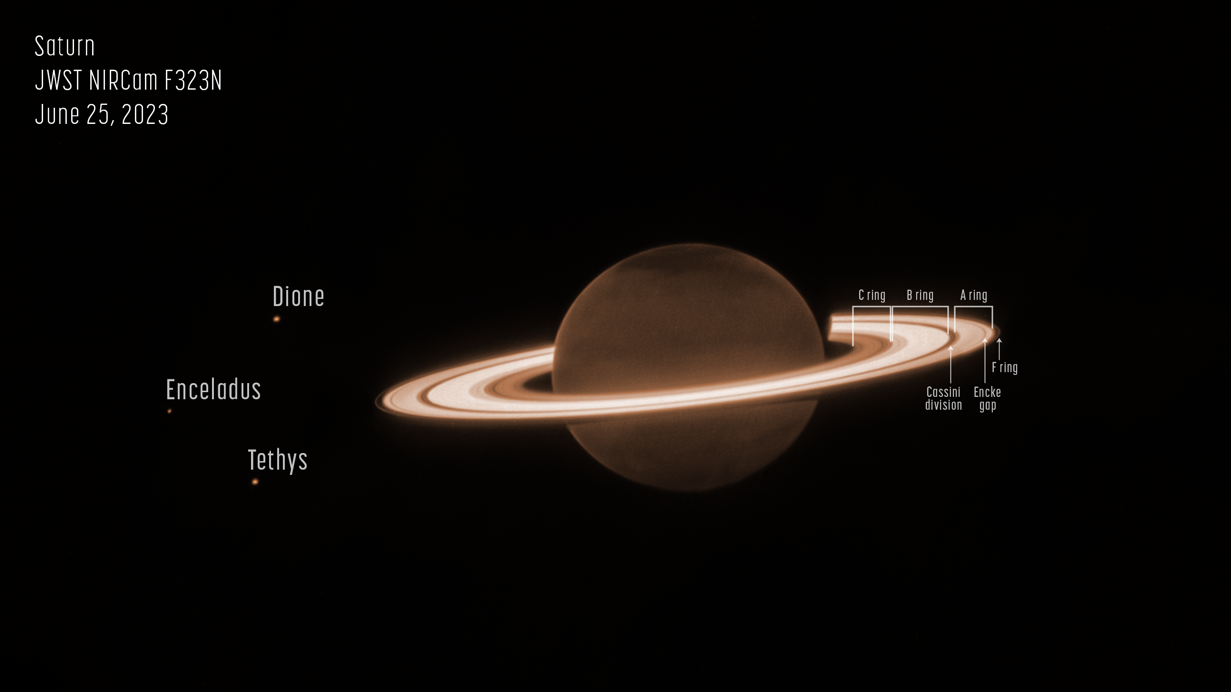
Unlike the atmosphere, Saturn’s rings lack methane, so at this infrared wavelength, they are no darker than usual and thus easily outshine the darkened planet. This new image of Saturn also reveals intricate details within the ring system, showcasing several of the planet’s moons like Dione, Enceladus, and Tethys.
Image of Saturn and some of its moons, captured by the James Webb Space Telescope’s NIRCam instrument on June 25, 2023. In this monochrome image, NIRCam filter F323N (3.23 microns) was color mapped with an orange hue.
Download the full-resolution image, both labeled and unlabeled, from the Space Telescope Science Institute.
Credits: NASA, ESA, CSA, STScI, M. Tiscareno (SETI Institute), M. Hedman (University of Idaho), M. El Moutamid (Cornell University), M. Showalter (SETI Institute), L. Fletcher (University of Leicester), H. Hammel (AURA); image processing by J. DePasquale (STScI).
“We are very pleased to see JWST produce this beautiful image, which is confirmation that our deeper scientific data also turned out well,” said Dr. Matthew Tiscareno, a senior research scientist at the SETI Institute who led the process of designing this observation. “We look forward to digging into the deep exposures to see what discoveries may await.”
Over the past few decades, missions like NASA’s Pioneer 11, Voyagers 1 and 2, the Cassini spacecraft and the Hubble Space Telescope have observed Saturn’s atmosphere and rings. The image captured by JWST is just a taste of what this observatory will uncover about Saturn in the coming years as scientists. This image is part of a suite of deeply exposed images where researchers hope to identify new ring structures and perhaps even new moons of Saturn.
Moving from the inner to the outer features of Saturn’s rings, we can observe the dark C ring, the bright B ring, the narrow and dark Cassini Division, and the medium-bright A ring with the dark Encke Gap near its outer edge. Additionally, off the outer edge of the A ring, we can see the narrow strand known as the F ring. The rings cast a shadow on the planet and vice versa, creating intriguing visual effects.
In-depth exposures not shown in this image will allow scientists to investigate Saturn’s fainter rings, including the thin G ring and diffuse E ring, which are not visible here. Saturn’s rings consist of an assortment of rocky and icy fragments, ranging in size from smaller than a grain of sand to as large as mountains on Earth. Recently, researchers used JWST to explore Enceladus and discovered a substantial plume emanating from the moon’s southern pole. This plume contains particles and copious amounts of water vapor, contributing to Saturn’s E ring.
Comparing the northern and southern poles of Saturn in this image, we can observe typical
seasonal changes. It’s currently summertime in Saturn’s northern hemisphere, while the southern hemisphere emerges from winter darkness. However, the northern pole appears unusually dark, potentially due to an unknown seasonal process affecting polar aerosols. A faint brightening at the edge of Saturn’s disk might be attributed to high-altitude methane fluorescence or emission from the ionosphere’s trihydrogen ion (H3+). Spectroscopy from JWST could help confirm these possibilities.
Science Credits
NASA, ESA, CSA, STScI, Matt Tiscareno (SETI Institute), Matt Hedman (University of Idaho), Maryame El Moutamid (Cornell University), Mark Showalter (SETI Institute), Leigh Fletcher (University of Leicester), Heidi Hammel (AURA)
Image Processing Credits
J. DePasquale (STScI)
About the Authors
- Heidi B. Hammel is a JWST interdisciplinary scientist leading JWST’s Cycle 1 Guaranteed Time Observations (GTO) of the solar system. She is the vice president for science at the Association of Universities for Research in Astronomy (AURA) in Washington, D.C.
- Leigh Fletcher is a professor of planetary science at the University of Leicester in England. Leigh is the principal investigator for several of JWST’s Guaranteed Time Observation Programs, including Program 1247 highlighted here.
- Matt Tiscareno is a Senior Research Scientist at the SETI Institute, California, where he studies the dynamics of planetary systems, including planetary rings. He is an integral member of the JWST Guaranteed Time Observation team for the study of Saturn.
About the SETI Institute
Founded in 1984, the SETI Institute is a non-profit, multi-disciplinary research and education organization whose mission is to lead humanity’s quest to understand the origins and prevalence of life and intelligence in the Universe and to share that knowledge with the world. Its research encompasses the physical and biological sciences and leverages expertise in data analytics, machine learning and advanced signal detection technologies. The SETI Institute is a distinguished research partner for industry, academia and government agencies, including NASA and NSF.
Contact information
Rebecca McDonald
Director of Communications
SETI Institute
[email protected]
News
Related News
Researchers Propose Searching the Moon for Microscopic Technosignatures
New study outlines the first quantitative framework for searching lunar regolith for microscopic technosignatures. #Press Releases #Moon #Technosignatures #Lewis Pinault #Andrew Siemion #Astrobiology #SETI #Solar System #AI and Machine Learning #Bill Diamond
The SETI Institute and ETH Zurich join forces to search for the origin of life
ETH Zurich and the SETI Institute announced a strategic scientific partnership today. The US-based research organization will provide start-up funding for a new assistant professorship and associated research activities at ETH Zurich. #Press Releases #SETI Institute #Partnerships #ETH Zurich #Bill Diamond
JWST Reveals a Race Against Time for Forming Planets
SETI Institute scientist Uma Gorti co-authors one of the largest JWST studies of how planet-forming disks lose their gas #Press Releases #JWST #Astronomy #Astrophysics #Uma Gorti
New study reveals how space rocks become meteorites
Analysis of the atmospheric passage of 75 meteorite falls identifies seven distinct processes as space rocks melt, fragment and slow before they fall as meteorites #Press Releases #Comets, Meteors, and Asteroids #Peter Jenniskens #Meteorites #Astronomy #Stuart Pilorz
SETI Institute Team Looks for a New Way to Find Resources in Space
#Press Releases #Pablo Sobron #Moon #Asteroids #Planetary Exploration #Spectroscopy #Astrobiology
SETI Institute In the News: July Roundup 2026
#SETI Institute in the News #SETI Institute #Community #Peter Jenniskens #Lucian Walkowicz #Chelsea Haramia #Pascal Lee #Bill Diamond #Seth Shostak #Meteorites #SETI #UAPs #NASA Missions and Observatories #Discovery and Futures Lab #MarsResearch
Related Projects
SkyMapper: Expanding Access to Real-time Astronomy Through a Global Astronomical Network
SkyMapper and the SETI Institute are connecting educators, students and the public to live astronomical observations through a distributed astronomical network. #SkyMapper #SETI #Citizen Science #Astronomy
Virtual Planetary Laboratory
How can we best assess whether an exoplanet supports life? #VPL
Discovery and Futures Lab
What happens if life beyond Earth is discovered? The Discovery and Futures Lab at the SETI Institute fosters novel and anticipatory research at the intersection of science, society, our planet, and the search for life beyond Earth. #Discovery and Futures LabSupport the
SETI Institute
Scientists are getting closer in their search for life beyond earth. But with limited federal funding for the search for extraterrestrial intelligence, supporters are the reason cutting-edge scientists can keep their eyes on the sky.