









Wednesday, Aug 27, 2025

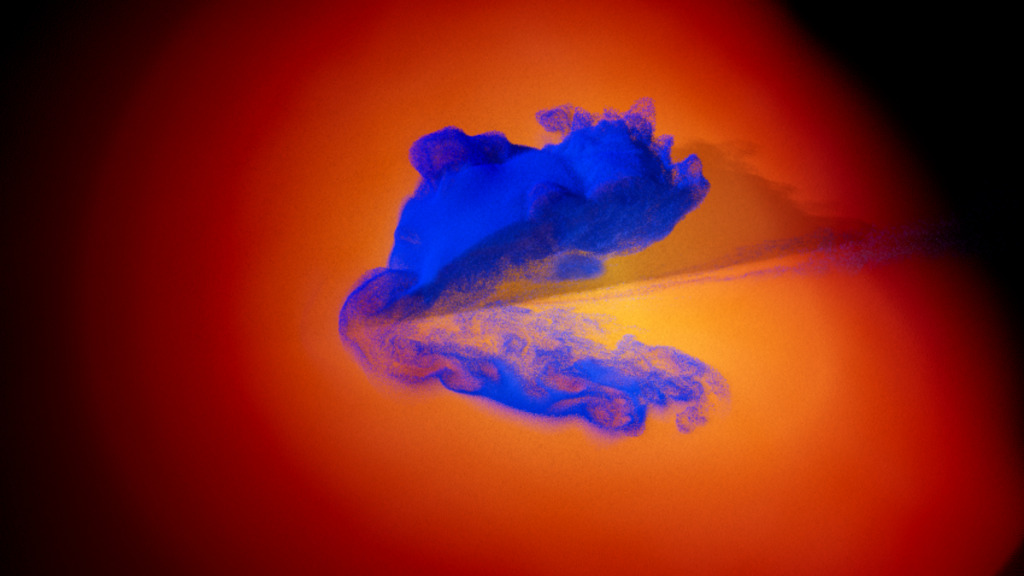
Jacob Kegerreis/Thomas Sandnes/Durham University.

At a Glance

  • Study Title: New Clues About Jupiter’s Mysterious Core
  • Lead Author: Dr. Thomas Sandnes, Durham University
  • SETI Institute Contributor: Dr. Jacob Kegerreis, SETI Institute and NASA Ames
  • Key Finding: Jupiter’s dilute core -- where heavy elements gradually transition into the planet’s hydrogen- and helium-rich outer layers – is unlikely to have been formed by a single, catastrophic collision with another planet.
  • Method: High-resolution supercomputer simulations modeling planetary impacts and material mixing dynamics.
  • Significance: Provides fresh insights into the formation and evolution of gas giants like Jupiter and Saturn, and helps scientists interpret the interiors of giant exoplanets across the galaxy.
  • Published In: Monthly Notices of the Royal Astronomical Society  (2025)
  • https://www.seti.org/news/new-clues-about-jupiter-s-mysterious-core/

A new paper led by Dr. Thomas Sandnes, Durham University, and co-authored by an international team of scientists, including SETI Institute Affiliate, Dr. Jacob Kegerreis, challenges a proposed explanation for what produced Jupiter's dilute core, which gradually transitions into the envelope, with a smoothly changing mixture of the heavy core materials and the hydrogen and helium. The previous theory was that the gas giant's core was caused by a collision with another planet, causing its core material to mix with its outer region. The team used computer simulations and found no evidence that such a collision would explain Jupiter’s core. Instead, they think the planet's core formed through gradual processes as it accumulated material over millions of years, rather than as the result of a single, catastrophic impact.

Understanding how Jupiter formed offers insights beyond the planet itself. Saturn, another gas giant in our Solar system, also appears to have a dilute core. And similar planetary structures could exist in planets across the galaxy.

“This helps us to better understand what can happen in the deep interior of planets like Jupiter and Saturn during the messy process of planet formation,” said co-author Dr. Jacob Kegerreis of the SETI Institute and NASA Ames. “It also shows how powerful modern simulations have become for unlocking the hidden stories inside giant planets.”

The study was published in Monthly Notices of the Royal Astronomical Society.

News

Related News

Featured Image
Sep 8, 2026
Researchers Propose Searching the Moon for Microscopic Technosignatures
New study outlines the first quantitative framework for searching lunar regolith for microscopic technosignatures. #Press Releases #Moon #Technosignatures #Lewis Pinault #Andrew Siemion #Astrobiology #SETI #Solar System #AI and Machine Learning #Bill Diamond

Featured Image
Aug 25, 2026
JWST Reveals a Race Against Time for Forming Planets
SETI Institute scientist Uma Gorti co-authors one of the largest JWST studies of how planet-forming disks lose their gas #Press Releases #JWST #Astronomy #Astrophysics #Uma Gorti
Featured Image
Jul 20, 2026
SETI Institute In the News: June Roundup 2026
Throughout June 2026, SETI Institute scientists, affiliates, and collaborators contributed to discussions spanning interstellar visitors, planetary science, technosignature searches, animal cognition, and the scientific process guiding the search for life beyond Earth. #SETI Institute in the News #SETI Institute #Community #Eduardo Bendek #Optical SETI #SETI #3I/ATLAS #ATA #Comets, Meteors, and Asteroids #Solar System #Franck Marchis #Ariel Graykowski #Jill Tarter #Vishal Gajjar #Radio Astronomy #Bill Diamond #Lori Marino
Featured Image
Jul 17, 2026
Two SETI Institute Scientists Honored with Asteroids Bearing Their Names
#Comets, Meteors, and Asteroids #Ariel Graykowski #Matthew Tiscareno #Planetary Astronomy #Solar System #Saturn
Featured Image
Jun 4, 2026
SETI Institute In the News: May Roundup 2026
#SETI Institute in the News #SETI Institute #Community #Solar System #Matija Ćuk #Neptune #SETI #Bill Diamond #UAPs #Drake Awards #Lori Marino #Matthew Tiscareno #Outreach #Exoplanets #Carl Sagan Center
Featured Image
Jun 1, 2026
SETI Institute Awards $1 Million in STRIDE Grants to Advance Astrobiology, Exoplanet Science, and Public Engagement
#Press Releases #STRIDE #Research #Carl Sagan Center #Spectroscopy #Solar System #SETI #Climate and Bioscience #Astronomy #Astrobiology #Exoplanets #Data Science #Education #Outreach #Hat Creek Radio Observatory #Unistellar #SkyMapper
Research

Related Projects

Featured Image
SkyMapper • SETI • Citizen Science • Astronomy
SkyMapper: Expanding Access to Real-time Astronomy Through a Global Astronomical Network
SkyMapper and the SETI Institute are connecting educators, students and the public to live astronomical observations through a distributed astronomical network. #SkyMapper #SETI #Citizen Science #Astronomy
Featured Image
VPL
Virtual Planetary Laboratory
How can we best assess whether an exoplanet supports life? #VPL
Featured Image
Discovery and Futures Lab
What happens if life beyond Earth is discovered? The Discovery and Futures Lab at the SETI Institute fosters novel and anticipatory research at the intersection of science, society, our planet, and the search for life beyond Earth.  #Discovery and Futures Lab
Support Us

Support the
SETI Institute

Scientists are getting closer in their search for life beyond earth. But with limited federal funding for the search for extraterrestrial intelligence, supporters are the reason cutting-edge scientists can keep their eyes on the sky.