








Two SETI Institute planetary scientists now have asteroids bearing their names, an honor!
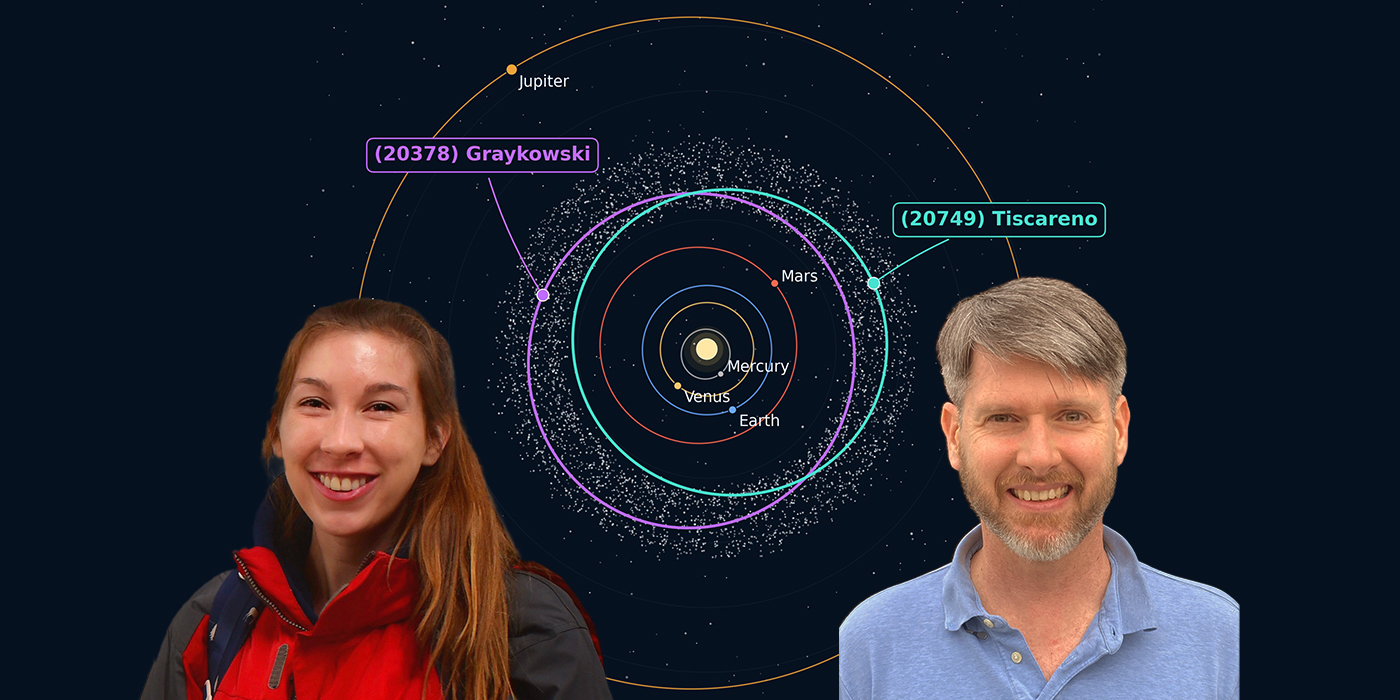
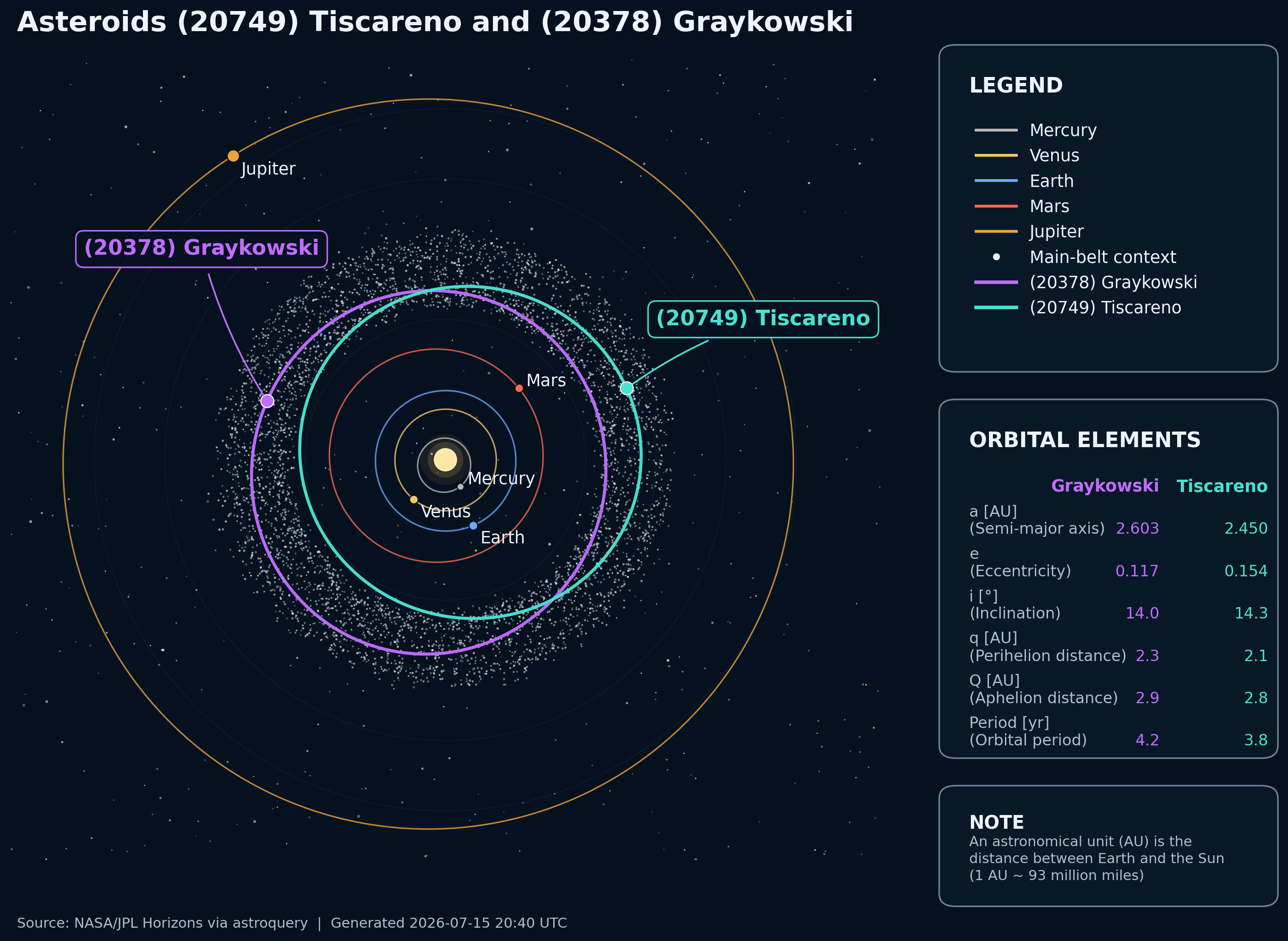
The International Astronomical Union's Working Group for Small Body Nomenclature recently approved the names (20749) Graykowski and (29969) Tiscareno, honoring Dr. Ariel Graykowski and Dr. Matthew Tiscareno for their contributions to planetary science. The names were announced in the latest WGSBN Bulletin, which includes 208 newly named minor planets.
Dr. Graykowski studies asteroids, comets and other small bodies throughout the Solar System. She also leads a citizen science project that lets amateur astronomers with small telescopes monitor comets, increasing public opportunities to contribute to planetary science.
"When I saw the announcement, I couldn’t stop smiling,” said Graykowski. “Throughout my career, I’ve seen many incredible planetary scientists have asteroids named after them, and I always thought it was the coolest thing. Now that one is named after me, it feels surreal. I can’t wait to observe it!”
Dr. Tiscareno is internationally recognized for research on planetary rings, moons and Solar System dynamics. His work with data from NASA's Cassini mission has transformed our understanding of Saturn's rings and their interactions with nearby moons, while broader research explores how small bodies evolve throughout the Solar System.
“I’m exceedingly grateful for this beautiful honor,” said Tiscareno. “It’s a great moment for my family to be honored in this way.”
Naming an asteroid is a lasting recognition bestowed by the International Astronomical Union to honor individuals who have made important contributions to science. With more than a million known asteroids, only a small fraction receives official names.
Congratulations to Dr. Ariel Graykowski and Dr. Matthew Tiscareno on this well-deserved recognition.
News
Related News
Researchers Propose Searching the Moon for Microscopic Technosignatures
New study outlines the first quantitative framework for searching lunar regolith for microscopic technosignatures. #Press Releases #Moon #Technosignatures #Lewis Pinault #Andrew Siemion #Astrobiology #SETI #Solar System #AI and Machine Learning #Bill Diamond

New Meteor Shower Identifies Asteroid as a Cloaked Comet
#Comets, Meteors, and Asteroids #CAMS #Peter Jenniskens
New study reveals how space rocks become meteorites
Analysis of the atmospheric passage of 75 meteorite falls identifies seven distinct processes as space rocks melt, fragment and slow before they fall as meteorites #Press Releases #Comets, Meteors, and Asteroids #Peter Jenniskens #Meteorites #Astronomy #Stuart Pilorz
SETI Institute In the News: June Roundup 2026
Throughout June 2026, SETI Institute scientists, affiliates, and collaborators contributed to discussions spanning interstellar visitors, planetary science, technosignature searches, animal cognition, and the scientific process guiding the search for life beyond Earth. #SETI Institute in the News #SETI Institute #Community #Eduardo Bendek #Optical SETI #SETI #3I/ATLAS #ATA #Comets, Meteors, and Asteroids #Solar System #Franck Marchis #Ariel Graykowski #Jill Tarter #Vishal Gajjar #Radio Astronomy #Bill Diamond #Lori Marino
A Remarkably Ancient Visitor: 3I/ATLAS
#3I/ATLAS #Comets, Meteors, and Asteroids #JWST
SETI Institute In the News: May Roundup 2026
#SETI Institute in the News #SETI Institute #Community #Solar System #Matija Ćuk #Neptune #SETI #Bill Diamond #UAPs #Drake Awards #Lori Marino #Matthew Tiscareno #Outreach #Exoplanets #Carl Sagan CenterResearch
Related Projects
SkyMapper: Expanding Access to Real-time Astronomy Through a Global Astronomical Network
SkyMapper and the SETI Institute are connecting educators, students and the public to live astronomical observations through a distributed astronomical network. #SkyMapper #SETI #Citizen Science #Astronomy
Virtual Planetary Laboratory
How can we best assess whether an exoplanet supports life? #VPL
Discovery and Futures Lab
What happens if life beyond Earth is discovered? The Discovery and Futures Lab at the SETI Institute fosters novel and anticipatory research at the intersection of science, society, our planet, and the search for life beyond Earth. #Discovery and Futures LabSupport the
SETI Institute
Scientists are getting closer in their search for life beyond earth. But with limited federal funding for the search for extraterrestrial intelligence, supporters are the reason cutting-edge scientists can keep their eyes on the sky.