








The MAVEN spacecraft, designed to investigate how Mars went from being a kinder, gentler world to one that’s cold, dry and with only the thinnest of atmospheres, has arrived. It has begun to orbit the Red Planet, where it will sample its air for clues to this world’s past.
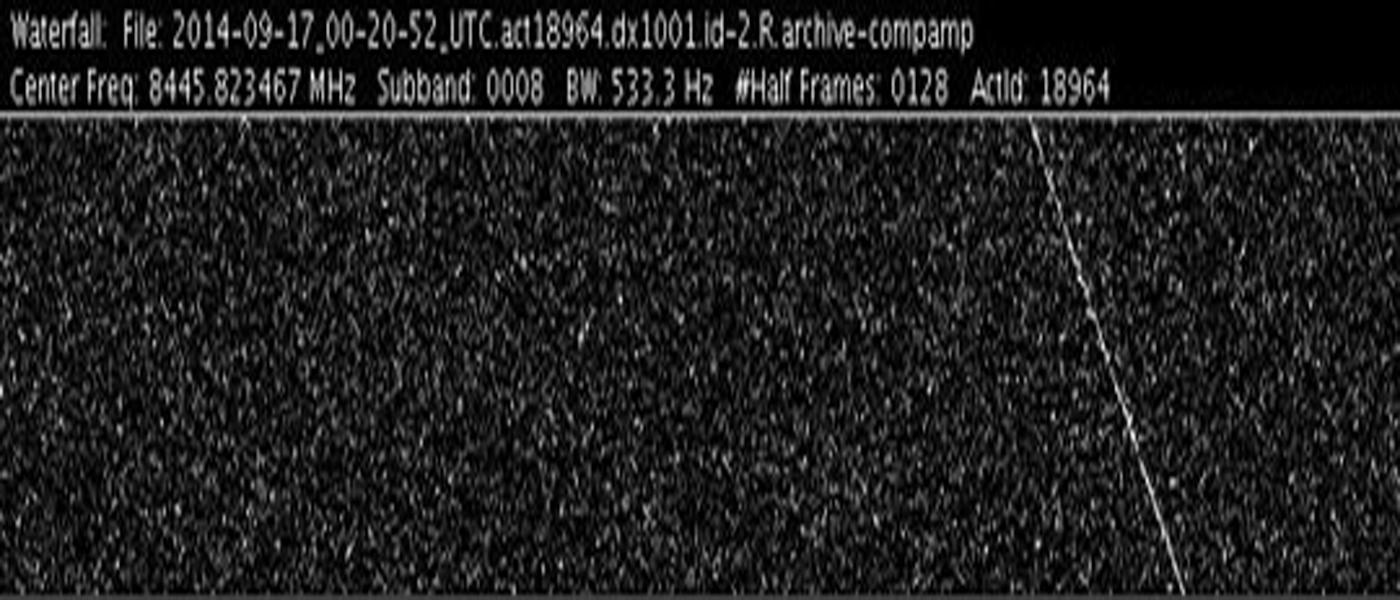
On September 17, SETI engineer Jon Richards used the Allen Telescope Array to search for telemetry signals from MAVEN and, as you can see in the plot above, found a transmission at 8446 MHz. The signal appears as a diagonal streak in the plot, which graphs signal strength over a narrow range of radio frequencies vs time (frequency increases horizontally and time increases vertically). The obvious drift of the signal to lower frequencies is caused by changes in the Doppler shift of the transmission due to Earth’s rotation.
This sort of observation is less about MAVEN than about the ATA. It is a useful end-to-end test of the Array’s performance.
News
Related News
Researchers Propose Searching the Moon for Microscopic Technosignatures
New study outlines the first quantitative framework for searching lunar regolith for microscopic technosignatures. #Press Releases #Moon #Technosignatures #Lewis Pinault #Andrew Siemion #Astrobiology #SETI #Solar System #AI and Machine Learning #Bill Diamond

SETI Institute Achievements: Q2 2026 Activity Report
During the second quarter of 2026, the SETI Institute was especially active and made strong progress in research, education, outreach, and public engagement. Our scientists published over 80 peer-reviewed papers in fields such as SETI, astrobiology, planetary science, exoplanets, and heliophysics. #Activity Reports #Carl Sagan Center #Outreach #Education #AIR #Community #Research #SETI Institute
SETI Institute In the News: July Roundup 2026
#SETI Institute in the News #SETI Institute #Community #Peter Jenniskens #Lucian Walkowicz #Chelsea Haramia #Pascal Lee #Bill Diamond #Seth Shostak #Meteorites #SETI #UAPs #NASA Missions and Observatories #Discovery and Futures Lab #Mars
50 Years on Mars: From Viking to Today's Rovers
#Blog #Simon Steel #Pascal Lee #Mars
50 Years After Viking 1: The Mission That Changed the Search for Life on Mars
Half a century after the first successful Mars landing, Viking's greatest legacy may be the questions it taught us to ask. #Mars #NASA Missions and Observatories #Anniversary
SETI Institute In the News: June Roundup 2026
Throughout June 2026, SETI Institute scientists, affiliates, and collaborators contributed to discussions spanning interstellar visitors, planetary science, technosignature searches, animal cognition, and the scientific process guiding the search for life beyond Earth. #SETI Institute in the News #SETI Institute #Community #Eduardo Bendek #Optical SETI #SETI #3I/ATLAS #ATA #Comets, Meteors, and Asteroids #Solar System #Franck Marchis #Ariel Graykowski #Jill Tarter #Vishal Gajjar #Radio Astronomy #Bill Diamond #Lori MarinoResearch
Related Projects
SkyMapper: Expanding Access to Real-time Astronomy Through a Global Astronomical Network
SkyMapper and the SETI Institute are connecting educators, students and the public to live astronomical observations through a distributed astronomical network. #SkyMapper #SETI #Citizen Science #Astronomy
Virtual Planetary Laboratory
How can we best assess whether an exoplanet supports life? #VPL
Discovery and Futures Lab
What happens if life beyond Earth is discovered? The Discovery and Futures Lab at the SETI Institute fosters novel and anticipatory research at the intersection of science, society, our planet, and the search for life beyond Earth. #Discovery and Futures LabSupport the
SETI Institute
Scientists are getting closer in their search for life beyond earth. But with limited federal funding for the search for extraterrestrial intelligence, supporters are the reason cutting-edge scientists can keep their eyes on the sky.