Wednesday, Jun 25, 2025

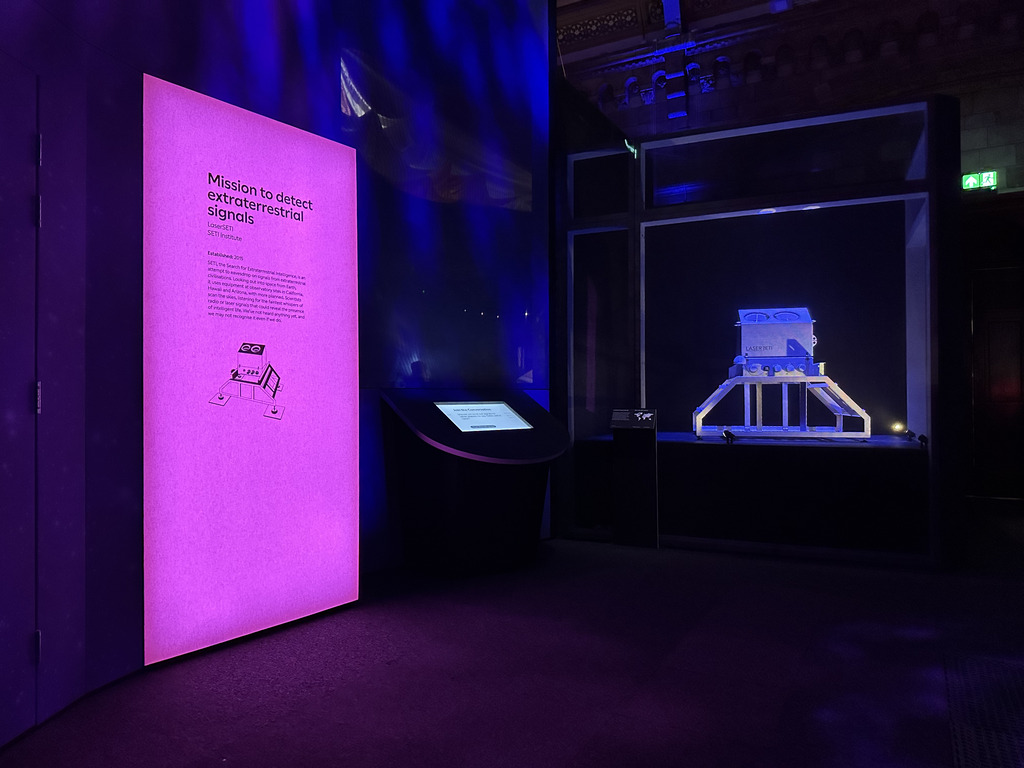
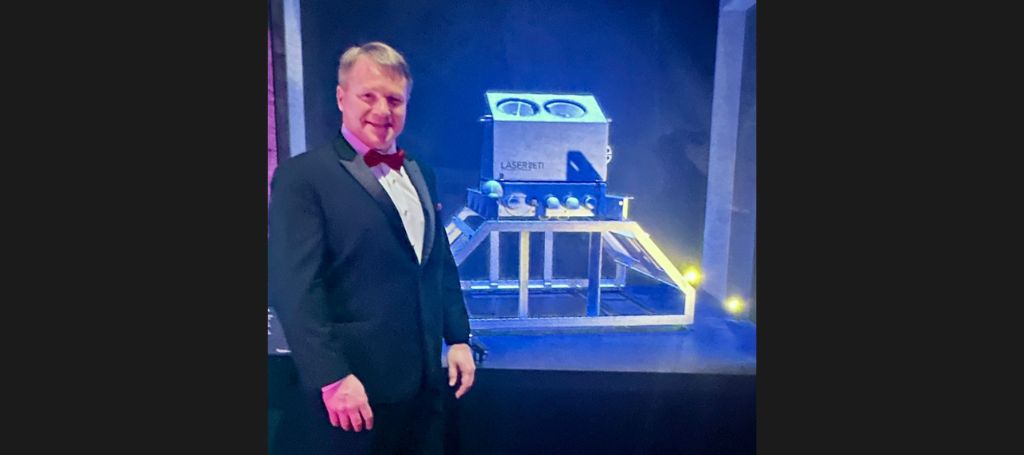
LaserSETI display at the Natural History Museum in London, UK. Image Credit: Eliot Gillum

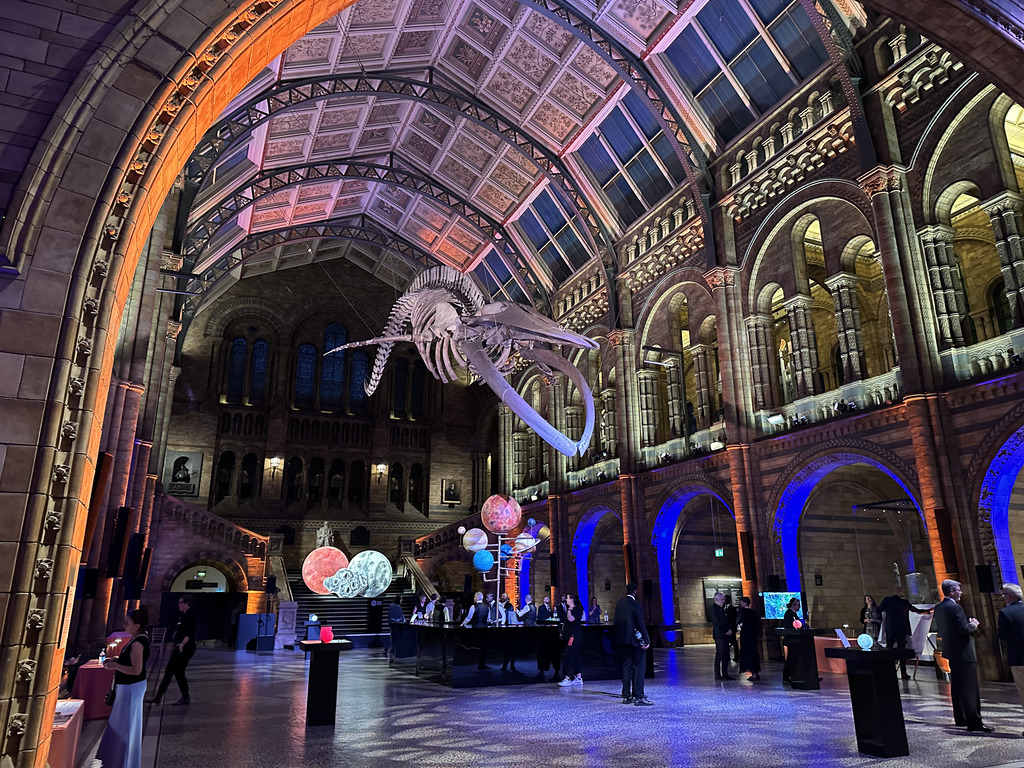
Could Life Exist Beyond Earth? This question holds universal appeal and has the power to revolutionize how we view our place in the cosmos—if we ever find an answer.  It’s a question that is the lifeblood of the SETI Institute and also the theme of a new exhibit at the Natural History Museum in London, UK.

The exhibit, "Space: Could Life Exist Beyond Earth," takes you on a journey through space and time, exploring the museum’s amazing collections. Famous for its collection and research into meteorites, the journey starts here on Earth at the dawn of the solar system. On display are meteorites like Allende, which fell in Mexico in 1969 and contain minerals that formed before our solar system took shape 4.6 billion years ago, thus representing the original building blocks of Earth and the other planets. Samples of the earliest forms of life on Earth, Stromatolites —which were created by the ancient cyanobacteria responsible for our oxygen-rich atmosphere — lead us out to Mars and the possibility of ancient life on our nearest neighbor. There is a full-scale model of the Rosalind Franklin ExoMars Rover, and you can even drive a model rover across the surface of the Red Planet. Outwards, then, to the icy moons of the gas giants: Jupiter’s Europa and Saturn’s Titan; Titan, possibly an analog world for the primordial Earth. A model of the Dragonfly helicopter adorns the penultimate gallery.  As we move towards the end of the exhibit, we visit worlds around other stars – exoplanets like the TRAPPIST-1 system with its seven Earth-sized planets orbiting a tiny red dwarf star. Could any of these be an Earth 2.0, and maybe even be the home world for an advanced alien race thinking as we do about life across the galaxy?

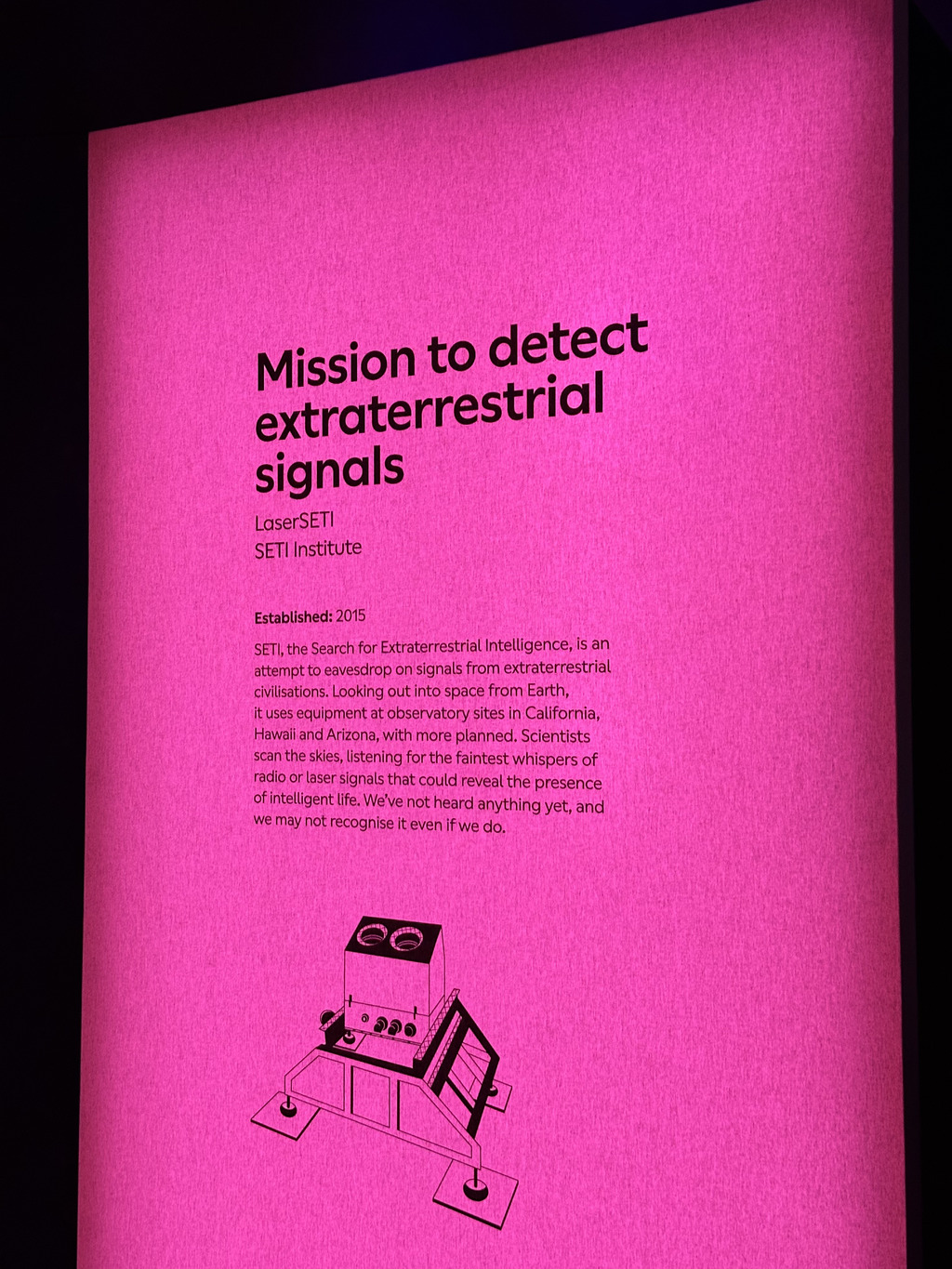
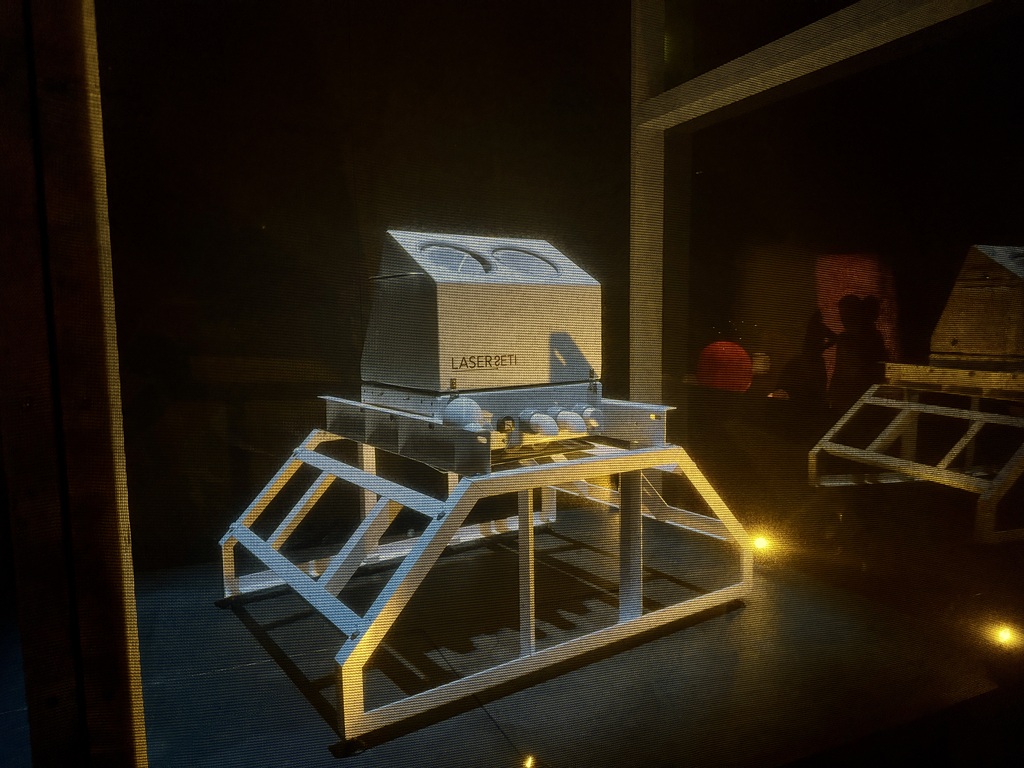
No exhibit on life beyond Earth would be complete without mentioning SETI – the search for extraterrestrial intelligence, and the exhibit ends with a cornerstone display, the LaserSETI telescope.  LaserSETI works by continuously surveying the entire sky for laser pulses from deep space, which could be extraterrestrial communication lasers or high-powered propulsion systems for light sails. These possibilities may sound like science fiction, but light sail propulsion is already an area of active research, and NASA is testing a prototype laser communication system with the recently deployed Psyche spacecraft. Since high-powered lasers could be common among technologically advanced civilizations but don’t occur naturally, LaserSETI is searching the skies for a sign. The Natural History Museum approached the SETI Institute and LaserSETI creator Eliot Gillum in 2024, needing something that represents the cutting-edge search for extraterrestrial intelligence. 

Image Credit: Eliot Gillum.

Working with the museum design team, Eliot, along with Unistellar’s Franck Marchis and Lauren Sgro, helped develop the exhibit space that the LaserSETI instrument would occupy as well as the descriptions and captions that present the LaserSETI story and science to the public. Shipped safely and securely from San Francisco to London, LaserSETI was unveiled to the public as part of the VIP opening of the exhibit on May 14, 2025, with its proud creator in attendance!

Space: Could Life Exist Beyond Earth? runs until February 22, 2026. Following the exhibit’s closure, the LaserSETI instrument will transition from a museum celebrity to a working research tool deployed as part of the LaserSETI network searching for intelligent life beyond Earth.

For more information:
Space: Could Life Exist Beyond Earth?
https://www.nhm.ac.uk/visit/exhibitions/space.html

LaserSETI
https://laserseti.net

News

Related News

Featured Image
Sep 8, 2026
Researchers Propose Searching the Moon for Microscopic Technosignatures
New study outlines the first quantitative framework for searching lunar regolith for microscopic technosignatures. #Press Releases #Moon #Technosignatures #Lewis Pinault #Andrew Siemion #Astrobiology #SETI #Solar System #AI and Machine Learning #Bill Diamond
Featured Image
Sep 1, 2026
The SETI Institute and ETH Zurich join forces to search for the origin of life
ETH Zurich and the SETI Institute announced a strategic scientific partnership today. The US-based research organization will provide start-up funding for a new assistant professorship and associated research activities at ETH Zurich. #Press Releases #SETI Institute #Partnerships #ETH Zurich #Bill Diamond
Featured Image
Aug 27, 2026
SETI Institute Achievements: Q2 2026 Activity Report
During the second quarter of 2026, the SETI Institute was especially active and made strong progress in research, education, outreach, and public engagement. Our scientists published over 80 peer-reviewed papers in fields such as SETI, astrobiology, planetary science, exoplanets, and heliophysics. #Activity Reports #Carl Sagan Center #Outreach #Education #AIR #Community #Research #SETI Institute
Featured Image
Aug 21, 2026
Look Up: A Lunar Eclipse on August 27
#Eclipse #Community #Andrew Fraknoi
Featured Image
Aug 13, 2026
SETI Institute In the News: July Roundup 2026
#SETI Institute in the News #SETI Institute #Community #Peter Jenniskens #Lucian Walkowicz #Chelsea Haramia #Pascal Lee #Bill Diamond #Seth Shostak #Meteorites #SETI #UAPs #NASA Missions and Observatories #Discovery and Futures Lab #Mars
Featured Image
Aug 12, 2026
Hide the Star: How Roman Will See Exoplanets
#Blog #Franck Marchis #Margaret Turnbull #Nancy Grace Roman Space Telescope #Planetary Exploration #NASA Missions and Observatories #Exoplanets #Spectroscopy #Astronomy
Research

Related Projects

Featured Image
SkyMapper • SETI • Citizen Science • Astronomy
SkyMapper: Expanding Access to Real-time Astronomy Through a Global Astronomical Network
SkyMapper and the SETI Institute are connecting educators, students and the public to live astronomical observations through a distributed astronomical network. #SkyMapper #SETI #Citizen Science #Astronomy
Featured Image
VPL
Virtual Planetary Laboratory
How can we best assess whether an exoplanet supports life? #VPL
Featured Image
Discovery and Futures Lab
What happens if life beyond Earth is discovered? The Discovery and Futures Lab at the SETI Institute fosters novel and anticipatory research at the intersection of science, society, our planet, and the search for life beyond Earth.  #Discovery and Futures Lab
Support Us

Support the
SETI Institute

Scientists are getting closer in their search for life beyond earth. But with limited federal funding for the search for extraterrestrial intelligence, supporters are the reason cutting-edge scientists can keep their eyes on the sky.