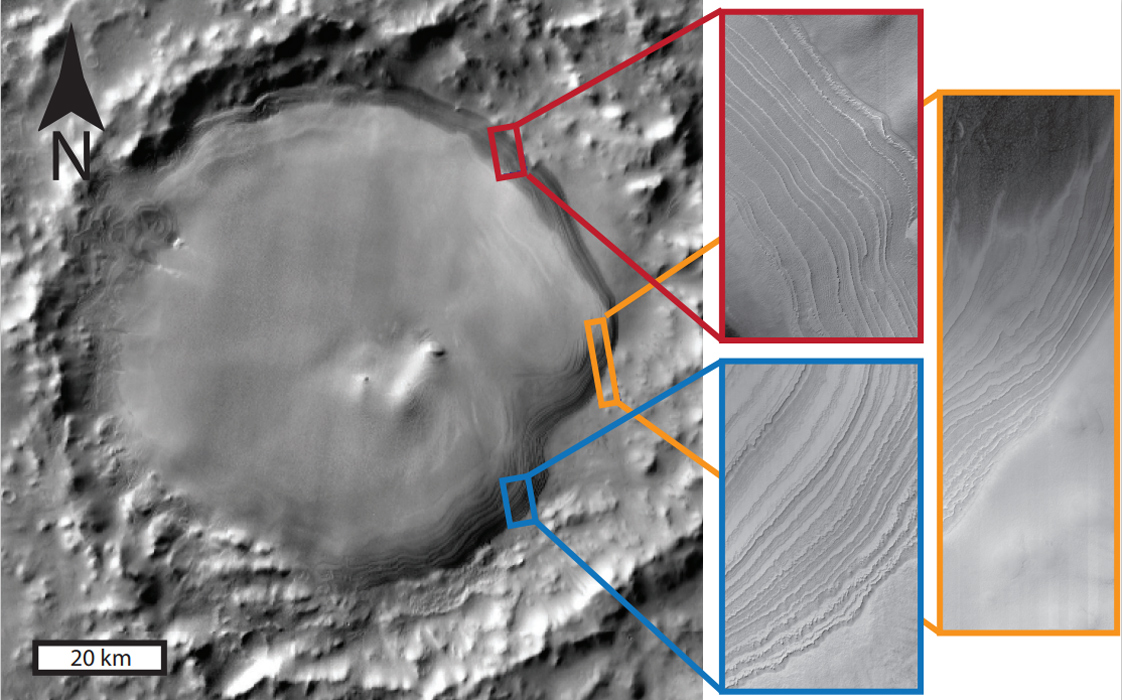
Researchers recently discovered deposits of layered ice in craters in Mars’ southern hemisphere. These deposits gave the team insights into the past orientation of the planet, which in turn, helps us understand more about Mars’ past climate. And that, of course, can help us figure out just when Mars could have been habitable.
The results of this study were published in Geophysical Research Letters with lead author Michael Sori, who matched the ice layers to the tilt of Mars’ axis. Basically, these ice deposits tell us about the temperature, hydrology, and even planetary dynamics of the red planet, just as similar layers can tell us about the same aspects of Earth. The tilt of a planet and how it orbits the Sun affects the temperature which depends on the amount of sunlight hitting the surface.
So thicker layers mean colder periods. That makes sense, right?
You also have to add in the precession of the planet’s axis, or how much it wobbles in space like a top. That can also affect how much sunlight reaches the surface, and as the precession changes the axial tilt over time, different regions are affected in different ways and at different times. While this research only applies to Mars’ recent past, it does come with an unprecedented amount of resolution. Sori notes: It was unexpected how cleanly those patterns matched to the orbital cycles. It was just such a perfect match, as good as you can ask for.
Sori and his team used one crater in particular, Burroughs crater, which is 74 kilometers wide and has “exceptionally well-preserved” ice layers that were visible in imagery taken by the HiRISE camera onboard NASA’s Mars Reconnaissance Orbiter. An analysis of the thickness and the shapes found that the patterns matched that axial tilt and precession over the last four to five million years.
It should be noted that one of the requirements for the ice layers they used in the study was that they had to be young and clean, which is why we currently cannot look much farther back in Mars’ history. Older ice is more complicated to study with a lot of variables to account for. It can be done, but it’s not as precise as scientists prefer.
Sori mentions that a welcome area of research would be if we ever can get ice cores on Mars as we do on Earth. Our rovers currently aren’t capable of that, so for now, we’ll have to stick with ground-penetrating radar and high-resolution imagery.
More Information
AGU press release
“Orbital Forcing of Martian Climate Revealed in a South Polar Outlier Ice Deposit,” Michael M. Sori et al., 2022 March 29, Geophysical Research Letters
This story was written for the Daily Space podcast/YouTube series. Want more news from myself, Dr. Pamela Gay, and Erik Madaus? Check out DailySpace.org.
)