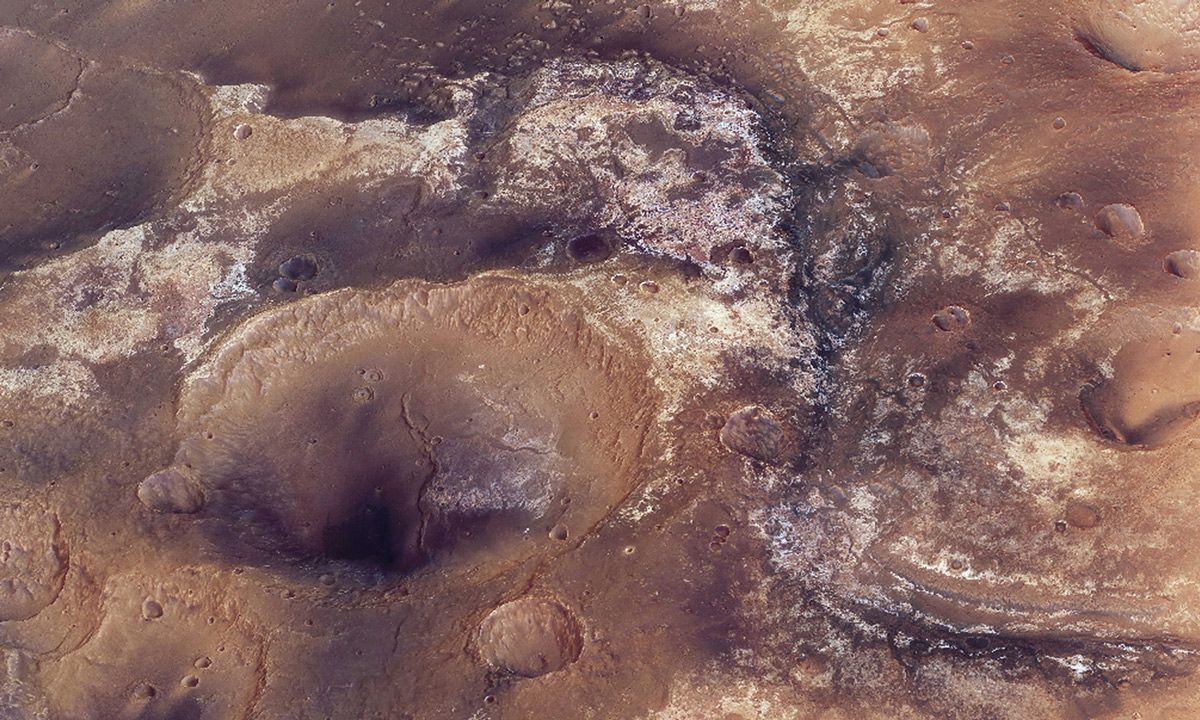
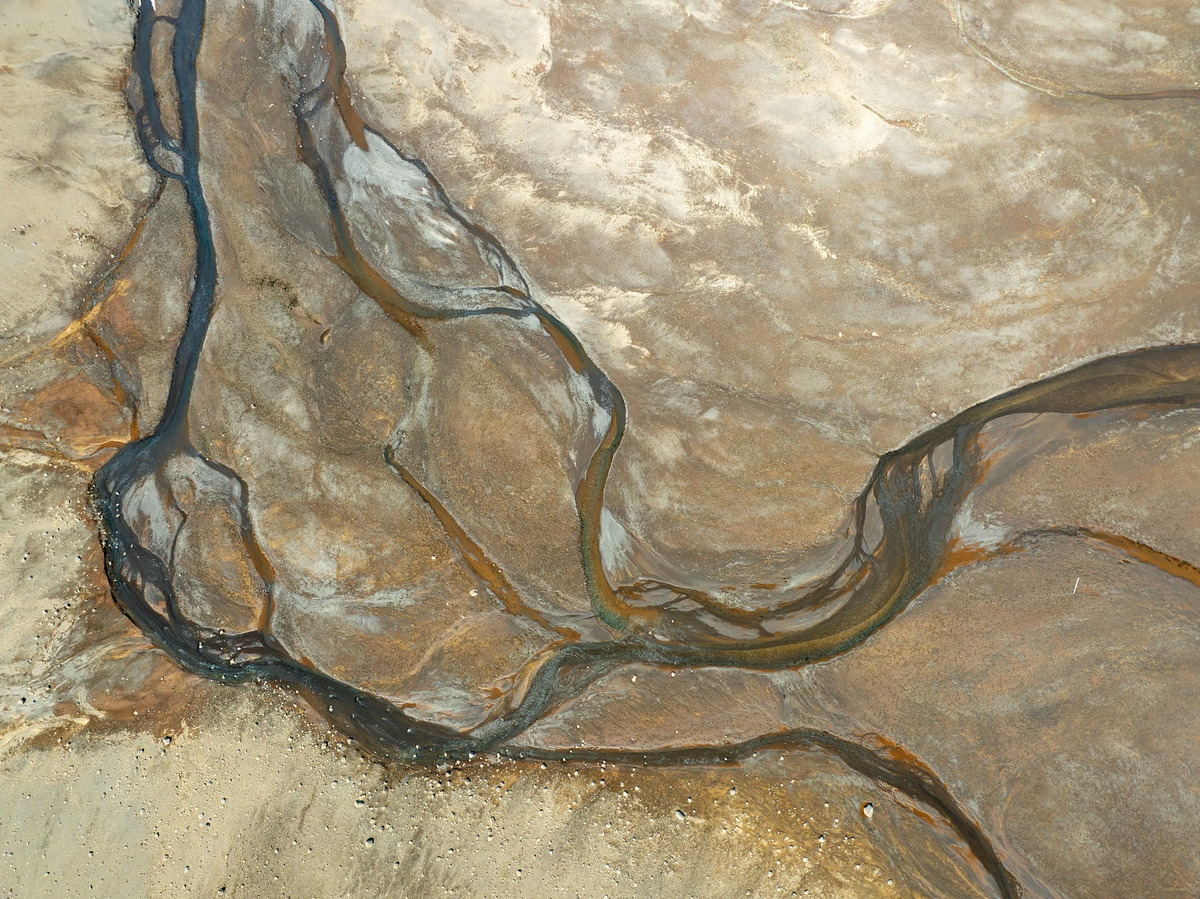
View of Mawrth Vallis showing ancient martian clays in the bright regions, a large channel (flowing to the north), and several smaller water-carved features. Image credit: C. Gross, Freie Universität Berlin, German High Resolution Stereo Camera (HRSC) instrument on Mars Express.
A new hypothesis from SETI Institute scientist Dr. Janice Bishop and Dr. Melissa Lane from Fibernetics in Pennsylvania could explain how early Mars may have had water on its surface, similar to Earth, even though today its atmosphere is too thin to support liquid water. Bishop and Lane suggest underground water could have formed clays and carbonates billions of years ago – either through subsurface reactions with rocks or precipitation from saturated pore waters. Later, salty, acidic water at the surface could have caused more reactions, forming sulfates and iron oxides, changing the widespread early magnesium clay and iron carbonate into more stable altered forms of these minerals, and releasing carbon dioxide into the atmosphere in the process.
This release of abundant CO₂ could have warmed Mars’ atmosphere enough to support liquid water on the surface. The idea builds on studies by other researchers who discovered unusual mineral patterns on Mars, including a rare iron carbonate called siderite at Gale Crater and deep layers of magnesium-rich clay at Mawrth Vallis.
One of the challenges with understanding Mars’ past climate is modeling the atmosphere. Today, its atmosphere is too thin to support liquid water on the planet. But rushing water must have been present earlier to carve channels, deltas, and valley networks evident across the planet. Further, the climate was likely similar to Earth’s at one point to form many of the same minerals on both planets.
Before scientists launched remote sensing missions to Mars over the past three decades, they expected to find large amounts of carbonate on the planet's surface as a sink for the missing atmospheric carbon dioxide. However, they have observed only a few small carbonate outcrops exposed on the surface. Bishop and Lane’s theory could explain why. If much of the carbonate initially formed underground and was later dissolved at the surface, some would have released large amounts of carbon dioxide into the atmosphere.
Findings from two recent papers — one in Science by Tutolo et al. and another in Nature Geoscience by McNeil et al. — inspired Bishop and Lane's global hypothesis. Tutolo and his team discovered siderite and proposed that sulfate-rich brines may have dissolved the siderite, releasing carbon dioxide and producing sulfates and iron oxides at Gale Crater. McNeil's team, investigating clays at Mawrth Vallis, showed how deep magnesium clays changed into more stable Fe-rich forms when exposed to acidic water.
Bringing these pieces together, Bishop and Lane suggest a chain reaction. As buried carbonate minerals dissolved, they released carbon dioxide, warming the atmosphere and making it easier for water to remain liquid. In turn, the water could dissolve more carbonate, continuing the cycle in a snowball effect and creating warmer, wetter conditions to form globally distributed Martian rivers, lakes and deltas.
The findings offer a new way to think about how early Mars may have sustained flowing water — and how underground geochemistry could have played a much more significant role than previously thought.
Read Article: https://www.science.org/stoken/author-tokens/ST-2564/full
)