Friday, May 17 2013 - 10:00 am, PDT
Mountain View, California - A team of researchers from the SETI Institute, the Mars Institute, NASA Ames Research Center, and the space robotics company Honeybee Robotics has successfully completed a first series of field tests aimed at investigating how humans will explore and work on Near-Earth Asteroids (NEAs) and eventually the two moons of Mars, Phobos and Deimos.
From 13 to 15 April 2013, field experiments were conducted at the U.S. Army’s National Training Center (NTC) at Fort Irwin, California, to evaluate geotechnical methods and systems that will enable humans to be productive explorers in the low gravity environment of small rocky bodies. Sub-kilometer sized NEAs, Phobos, and Deimos are among destinations currently considered by NASA for future human missions into Deep Space.
“Human missions to Near-Earth Asteroids and to the moons of Mars present us with the exciting challenge of exploring planetary bodies with extremely low gravity” says Pascal Lee, planetary scientist at the SETI Institute and leader of the field test. “The goal of our field test was to learn how to characterize the physical properties of small body surfaces, and to test ideas that might enable humans to more productively explore these low-gravity worlds.”
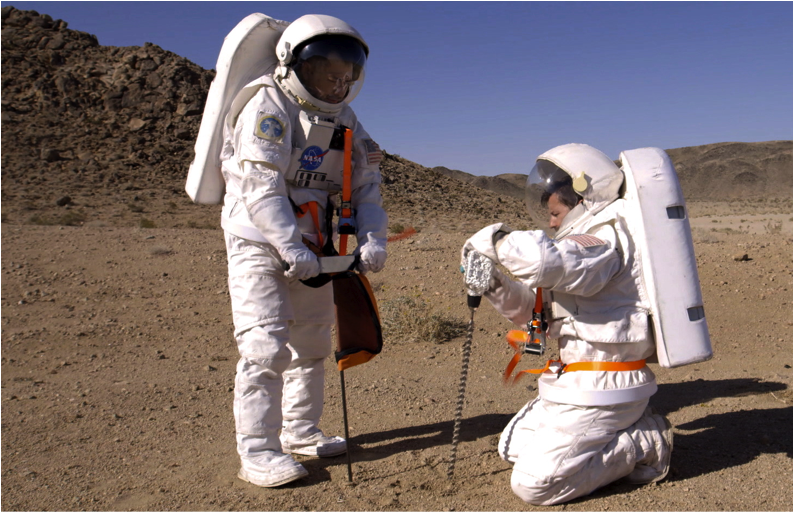
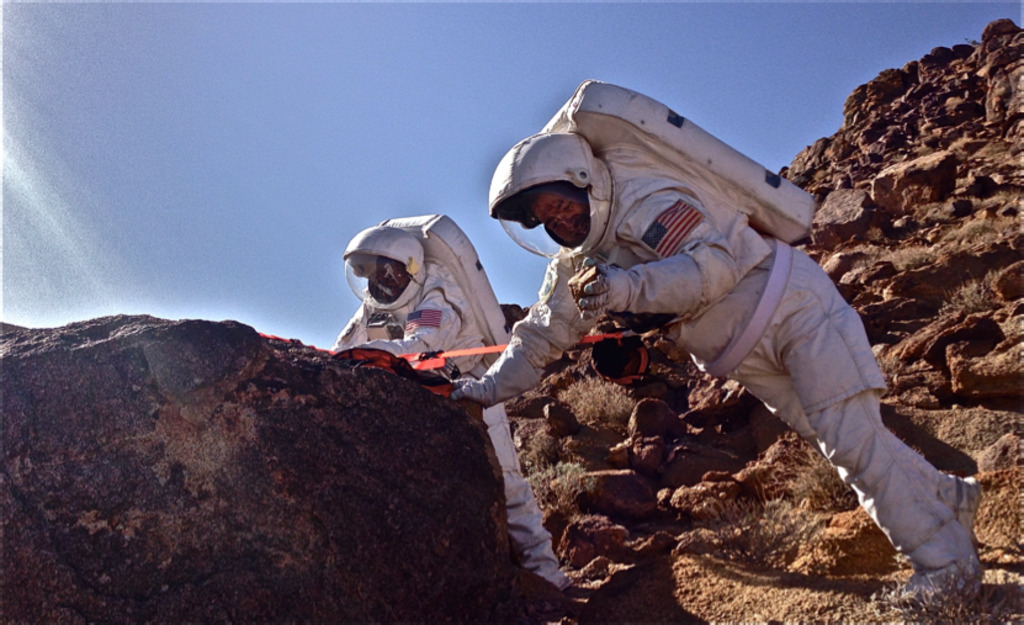
The Mojave field test included three investigations: 1) a study of whether conventional field tools commonly used to characterize the mechanical properties of soils on Earth are suitable for small bodies; 2) an evaluation of how different anchoring systems might allow robotic spacecraft and astronauts to remain bound to a low gravity body; 3) a study of how astronauts might conduct geological sampling on a small body while using anchors and tethers.
“It’s important to analyze and understand how conventional civil engineering methods and systems perform in natural settings on Earth before adapting them to the exploration of small bodies” explains Kris Zacny, Director of planetary exploration robotics at Honeybee Robotics in Pasadena, California. Honeybee Robotics is the company that developed the Rock Abrasion Tool (RAT) on NASA’s Mars Exploration Rovers, Spirit and Opportunity, and the Sample Manipulation System (SMS) and Dust Removal Tool (DRT) on NASA’s Mars Science Laboratory (MSL) rover, Curiosity.
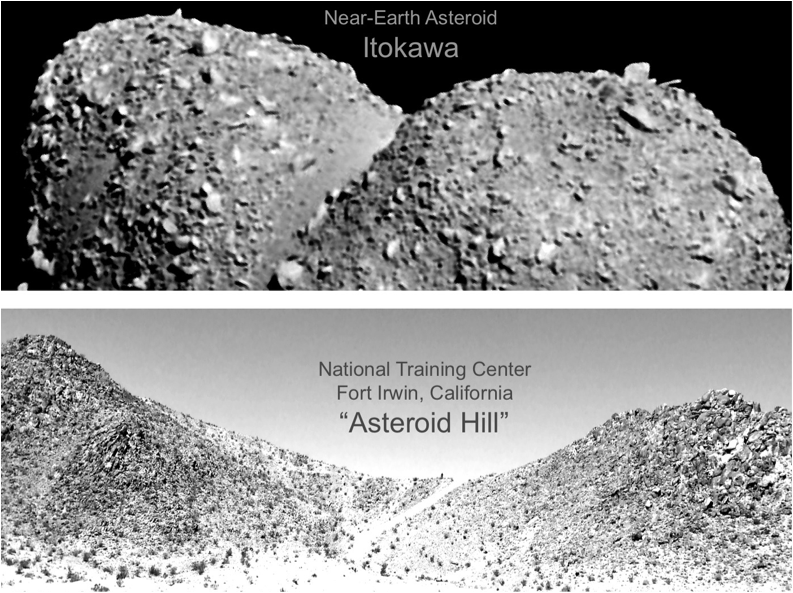
The Mojave field test was carried out on a small rocky hill at the NTC with many exposed blocks of weathered granite called tors. The site, now named “Asteroid Hill”, is reminiscent of the blocky surface of Near-Earth Asteroid (25143) Itokawa, which was explored in 2005 by Japan’s Hayabusa robotic spacecraft. “While neither the composition of the rocks nor the gravity at Asteroid Hill are similar to what they are on NEAs, the relevance of the site resides in the similarity in terrain texture (gravel and block abundance and sizes), topography, and scale between Asteroid Hill and Itokawa” notes Lee.
“This is an interesting analog site for planning future NASA robotic and human asteroid exploration, as it not only resembles the surface of the only sub-kilometer NEA explored by spacecraft to date, Itokawa, but it is well supported logistically by the U.S. Army’s National Training Center” said Terry Fong, Director of the Intelligent Robotics Group at NASA Ames Research Center.
The Mojave field test builds on an existing partnership between NASA and the U.S. Army’s National Training Center at Fort Irwin. The latter is home to NASA’s Goldstone Deep Space Network (DSN) tracking station. “The National Training Center’s participation in this field test with NASA represents another positive development in our Joint Interagency Intergovernmental and Multinational (JIIM) partnership. It allows NTC to showcase it's soldiers, the NTC community, and NTC's vast training resources” said Cyle Fena, Deputy G3 at the NTC.
The Mojave Field Test will be featured as part of an upcoming television documentary filmed by First Canyon Media, Inc, titled Mission Asteroid. Produced by the Canadian Broadcasting Corporation (CBC), Mission Asteroid is expected to air in North America in Fall 2013.
Figure 1: Top: 538 meter-long Near Earth Asteroid (25143) Itokawa imaged by Japan’s Hayabusa spacecraft. The asteroid is likely a loosely consolidated rubble pile (JAXA). Bottom: Similar scaled Asteroid Hill at the National Training Center, Fort Irwin, California, the site of the April 2013 NASA Mojave Field Test. Note the blocky to gravelly surface made of granite tors and debris. (NASA).
Figure 2: Pascal Lee (SETI Institute and Mars Institute) (left) measures the bearing capacity of gravelly soil at Asteroid Hill, National Training Center, Fort Irwin, California, using a static cone penetrometer, while Kris Zacny (Honeybee Robotics) drives an anchor into the same material to evaluate the system’s design and performance. These field tests will help design surface exploration systems optimized for the exploration of Near-Earth Asteroids, Phobos, and Deimos. 14 April 2013. (First Canyon Media).
Figure 3: Pascal Lee (SETI Institute and Mars Institute) (right) and Sgt Andre Pearson (U.S. Army, NTC) conduct “small body” geological sampling in simulated spacesuits while anchored and tethered on a steep boulder slope at Asteroid Hill, National Training Center, Fort Irwin, California. 15 April 2013. (NASA).
About the SETI Institute
Founded in 1984, the SETI Institute is a non-profit, multi-disciplinary research and education organization whose mission is to lead humanity’s quest to understand the origins and prevalence of life and intelligence in the Universe and to share that knowledge with the world. Our research encompasses the physical and biological sciences and leverages expertise in data analytics, machine learning and advanced signal detection technologies. The SETI Institute is a distinguished research partner for industry, academia and government agencies, including NASA and NSF.
Contact information
Marc Boucher
CEO, Mars Institute
[email protected]
+1 650 641 0193
News
Related News
Researchers Propose Searching the Moon for Microscopic Technosignatures
New study outlines the first quantitative framework for searching lunar regolith for microscopic technosignatures. #Press Releases #Moon #Technosignatures #Lewis Pinault #Andrew Siemion #Astrobiology #SETI #Solar System #AI and Machine Learning #Bill Diamond
The SETI Institute and ETH Zurich join forces to search for the origin of life
ETH Zurich and the SETI Institute announced a strategic scientific partnership today. The US-based research organization will provide start-up funding for a new assistant professorship and associated research activities at ETH Zurich. #Press Releases #SETI Institute #Partnerships #ETH Zurich #Bill Diamond
JWST Reveals a Race Against Time for Forming Planets
SETI Institute scientist Uma Gorti co-authors one of the largest JWST studies of how planet-forming disks lose their gas #Press Releases #JWST #Astronomy #Astrophysics #Uma Gorti
New study reveals how space rocks become meteorites
Analysis of the atmospheric passage of 75 meteorite falls identifies seven distinct processes as space rocks melt, fragment and slow before they fall as meteorites #Press Releases #Comets, Meteors, and Asteroids #Peter Jenniskens #Meteorites #Astronomy #Stuart Pilorz
SETI Institute Team Looks for a New Way to Find Resources in Space
#Press Releases #Pablo Sobron #Moon #Asteroids #Planetary Exploration #Spectroscopy #Astrobiology
SETI Institute In the News: July Roundup 2026
#SETI Institute in the News #SETI Institute #Community #Peter Jenniskens #Lucian Walkowicz #Chelsea Haramia #Pascal Lee #Bill Diamond #Seth Shostak #Meteorites #SETI #UAPs #NASA Missions and Observatories #Discovery and Futures Lab #MarsResearch
Related Projects
SkyMapper: Expanding Access to Real-time Astronomy Through a Global Astronomical Network
SkyMapper and the SETI Institute are connecting educators, students and the public to live astronomical observations through a distributed astronomical network. #SkyMapper #SETI #Citizen Science #Astronomy
Virtual Planetary Laboratory
How can we best assess whether an exoplanet supports life? #VPL
Discovery and Futures Lab
What happens if life beyond Earth is discovered? The Discovery and Futures Lab at the SETI Institute fosters novel and anticipatory research at the intersection of science, society, our planet, and the search for life beyond Earth. #Discovery and Futures LabSupport the
SETI Institute
Scientists are getting closer in their search for life beyond earth. But with limited federal funding for the search for extraterrestrial intelligence, supporters are the reason cutting-edge scientists can keep their eyes on the sky.