Video: Watch Earth Detecting Earth animation video by Zayna Sheikh narrated by Seth Shostak. Watch on YouTube.
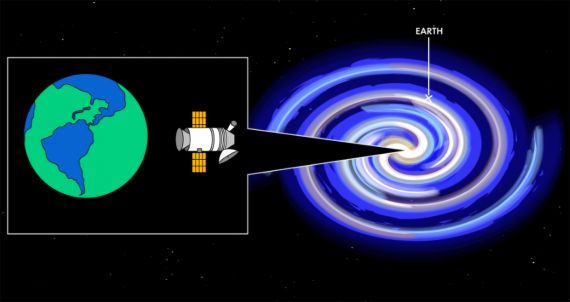
February 3, 2025, Mountain View, CA – A research team led by Dr. Sofia Sheikh of the SETI Institute, in collaboration with the Characterizing Atmospheric Technosignatures project and the Penn State Extraterrestrial Intelligence Center, set out to answer a simple question: If an extraterrestrial civilization existed with technology similar to ours, would they be able to detect Earth and evidence of humanity? If so, what signals would they detect, and from how far away?
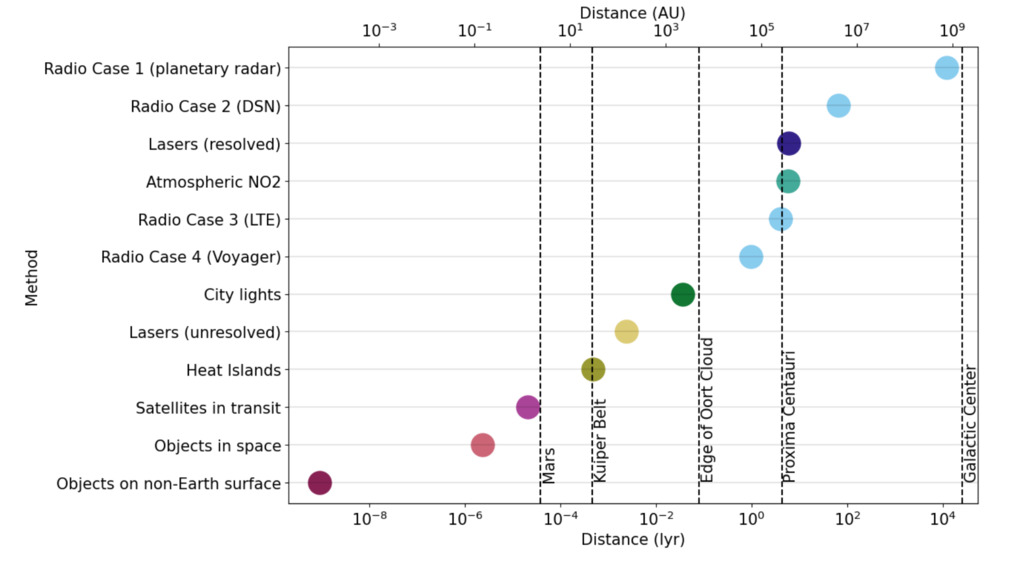
Researchers used a theoretical, modeling-based method, and this study is the first to analyze multiple types of technosignatures together rather than separately. The findings revealed that radio signals, such as planetary radar emissions from the former Arecibo Observatory, are Earth’s most detectable technosignatures, potentially visible from up to 12,000 light-years away.
Atmospheric technosignatures—such as nitrogen dioxide emissions—have become more detectable than they were a decade ago, thanks to advances in instruments like the James Webb Space Telescope and the upcoming Habitable Worlds Observatory (HWO). With HWO we could detect these emissions from as far as 5.7 light-years away, just beyond our closest stellar neighbor, Proxima Centauri.
Finally, as you get closer and closer to Earth, you would detect more and more human-made signatures simultaneously, including city lights, lasers, heat islands, and satellites, offering a comprehensive view of our technological presence.
"Our goal with this project was to bring SETI back 'down to Earth' for a moment and think about where we really are today with Earth's technosignatures and detection capabilities,” said Macy Huston, co-author and postdoc at the University of California, Berkeley, Department of Astronomy. “In SETI, we should never assume other life and technology would be just like ours, but quantifying what 'ours' means can help put SETI searches into perspective."
“One of the most satisfying aspects of this work was getting to use SETI as a cosmic mirror: what does Earth look like to the rest of the galaxy? And how would our current impacts on our planet be perceived,” said Sheikh. “While of course we cannot know the answer, this work allowed us to extrapolate and imagine what we might assume if we ever discover a planet, with, say, high concentrations of pollutants in its atmosphere."
SETI scientists search for advanced alien civilizations by looking for signs of technology -- signals or patterns that cannot be explained by natural phenomena that may indicate intelligent life. These signals are called technosignatures and come in various forms. Radio telescopes are the most commonly used tool for SETI searches. Researchers also use optical telescopes to scan for laser pulses that could indicate communication or propulsion patterns. Another approach involves studying the atmospheres of exoplanets in habitable zones around stars to look for chemical signatures that might suggest life or industrial activity. SETI scientists also consider technologies far beyond those currently invented on Earth, such as Dyson spheres, but these far-future technologies were not considered in this study.
This study demonstrates how Earth’s technosignatures can provide a multiwavelength framework for understanding the detectability of technology on other planets and shaping our search for intelligent life beyond Earth. Future telescopes and receivers could enhance our detection sensitivity or enable us to identify new types of technosignatures, such as other atmospheric signatures of pollution. Repeating this type of study over the years as astronomical technology advances and the human impact on the planet evolves could provide fresh insights and refine our approach to discovering extraterrestrial life.
This paper appears in the Astronomical Journal article "Earth Detecting Earth: At What Distance Could Earth's Constellation of Technosignatures be Detected with Present-day Technology? " by Sheikh et al.
DOI: 10.3847/1538-3881/ada3c7
About the SETI Institute
Founded in 1984, the SETI Institute is a non-profit, multi-disciplinary research and education organization whose mission is to lead humanity's quest to understand the origins and prevalence of life and intelligence in the universe and to share that knowledge with the world. Our research encompasses the physical and biological sciences and leverages expertise in data analytics, machine learning and advanced signal detection technologies. The SETI Institute is a distinguished research partner for industry, academia and government agencies, including NASA and NSF.
Contact information
Rebecca McDonald
Director of Communications
SETI Institute
[email protected]
News
Related News
Researchers Propose Searching the Moon for Microscopic Technosignatures
New study outlines the first quantitative framework for searching lunar regolith for microscopic technosignatures. #Press Releases #Moon #Technosignatures #Lewis Pinault #Andrew Siemion #Astrobiology #SETI #Solar System #AI and Machine Learning #Bill Diamond
The SETI Institute and ETH Zurich join forces to search for the origin of life
ETH Zurich and the SETI Institute announced a strategic scientific partnership today. The US-based research organization will provide start-up funding for a new assistant professorship and associated research activities at ETH Zurich. #Press Releases #SETI Institute #Partnerships #ETH Zurich #Bill Diamond
JWST Reveals a Race Against Time for Forming Planets
SETI Institute scientist Uma Gorti co-authors one of the largest JWST studies of how planet-forming disks lose their gas #Press Releases #JWST #Astronomy #Astrophysics #Uma Gorti
New study reveals how space rocks become meteorites
Analysis of the atmospheric passage of 75 meteorite falls identifies seven distinct processes as space rocks melt, fragment and slow before they fall as meteorites #Press Releases #Comets, Meteors, and Asteroids #Peter Jenniskens #Meteorites #Astronomy #Stuart Pilorz
SETI Institute Team Looks for a New Way to Find Resources in Space
#Press Releases #Pablo Sobron #Moon #Asteroids #Planetary Exploration #Spectroscopy #Astrobiology
SETI Institute In the News: July Roundup 2026
#SETI Institute in the News #SETI Institute #Community #Peter Jenniskens #Lucian Walkowicz #Chelsea Haramia #Pascal Lee #Bill Diamond #Seth Shostak #Meteorites #SETI #UAPs #NASA Missions and Observatories #Discovery and Futures Lab #MarsResearch
Related Projects
SkyMapper: Expanding Access to Real-time Astronomy Through a Global Astronomical Network
SkyMapper and the SETI Institute are connecting educators, students and the public to live astronomical observations through a distributed astronomical network. #SkyMapper #SETI #Citizen Science #Astronomy
Virtual Planetary Laboratory
How can we best assess whether an exoplanet supports life? #VPL
Discovery and Futures Lab
What happens if life beyond Earth is discovered? The Discovery and Futures Lab at the SETI Institute fosters novel and anticipatory research at the intersection of science, society, our planet, and the search for life beyond Earth. #Discovery and Futures LabSupport the
SETI Institute
Scientists are getting closer in their search for life beyond earth. But with limited federal funding for the search for extraterrestrial intelligence, supporters are the reason cutting-edge scientists can keep their eyes on the sky.