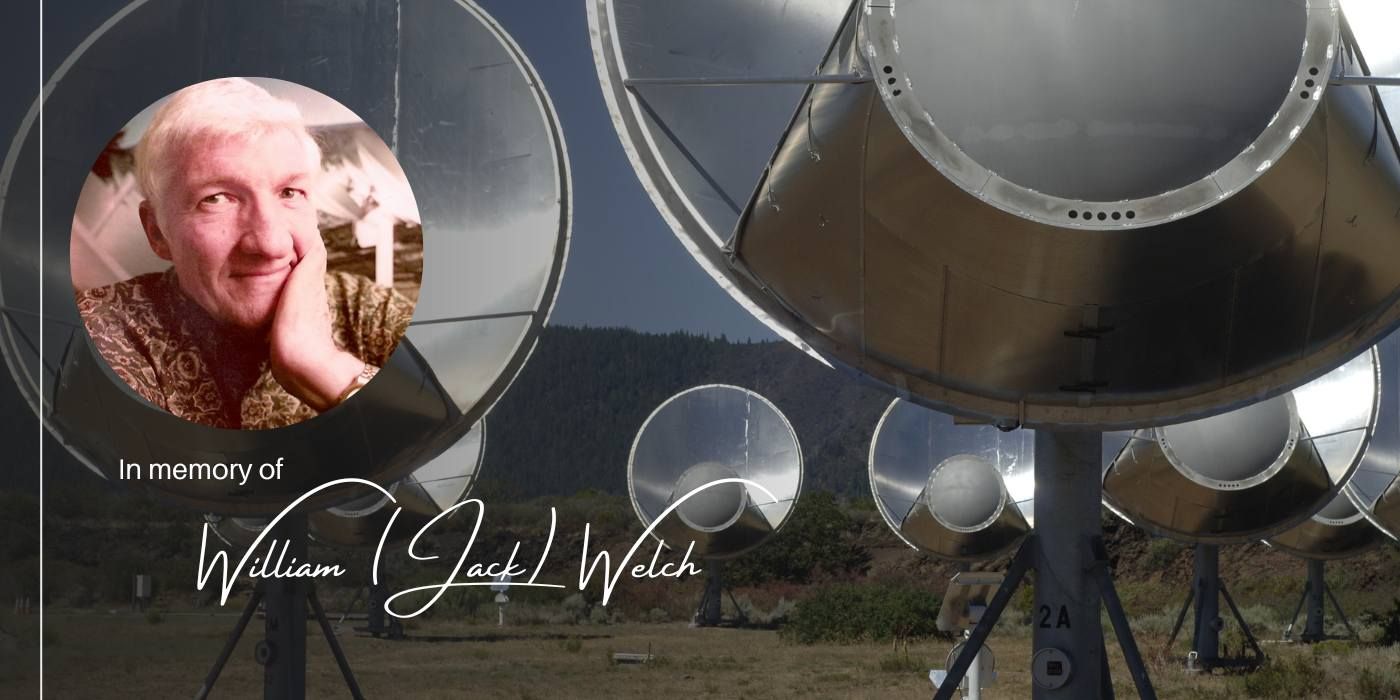
William (Jack) Welch, a pioneering astronomer whose visionary work in radio astronomy helped advance the search for extraterrestrial technology, passed away this week at the age of 90. Welch, a professor at the University of California, Berkeley (UCB), played a pivotal role in the design and development of the SETI Institute’s Allen Telescope Array (ATA), significantly advancing our understanding of the universe. Welch was married to SETI Institute co-founder Jill Tarter. Together, as a team, they envisioned and built the ATA, the first and still only observatory built specifically to conduct SETI research. Welch and Tarter helped shape the SETI Institute from the beginning, building it to become a world-class scientific research organization and propelling its mission.
Welch was a Founding Board Member and the Founding Vice President of the SETI Institute, elected at the first Board of Directors meeting on December 20, 1984. Welch served as Vice President/Vice Chair from 1984-2000; as Board Director/Trustee from 1984-2014 and was an Emeritus Trustee of the SETI Institute.
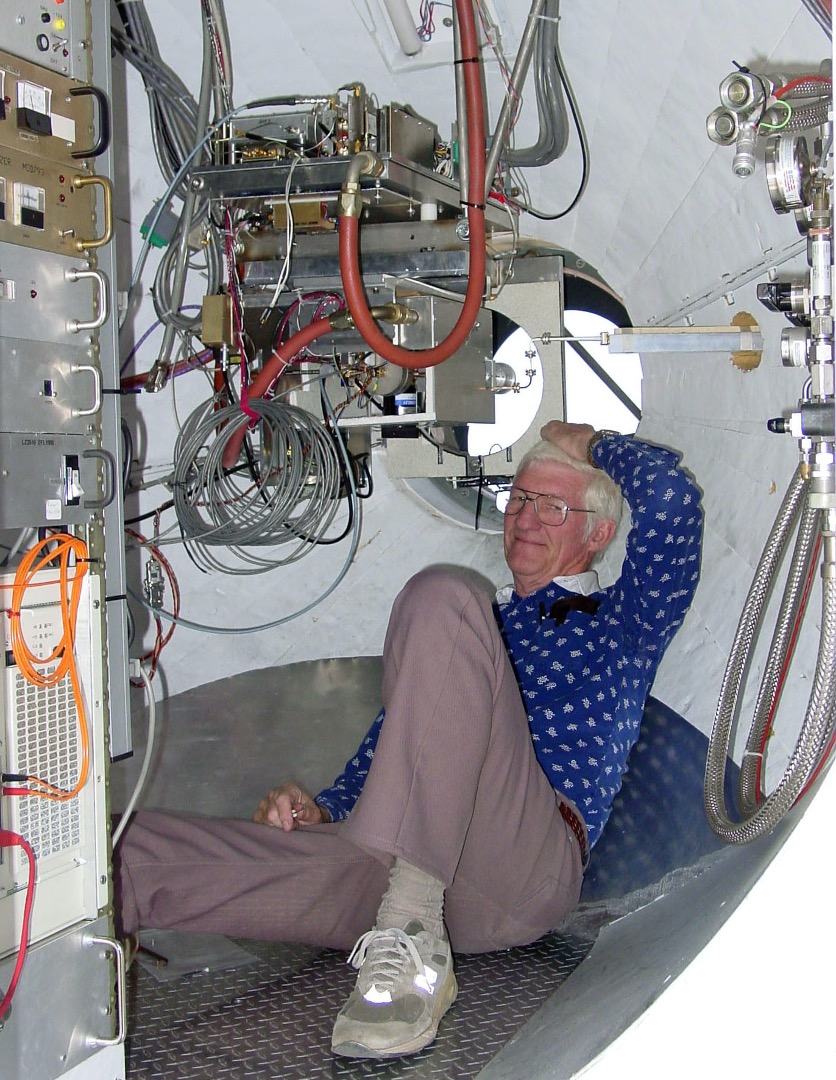
“Jack was that rare combination of scientist and engineer.” said Bill Diamond, SETI Institute CEO, “I first met Jack at the Hat Creek Observatory, and half of him was up inside one of the shrouds working on the feeds he designed. Jack was an innovator and inventor, committed to and passionate about SETI research and the science and technology behind it.”
“Jack was one of the founding members of the SETI Institute’s Board of Directors, whose reputation in radio astronomy was important in establishing the scientific credentials of the new organization,” said SETI Institute Trustee Andrew Fraknoi.
Welch earned his B.A. in Physics at Stanford University, in 1955. He continued his studies at UCB, obtaining a Ph.D. in Engineering Science in 1960. Welch's career at UCB spanned over four decades, during which time he contributed to the Electrical Engineering and Computer Sciences Department, the Astronomy Department, and the Graduate School. His research focused on millimeter interferometry and frequency-independent feeds and receivers, and he co-discovered interstellar NH3 and H2O with Charles Townes.
From 1971 to 1996, Welch served as the Director of the UCB Radio Astronomy Laboratory. His contributions to radio science were recognized nationally and internationally, including his election to the National Academy of Sciences in 1999, the Jansky Lecturer Award in 2001, and the URSI Balthasar van der Pol Gold Medal in 2008. Welch also held the Marilyn and Watson Alberts Chair for SETI at UCB between 1998 and 2011.
Known for starting the field of millimeter-wave interferometry, Welch's work led to discoveries in star formation, including identifying the first hot cores associated with massive protostars. His legacy includes over 100 journal articles and conference papers and his leadership in projects like the Combined Array for Research in Millimeter-wave Astronomy (CARMA) and the Allen Telescope Array.
Welch’s passion for uncovering the unknown extended beyond his research. As the first to hold UCB's chair for the search for extraterrestrial intelligence, he emphasized the importance of seeking intelligent life beyond Earth and advocated for SETI as a legitimate science. His dedication to exploring the universe matched his commitment to educating the next generation of astronomers.
Welch was also a pilot who learned to fly instead of driving from back and forth between Hat Creek Radio Observatory, the site of the ATA, and his home in Berkeley, CA. He ultimately decided to sell his Cessna to help fund construction of the ATA.
William "Jack" Welch leaves a legacy that transcends his contributions to radio astronomy and the search for extraterrestrial intelligence. His pioneering spirit, dedication to scientific exploration, and impact on the field will be remembered and celebrated by colleagues, students, and the broader scientific community.
News
Related News
Researchers Propose Searching the Moon for Microscopic Technosignatures
New study outlines the first quantitative framework for searching lunar regolith for microscopic technosignatures. #Press Releases #Moon #Technosignatures #Lewis Pinault #Andrew Siemion #Astrobiology #SETI #Solar System #AI and Machine Learning #Bill Diamond
The SETI Institute and ETH Zurich join forces to search for the origin of life
ETH Zurich and the SETI Institute announced a strategic scientific partnership today. The US-based research organization will provide start-up funding for a new assistant professorship and associated research activities at ETH Zurich. #Press Releases #SETI Institute #Partnerships #ETH Zurich #Bill Diamond
SETI Institute Achievements: Q2 2026 Activity Report
During the second quarter of 2026, the SETI Institute was especially active and made strong progress in research, education, outreach, and public engagement. Our scientists published over 80 peer-reviewed papers in fields such as SETI, astrobiology, planetary science, exoplanets, and heliophysics. #Activity Reports #Carl Sagan Center #Outreach #Education #AIR #Community #Research #SETI Institute
JWST Reveals a Race Against Time for Forming Planets
SETI Institute scientist Uma Gorti co-authors one of the largest JWST studies of how planet-forming disks lose their gas #Press Releases #JWST #Astronomy #Astrophysics #Uma Gorti
New study reveals how space rocks become meteorites
Analysis of the atmospheric passage of 75 meteorite falls identifies seven distinct processes as space rocks melt, fragment and slow before they fall as meteorites #Press Releases #Comets, Meteors, and Asteroids #Peter Jenniskens #Meteorites #Astronomy #Stuart Pilorz
SETI Institute In the News: July Roundup 2026
#SETI Institute in the News #SETI Institute #Community #Peter Jenniskens #Lucian Walkowicz #Chelsea Haramia #Pascal Lee #Bill Diamond #Seth Shostak #Meteorites #SETI #UAPs #NASA Missions and Observatories #Discovery and Futures Lab #MarsResearch
Related Projects
SkyMapper: Expanding Access to Real-time Astronomy Through a Global Astronomical Network
SkyMapper and the SETI Institute are connecting educators, students and the public to live astronomical observations through a distributed astronomical network. #SkyMapper #SETI #Citizen Science #Astronomy
Virtual Planetary Laboratory
How can we best assess whether an exoplanet supports life? #VPL
Discovery and Futures Lab
What happens if life beyond Earth is discovered? The Discovery and Futures Lab at the SETI Institute fosters novel and anticipatory research at the intersection of science, society, our planet, and the search for life beyond Earth. #Discovery and Futures LabSupport the
SETI Institute
Scientists are getting closer in their search for life beyond earth. But with limited federal funding for the search for extraterrestrial intelligence, supporters are the reason cutting-edge scientists can keep their eyes on the sky.