Tuesday, Apr 01, 2025

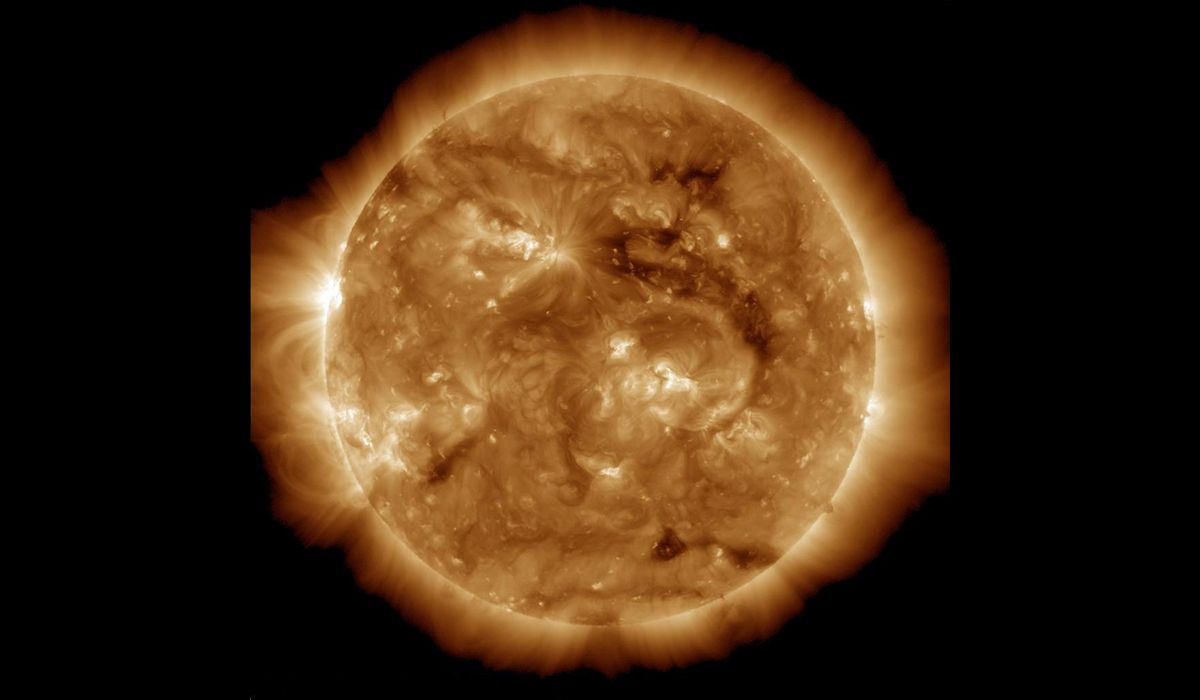
Pulses from the Sun. Credit: JPL/NASA/SDO/AIA.

An international team of researchers from the SETI Institute, Lockheed Martin Solar and Astrophysics Lab (LMSAL), Bay Area Environmental Research Institute (BAERI), and the University of Geneva wanted to build a more accurate and efficient computer model to understand the Sun’s atmosphere and better predict how it affects Earth and its technology. This effort was initiated by Quentin Wargnier, who moved to the start-up Green14 as an engineer responsible for simulations. The team developed a groundbreaking "Swiss army knife" for solar simulations to manage the Sun's complexity. This breakthrough will give scientists a better understanding of solar activity and improve space weather predictions that could affect Earth.

“This effort is a successful multi and cross-disciplinary effort that allowed the merging of a very powerful numerical scheme in an ambitious multi-physics and multi-fluids numerical modeling code (Ebysus),” said the SETI Institute’s Juan Martinez-Sykora, MUSE science deputy lead EUVIST Co-I.

The Sun is constantly active, emitting streams of charged particles and magnetic fields comprising solar wind. This solar weather creates beautiful effects, such as the northern lights, but can also negatively affect satellites, GPS systems, and power grids. Understanding and accurately predicting solar weather can help manage impacts.

To develop a model that could manage the Sun’s different layers, gases, varying temperatures and conditions, magnetic fields, and chemical reactions, all happening at different timescales, the researchers used the PIROCK method. Unlike other methods that handle each physical process separately (known as operator splitting), PIROCK considers them all simultaneously, adjusting calculations and providing faster, more accurate results.

This new method will allow interpreting observations from NASA missions, including IRIS and MUSE, which are studying the Sun's atmosphere. The model will help scientists analyze the data captured by these instruments, leading to new insights about the Sun.

This significant advance, published in Astronomy & Astrophysics on March 28, 2025, marks a key step toward solving some of the Sun’s biggest mysteries and improving our ability to forecast space weather.

The paper is published here:  https://www.aanda.org/articles/aa/full_html/2025/03/aa52351-24/aa52351-24.html

News

Related News

Featured Image
Sep 8, 2026
Researchers Propose Searching the Moon for Microscopic Technosignatures
New study outlines the first quantitative framework for searching lunar regolith for microscopic technosignatures. #Press Releases #Moon #Technosignatures #Lewis Pinault #Andrew Siemion #Astrobiology #SETI #Solar System #AI and Machine Learning #Bill Diamond
Featured Image
Sep 1, 2026
The SETI Institute and ETH Zurich join forces to search for the origin of life
ETH Zurich and the SETI Institute announced a strategic scientific partnership today. The US-based research organization will provide start-up funding for a new assistant professorship and associated research activities at ETH Zurich. #Press Releases #SETI Institute #Partnerships #ETH Zurich #Bill Diamond
Featured Image
Aug 25, 2026
JWST Reveals a Race Against Time for Forming Planets
SETI Institute scientist Uma Gorti co-authors one of the largest JWST studies of how planet-forming disks lose their gas #Press Releases #JWST #Astronomy #Astrophysics #Uma Gorti
Featured Image
Aug 24, 2026
New study reveals how space rocks become meteorites
Analysis of the atmospheric passage of 75 meteorite falls identifies seven distinct processes as space rocks melt, fragment and slow before they fall as meteorites #Press Releases #Comets, Meteors, and Asteroids #Peter Jenniskens #Meteorites #Astronomy #Stuart Pilorz
Featured Image
Aug 12, 2026
Hide the Star: How Roman Will See Exoplanets
#Blog #Franck Marchis #Margaret Turnbull #Nancy Grace Roman Space Telescope #Planetary Exploration #NASA Missions and Observatories #Exoplanets #Spectroscopy #Astronomy
Featured Image
Jul 20, 2026
SETI Institute In the News: June Roundup 2026
Throughout June 2026, SETI Institute scientists, affiliates, and collaborators contributed to discussions spanning interstellar visitors, planetary science, technosignature searches, animal cognition, and the scientific process guiding the search for life beyond Earth. #SETI Institute in the News #SETI Institute #Community #Eduardo Bendek #Optical SETI #SETI #3I/ATLAS #ATA #Comets, Meteors, and Asteroids #Solar System #Franck Marchis #Ariel Graykowski #Jill Tarter #Vishal Gajjar #Radio Astronomy #Bill Diamond #Lori Marino
Research

Related Projects

Featured Image
SkyMapper • SETI • Citizen Science • Astronomy
SkyMapper: Expanding Access to Real-time Astronomy Through a Global Astronomical Network
SkyMapper and the SETI Institute are connecting educators, students and the public to live astronomical observations through a distributed astronomical network. #SkyMapper #SETI #Citizen Science #Astronomy
Featured Image
VPL
Virtual Planetary Laboratory
How can we best assess whether an exoplanet supports life? #VPL
Featured Image
Discovery and Futures Lab
What happens if life beyond Earth is discovered? The Discovery and Futures Lab at the SETI Institute fosters novel and anticipatory research at the intersection of science, society, our planet, and the search for life beyond Earth.  #Discovery and Futures Lab
Support Us

Support the
SETI Institute

Scientists are getting closer in their search for life beyond earth. But with limited federal funding for the search for extraterrestrial intelligence, supporters are the reason cutting-edge scientists can keep their eyes on the sky.