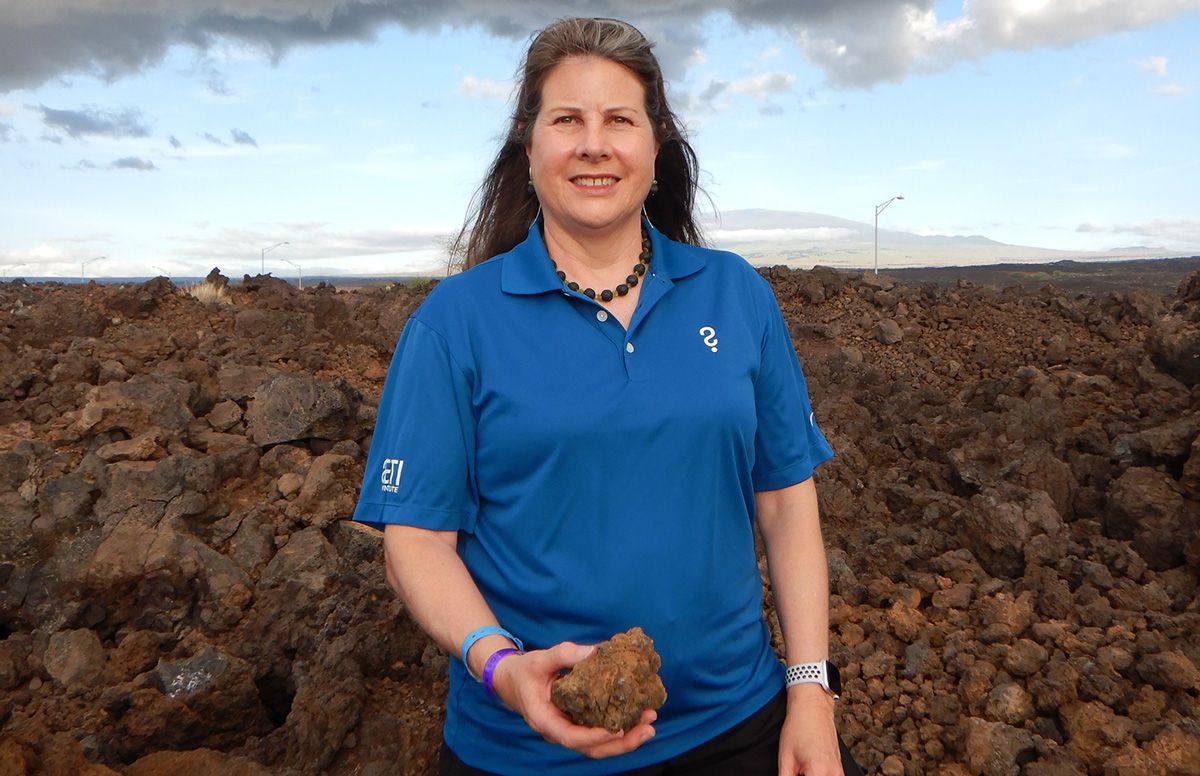
At last month’s Drake Awards ceremony, the SETI Institute also had the privilege of recognizing Janice Bishop with the Carl Sagan Center (CSC) 2021 Director's Award. Bishop is a senior research scientist at the SETI Institute and Chair of its astrobiology group. She is a chemist and planetary scientist who explores Mars using spectroscopy.
The CSC Director’s Award honors scientists for outstanding achievements in astrobiology, technology, and exploration of life in the universe. Beyond excellence in science, the awardees must have demonstrated their commitment to mentoring and educating the next generation of scientists while sharing the excitement of exploration and discovery with the public.
“She’s a martian from the sky,” said Nathalie Cabrol, Director of the CSC at the SETI Institute. "She's working from orbiters. The excellence of her work is known internationally. But it's not only about excellence in science. It's also her excellence as a mentor. She's an exceptional scientist, but she's also an exceptional human being, and she's also a friend that I appreciate very much."
Bishop’s investigations of CRISM data of Mars are revealing clays and sulfates in the ancient rocks that provide information about the geochemical environment at the time the minerals formed. Bishop studies the spectral fingerprints of minerals and rocks in the lab to generate a spectral library to identify these in the Martian data. Her research also involves collecting and studying Mars analog rocks and soils at various locations, including volcanic islands, cold deserts, hydrothermal regions, acidic aqueous sites, and meteorites which are the only Martian samples available on Earth to date.
“I’m fortunate to have an exciting and interesting job with outstanding colleagues," said Bishop.
Bishop is the third recipient of the CSC Director’s Award. In 2019 the SETI Institute recognized Lori Fenton and Pablo Sobron.
To learn more about science at the CSC, explore here.
News
Related News
Researchers Propose Searching the Moon for Microscopic Technosignatures
New study outlines the first quantitative framework for searching lunar regolith for microscopic technosignatures. #Press Releases #Moon #Technosignatures #Lewis Pinault #Andrew Siemion #Astrobiology #SETI #Solar System #AI and Machine Learning #Bill Diamond
The SETI Institute and ETH Zurich join forces to search for the origin of life
ETH Zurich and the SETI Institute announced a strategic scientific partnership today. The US-based research organization will provide start-up funding for a new assistant professorship and associated research activities at ETH Zurich. #Press Releases #SETI Institute #Partnerships #ETH Zurich #Bill Diamond
SETI Institute Achievements: Q2 2026 Activity Report
During the second quarter of 2026, the SETI Institute was especially active and made strong progress in research, education, outreach, and public engagement. Our scientists published over 80 peer-reviewed papers in fields such as SETI, astrobiology, planetary science, exoplanets, and heliophysics. #Activity Reports #Carl Sagan Center #Outreach #Education #AIR #Community #Research #SETI Institute
SETI Institute Team Looks for a New Way to Find Resources in Space
#Press Releases #Pablo Sobron #Moon #Asteroids #Planetary Exploration #Spectroscopy #Astrobiology
SETI Institute In the News: July Roundup 2026
#SETI Institute in the News #SETI Institute #Community #Peter Jenniskens #Lucian Walkowicz #Chelsea Haramia #Pascal Lee #Bill Diamond #Seth Shostak #Meteorites #SETI #UAPs #NASA Missions and Observatories #Discovery and Futures Lab #Mars
Celebrating 25 Years of Exoplanet Astrobiology: Welcoming the Virtual Planetary Laboratory to its New Home at the SETI Institute
#VPL #Astrobiology #SETI Institute #Victoria Meadows #Andrew Lincowski #Eric Wolf #Nicholas Wogan #Kimberly Bott #Hannah DawsonResearch
Related Projects
SkyMapper: Expanding Access to Real-time Astronomy Through a Global Astronomical Network
SkyMapper and the SETI Institute are connecting educators, students and the public to live astronomical observations through a distributed astronomical network. #SkyMapper #SETI #Citizen Science #Astronomy
Virtual Planetary Laboratory
How can we best assess whether an exoplanet supports life? #VPL
Discovery and Futures Lab
What happens if life beyond Earth is discovered? The Discovery and Futures Lab at the SETI Institute fosters novel and anticipatory research at the intersection of science, society, our planet, and the search for life beyond Earth. #Discovery and Futures LabSupport the
SETI Institute
Scientists are getting closer in their search for life beyond earth. But with limited federal funding for the search for extraterrestrial intelligence, supporters are the reason cutting-edge scientists can keep their eyes on the sky.