Image Credit: NASA/JPL-Caltech/T. Pyle (SSC)
June 27, 2019, Mountain View, CA and Marseille, France -- Unistellar is proud to announce that the eVscope, its revolutionary and powerful new consumer telescope, has demonstrated the ability to detect transiting exoplanets. This will allow citizen astronomers who soon receive the first eVscopes to begin contributing—easily but decisively—to one of the most exciting scientific endeavors in astronomy today: the search for worlds around distant suns.
Unistellar is the start-up behind this uniquely user-friendly digital telescope. The eVscope’s light-amplification technology and autonomous field detection make it possible for anyone to observe galaxies, nebulae, and comets in unparalleled crisp and colorful detail. In partnership with the SETI Institute, the Unistellar eVscope also allows everyone to contribute to astronomical discoveries while observing the night sky.
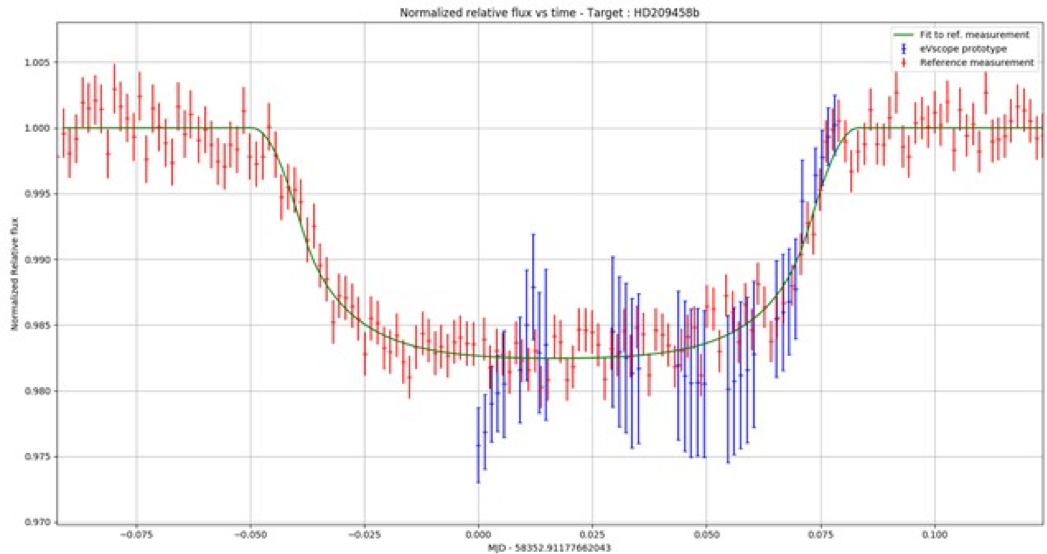
The Unistellar team recently used an eVscope to identify the transit of two Jupiter-size planets in distant constellations: Osiris, known as HD 209458b, a gas giant 160 light-years from our Solar System; and WASP-43b, a “hot Jupiter” 280 light-years away. The Unistellar eVscope detected the small variation in light generated when these exoplanets traveled in front of their stars.
“Detecting transiting exoplanets with a worldwide array of these powerful backyard telescopes will generate invaluable astronomical data,” explained Franck Marchis, senior astronomer at the SETI Institute and Unistellar’s Chief Scientific Officer. “With enough data points collected from coordinated observing campaigns using eVscopes, scientists will be able to refine the orbits of those new worlds, probe their surroundings, and detect tiny gravitational influences that indicate of the presence of a smaller nearby exoplanet in the same system.”
A single Unistellar eVscope was sufficient to make this detection. Soon, the company will start delivering more than 2,500 pre-ordered digital telescopes. This will create the world’s largest network of citizen astronomers, each of whom will be able to engage in an unprecedented level of collaboration with professional, amateur, and even novice astronomers conducting worldwide observation campaigns—including large institutional exoplanetary projects such as TESS, PLATO and JWST.
“The Unistellar eVscope has demonstrated that it is both a breathtaking deep-sky observing device and a groundbreaking scientific tool,” said Laurent Marfisi, Unistellar’s CEO. “By proving that exoplanet detection is possible with our citizen astronomy network, we are getting closer to our goal of creating a new and unprecedented level of space exploration.”
About Unistellar
Unistellar is the start-up behind the eVscope, a unique, compact, and user-friendly digital telescope. Its light-amplification technology allows users to observe galaxies, nebulae, and comets in unparalleled crisp and colorful detail. In partnership with the SETI Institute, the Unistellar eVscope also allows anyone to contribute to astronomical discoveries while observing.
The Unistellar eVscope received a CES Innovation Award in 2018 in the category Tech for a Better World and has been nominated for a SXSW 2019 Innovation Award. It has raised more than $3 million through crowdfunding, and more than 2,500 digital telescopes have already been pre-ordered.
Unistellar will be present at the Star’s Up Meudon, near Paris, on June 28 and 29, and at the World Conference of Science Journalists in Lausanne on July 2 and 3.
View/download the press release here: https://en.calameo.com/read/004812363ea30b235e30a
About the SETI Institute
Founded in 1984, the SETI Institute is a non-profit, multi-disciplinary research and education organization whose mission is to lead humanity’s quest to understand the origins and prevalence of life and intelligence in the Universe and to share that knowledge with the world. Our research encompasses the physical and biological sciences and leverages expertise in data analytics, machine learning and advanced signal detection technologies. The SETI Institute is a distinguished research partner for industry, academia and government agencies, including NASA and NSF.
Contact information
Ludovic Nachury
Head of Communication
[email protected]
+33 6 24 31 63 89
Rebecca McDonald
Director of Communications
SETI Institute
189 Bernardo Ave., Suite 200
Mountain View, CA 94043
[email protected]
www.seti.org
News
Related News
Researchers Propose Searching the Moon for Microscopic Technosignatures
New study outlines the first quantitative framework for searching lunar regolith for microscopic technosignatures. #Press Releases #Moon #Technosignatures #Lewis Pinault #Andrew Siemion #Astrobiology #SETI #Solar System #AI and Machine Learning #Bill Diamond
The SETI Institute and ETH Zurich join forces to search for the origin of life
ETH Zurich and the SETI Institute announced a strategic scientific partnership today. The US-based research organization will provide start-up funding for a new assistant professorship and associated research activities at ETH Zurich. #Press Releases #SETI Institute #Partnerships #ETH Zurich #Bill Diamond
SETI Institute Achievements: Q2 2026 Activity Report
During the second quarter of 2026, the SETI Institute was especially active and made strong progress in research, education, outreach, and public engagement. Our scientists published over 80 peer-reviewed papers in fields such as SETI, astrobiology, planetary science, exoplanets, and heliophysics. #Activity Reports #Carl Sagan Center #Outreach #Education #AIR #Community #Research #SETI Institute
JWST Reveals a Race Against Time for Forming Planets
SETI Institute scientist Uma Gorti co-authors one of the largest JWST studies of how planet-forming disks lose their gas #Press Releases #JWST #Astronomy #Astrophysics #Uma Gorti
New study reveals how space rocks become meteorites
Analysis of the atmospheric passage of 75 meteorite falls identifies seven distinct processes as space rocks melt, fragment and slow before they fall as meteorites #Press Releases #Comets, Meteors, and Asteroids #Peter Jenniskens #Meteorites #Astronomy #Stuart Pilorz
SETI Institute Team Looks for a New Way to Find Resources in Space
#Press Releases #Pablo Sobron #Moon #Asteroids #Planetary Exploration #Spectroscopy #AstrobiologyResearch
Related Projects
SkyMapper: Expanding Access to Real-time Astronomy Through a Global Astronomical Network
SkyMapper and the SETI Institute are connecting educators, students and the public to live astronomical observations through a distributed astronomical network. #SkyMapper #SETI #Citizen Science #Astronomy
Virtual Planetary Laboratory
How can we best assess whether an exoplanet supports life? #VPL
Discovery and Futures Lab
What happens if life beyond Earth is discovered? The Discovery and Futures Lab at the SETI Institute fosters novel and anticipatory research at the intersection of science, society, our planet, and the search for life beyond Earth. #Discovery and Futures LabSupport the
SETI Institute
Scientists are getting closer in their search for life beyond earth. But with limited federal funding for the search for extraterrestrial intelligence, supporters are the reason cutting-edge scientists can keep their eyes on the sky.