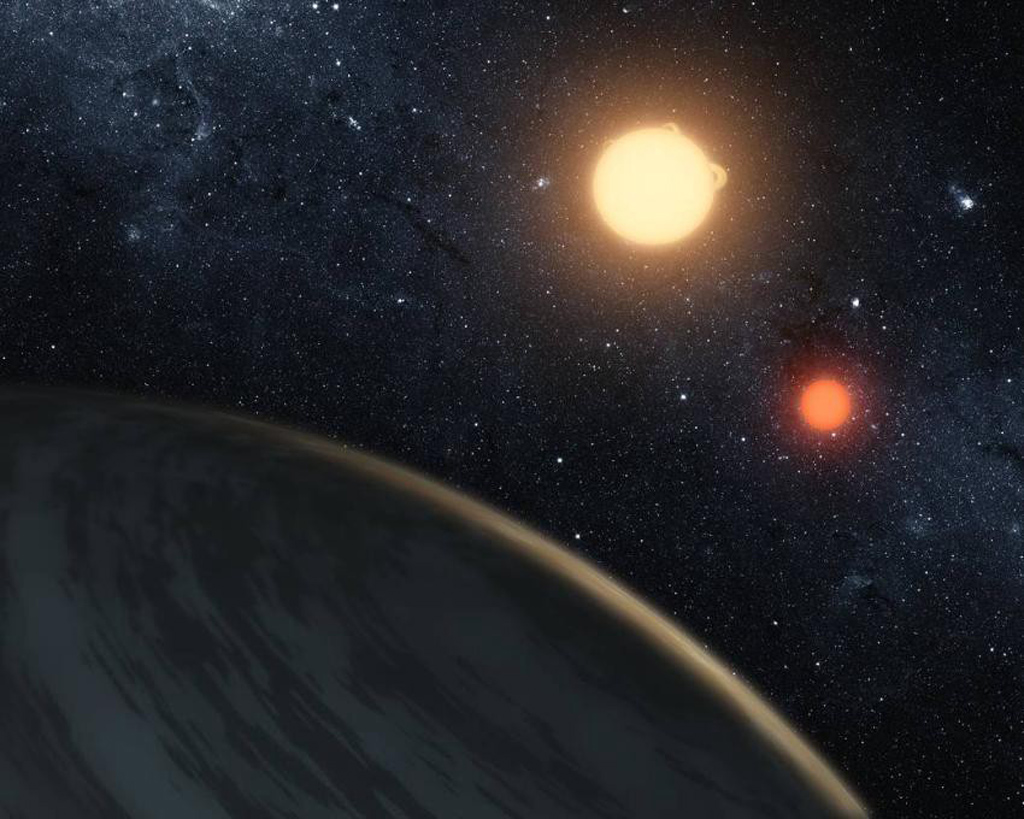
Exoplanets, it turns out, are difficult to take detailed pictures of at this point in time. At best, you get a blocked-out star and a tiny bright dot next to it. Although our telescopes are improving decade by decade, we still have to imagine what these distant worlds might look like.
That’s not to say that we cannot detect exoplanets from the ground. While Kepler and TESS use the transit method of finding exoplanets — where they look for dips in the light of a star as a planet passes between the star and the space telescope — ground-based observations can also find and confirm worlds in other star systems. To do this, they use the radial velocity method, where they measure changes in the velocity of a star as an orbiting planet gravitationally tugs on it.
And astronomers using the 193-centimeter telescope at the Observatoire de Haute-Provence in France were able to detect the known exoplanet Kepler-16b. This particular world fascinated everyone when it was discovered ten years ago because it was the first circumbinary exoplanet discovered, proving that a world like Tatooine in Star Wars could and in fact does exist. The team chose this target to prove that their telescope could be used to find exoplanets, as Dr. Isabelle Boisse explains: Our discovery shows how ground-based telescopes remain entirely relevant to modern exoplanet research and can be used for exciting new projects. Having shown we can detect Kepler-16b, we will now analyze data taken on many other binary star systems, and search for new circumbinary planets.
The results of these observations were published in the Monthly Notices of the Royal Astronomical Society.
Good luck to the team in France. May you find many more circumbinary planetary systems.
More Information
RAS press release
“BEBOP III. Observations and an independent mass measurement of Kepler-16 (AB) b — the first circumbinary planet detected with radial velocities,” Amaury H M J Triaud et al., 2022 February 25, Monthly Notices of the Royal Astronomical Society
This story was written for the Daily Space podcast/YouTube series. Want more news from myself, Dr. Pamela Gay, and Erik Madaus? Check out DailySpace.org.
Article originally published on medium.com.
News
Related News
JWST Reveals a Race Against Time for Forming Planets
SETI Institute scientist Uma Gorti co-authors one of the largest JWST studies of how planet-forming disks lose their gas #Press Releases #JWST #Astronomy #Astrophysics #Uma Gorti
New study reveals how space rocks become meteorites
Analysis of the atmospheric passage of 75 meteorite falls identifies seven distinct processes as space rocks melt, fragment and slow before they fall as meteorites #Press Releases #Comets, Meteors, and Asteroids #Peter Jenniskens #Meteorites #Astronomy #Stuart Pilorz
Hide the Star: How Roman Will See Exoplanets
#Blog #Franck Marchis #Margaret Turnbull #Nancy Grace Roman Space Telescope #Planetary Exploration #NASA Missions and Observatories #Exoplanets #Spectroscopy #Astronomy
Beyond Disclosure Day: The Real-World Protocols
#Press Releases #SETI #Astronomy #Bill Diamond #SETI Institute
SETI Institute In the News: May Roundup 2026
#SETI Institute in the News #SETI Institute #Community #Solar System #Matija Ćuk #Neptune #SETI #Bill Diamond #UAPs #Drake Awards #Lori Marino #Matthew Tiscareno #Outreach #Exoplanets #Carl Sagan Center
SETI Institute Awards $1 Million in STRIDE Grants to Advance Astrobiology, Exoplanet Science, and Public Engagement
#Press Releases #STRIDE #Research #Carl Sagan Center #Spectroscopy #Solar System #SETI #Climate and Bioscience #Astronomy #Astrobiology #Exoplanets #Data Science #Education #Outreach #Hat Creek Radio Observatory #Unistellar #SkyMapperResearch
Related Projects
SkyMapper: Expanding Access to Real-time Astronomy Through a Global Astronomical Network
SkyMapper and the SETI Institute are connecting educators, students and the public to live astronomical observations through a distributed astronomical network. #SkyMapper #SETI #Citizen Science #Astronomy
Virtual Planetary Laboratory
How can we best assess whether an exoplanet supports life? #VPL
Discovery and Futures Lab
What happens if life beyond Earth is discovered? The Discovery and Futures Lab at the SETI Institute fosters novel and anticipatory research at the intersection of science, society, our planet, and the search for life beyond Earth. #Discovery and Futures LabSupport the
SETI Institute
Scientists are getting closer in their search for life beyond earth. But with limited federal funding for the search for extraterrestrial intelligence, supporters are the reason cutting-edge scientists can keep their eyes on the sky.