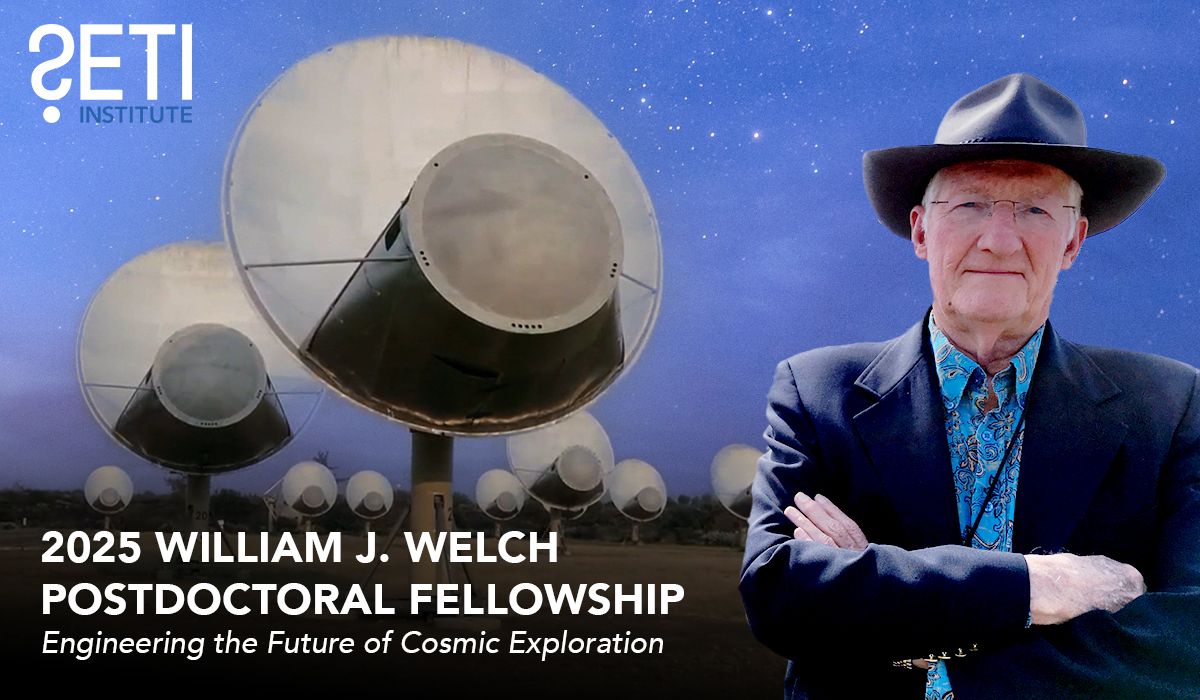
November 13, 2024, Mountain View, CA -- The SETI Institute is pleased to open the call for applications for the 2025 William J. Welch Postdoctoral Fellowship (WJWPF), focusing on "Engineering the Future of Cosmic Exploration." The William J. Welch Postdoctoral Fellowship aims to support exceptional early-career scientists in developing and employing novel instrumentation to answer fundamental questions in astronomy and astrophysics, focusing on the search for extraterrestrial intelligence or technosignatures. The proposed research program should broadly contribute to the mission of the SETI Institute, which is to lead humanity’s quest to understand the origins and prevalence of life and intelligence in the universe and share that knowledge with the world. The application deadline is December 20, 2024.
“We are thrilled to continue to honor Jack Welch’s enduring contributions to technosignature science and the Allen Telescope Array through enabling promising early career scientists to undertake research at the forefront of radio astrophysics and instrumentation,” said Dr. Andrew Siemion, Bernard M. Oliver Chair for SETI at the SETI Institute.
Fellowship research may cover a wide range of fields, including:
- Advanced radio astronomy techniques
- The interstellar medium
- The development of cutting-edge instrumentation and technology in radio astronomy
- Time-domain/radio transient science
- Technosignatures
The fellowship offers mentorship in a collaborative environment with leading researchers, access to the SETI Institute's advanced facilities, and the opportunity to engage with top Silicon Valley technologists. Fellows will receive a stipend of $85,000 and a $10,000/year allowance for research-related expenses and conference attendance.
For more information on the WJWPF and application details, please click here.
About the SETI Institute
Founded in 1984, the SETI Institute is a non-profit, multi-disciplinary research and education organization whose mission is to lead humanity's quest to understand the origins and prevalence of life and intelligence in the universe and share that knowledge with the world. Our research encompasses the physical and biological sciences and leverages data analytics, machine learning, and advanced signal detection technologies. The SETI Institute is a distinguished research partner for industry, academia, and government agencies, including NASA and the National Science Foundation.
Contact information
Rebecca McDonald
Director of Communications
SETI Institute
News
Related News
Researchers Propose Searching the Moon for Microscopic Technosignatures
New study outlines the first quantitative framework for searching lunar regolith for microscopic technosignatures. #Press Releases #Moon #Technosignatures #Lewis Pinault #Andrew Siemion #Astrobiology #SETI #Solar System #AI and Machine Learning #Bill Diamond
The SETI Institute and ETH Zurich join forces to search for the origin of life
ETH Zurich and the SETI Institute announced a strategic scientific partnership today. The US-based research organization will provide start-up funding for a new assistant professorship and associated research activities at ETH Zurich. #Press Releases #SETI Institute #Partnerships #ETH Zurich #Bill Diamond
SETI Institute Achievements: Q2 2026 Activity Report
During the second quarter of 2026, the SETI Institute was especially active and made strong progress in research, education, outreach, and public engagement. Our scientists published over 80 peer-reviewed papers in fields such as SETI, astrobiology, planetary science, exoplanets, and heliophysics. #Activity Reports #Carl Sagan Center #Outreach #Education #AIR #Community #Research #SETI Institute
JWST Reveals a Race Against Time for Forming Planets
SETI Institute scientist Uma Gorti co-authors one of the largest JWST studies of how planet-forming disks lose their gas #Press Releases #JWST #Astronomy #Astrophysics #Uma Gorti
New study reveals how space rocks become meteorites
Analysis of the atmospheric passage of 75 meteorite falls identifies seven distinct processes as space rocks melt, fragment and slow before they fall as meteorites #Press Releases #Comets, Meteors, and Asteroids #Peter Jenniskens #Meteorites #Astronomy #Stuart Pilorz
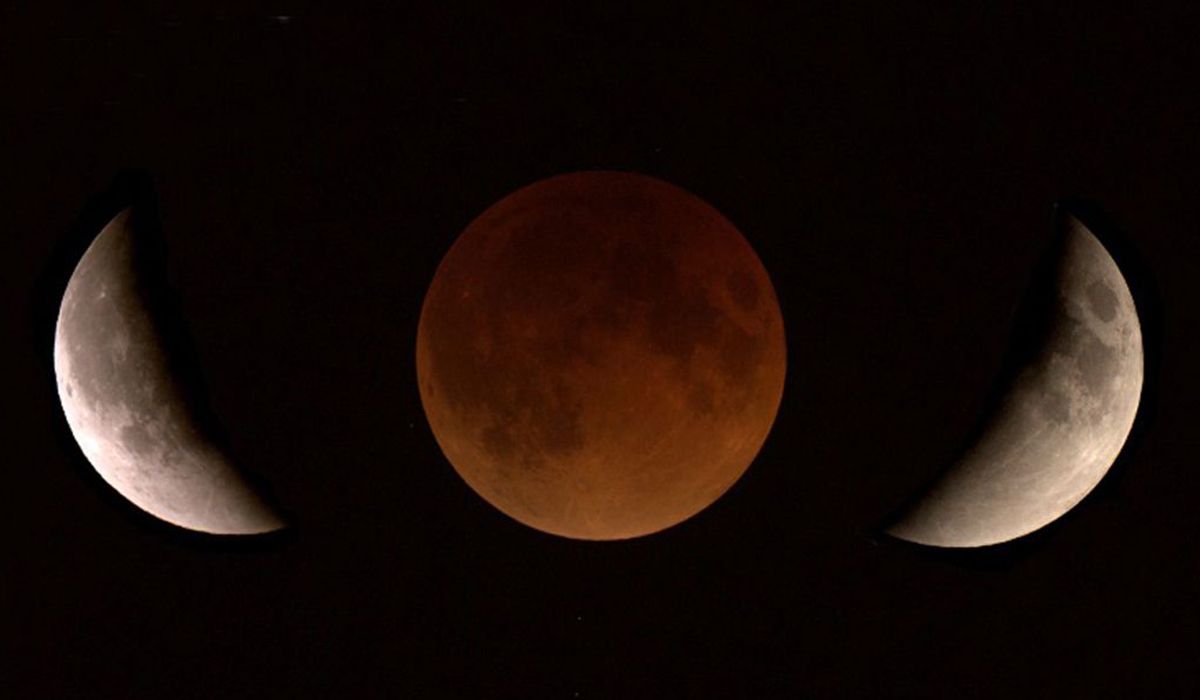
Look Up: A Lunar Eclipse on August 27
#Eclipse #Community #Andrew FraknoiResearch
Related Projects
SkyMapper: Expanding Access to Real-time Astronomy Through a Global Astronomical Network
SkyMapper and the SETI Institute are connecting educators, students and the public to live astronomical observations through a distributed astronomical network. #SkyMapper #SETI #Citizen Science #Astronomy
Virtual Planetary Laboratory
How can we best assess whether an exoplanet supports life? #VPL
Discovery and Futures Lab
What happens if life beyond Earth is discovered? The Discovery and Futures Lab at the SETI Institute fosters novel and anticipatory research at the intersection of science, society, our planet, and the search for life beyond Earth. #Discovery and Futures LabSupport the
SETI Institute
Scientists are getting closer in their search for life beyond earth. But with limited federal funding for the search for extraterrestrial intelligence, supporters are the reason cutting-edge scientists can keep their eyes on the sky.