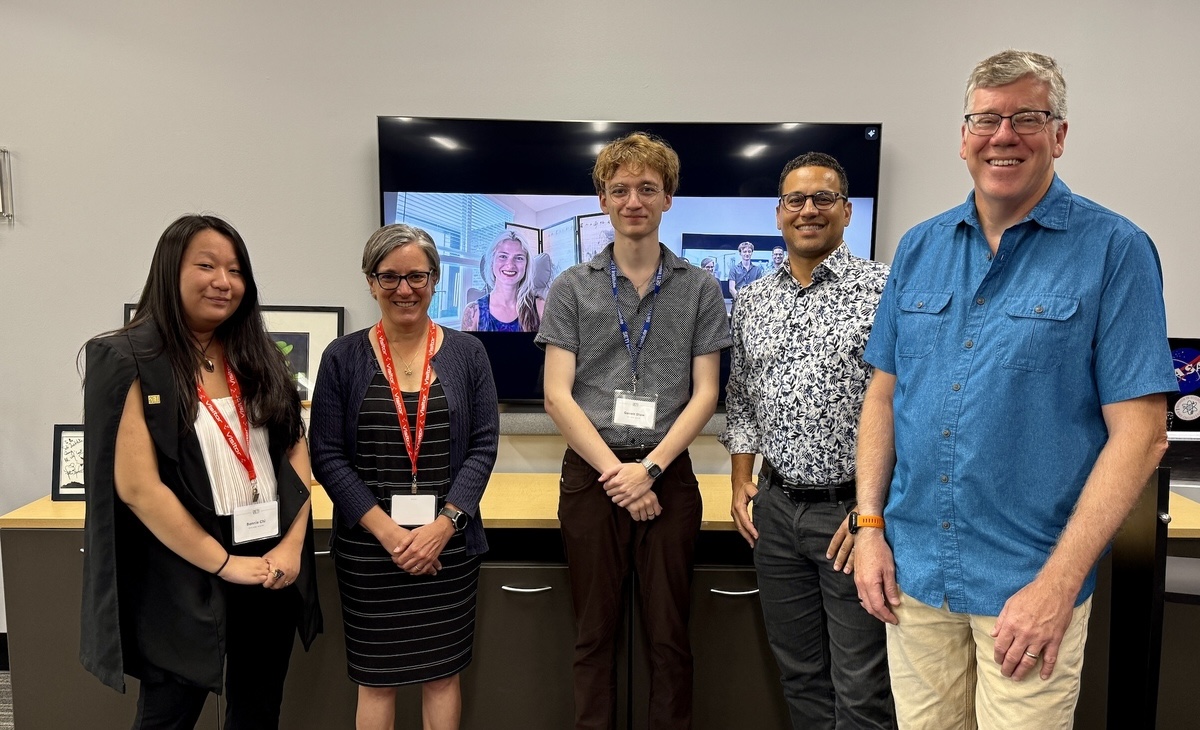









L-R: Bonnie Chi, Jean Chair, Lauren Sgro (onscreen), Garrett Shaw, Franck Marchis, Doug Caldwell.
The SETI Institute’s Community College Internship program is an ongoing collaboration between Bay Area community colleges and the SETI Institute, providing students with a research experience during their spring semester. Now in its third year, the program has welcomed students from Diablo Valley College in Pleasant Hill, CA and Evergreen Valley College in San Jose.
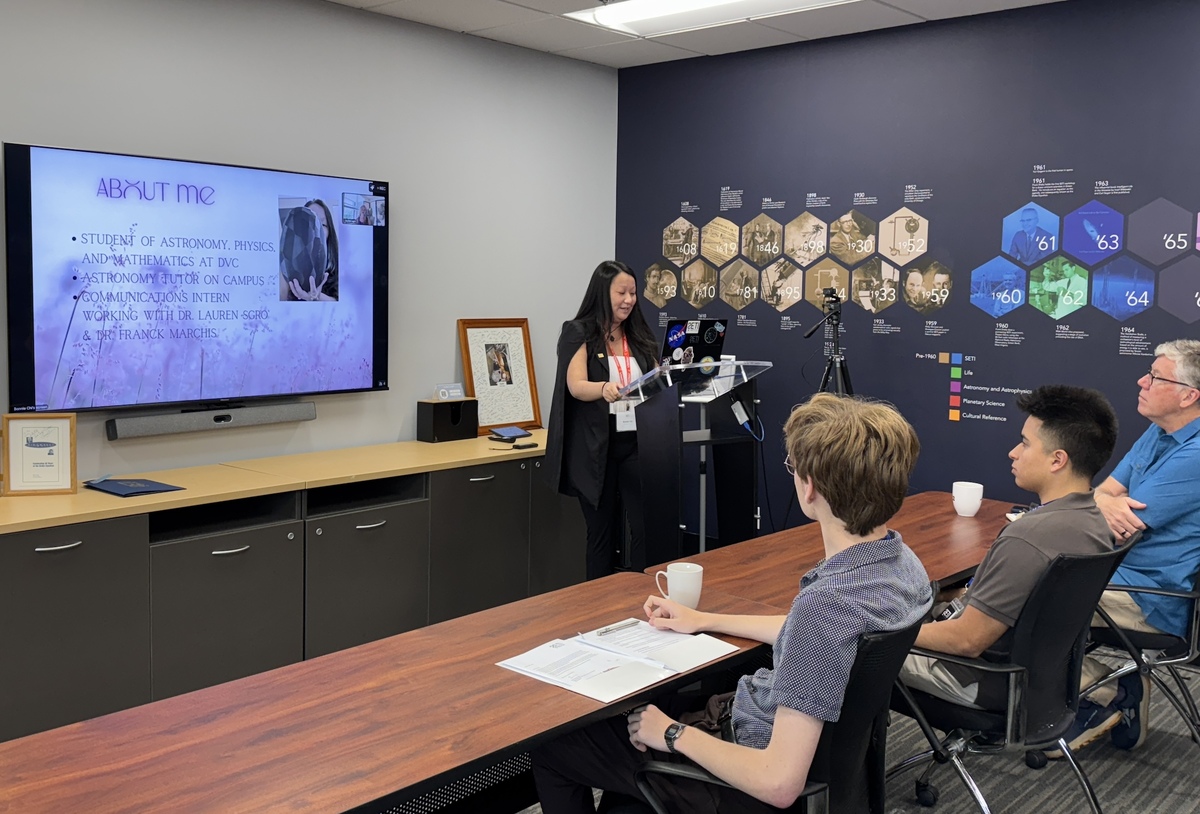
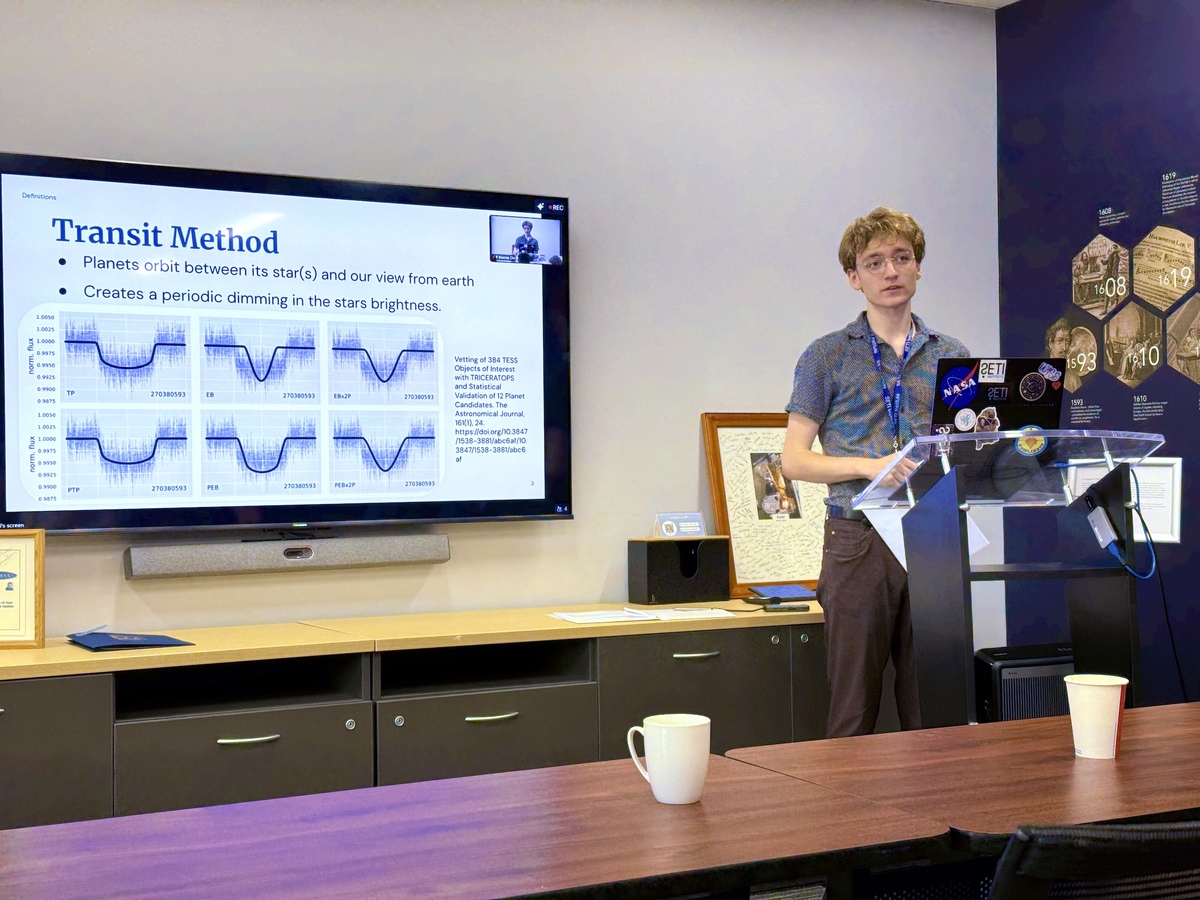
On June 7th, this year’s interns, Bonnie Chi and Garrett Shaw, both from Diablo Valley College (DVC), completed their research internships and presented their work to an audience of SETI Institute scientists and incoming REU summer interns.
“Because research opportunities are often limited at community colleges, where the primary focus is on teaching and faculty are dedicated mainly to instruction, the SETI Institute’s Spring semester internship is especially valuable,” said Dr. Jean Chiar of Diablo Valley College, who supports the program.
Bonnie Chi, who is studying astronomy, mathematics and physics at DVC, worked with mentors Dr. Lauren Sgro and Dr. Franck Marchis on science communications at the Unistellar/SETI Institute office in San Francisco. Bonnie wrote articles, created infographics and led social media postings for Unistellar’s citizen science community. Bonnie’s Cosmic Cataclysms article provided insight into transient events in the universe – gamma-ray bursts, novae and supernovae, and introduced the importance of Type 1a supernovae as distance indicators in cosmology. Her colorful and clear infographics, on subjects such as satellite orbits and insights into the nature of comets, will become part of Unistellar’s body of resources for citizen science astronomers. Bonnie will continue her studies at DVC in the fall, including Independent Study and telescope training with DVC’s Dr. Jean Chiar.
“Bonnie was a such a delight to work with. I’m so grateful for the Community College Internship program and that it brought her into our team,” said Dr. Lauren Sgro of Unistellar and the SETI Institute. “Getting to watch her grow her skills throughout the program was such a gift, and she created some fantastic works. I can’t wait to see what she does next in her career. Great job Bonnie!”
Garrett Shaw, working with mentor Doug Caldwell, focused on the detection and classification of exoplanets using observations from TESS, the Transiting Exoplanet Survey Satellite. Garrett contributed to the development of a machine learning tool to identify false positives – observations that were classified as planetary transits but were actually due to other phenomena, such as stellar variability, background objects and instrumental effects. Garrett’s work forms the foundation for future student development, enabling continued improvement of the machine learning architecture. Garrett leaves EVC this summer to study computational biology and bioinformatics at UC San Diego.
“Garrett continued the series of excellent interns that I have had the privilege to work with through the Community College Internship program,” said Dr. Doug Caldwell who has been a mentor for the program since its inception. “When I mentioned that there was a machine learning aspect of the project that hadn’t received much attention, he jumped in with both feet. I am confident that Garrett’s curiosity and strong computational background will serve him well in his career.”
This ongoing collaboration between the SETI Institute and local colleges expands the student internship experience beyond traditional summer programming, in addition providing opportunities for excellent students studying at colleges that cannot offer in-house research experiences. The SETI Institute hopes to expand internship opportunities to other Bay Area community colleges in the coming years.
News
Related News
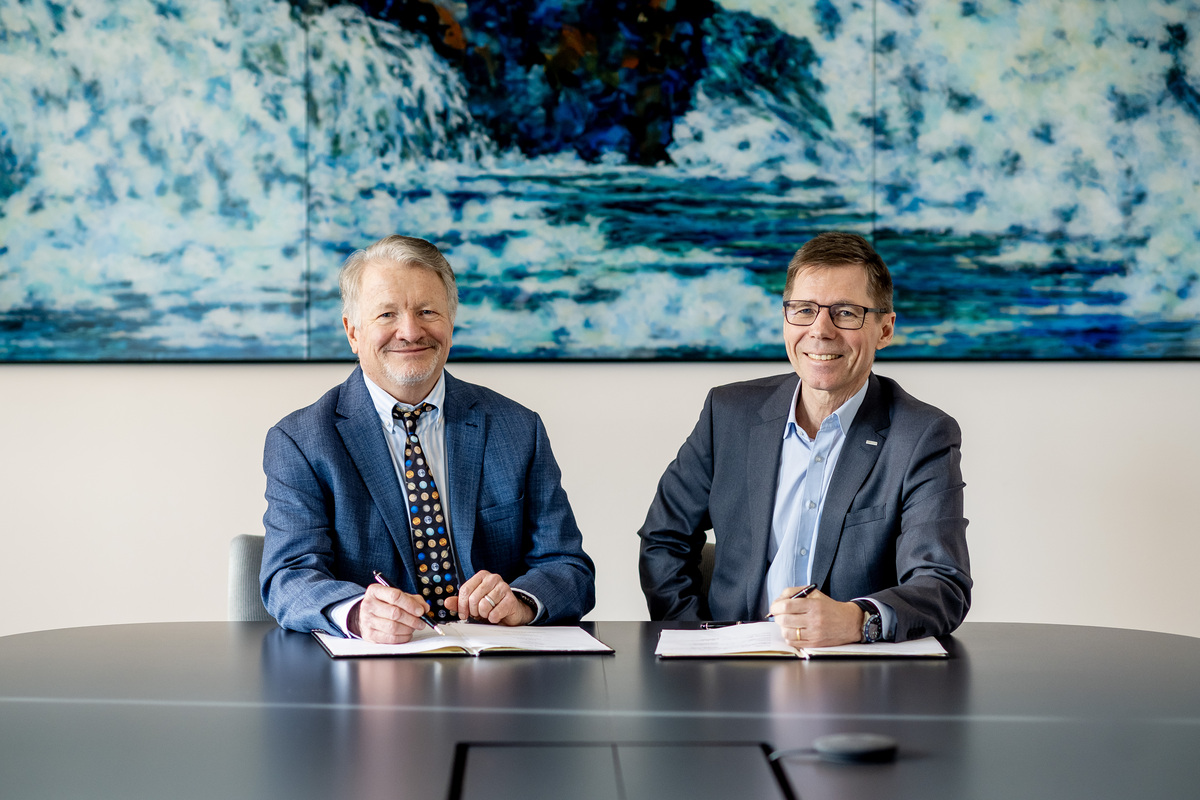
The SETI Institute and ETH Zurich join forces to search for the origin of life
ETH Zurich and the SETI Institute announced a strategic scientific partnership today. The US-based research organization will provide start-up funding for a new assistant professorship and associated research activities at ETH Zurich. #Press Releases #SETI Institute #Partnerships #ETH Zurich #Bill Diamond

SETI Institute Achievements: Q2 2026 Activity Report
During the second quarter of 2026, the SETI Institute was especially active and made strong progress in research, education, outreach, and public engagement. Our scientists published over 80 peer-reviewed papers in fields such as SETI, astrobiology, planetary science, exoplanets, and heliophysics. #Activity Reports #Carl Sagan Center #Outreach #Education #AIR #Community #Research #SETI Institute
SETI Institute In the News: July Roundup 2026
#SETI Institute in the News #SETI Institute #Community #Peter Jenniskens #Lucian Walkowicz #Chelsea Haramia #Pascal Lee #Bill Diamond #Seth Shostak #Meteorites #SETI #UAPs #NASA Missions and Observatories #Discovery and Futures Lab #Mars
Hide the Star: How Roman Will See Exoplanets
#Blog #Franck Marchis #Margaret Turnbull #Nancy Grace Roman Space Telescope #Planetary Exploration #NASA Missions and Observatories #Exoplanets #Spectroscopy #Astronomy
SETI Institute In the News: June Roundup 2026
Throughout June 2026, SETI Institute scientists, affiliates, and collaborators contributed to discussions spanning interstellar visitors, planetary science, technosignature searches, animal cognition, and the scientific process guiding the search for life beyond Earth. #SETI Institute in the News #SETI Institute #Community #Eduardo Bendek #Optical SETI #SETI #3I/ATLAS #ATA #Comets, Meteors, and Asteroids #Solar System #Franck Marchis #Ariel Graykowski #Jill Tarter #Vishal Gajjar #Radio Astronomy #Bill Diamond #Lori Marino
SETI Institute Achievements: Q1 2026 Activity Report
#Activity Reports #Carl Sagan Center #Outreach #Education #AIR #Community #Research #SETI InstituteResearch
Related Projects
SkyMapper: Expanding Access to Real-time Astronomy Through a Global Astronomical Network
SkyMapper and the SETI Institute are connecting educators, students and the public to live astronomical observations through a distributed astronomical network. #SkyMapper #SETI #Citizen Science #Astronomy
Virtual Planetary Laboratory
How can we best assess whether an exoplanet supports life? #VPL
Discovery and Futures Lab
What happens if life beyond Earth is discovered? The Discovery and Futures Lab at the SETI Institute fosters novel and anticipatory research at the intersection of science, society, our planet, and the search for life beyond Earth. #Discovery and Futures LabSupport the
SETI Institute
Scientists are getting closer in their search for life beyond earth. But with limited federal funding for the search for extraterrestrial intelligence, supporters are the reason cutting-edge scientists can keep their eyes on the sky.