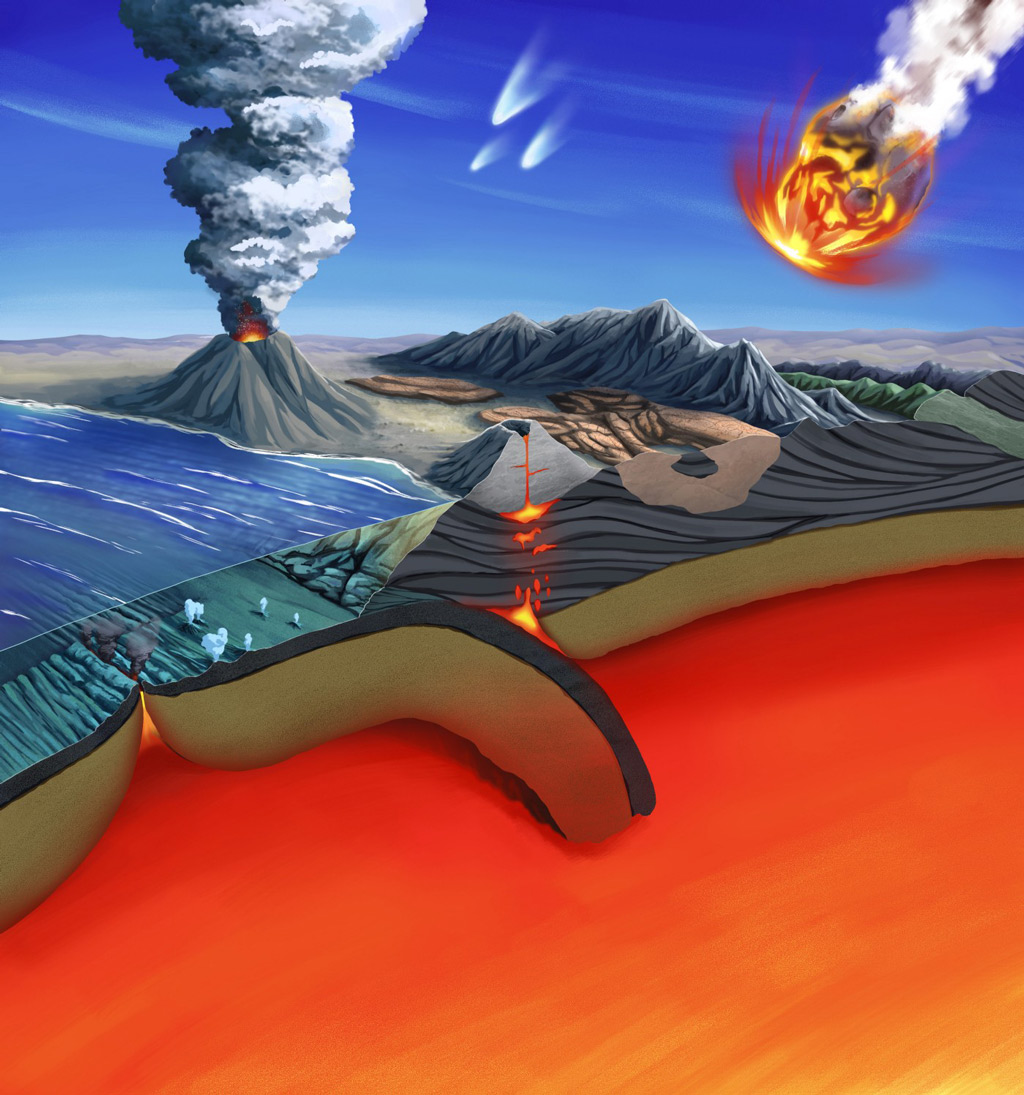
IMAGE: Methane in a planet’s atmosphere may be a sign of life if nonbiological sources can be ruled out. This illustration summarizes the known abiotic sources of methane on Earth, including outgassing from volcanoes, reactions in settings such as mid-ocean ridges, hydrothermal vents, and subduction zones, and impacts from asteroids and comets. CREDIT: 2022 Elena Hartley
By Beth Johnson
There is a place where planetary science and astrobiology start to cross over, and that is generally where we start questioning just how to go about finding life on other worlds. So far, we haven’t found anything anywhere, which is a huge disappointment to pretty much everyone. Right now, all we have are hypotheses about where life could exist, and we continue to expand on that list sort of as a thread of optimism that we’re not alone. Frankly, I’d be happy if we found some microbes somewhere that isn’t Earth, and we’ve definitely been adding to the possibilities the more extremophiles we find.
But how do we go about detecting said life if it’s there? And where should we look? Sure, we’ve found life here in sulfur pools and at the bottom of the ocean, under the ice caps, at the tops of mountains living in the snow. I mean, the planet is teeming with life. What’s next?
A new study published this week in Proceedings of the National Academy of Science focuses on one particular potential sign of life: methane. In particular, this study seeks to list out the circumstances under which biological sources of methane should be considered when it comes to a rocky world.
First off, let’s talk about the non-biological sources of methane. These include volcanoes, some underwater reactions near mid-ocean ridges and hydrothermal vents, as well as asteroid and comet impacts. Volcanoes, however, would also add other gases to the atmosphere, so if we detect carbon monoxide and methane, we could probably rule out life there. Life tends to consume carbon monoxide, so perhaps if we found methane and carbon dioxide instead, we have a sign of life.
Second, methane is incredibly unstable in the atmosphere because sunlight breaks it down. Coauthor Joshua Krissansen-Totton explains: If you detect a lot of methane on a rocky planet, you typically need a massive source to explain that. We know biological activity creates large amounts of methane on Earth and probably did on the early Earth as well because making methane is a fairly easy thing to do metabolically.
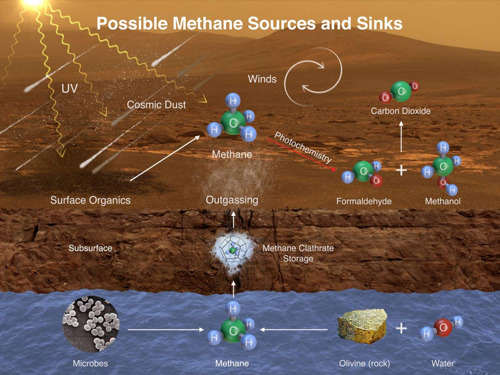
IMAGE: This diagram shows possible ways by which methane might incorporate into Mars’ atmosphere (sources) and disappear from the atmosphere (sinks). CREDIT: NASA/JPL-Caltech/SAM-GSFC/Univ. of Michigan
Now all of this methane speculation mostly came about because we keep detecting methane on Mars. NASA’s Curiosity rover has detected multiple surges in the amount of atmospheric methane on the red planet. ESA’s Mars Express has confirmed several of the detections as well, but no one has a solid answer for why they keep occurring. They manage to rule out reasons, such as wind erosion releasing methane from the rocks on the planet, because the amounts aren’t enough.
And there’s the Trace Gas Orbiter onboard ExoMars, which hasn’t found the same levels higher up in the atmosphere that Curiosity has detected. That discrepancy led to an entire debate about which measurements were correct, and the answer, as most things in astronomy turn out to be, was both.
Somehow, methane is building up close to the surface at night, which is when Curiosity’s sensor is used because of the power levels it requires. Meanwhile, the Trace Gas Orbiter has to be used in daylight to measure atmospheric methane, when all of that concentrated methane from near the surface gets moved up into the circulating air and diluted by the wider atmosphere.
All of this is to say that we know methane is seeping out from Gale crater and likely other places on Mars, but it’s not building up enough to be detected in the atmosphere, and we certainly don’t know for certain what the cause of the actual methane is. Is it in the rocks themselves? Unlikely in the quantities we keep seeing with Curiosity. Is there life underground creating it? Maybe?
And now we come back to the main point of today’s segment — Titan.
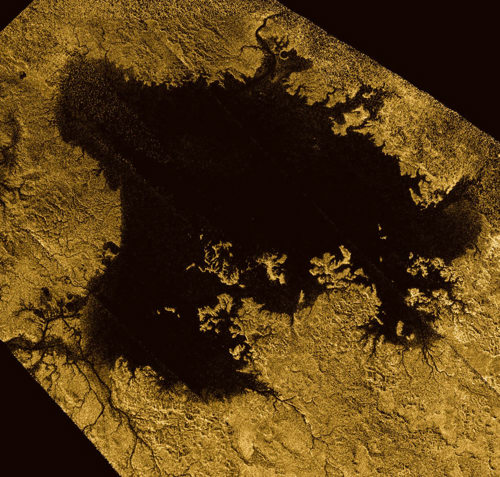
IMAGE: Ligiea Mare is the second largest body of liquid on Saturn’s moon Titan. CREDIT: NASA/JPL-Caltech/ASI/Cornell
Saturn’s largest moon is covered in methane. Literally. There are lakes of liquid methane on the surface of Titan, and everyone is so interested in understanding these lakes that not one but two missions are in the works to explore and understand this moon.
First up, NASA’s Dragonfly drone, which is sort of like the Ingenuity helicopter on steroids, plans to explore the surface and atmosphere of Titan. The atmosphere of the tiny world is similar to that of Earth about 3.5 billion years ago when life first emerged. Dragonfly is planned for launch in 2027 and hopes to figure out what starting ingredients are necessary.
ESA’s POSEIDON mission, which is still in the proposal stage, will have two separate vehicles — an orbiter and a lander. The orbiter will collect all that wonderful atmospheric data we need and the lander would go find a lake and collect data on the actual liquid methane.
All of this is in an effort to answer the question: Can we reliably use methane as a signature of life on other worlds? After all, more than 70% of the methane in our own atmosphere here on Earth is biologically created. It’s not impossible for the same to be true on Mars and Titan, just in smaller quantities. But before we can state that we have found zebras, we have to check for horses. And that’s why missions to these two worlds, especially ones looking for direct signs of biological activity, are incredibly important.
The broader implication here is that, once we know for certain that methane on either world is biologically produced, we can start to put together combinations of atmospheric makeup that we can then look for with a more sensitive telescope, like JWST. That means cataloging exoplanet atmospheres and maybe, possibly, finally… finding life on even more distant worlds.
New study outlines the first quantitative framework for searching lunar regolith for microscopic technosignatures.
#Press Releases
#Moon
#Technosignatures
#Lewis Pinault
#Andrew Siemion
#Astrobiology
#SETI
#Solar System
#AI and Machine Learning
#Bill Diamond
Throughout June 2026, SETI Institute scientists, affiliates, and collaborators contributed to discussions spanning interstellar visitors, planetary science, technosignature searches, animal cognition, and the scientific process guiding the search for life beyond Earth.
#SETI Institute in the News
#SETI Institute
#Community
#Eduardo Bendek
#Optical SETI
#SETI
#3I/ATLAS
#ATA
#Comets, Meteors, and Asteroids
#Solar System
#Franck Marchis
#Ariel Graykowski
#Jill Tarter
#Vishal Gajjar
#Radio Astronomy
#Bill Diamond
#Lori Marino
#SETI Institute in the News
#SETI Institute
#Community
#Solar System
#Matija Ćuk
#Neptune
#SETI
#Bill Diamond
#UAPs
#Drake Awards
#Lori Marino
#Matthew Tiscareno
#Outreach
#Exoplanets
#Carl Sagan Center
Throughout June 2026, SETI Institute scientists, affiliates, and collaborators contributed to discussions spanning interstellar visitors, planetary science, technosignature searches, animal cognition, and the scientific process guiding the search for life beyond Earth.
#SETI Institute in the News
#SETI Institute
#Community
#Eduardo Bendek
#Optical SETI
#SETI
#3I/ATLAS
#ATA
#Comets, Meteors, and Asteroids
#Solar System
#Franck Marchis
#Ariel Graykowski
#Jill Tarter
#Vishal Gajjar
#Radio Astronomy
#Bill Diamond
#Lori Marino
#SETI Institute in the News
#SETI Institute
#Community
#Solar System
#Matija Ćuk
#Neptune
#SETI
#Bill Diamond
#UAPs
#Drake Awards
#Lori Marino
#Matthew Tiscareno
#Outreach
#Exoplanets
#Carl Sagan Center
SkyMapper and the SETI Institute are connecting educators, students and the public to live astronomical observations through a distributed astronomical network.
#SkyMapper
#SETI
#Citizen Science
#Astronomy
What happens if life beyond Earth is discovered? The Discovery and Futures Lab at the SETI Institute fosters novel and anticipatory research at the intersection of science, society, our planet, and the search for life beyond Earth.
#Discovery and Futures Lab
SkyMapper and the SETI Institute are connecting educators, students and the public to live astronomical observations through a distributed astronomical network.
What happens if life beyond Earth is discovered? The Discovery and Futures Lab at the SETI Institute fosters novel and anticipatory research at the intersection of science, society, our planet, and the search for life beyond Earth.
Scientists are getting closer in their search for life beyond earth. But with limited federal funding for the search for extraterrestrial intelligence, supporters are the reason cutting-edge scientists can keep their eyes on the sky.
)