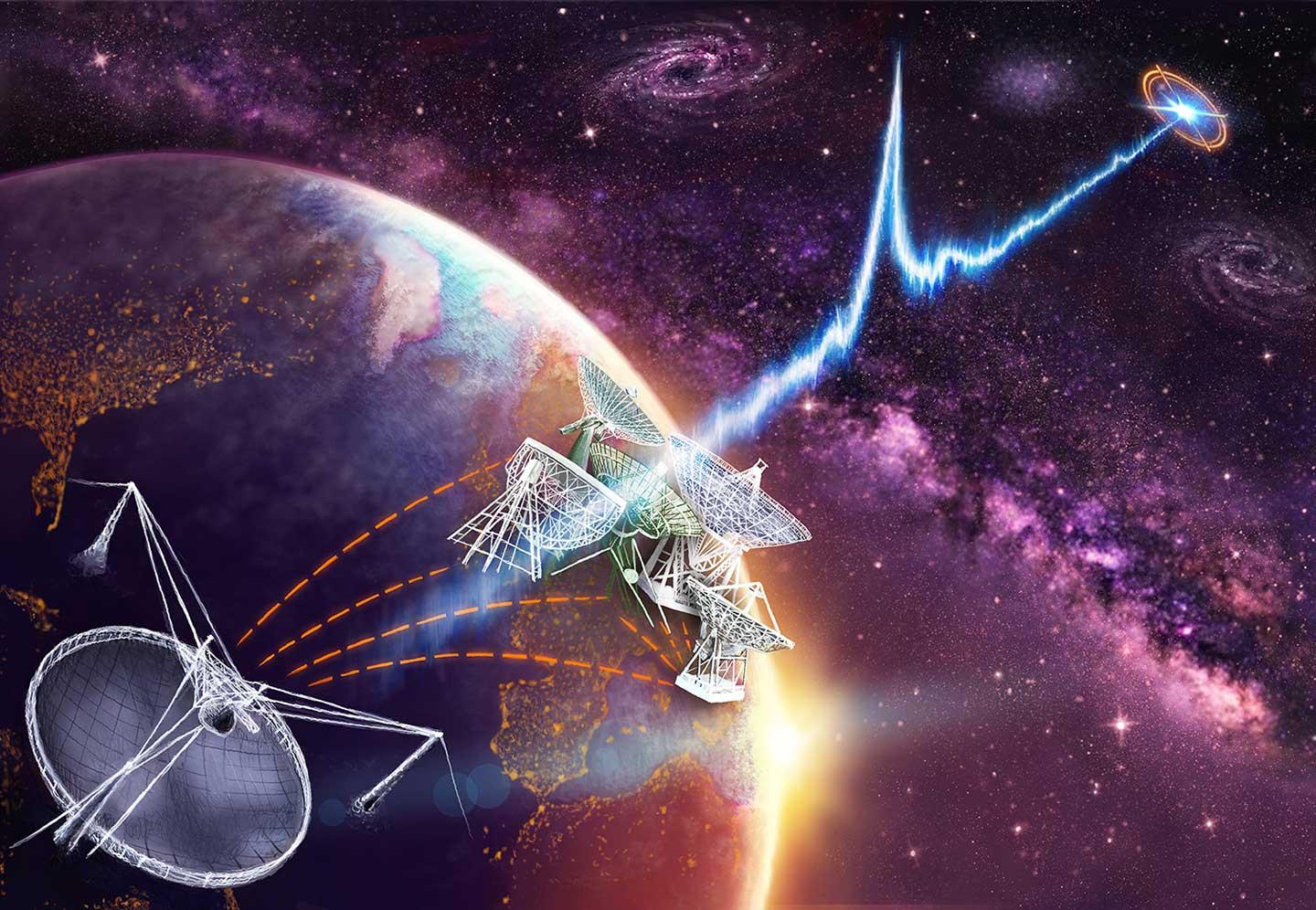
Artist impression of a fast radio burst credit Danielle Futselaar
One of the most interesting stories to come out of this week’s meeting of the American Astronomical Society is the announcement that astronomers using the new CHIME radio telescope in British Columbia have found another repeating fast radio burster, or FRB.
During the last decade, FRBs have taken center stage as one of the hottest topics in astronomy. That’s because (1) they seem to be a common phenomenon, and (2) we still don’t understand them.
It’s lore among astronomy grad students that cosmic phenomena are either singular – in other words, there’s only one in the universe – or they’re very common. For example, some folks have argued that Earth might be unique. Maybe there’s only one such bio-friendly world in our galaxy, and we live on it. But a more frequently heard opinion is that, among the trillion planets of the Milky Way, there could be many billions that have spawned life.
When, a few years ago, only a handful of FRBs were known, it was unclear whether they were rare or otherwise. Now that more than 60 have been detected, researchers can safely say that there are probably thousands of these things going off every day. They are as ubiquitous as indoor plumbing.
What is unusual and noteworthy about the latest FRB is that it repeats. There’s a short flash of radio energy – quicker than an eye blink – and then, maybe two days later, it flashes again. Only one other burster, FRB 121102 (discovered in 2012) has ever done encores.
The repetition tells you something about the cause of these radio flashes. Obviously, you can’t expect that colliding black holes or neutron stars are going to return to their corners and collide again a few days later. Whatever is responsible for this series of bursts has to be an ongoing phenomenon.
In addition, the phenomenon has to be tremendously energetic. The radio flashes come from billions of light-years away. The first repeating burster, FRB 121102, is located in an unremarkable galaxy that’s more than a thousand times farther than the Andromeda nebula. Not next door. Clearly, something in that galaxy can muster sufficient energy to produce a signal detectable here on Earth. And it can come up with that energy every few days or so.
Obviously, there’s fame and tenure awaiting anyone who can figure out exactly what powers fast radio bursts. But could it be that these signals are due to aliens?
Probably not, especially when you look back at astronomical history. Aliens are frequently given the credit for causing new celestial phenomenon. A half century ago, Soviet scientists suspected that quasars were actually signals broadcast by highly advanced societies far, far away. In the 1960s, British radio astronomers temporarily referred to pulsars as Little Green Men. More recent suspected alien handiwork includes the puzzling behavior of Tabby’s Star and even the odd hexagonal feature seen in the cloud tops at Saturn’s north pole.
But you can safely bet that aliens are not the cause of FRBs. Why? The bursters are seen all over the sky, that’s why. The same sort of signal is coming from galaxies that are generally separated by billions of light-years. So how could aliens organize so much of the universe to engage in broadcasting the same sort of signal? There’s hardly been enough time since the Big Bang to coordinate such widespread teamwork, even if you can think of a reason for it!
If past experience continues to be prologue, the number of known FRBs is going to increase rapidly now. CHIME will find many of them, and the astronomical community is definitely stoked. As a result, I think you can reckon on some clever theoretician coming up with an explanation for these bizarre phenomena within a year or two. I doubt it will be aliens.
)