










Tuesday, Apr 06, 2021

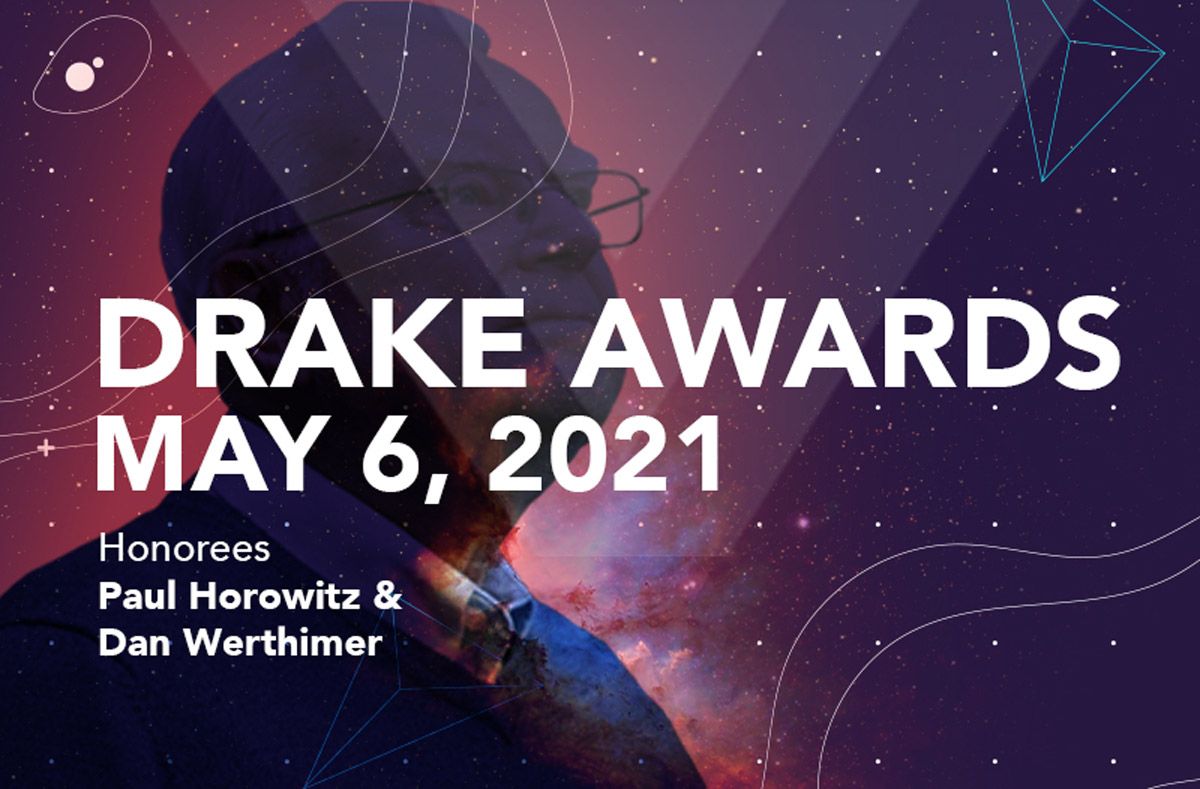
April 6, 2021, Mountain View, CA – The SETI Institute has named Dan Werthimer and Paul Horowitz as recipients of the 2021 Drake Award.

The award, named after Frank Drake, the astronomer who conducted the first modern experiment to seek extraterrestrial intelligence, honors those scientists and engineers who have made substantial contributions to the search for and understanding of life beyond Earth.

The 2021 Drake Awards mark the first time this SETI Institute award has simultaneously recognized the achievements of two people, a testament to the extraordinary contributions each has made to SETI Research.

“It's a tremendous honor to receive this award in Frank's name,” said Werthimer, who is Chief Scientist at the Berkeley SETI Research Center. "He was a huge and inspiring influence on my life and was the one who enticed me into SETI work. If it weren’t for Frank, I would have been rich. Everyone in the Homebrew computer club (including Steve Jobs and Wozniak) got rich except me because Frank got me keen on SETI. I'm also elated to share this award with my wonderful friend Paul.”

Werthimer was the co-founder and principal investigator for the enormously popular screen saver, SETI@home, which more than 8 million members of the public have used to process data collected by radio telescopes searching for emissions from other intelligence. SETI@home brought SETI very literally into people’s homes and helped establish it as a mainstream science in the public’s minds. Werthimer has also been instrumental – in all senses – in developing low-cost and innovative multichannel receivers for radio SETI, as well as devices to look for short laser flashes from other star systems, an endeavor known as optical SETI.

Paul Horowitz is an emeritus Professor of Physics and Electrical Engineering at Harvard University. Well known for his work on circuit design and author of a foundational textbook on electronics, Horowitz is, like Werthimer, one of SETI’s most influential pioneers. In the 1980s, he designed the first million- and billion-channel SETI receivers. These laid the groundwork for today’s SETI technologies. He also supervised the construction of the first dedicated optical SETI telescope.

“I am greatly honored to have been chosen to join the ranks of giants like Drake, Townes, and other distinguished recipients of the SETI Institute's Drake Award,” said Horowitz. “And I cannot think of anyone I'd rather share it with than Dan (thus further diminishing his chances of becoming rich).”

Drake Award recipients are nominated by the SETI Institute’s Science Advisory Board and approved by the SETI Institute’s Board of Trustees. Past recipients are Frank Drake, Charles Townes, William Borucki, Victoria S. Meadows and Jason Wright.

“Paul and Dan’s contributions to SETI research and associated technology developments have transformed the field,” said Bill Diamond, CEO of the SETI Institute. “Indeed, it was Frank Drake himself who nominated Paul and Dan in recognition of their innumerable achievements. We are delighted to be honoring them together.”

The presentation of the 2020 Drake Award will take place on May 6, 2021, at a virtual public event. In addition to Werthimer and Horowitz, special guests will include Bill Nye, Adam Savage, Frank Drake and Jill Tarter.

Tickets for the presentation are available here: drakeawards.seti.org/register. 

About the SETI Institute
Founded in 1984, the SETI Institute is a non-profit, multi-disciplinary research and education organization whose mission is to lead humanity’s quest to understand the origins and prevalence of life and intelligence in the Universe and to share that knowledge with the world. Our research encompasses the physical and biological sciences and leverages expertise in data analytics, machine learning and advanced signal detection technologies. The SETI Institute is a distinguished research partner for industry, academia and government agencies, including NASA and NSF.

Contact information
Rebecca McDonald
Director of Communications
SETI Institute
[email protected]

News

Related News

Featured Image
Sep 8, 2026
Researchers Propose Searching the Moon for Microscopic Technosignatures
New study outlines the first quantitative framework for searching lunar regolith for microscopic technosignatures. #Press Releases #Moon #Technosignatures #Lewis Pinault #Andrew Siemion #Astrobiology #SETI #Solar System #AI and Machine Learning #Bill Diamond

Featured Image
Sep 1, 2026
The SETI Institute and ETH Zurich join forces to search for the origin of life
ETH Zurich and the SETI Institute announced a strategic scientific partnership today. The US-based research organization will provide start-up funding for a new assistant professorship and associated research activities at ETH Zurich. #Press Releases #SETI Institute #Partnerships #ETH Zurich #Bill Diamond
Featured Image
Aug 27, 2026
SETI Institute Achievements: Q2 2026 Activity Report
During the second quarter of 2026, the SETI Institute was especially active and made strong progress in research, education, outreach, and public engagement. Our scientists published over 80 peer-reviewed papers in fields such as SETI, astrobiology, planetary science, exoplanets, and heliophysics. #Activity Reports #Carl Sagan Center #Outreach #Education #AIR #Community #Research #SETI Institute
Featured Image
Aug 25, 2026
JWST Reveals a Race Against Time for Forming Planets
SETI Institute scientist Uma Gorti co-authors one of the largest JWST studies of how planet-forming disks lose their gas #Press Releases #JWST #Astronomy #Astrophysics #Uma Gorti
Featured Image
Aug 24, 2026
New study reveals how space rocks become meteorites
Analysis of the atmospheric passage of 75 meteorite falls identifies seven distinct processes as space rocks melt, fragment and slow before they fall as meteorites #Press Releases #Comets, Meteors, and Asteroids #Peter Jenniskens #Meteorites #Astronomy #Stuart Pilorz
Featured Image
Aug 19, 2026
SETI Institute Team Looks for a New Way to Find Resources in Space
#Press Releases #Pablo Sobron #Moon #Asteroids #Planetary Exploration #Spectroscopy #Astrobiology
Research

Related Projects

Featured Image
SkyMapper • SETI • Citizen Science • Astronomy
SkyMapper: Expanding Access to Real-time Astronomy Through a Global Astronomical Network
SkyMapper and the SETI Institute are connecting educators, students and the public to live astronomical observations through a distributed astronomical network. #SkyMapper #SETI #Citizen Science #Astronomy
Featured Image
VPL
Virtual Planetary Laboratory
How can we best assess whether an exoplanet supports life? #VPL
Featured Image
Discovery and Futures Lab
What happens if life beyond Earth is discovered? The Discovery and Futures Lab at the SETI Institute fosters novel and anticipatory research at the intersection of science, society, our planet, and the search for life beyond Earth.  #Discovery and Futures Lab
Support Us

Support the
SETI Institute

Scientists are getting closer in their search for life beyond earth. But with limited federal funding for the search for extraterrestrial intelligence, supporters are the reason cutting-edge scientists can keep their eyes on the sky.