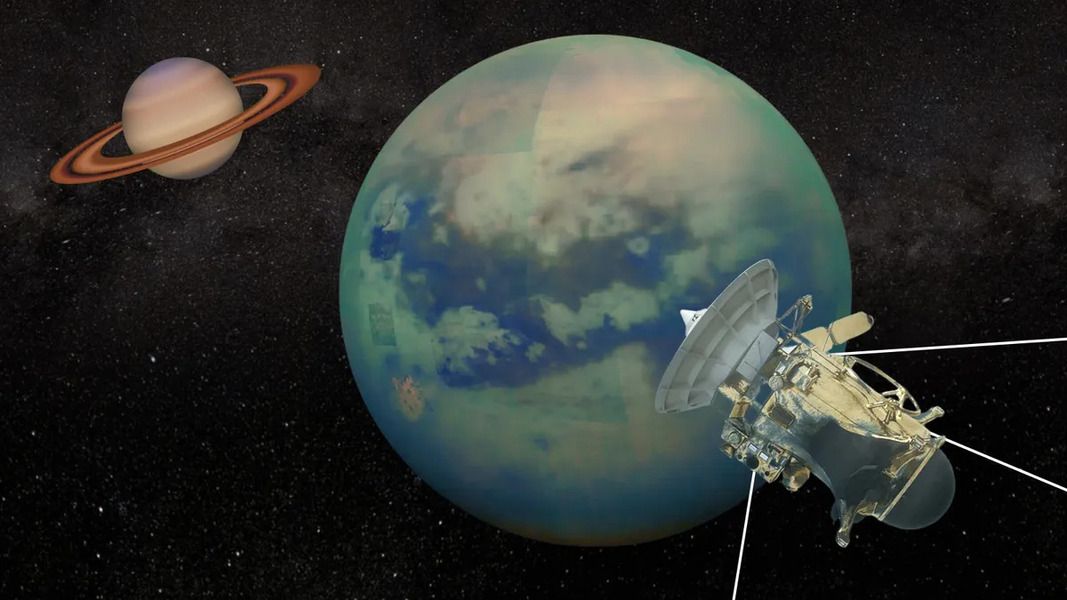
An illustration shows the Cassini spacecraft investigating Titan with its parent planet Saturn in the background (Image credit: NASA/Robert Lea)
What would that mean for the search for life beyond Earth?
Can wind move rocks? Not here on Earth, but what about elsewhere in our solar system? A new study from SETI Institute scientists Dr. John Marshall and Dr. Lori Fenton suggests that wind on Titan might be able to roll pebbles or even small rocks across its surface. The findings provide new insights about Saturn’s moon, where winds, low gravity, and an icy landscape combine to create desert dunes and rocky plains.
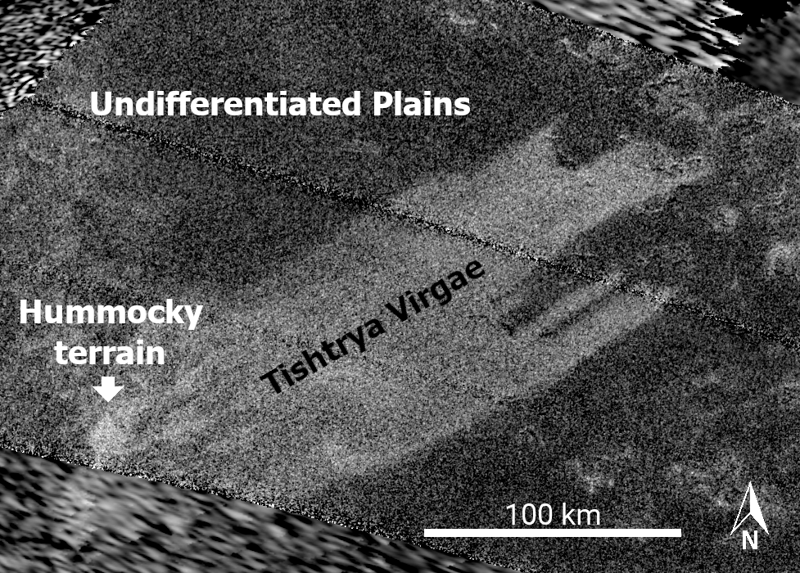
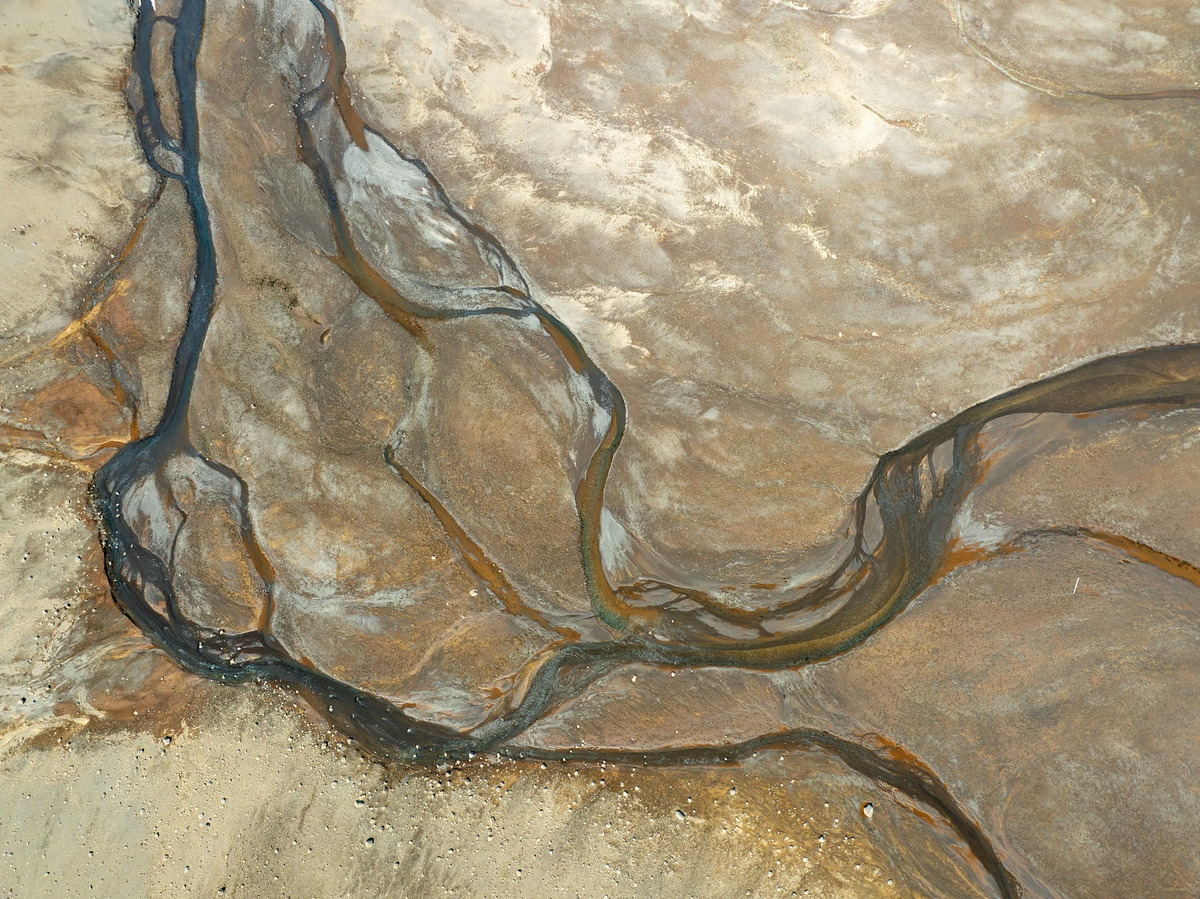
“Radar images from the Cassini mission reveal elongated streaks on Titan's surface that can extend for hundreds of kilometers,” said Fenton. “Colleagues have proposed that they are windblown deposits of water ice eroded from nearby hills. We're proposing that the water ice in these streaks could be made of wind-rolled stones.”
These bright streaks emanate from hummocky (hilly) terrain on Titan and extend northeastward, aligning with known wind patterns. Such streaks are candidates for fields of wind-rolled stones made of water ice. Image credit: Titan Cassini SAR - HiSAR Global Mosaic 351m (Elachi et al., 2005; Stephan et al., 2009), prepared using JMARS (Christensen et al., 2009).
Titan’s landscape is distinctive compared to Earth and Mars. On Earth, wind can move grains of sand, shaping deserts over time. On Mars, it can carve landscapes and form dust storms. Three factors make Titan different:
• Low gravity (just 14% of Earth’s) means even large objects are easier to move. • A thick, dense atmosphere (four times denser than Earth’s) helps wind create a more significant impact. • Low density stones of water ice (⅓ as dense as Earth’s silicate rocks) are relatively easy for the wind to mobilize.
The researchers conducted a mathematical analysis, limited by engineering and aerodynamic theory, to understand the impact of these factors. Their study suggests that Titan’s wind could roll stones as large as 1.5 feet (0.5 meters) in diameter, something not observed on other planets or moons.
Scientists believe Titan is an interesting location in the search for life beyond Earth. It has liquid on its surface and may also have a subsurface ocean of liquid water. Further, organic compounds have been detected in its atmosphere and on its surface. These conditions make Titan an intriguing place to investigate its habitability and the possibility of life elsewhere in our solar system.
Dragonfly is a NASA mission to Titan scheduled to launch in 2028. It will make short flights around the surface of Titan to explore the chemistry and habitability of various sites. The findings of this study could help inform sites where Dragonfly should explore and what it should study.
“Our work shows that on Titan, not just rivers, but also the wind, can transport stones from uplands to low-lying plains that missions such as Dragonfly can easily reach,” said Marshall. “These stones were eroded from icy bedrock that holds information about Titan's geological, and perhaps biological, past. The wind helps to make these stones accessible so that mission planners can figure out which set of hills to explore next. A good analogy on Earth would be looking for gold nuggets in rivers and streams to figure out which mountain may be hiding a mother lode.”
This paper expands our understanding of extreme environments and how planetary landscapes might impact habitability. The paper appears in the journal Planetary & Space Science here.
References:
Christensen, P.R., Engle, E., Anwar, S., Dickenshied, S., Noss, D., Gorelick, N., Weiss- Malik, M., 2009. JMARS—A Planetary GIS. Paper presented at the American Geophysical Union Fall Meeting, San Francisco, CA. Abstract IN22A-06.
Elachi, C., Wall, S., Allison, M., Anderson, Y., Boehmer, R., Callahan, P., Encrenaz, P., et al., 2005. Cassini radar views the surface of Titan. Science 308 (5724), 970–974. https://doi.org/10.1126/science.1109919.
Stephan, K., Jaumann, R., Karkoschka, E., Kirk, R., Barnes, J.W., Tomasko, M.G., Turtle, E.P., et al., 2009. Mapping products of Titan’s surface. In: Brown, R.H., Lebreton, J.P., Waite, J.H. (Eds.), Titan from Cassini-Huygens (Ch. 19. Springer, New York, NY, pp. 489–510. https://doi.org/10.1007/978-1-4020-9215-2.
New study outlines the first quantitative framework for searching lunar regolith for microscopic technosignatures.
#Press Releases
#Moon
#Technosignatures
#Lewis Pinault
#Andrew Siemion
#Astrobiology
#SETI
#Solar System
#AI and Machine Learning
#Bill Diamond
Throughout June 2026, SETI Institute scientists, affiliates, and collaborators contributed to discussions spanning interstellar visitors, planetary science, technosignature searches, animal cognition, and the scientific process guiding the search for life beyond Earth.
#SETI Institute in the News
#SETI Institute
#Community
#Eduardo Bendek
#Optical SETI
#SETI
#3I/ATLAS
#ATA
#Comets, Meteors, and Asteroids
#Solar System
#Franck Marchis
#Ariel Graykowski
#Jill Tarter
#Vishal Gajjar
#Radio Astronomy
#Bill Diamond
#Lori Marino
#SETI Institute in the News
#SETI Institute
#Community
#Solar System
#Matija Ćuk
#Neptune
#SETI
#Bill Diamond
#UAPs
#Drake Awards
#Lori Marino
#Matthew Tiscareno
#Outreach
#Exoplanets
#Carl Sagan Center
Throughout June 2026, SETI Institute scientists, affiliates, and collaborators contributed to discussions spanning interstellar visitors, planetary science, technosignature searches, animal cognition, and the scientific process guiding the search for life beyond Earth.
#SETI Institute in the News
#SETI Institute
#Community
#Eduardo Bendek
#Optical SETI
#SETI
#3I/ATLAS
#ATA
#Comets, Meteors, and Asteroids
#Solar System
#Franck Marchis
#Ariel Graykowski
#Jill Tarter
#Vishal Gajjar
#Radio Astronomy
#Bill Diamond
#Lori Marino
#SETI Institute in the News
#SETI Institute
#Community
#Solar System
#Matija Ćuk
#Neptune
#SETI
#Bill Diamond
#UAPs
#Drake Awards
#Lori Marino
#Matthew Tiscareno
#Outreach
#Exoplanets
#Carl Sagan Center
SkyMapper and the SETI Institute are connecting educators, students and the public to live astronomical observations through a distributed astronomical network.
#SkyMapper
#SETI
#Citizen Science
#Astronomy
What happens if life beyond Earth is discovered? The Discovery and Futures Lab at the SETI Institute fosters novel and anticipatory research at the intersection of science, society, our planet, and the search for life beyond Earth.
#Discovery and Futures Lab
SkyMapper and the SETI Institute are connecting educators, students and the public to live astronomical observations through a distributed astronomical network.
What happens if life beyond Earth is discovered? The Discovery and Futures Lab at the SETI Institute fosters novel and anticipatory research at the intersection of science, society, our planet, and the search for life beyond Earth.
Scientists are getting closer in their search for life beyond earth. But with limited federal funding for the search for extraterrestrial intelligence, supporters are the reason cutting-edge scientists can keep their eyes on the sky.
)