First Search of Galactic Center for Technosignatures
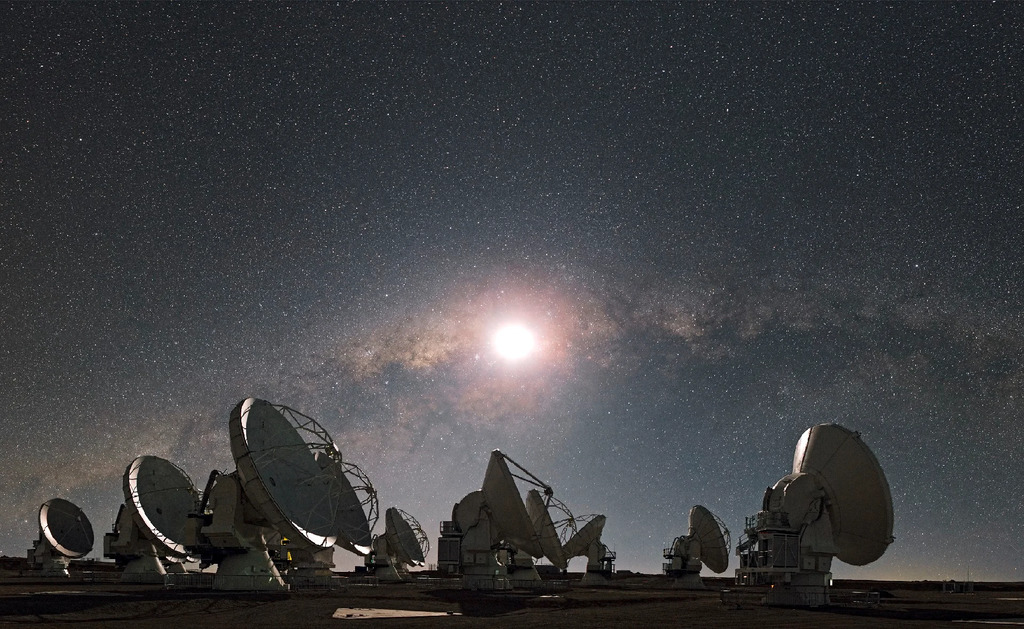
Using the Murchison Widefield Array radio telescope in Australia, three researchers focused on small portion of the center of our galaxy for seven hours to try to detect any signs of alien technology at the 150-megahertz wavelength. Though nothing was found in this search, it is a start in the exploration of the galactic center – a prime location for the potential extraterrestrial life.
As [Chenoa] Tremblay points out, on Earth we didn’t start communicating via radio until the first ever radio broadcast on Christmas Eve, 1906. If a civilization more than 116 light years away began pointing their telescopes at us today, they wouldn’t even be able to pick up those signals yet.
In early December 2021, the Stratospheric Observatory for Infrared Astronomy (SOFIA) aircraft took off with another team of science educator observers as well as the scientists pursuing their research. In this case, the telescopic flight was to study nebulae and galaxies.
He [Milo Maughan] said it is important students learn about infrared telescope as they themselves will use infrared cameras in experiments they design.
“Using this device, they will gather data on the environment around them in a lab investigation to learn whatever they want to learn about in terms of radiation. It’s kind of like researchers submitting their proposal to SOFIA, so they can use the device to help them gather data and learn from it,” he said. “Science education has changed a lot over the last number of years. Rather than just teach what we know in science, we want students to actually do science and learn through their own investigations.”
Features on Arrokoth Named
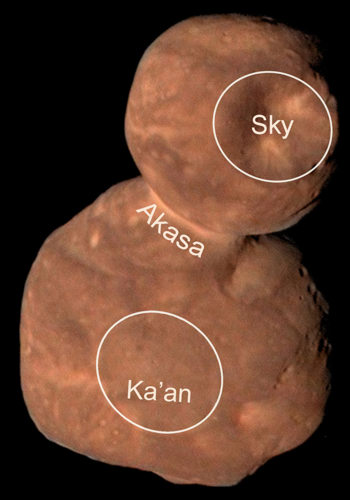
Arrokoth is the Kuiper Belt Object observed by the New Horizons spacecraft in 2019. Now three distinctive features have acquired official names: The circular arc on the larger section is “Ka’an”, the connecting neck is “Akasa”, and the large crater on the smaller section is “Sky”.
“Mayan paintings often show a snake arching over the scene, representing the sky or heaven,” said New Horizons co-investigator Dr. Mark Showalter, a researcher with the SETI Institute. “So we thought it was particularly appropriate to use ‘Ka’an’ for this prominent, arc-shaped feature on Arrokoth.”

SETI for Kids
SETI science is explained in an episode of a podcast for children interested in science: Fun Kids Science Weekly. This episode is entitled “Why Are Planets Round?”
How would aliens communicate with us, and how will we find out if they do? NASA and SETI scientist Ann Marie Cody joins us to chat more about how she finds signals from other planets, and how an intelligent race might contact us!
 Shortlisted! Famous Astronomers List Includes SETI Institute Inspirers
In a list of 21 famous astronomers who have changed the way we view the cosmos, two have direct ties to the SETI Institute: Frank Drake and Carl Sagan. Frank Drake, of course, performed the first modern SETI search, composed the famous Drake Equation, and was the Director of the Carl Sagan Center at the Institute. Carl Sagan, known for his writings on astronomy and for the television program “Cosmos”, was on the Institute’s Board of Trustees at the time of his death, and the Institute’s science exploration hub, the Carl Sagan Center for Research, was named in his honor.
Frank Drake (born 1930) is one of the pioneers in the search for extraterrestrial intelligence. He was one of the founders of the Search for Extraterrestrial Intelligence (SETI) and devised the Drake equation, a mathematical equation used to estimate the number of extraterrestrial civilizations in the Milky Way galaxy able to be detected.
Big Picture Science
Join hosts Seth Shostak and Molly Bentley each week as they explore emerging science and technology research.
Melting Down
Climate change isn’t waiting for us to act. We’ve missed several deadlines to mitigate the dangers of this existential threat, which suggests we prefer to avert our gaze rather than deal with the problem. It’s similar to the way society reacts to an incoming comet in the movie “Don’t Look Up!”
As a major Antarctic ice sheet shows signs of collapse, it’s no wonder we feel some “climate anxiety.” Can we leverage this emotion to spur action? That, and where hope lies, in this episode.
With guests Joellen Russell, Katie Mack, Jessica Tierney, Susan Clayton
Skeptic Check: 5G
5G, the latest mobile network standard, is coming. As new cell towers sprout around the world, do we know enough to confidently claim that this new technology is safe? After all, older networking standards relied on microwaves, radiation which has wavelengths of inches to a foot or so. 5G operates at much higher frequencies, with millimeter wavelengths.
Some are worried that being subjected to millimeter radiation could cause cancers. But what does science say? 5G: the promise and the perils.
With guests Jon Samet, Claire Parkinson, Bob Berman, David Ropeik
More Big Picture Science episodes can be found at http://bigpicturescience.org/episodes.
SETI Live
SETI Institute hosts interview cutting-edge scientists each week on social media. Recent SETI Live episodes include:
Sailing Toward a Near-Earth Asteroid: NEA Scout
Near-Earth Asteroid Scout, or NEA Scout, is a miniature spacecraft, known as a CubeSat, developed under NASA’s Advanced Exploration Systems Program. NASA selected NEA Scout as a secondary payload on Artemis I -- the first integrated, uncrewed flight test of the Space Launch System and Orion spacecraft. The NEA Scout will serve as a robotic reconnaissance mission to fly by and return data from an asteroid representative of near-Earth asteroids that may one day be human destinations.
Catching a ride on Artemis I, NEA Scout will deploy from the Space Launch System after the Orion spacecraft is separated from the upper stage. Once it reaches the lunar vicinity, it will perform imaging for instrument calibration. While cold gas thrusters will provide the initial propulsive maneuvers to place the spacecraft on the right trajectory, NEA Scout's hallmark solar sail will enable extended propulsion and efficient transit to 2020GE, the targeted asteroid during its approximate two-year cruise. The target is 2020 GE, a near-Earth asteroid (NEA) that is less than 60 feet (18 meters) in size. Asteroids smaller than 330 feet (100 meters) across have never been explored up close before. The spacecraft will use its science camera to get a closer look, measuring the object’s size, shape, rotation, and surface properties while looking for any dust and debris that might surround 2020 GE.
To discuss this mission and its scientific and technological objectives, SETI Institute Senior astronomer Franck Marchis invited JPL planetary scientist Julie Castillo-Rogez, the mission’s principal science investigator.
Finding Meteors with Data Science
Students at New College of Florida's Applied Data Science Master’s program joined the world-wide effort in analyzing data collected from cameras watching the night skies. Known as CAMS (Cameras for Allsky Meteor Surveillance), the effort is aimed at detecting meteors in the night sky through the use of data collected from multiple cameras watching night-time sky activity. Building on work initiated in 2017 by the Frontier Development Lab to automate the process and build a data processing pipleline, two student teams developed two new pipelines. What did they learn and how did they advance this project?
Guests: Sara Haman, Dimitri Angelov, Burcin Bozkaya
Videos of all past Facebook Live events can be found on our Facebook page, https://www.facebook.com/SETIInstitute/, or on our YouTube channel, https://www.youtube.com/SETIInstitute.
)