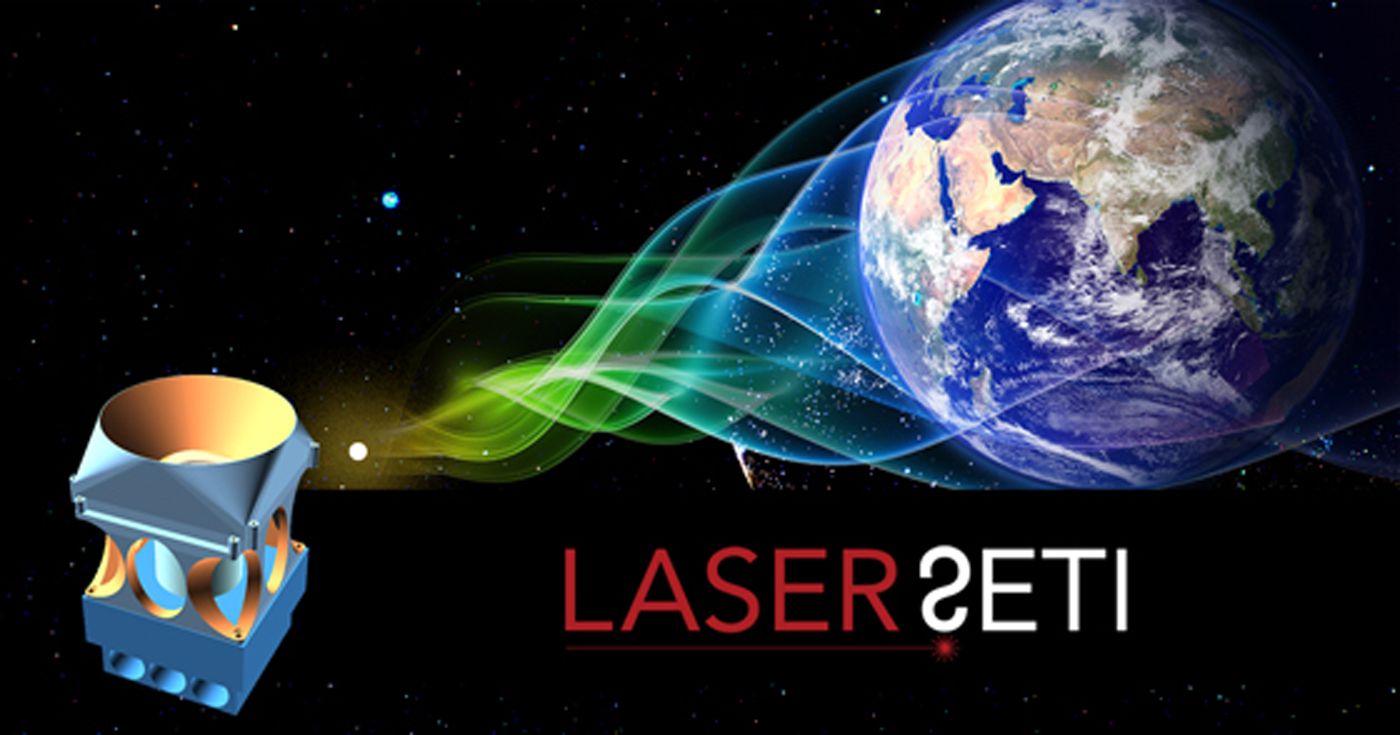
Have you heard about LaserSETI, a SETI Institute project to search for lasers originating from extraterrestrial intelligence? The idea is that advanced civilizations might be using lasers for a variety of purposes, and we could detect those laser signals from Earth.
In a recent video on the SETI Institute's YouTube channel, Dr. Franck Marchis, a researcher and the director of Citizen Science at the SETI Institute, and Dr.Lauren Sgro, the Outreach Manager for LaserSETI and SETI Institute researcher, discuss this exciting project.
LaserSETI uses specialized observatories that continuously scan the sky for brief, powerful laser pulses. These pulses would be monochromatic, meaning they consist of only a single wavelength of light. Since there are no known naturally occurring optical lasers in space, detecting one would be a indicate either extraterrestrial technology or a newly discovered astrophysical process — an exciting finding either way.
The project recently installed a third observatory in Sedona, Arizona, bringing its total sky coverage to about 30%. The goal is to eventually observe the entire sky all the time.
The researchers explain that advanced civilizations might be using lasers for things like:
Communication: Lasers can send vast amounts of information across vast distances. Perhaps a "cosmic internet" connects civilizations across different star systems!
Travel: Advanced civilizations could potentially use powerful lasers for beamed energy propulsion, using beams of light to propel spacecraft through space.
The video also highlights that LaserSETI can be used to study natural phenomena as well, such as meteors, satellite reentries, and even vanishing stars. Because the observatories are constantly watching the sky, they can capture and analyze these events, giving us valuable data about our universe.
To learn more about LaserSETI and the search for extraterrestrial intelligence, be sure to check out the full video: "Exploring the Science of LaserSETI: ET Civilizations, Bolides, Satellite Reentries, and Beyond" on the SETI Institute's YouTube channel.
During the second quarter of 2026, the SETI Institute was especially active and made strong progress in research, education, outreach, and public engagement. Our scientists published over 80 peer-reviewed papers in fields such as SETI, astrobiology, planetary science, exoplanets, and heliophysics.
#Activity Reports
#Carl Sagan Center
#Outreach
#Education
#AIR
#Community
#Research
#SETI Institute
#SETI Institute in the News
#SETI Institute
#Community
#Peter Jenniskens
#Lucian Walkowicz
#Chelsea Haramia
#Pascal Lee
#Bill Diamond
#Seth Shostak
#Meteorites
#SETI
#UAPs
#NASA Missions and Observatories
#Discovery and Futures Lab
#Mars
Throughout June 2026, SETI Institute scientists, affiliates, and collaborators contributed to discussions spanning interstellar visitors, planetary science, technosignature searches, animal cognition, and the scientific process guiding the search for life beyond Earth.
#SETI Institute in the News
#SETI Institute
#Community
#Eduardo Bendek
#Optical SETI
#SETI
#3I/ATLAS
#ATA
#Comets, Meteors, and Asteroids
#Solar System
#Franck Marchis
#Ariel Graykowski
#Jill Tarter
#Vishal Gajjar
#Radio Astronomy
#Bill Diamond
#Lori Marino
During the second quarter of 2026, the SETI Institute was especially active and made strong progress in research, education, outreach, and public engagement. Our scientists published over 80 peer-reviewed papers in fields such as SETI, astrobiology, planetary science, exoplanets, and heliophysics.
#Activity Reports
#Carl Sagan Center
#Outreach
#Education
#AIR
#Community
#Research
#SETI Institute
#SETI Institute in the News
#SETI Institute
#Community
#Peter Jenniskens
#Lucian Walkowicz
#Chelsea Haramia
#Pascal Lee
#Bill Diamond
#Seth Shostak
#Meteorites
#SETI
#UAPs
#NASA Missions and Observatories
#Discovery and Futures Lab
#Mars
Throughout June 2026, SETI Institute scientists, affiliates, and collaborators contributed to discussions spanning interstellar visitors, planetary science, technosignature searches, animal cognition, and the scientific process guiding the search for life beyond Earth.
#SETI Institute in the News
#SETI Institute
#Community
#Eduardo Bendek
#Optical SETI
#SETI
#3I/ATLAS
#ATA
#Comets, Meteors, and Asteroids
#Solar System
#Franck Marchis
#Ariel Graykowski
#Jill Tarter
#Vishal Gajjar
#Radio Astronomy
#Bill Diamond
#Lori Marino
SkyMapper and the SETI Institute are connecting educators, students and the public to live astronomical observations through a distributed astronomical network.
#SkyMapper
#SETI
#Citizen Science
#Astronomy
What happens if life beyond Earth is discovered? The Discovery and Futures Lab at the SETI Institute fosters novel and anticipatory research at the intersection of science, society, our planet, and the search for life beyond Earth.
#Discovery and Futures Lab
SkyMapper and the SETI Institute are connecting educators, students and the public to live astronomical observations through a distributed astronomical network.
What happens if life beyond Earth is discovered? The Discovery and Futures Lab at the SETI Institute fosters novel and anticipatory research at the intersection of science, society, our planet, and the search for life beyond Earth.
Scientists are getting closer in their search for life beyond earth. But with limited federal funding for the search for extraterrestrial intelligence, supporters are the reason cutting-edge scientists can keep their eyes on the sky.
)