Author: Beth Johnson
Friday, Feb 04, 2022

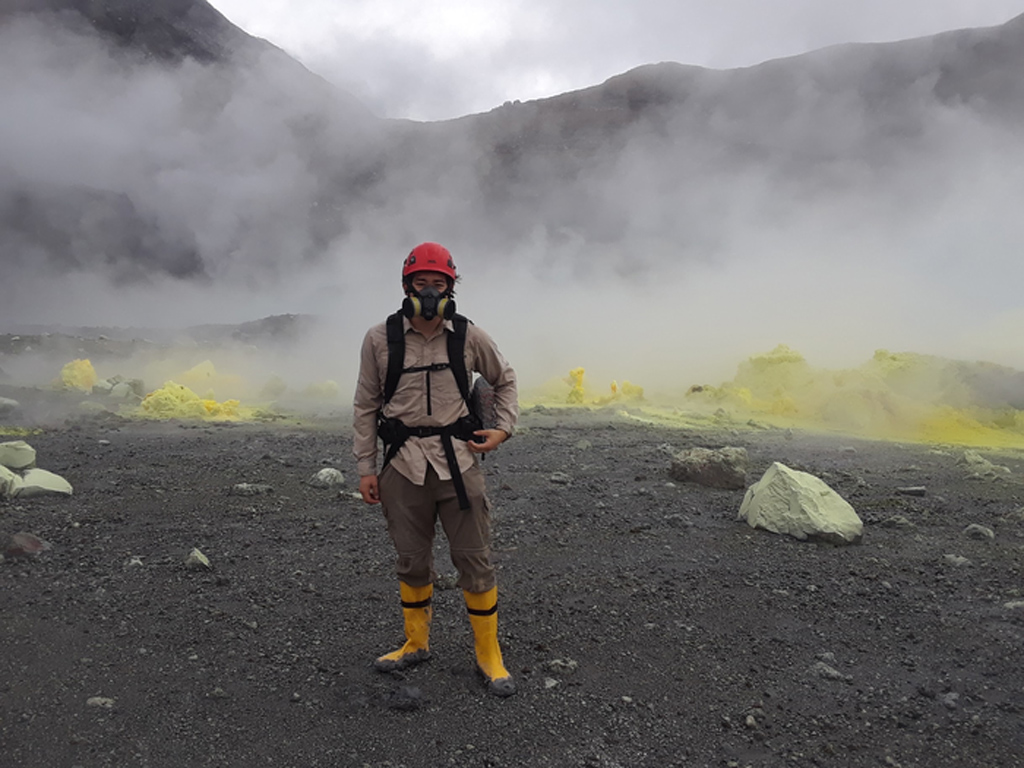
IMAGE: Fieldwork at Lagune Caliente lake in Poás volcanic lake, Costa Rica. CREDIT: Justin Wang


Helping us understand the past of Mars, since we haven’t gone there with humans, yet, is studying what we call analog sites here on Earth — places that bear striking similarities to Martian landscapes or features.

In new research published in Frontiers in Astronomy and Space Science led by graduate student Justin Wang, a research team studied the Poás volcano in Costa Rica. The hydrothermal crater lake on the volcano is considered to be one of the most inhospitable locations on Earth, ultra-acidic, and full of toxic metals. The water temperature can range from pleasant and comfortable to, well, boiling.

Oh, and rock and ash explosions happen on a recurring basis. So really not good for life.

And yet. And yet, over the past ten years, they have found microbes living in the lake. In fact, while they only found one species there back in 2013, the 2017 visit revealed some biodiversity occurring.

A DNA sequencing of the organisms found biochemical capabilities that help them tolerate the conditions. Per the press release: These included pathways to create energy using sulfur, iron, arsenic, carbon fixation (like plants), both simple and complex sugars, and bioplastic granules (which microorganisms can create and use as energy and carbon reserves during stress or starvation).

Overall, this research provides another avenue to examine when it comes to Mars analog sites. Volcanoes may seem to be bad for life, but they actually aren’t.


More Information

This story was written for the Daily Space podcast/YouTube series. Want more news from myself, Dr. Pamela Gay, and Erik Madaus? Check out DailySpace.org.

Originally published for medium.com.


News

Related News

Featured Image
Sep 8, 2026
Researchers Propose Searching the Moon for Microscopic Technosignatures
New study outlines the first quantitative framework for searching lunar regolith for microscopic technosignatures. #Press Releases #Moon #Technosignatures #Lewis Pinault #Andrew Siemion #Astrobiology #SETI #Solar System #AI and Machine Learning #Bill Diamond
Featured Image
Aug 19, 2026
SETI Institute Team Looks for a New Way to Find Resources in Space
#Press Releases #Pablo Sobron #Moon #Asteroids #Planetary Exploration #Spectroscopy #Astrobiology
Featured Image
Jul 21, 2026
Celebrating 25 Years of Exoplanet Astrobiology: Welcoming the Virtual Planetary Laboratory to its New Home at the SETI Institute
#VPL #Astrobiology #SETI Institute #Victoria Meadows #Andrew Lincowski #Eric Wolf #Nicholas Wogan #Kimberly Bott #Hannah Dawson
Featured Image
Jun 1, 2026
SETI Institute Awards $1 Million in STRIDE Grants to Advance Astrobiology, Exoplanet Science, and Public Engagement
#Press Releases #STRIDE #Research #Carl Sagan Center #Spectroscopy #Solar System #SETI #Climate and Bioscience #Astronomy #Astrobiology #Exoplanets #Data Science #Education #Outreach #Hat Creek Radio Observatory #Unistellar #SkyMapper
Featured Image
May 13, 2026
SETI Institute to Honor Dr. Matthew Tiscareno with 2026 Carl Sagan Center Director’s Award
The Drake Awards event will also recognize SETI Forward and SETI Institute REU student award recipients. #Press Releases #Drake Awards #Frank Drake #SETI #Awards #Planetary Astronomy #Astrobiology #SETI Forward #Education #Carl Sagan Center #Matthew Tiscareno #Nathalie Cabrol #REU
Featured Image
May 4, 2026
SETI Institute Announces Nominees for the Speculative Life BioArt Residency
Six international artists shortlisted for a new residency at the intersection of art, astrobiology, and biotechnology #AIR #SETI Institute #Speculative Life #Astrobiology #Danielle Siembieda #Nathalie Cabrol
Research

Related Projects

Featured Image
SkyMapper • SETI • Citizen Science • Astronomy
SkyMapper: Expanding Access to Real-time Astronomy Through a Global Astronomical Network
SkyMapper and the SETI Institute are connecting educators, students and the public to live astronomical observations through a distributed astronomical network. #SkyMapper #SETI #Citizen Science #Astronomy
Featured Image
VPL
Virtual Planetary Laboratory
How can we best assess whether an exoplanet supports life? #VPL
Featured Image
Discovery and Futures Lab
What happens if life beyond Earth is discovered? The Discovery and Futures Lab at the SETI Institute fosters novel and anticipatory research at the intersection of science, society, our planet, and the search for life beyond Earth.  #Discovery and Futures Lab
Support Us

Support the
SETI Institute

Scientists are getting closer in their search for life beyond earth. But with limited federal funding for the search for extraterrestrial intelligence, supporters are the reason cutting-edge scientists can keep their eyes on the sky.