Planetary Picture of the Day
Week of August 5, 2024
Giant storms, symmetrical dunes, a tiny moon, and an even tinier space station all feature in this week's cache of pictures.
Monday, 5 August 2024
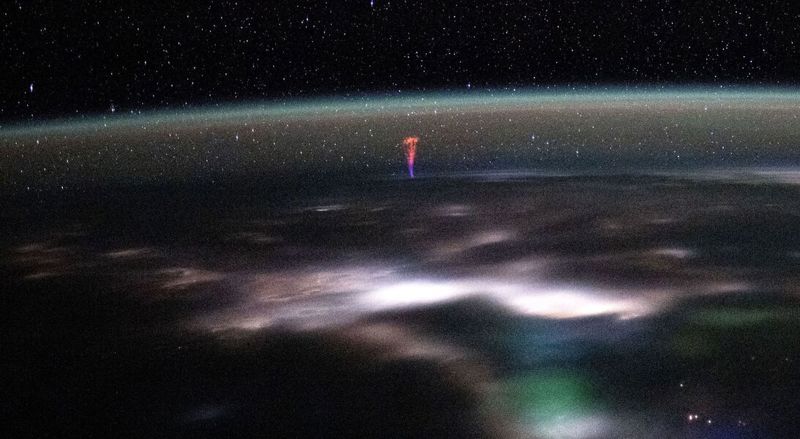
Credit: NASA
ed Sprite
Astronaut Matthew Dominick captured a gigantic jet from the International Space Station on July 1st. These rarely photographed red sprites are electrical discharges high above thunderstorms, up in the mesosphere (50-90 km). Go see the original so that you can zoom in on the sprite and see its enormous size: https://buff.ly/4foS6Ls
Tuesday, 6 August 2024
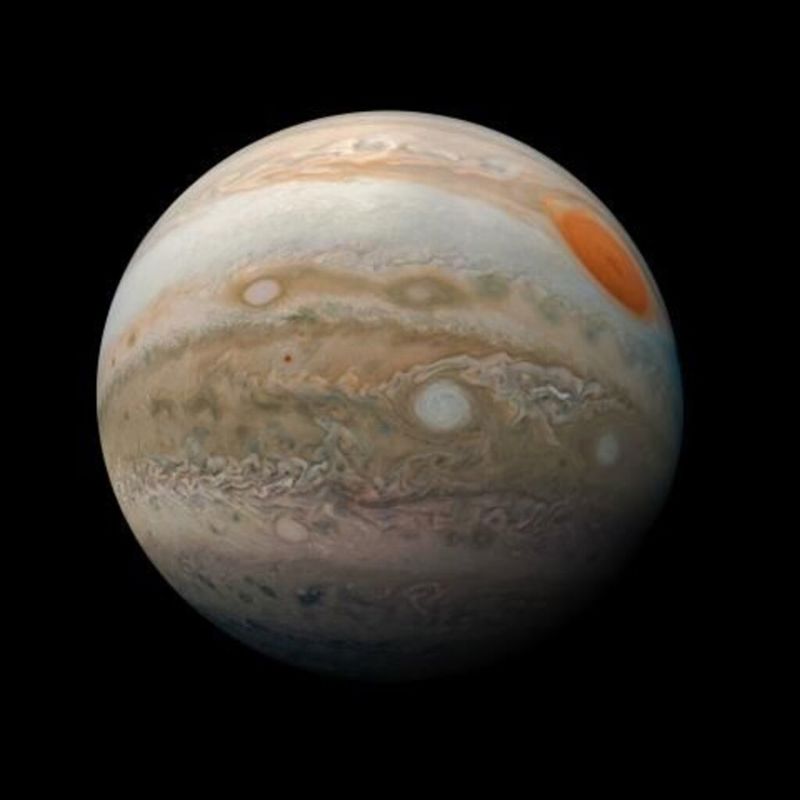
Credit: NASA/JPL-Caltech/SwRI/MSSS/Kevin M. Gill
Beautiful Jupiter
Sometimes, it's enough to share a gorgeous image of Jupiter. This one was taken by the JunoCam onboard NASA's Juno spacecraft during perijove 18 in 2019. The famous Great Red Spot, a storm observed for over 100 years, has been shrinking, possibly due to a lack of nearby storms to power it.
Wednesday, 7 August 2024
Credit: NASA/JPL-Caltech/University of Arizona
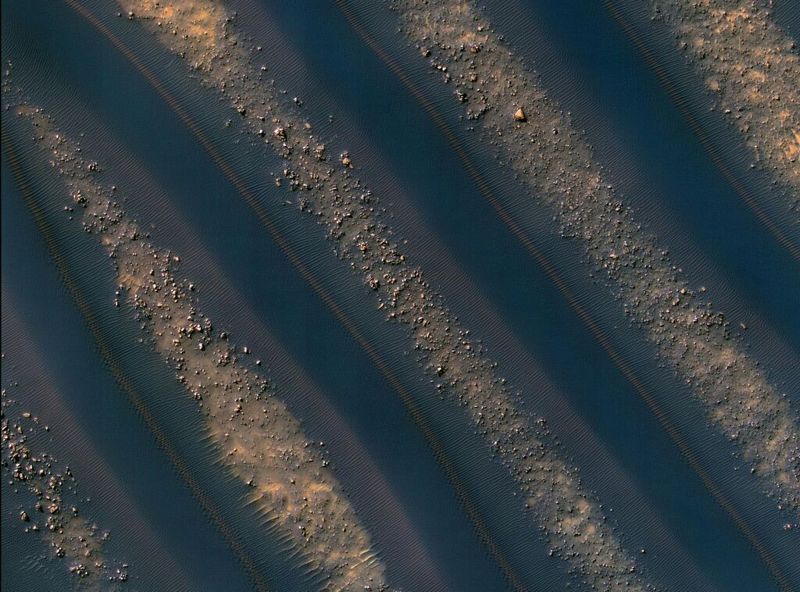
Dune Symmetry
Dunes of sand-sized materials have been trapped on the floors of many Martian craters. This is one example, from a crater in Noachis Terra, west of the giant Hellas impact basin.
The High Resolution Imaging Science Experiment (HiRISE) camera on NASA's Mars Reconnaissance Orbiter captured this view on Dec. 28, 2009.
The dunes here are linear, thought to be due to shifting wind directions. In places, each dune is remarkably similar to adjacent dunes, including a reddish (or dust-colored) band on northeast-facing slopes. Large angular boulders litter the floor between dunes.
Thursday, 8 August 2024
Credit: NASA/JPL-Caltech/Space Science Institute/CICLOPS
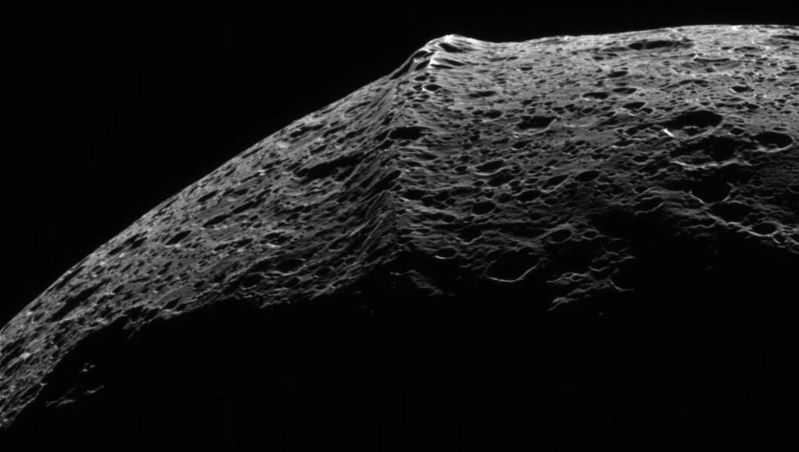
Iapetus, a Moon of Saturn
Iapetus orbits 3,561,000 kilometers from Saturn and is its third-largest moon. The moonlet has a diameter of 1,469 kilometers and a density of only 1.2 times that of liquid water. Scientists have suggested that Iapetus (like Rhea) is three-quarters ice and one-quarter rock. Unlike most large moons, the overall shape is neither spherical nor ellipsoid but has a bulging waistline and squashed poles. The unique equatorial ridge is so high that it visibly distorts Iapetus's shape even when viewed from a distance, often leading to its being characterized as walnut-shaped. This ridge runs along the center of Cassini Regio, about 1,300 km long, 20 km wide, and 13 km high. The ridge was discovered when the Cassini spacecraft imaged Iapetus on December 31, 2004, although its existence had been inferred from the moon's polar images by Voyager 2.
Friday, 9 August 2024
Credit: Andrew McCarthy
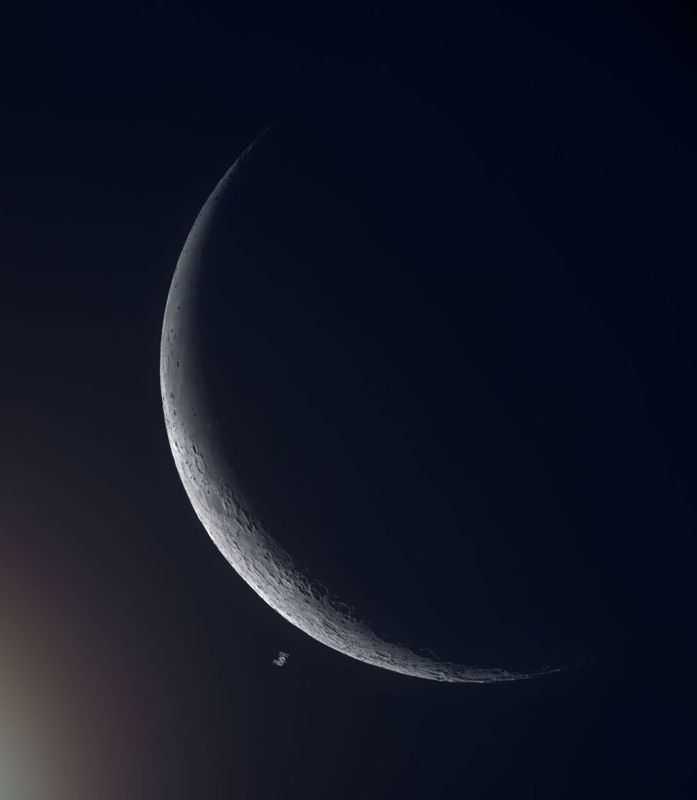
A Cosmic Journey
The International Space Station was captured by Andrew McCarthy (who else?) as it flew past the Moon. This is high-precision astrophotography that lasts less than a second. Enjoy the weekend and don't forget to look up!
)