Wednesday, Dec 11, 2013

The Hemlmholtz Foundation award allows Bishop to travel to Berlin and work with colleagues there. Her research focuses on identifying the composition of ancient martian rocks, an endeavor that sheds light on the environment of this intriguing world as it was billions of years ago. Much of her work uses the CRISM (Compact Reconnaissance Imaging Spectrometer for Mars) instrument on-board the Mars Reconnaissance Orbiter, which has been circling the Red Planet since 2005. The task set for CRISM was to “follow the water,” to study Mars’ hydrological history and aqueous environment. A better understanding of the quantity, duration, availability, acidity, temperature, and saltiness of water on the surface of Mars in the distant past will shape attempts to find evidence for ancient life there.

“I am working with scientists at the DLR (German Aerospace Center) and the Freie Universität (FU) Berlin to overlay mineralogy identified using CRISM data on topographic imagery from the HRSC, the High Resolution Stereo Camera aboard the Mars Express orbiter,” says Bishop.

“With this technique, we are able to image the mineral stratigraphy of the martian landscape with a resolution of 18 meters. This is a powerful tool for understanding the geology of Mars and is enabling insights into the ancient geochemical environments at locations such as Juventae Chasma, Libya Montes, and Mawrth Vallis on Mars.”

Bishop benefits from being able to more easily work with colleagues at the DLR and the FU, rather than having to accommodate the nine hour time difference between California and Berlin.

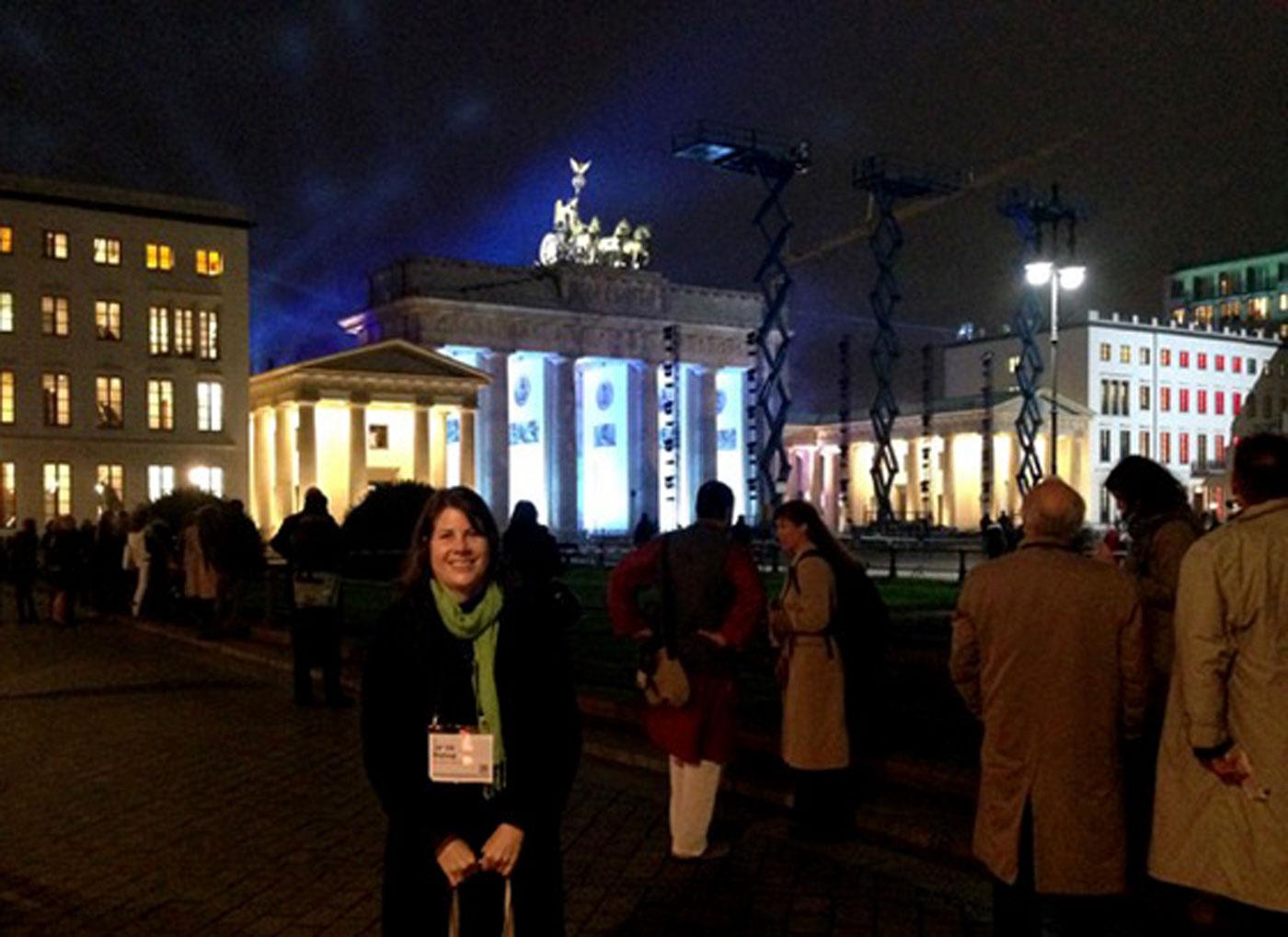
The Helmholtz Foundation also invited Bishop to an annual event, Falling Walls, an international conference on future breakthroughs in science and technology. This conference takes place each November, on the anniversary of the fall of the Berlin wall. The festivities in 2014 included meeting with Chancellor Angela Merkel and a dinner near the Brandenburg Gate to celebrate the 25th anniversary of the wall coming down.

In addition to her Helmholtz award, Bishop has also received a grant from the Humboldt Foundation to work at the FU Berlin this spring. The grant is known as a Research Fellowship for a Renewed Research Stay because Bishop is an alumna of their postdoctoral fellowship program.

News

Related News

Featured Image
May 13, 2026
SETI Institute to Honor Dr. Matthew Tiscareno with 2026 Carl Sagan Center Director’s Award
The Drake Awards event will also recognize SETI Forward and SETI Institute REU student award recipients. #Press Releases #Drake Awards #Frank Drake #SETI #Awards #Planetary Astronomy #Astrobiology #SETI Forward #Education #Carl Sagan Center #Matthew Tiscareno #Nathalie Cabrol #REU
Featured Image
May 7, 2026
SETI Institute In the News: April Roundup 2026
#SETI Institute in the News #SETI Institute #Community #SETI #Discovery and Futures Lab #Lucian Walkowicz #Chelsea Haramia #NASA Missions and Observatories #Pascal Lee #Mars #Janice Bishop #Mark Showalter #JWST #Uranus #Bill Diamond #UAPs
Featured Image
Apr 1, 2026
SETI Institute Names Lori Marino as 2026 Drake Award Recipient
Honoring pioneering research on the evolution of intelligence on Earth and beyond. #Press Releases #Drake Awards #Frank Drake #SETI #Lucian Walkowicz #Bill Diamond #Astrobiology #Awards #Lori Marino
Featured Image
Jan 15, 2026
SETI Institute Opens Call for Nominations for the 2026 Tarter Award
#Press Releases #Jill Tarter #ATA #Awards #Tarter Award
Featured Image
Oct 23, 2025
SETI Pioneer Jill Tarter Awarded Fellows Medal by California Academy of Sciences
#Press Releases #Jill Tarter #Awards #SETI #ATA #Project Phoenix #Bill Diamond
Featured Image
Oct 7, 2025
SETI Institute In the News 2025: September Roundup
#SETI Institute in the News #SETI Institute #Community #Janice Bishop #Ariel Graykowski #Peter Jenniskens #Nathalie Cabrol #Pascal Lee
Research

Related Projects

Featured Image
SkyMapper • SETI • Citizen Science • Astronomy
SkyMapper: Expanding Access to Real-time Astronomy Through a Global Astronomical Network
SkyMapper and the SETI Institute are connecting educators, students and the public to live astronomical observations through a distributed astronomical network. #SkyMapper #SETI #Citizen Science #Astronomy
Featured Image
VPL
Virtual Planetary Laboratory
How can we best assess whether an exoplanet supports life? #VPL
Featured Image
Discovery and Futures Lab
What happens if life beyond Earth is discovered? The Discovery and Futures Lab at the SETI Institute fosters novel and anticipatory research at the intersection of science, society, our planet, and the search for life beyond Earth.  #Discovery and Futures Lab
Support Us

Support the
SETI Institute

Scientists are getting closer in their search for life beyond earth. But with limited federal funding for the search for extraterrestrial intelligence, supporters are the reason cutting-edge scientists can keep their eyes on the sky.