)

Wednesday, Jun 12, 2024

By Lauren Sgro
The space around us is hardly empty – there’s millions of asteroids orbiting the Sun along with the Earth and other planets in our solar system. But one day every year we come together to acknowledge these space rocks and the impact they often have on our home. That day is June 30, also known as asteroid day. As asteroid day approaches this year, so will an asteroid called 2011 UL21.
2011 UL21 and Other Apollo Asteroids Cross Earth’s Orbit
UL21 is quite large, at almost 2.3 km in diameter, and falls into the category of Apollo asteroids. Named after the Greek god Apollo, who was known for his epic journeys, these asteroids come in a variety of sizes from a few meters to several kilometers across, like 2011 UL21 (nicknamed “Umbra Lumina”). More importantly, Apollo asteroids get up close and personal by crossing Earth’s orbit, although their orbits around the Sun are larger than Earth’s. This is in direct contrast to their more distant cousins, the Amor asteroids, which flirt with Earth’s orbit but never quite intersect it, or the Atira group, which never venture outside Earth’s orbit at all and prefer to stay closer to the Sun. Aten asteroids do also cross Earth’s path, albeit with smaller orbits than the Apollos.
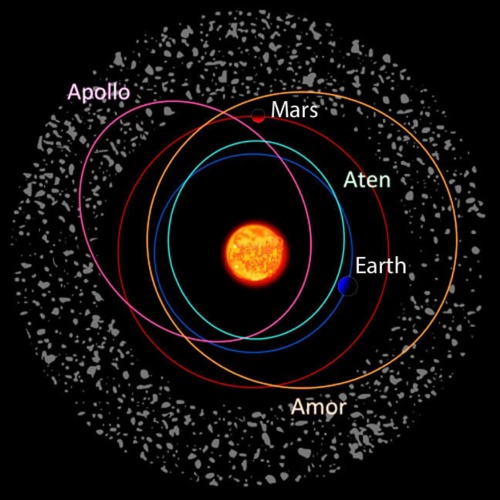
Some of the different classes of Near-Earth Asteroids. Asteroid Umbra Lumina (2011 UL21) is an Apollo Asteroid, which have orbits similar to those shown in pink. Credit: ESA
Zooming Past Earth Just in Time for Asteroid Day
Apollo asteroids are part of a group called Near-Earth Objects, or NEAs. Scientists keep a close eye on NEAS to make sure they’re not about to crash into our planetary party, and an even closer gaze on a subset of NEASs called Potentially Hazardous Asteroids that fly quite close to our home. Although Umbra Lumina is classified as a PHA, there is no need to fret. Although Umbra Lumina will make its close approach on June 27 – just in time for asteroid day – it will still be 6.6 million km away (4.1 million miles). That’s 17 times the distance from the Earth to the Moon! This rocky body won’t come this close for another 65 years, so catch a glimpse at it now! During its approach and in the subsequent weeks, it should reach 11th magnitude, which is bright enough to gather data with a Unistellar telescope.
Scientists need your help to study Umbra Lumina in more detail. While we know that this asteroid takes 1129 days to orbit the Sun, there is disagreement on how long it takes to rotate on its axis, a characteristic known as its rotation period. Some studies have deduced a rotation period of 2.7 hours, while others report that it takes 1.5 hours to spin. Only with your observations during this flyby can astronomers get the necessary data they need to settle the score and find out how this rock flies through space.
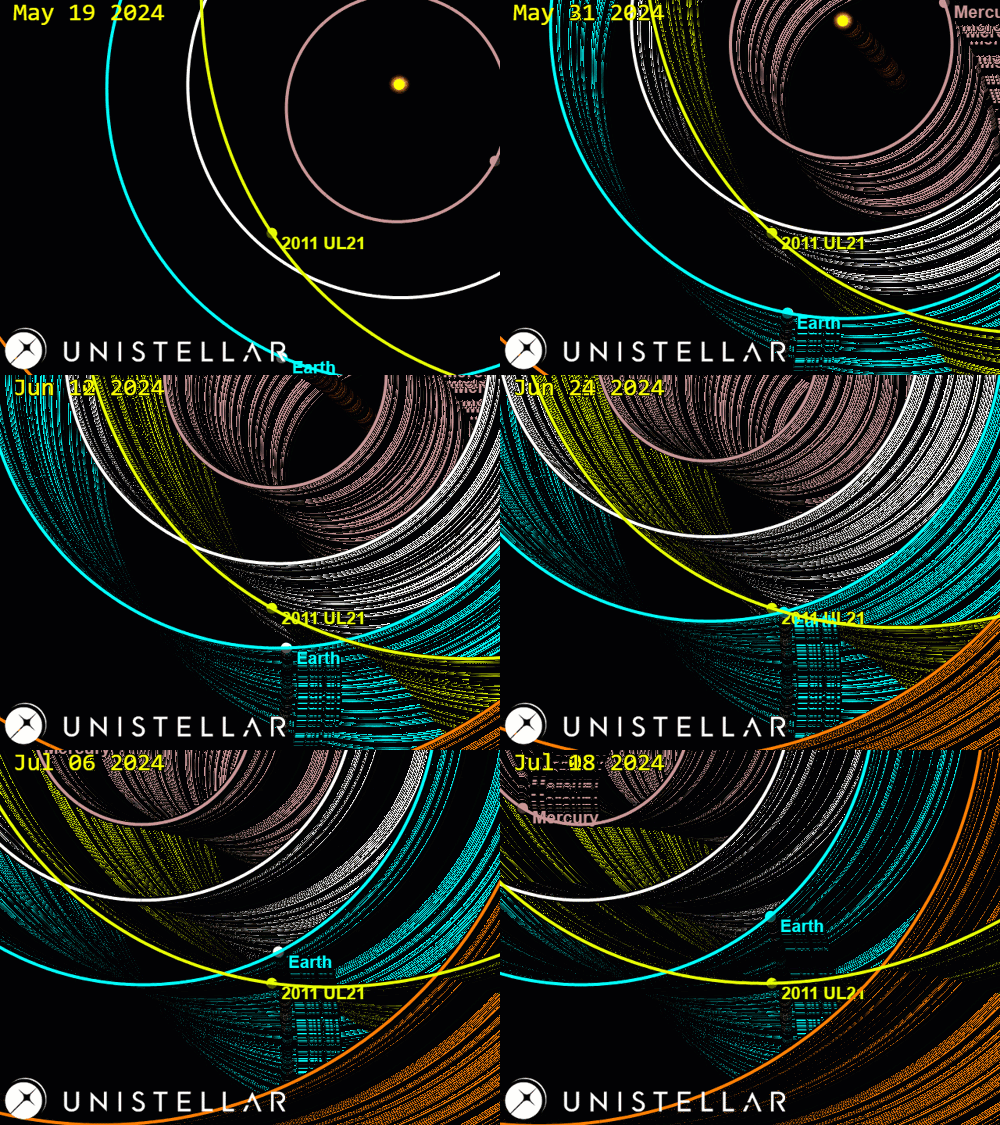
The orbit of Umbra Lumina (2011 UL21). Credit: Tony Dunn
How Can You Help? Observe Umbra Lumina with your Unistellar Telescope!
Although Umbra Lumina’s flyby occurs on June 27, you can start observing it earlier. This asteroid will be visible in the Southern Hemisphere starting on June 22nd before becoming visible worldwide around June 28th. It will continue to be a bright target for a few weeks in July, when it will be easy to gather data that will aid in the search for its rotation period.
To observe 2011 UL21 (aka Umbra Lumina) with your Unistellar telescope:
Follow the Tutorial for A. The target is in the Unistellar app’s database.
Use the following observation parameters:
- Record Duration: 40 minutes
- Exposure time: 4 seconds
- Gain: 25 dB
Nore: The target is also available on the Moving Target Ephemeris webpage. A single observation is enough to refine the orbit though more observations are always welcome.







News
Related News
Aug 19, 2026
SETI Institute Team Looks for a New Way to Find Resources in Space
#Press Releases #Pablo Sobron #Moon #Asteroids #Planetary Exploration #Spectroscopy #Astrobiology
Jun 17, 2026
Community College Internship Program Celebrates Fourth Year of Student Research Achievement
#Community College Internship #Education #Lauren Sgro #Unistellar #Uma Gorti #Douglas Caldwell #Pamela Harman #Simon Steel
Jun 1, 2026
SETI Institute Awards $1 Million in STRIDE Grants to Advance Astrobiology, Exoplanet Science, and Public Engagement
#Press Releases #STRIDE #Research #Carl Sagan Center #Spectroscopy #Solar System #SETI #Climate and Bioscience #Astronomy #Astrobiology #Exoplanets #Data Science #Education #Outreach #Hat Creek Radio Observatory #Unistellar #SkyMapper
Mar 25, 2026
From Earth to the Moon with Artemis II – And Citizen Scientists
#Artemis II #citizen science #Unistellar
Mar 20, 2026
SETI Live: Unistellar + Citizen Science (Part 8)
#Blog #Unistellar #Citizen Science #Lauren Sgro #Franck Marchis #Astronomy #NASA Missions and Observatories #SETI Institute #Comets, Meteors, and Asteroids #Artemis II #3I/ATLAS
Feb 3, 2026
SETI Institute In the News: January Roundup 2026
January brought a wide range of thoughtful science conversations featuring researchers from the SETI Institute, spanning everything from hands-on planetary defense with citizen scientists to careful examinations of interstellar visitors and the signals that reach us across the galaxy. #SETI Institute in the News #SETI Institute #Community #Franck Marchis #Sofia Sheikh #Matija Ćuk #ATA #3I/ATLAS #Unistellar #Astronomy #SETI #Mars
Aug 19, 2026
#Press Releases
#Pablo Sobron
#Moon
#Asteroids
#Planetary Exploration
#Spectroscopy
#Astrobiology
Jun 17, 2026
#Community College Internship
#Education
#Lauren Sgro
#Unistellar
#Uma Gorti
#Douglas Caldwell
#Pamela Harman
#Simon Steel
Community College Internship Program Celebrates Fourth Year of Student Research Achievement
Jun 1, 2026
#Press Releases
#STRIDE
#Research
#Carl Sagan Center
#Spectroscopy
#Solar System
#SETI
#Climate and Bioscience
#Astronomy
#Astrobiology
#Exoplanets
#Data Science
#Education
#Outreach
#Hat Creek Radio Observatory
#Unistellar
#SkyMapper
SETI Institute Awards $1 Million in STRIDE Grants to Advance Astrobiology, Exoplanet Science, and Public Engagement
Mar 25, 2026
#Artemis II
#citizen science
#Unistellar
From Earth to the Moon with Artemis II – And Citizen Scientists
Mar 20, 2026
#Blog
#Unistellar
#Citizen Science
#Lauren Sgro
#Franck Marchis
#Astronomy
#NASA Missions and Observatories
#SETI Institute
#Comets, Meteors, and Asteroids
#Artemis II
#3I/ATLAS
SETI Live: Unistellar + Citizen Science (Part 8)
Feb 3, 2026
SETI Institute In the News: January Roundup 2026
January brought a wide range of thoughtful science conversations featuring researchers from the SETI Institute, spanning everything from hands-on planetary defense with citizen scientists to careful examinations of interstellar visitors and the signals that reach us across the galaxy.
#SETI Institute in the News
#SETI Institute
#Community
#Franck Marchis
#Sofia Sheikh
#Matija Ćuk
#ATA
#3I/ATLAS
#Unistellar
#Astronomy
#SETI
#Mars
Research
Related Projects

SkyMapper • SETI • Citizen Science • Astronomy
SkyMapper: Expanding Access to Real-time Astronomy Through a Global Astronomical Network
SkyMapper and the SETI Institute are connecting educators, students and the public to live astronomical observations through a distributed astronomical network. #SkyMapper #SETI #Citizen Science #Astronomy
VPL
Virtual Planetary Laboratory
How can we best assess whether an exoplanet supports life? #VPL
Discovery and Futures Lab
Discovery and Futures Lab
What happens if life beyond Earth is discovered? The Discovery and Futures Lab at the SETI Institute fosters novel and anticipatory research at the intersection of science, society, our planet, and the search for life beyond Earth. #Discovery and Futures Lab
May 17, 2026
SkyMapper: Expanding Access to Real-time Astronomy Through a Global Astronomical Network
SkyMapper and the SETI Institute are connecting educators, students and the public to live astronomical observations through a distributed astronomical network.
#SkyMapper
#SETI
#Citizen Science
#Astronomy
May 5, 2026
Virtual Planetary Laboratory
How can we best assess whether an exoplanet supports life?
#VPL
Apr 16, 2026
Discovery and Futures Lab
What happens if life beyond Earth is discovered? The Discovery and Futures Lab at the SETI Institute fosters novel and anticipatory research at the intersection of science, society, our planet, and the search for life beyond Earth.
#Discovery and Futures Lab
Support Us
Support the
SETI Institute
Scientists are getting closer in their search for life beyond earth. But with limited federal funding for the search for extraterrestrial intelligence, supporters are the reason cutting-edge scientists can keep their eyes on the sky.